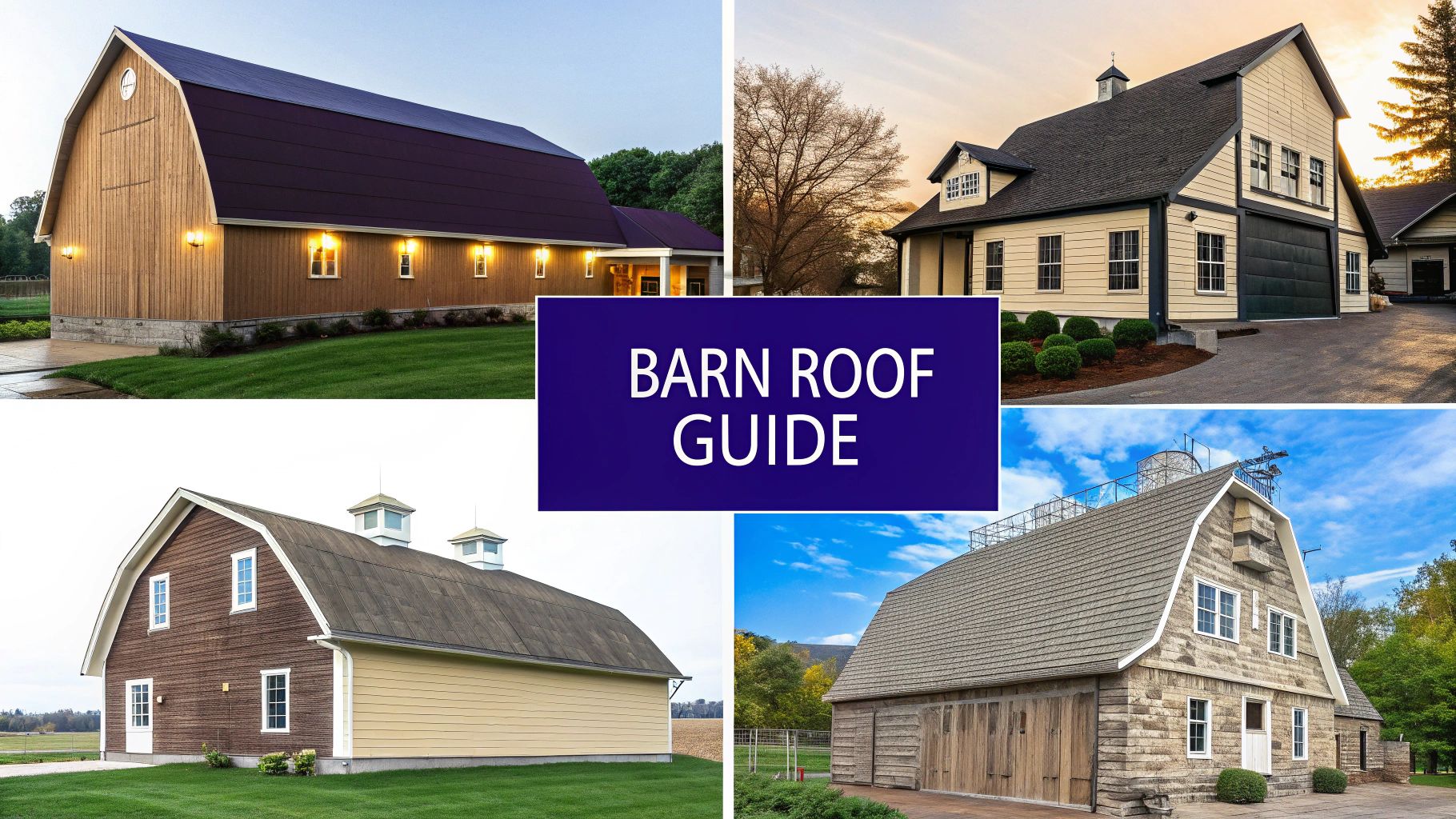
Choosing the right roof for your barn isn't just about looks—it's about matching the design to what you really need. Are you trying to maximize storage, get the best airflow for your animals, or just stick to a tight budget? The big four in the barn world are the Gable, Gambrel, Monitor, and Shed roof, and each one brings something different to the table.
Matching Your Barn Roof Style to Your Needs
Think of barn roofs like tools in a toolbox. You wouldn't grab a sledgehammer for a finishing nail, right? The same logic applies here. Picking a roof designed for epic hay storage when all you need is a simple workshop is a mismatch waiting to happen. Every roof style is engineered to solve a specific problem, and getting this choice right from the start impacts everything from daily usability to long-term costs.
The structure you choose has to work for you. A farmer who needs to pack in as much hay as possible is going to love a design that a horse trainer, who needs incredible airflow and light for their arena, would find completely impractical. Figuring out that core purpose is always step one. A good roof should feel like a natural extension of the building's function, which is why it's helpful to explore different types of steel buildings to see how everything fits together.
This simple visual breaks it down perfectly, connecting your main goal to the roof style that gets the job done.
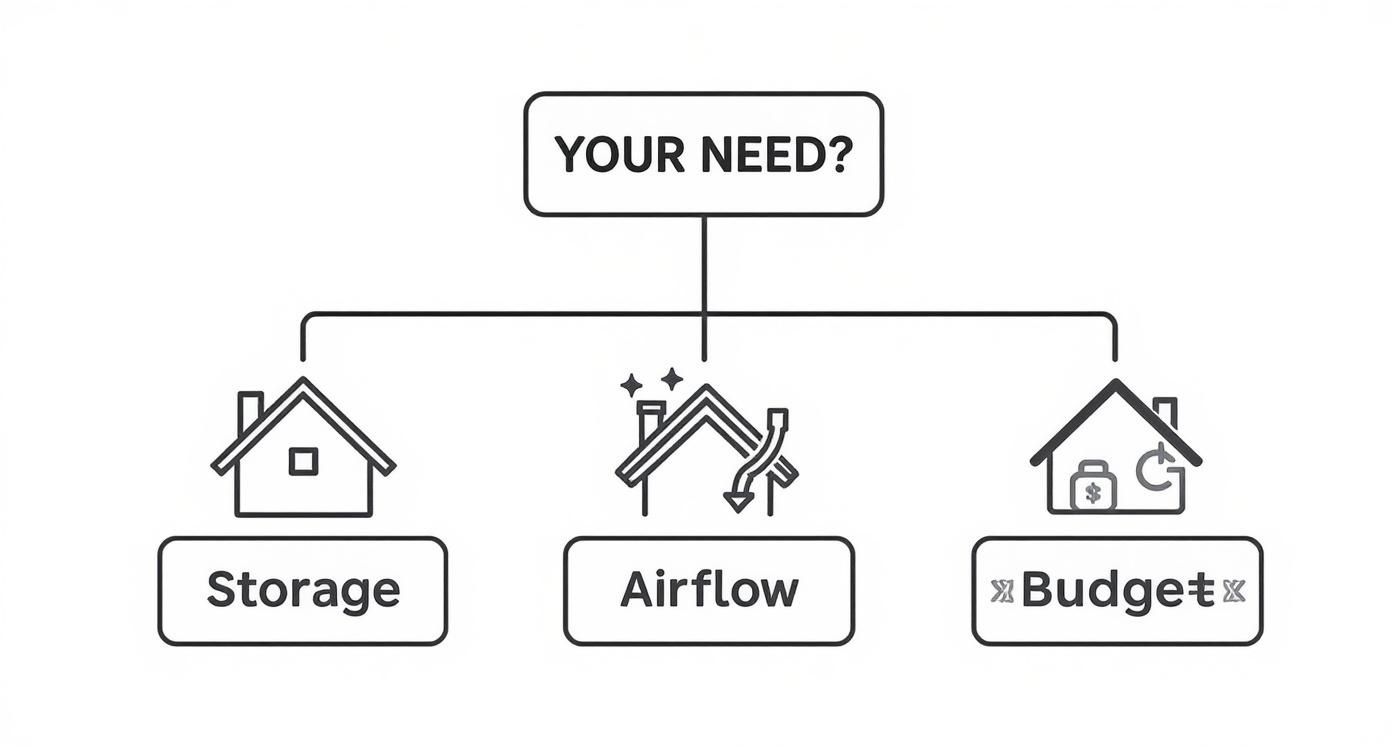
As you can see, your primary driver—whether it's getting the most space, the best ventilation, or the lowest price tag—points you directly to an ideal starting point for your design.
Comparing Popular Barn Roof Styles
Before we get into the nitty-gritty of each design, this table gives you a quick, at-a-glance comparison. Think of it as a cheat sheet to help you narrow down the best options for your new steel building.
| Roof Style | Primary Benefit | Ideal Use Case | Relative Cost |
|---|---|---|---|
| Gable | Simplicity and cost-effectiveness | General-purpose sheds, workshops, garages | Low |
| Gambrel | Maximum interior storage space | Hay barns, lofts, two-story structures | Medium |
| Monitor | Superior ventilation and natural light | Livestock housing, equestrian arenas, workshops | High |
| Shed/Lean-To | Economy and easy construction | Equipment storage, additions, simple shelters | Very Low |
This lays out the trade-offs pretty clearly. A Gable roof is your go-to, no-fuss workhorse for most projects where the budget is a key factor. On the other hand, a Monitor roof is a serious investment, but for things like animal comfort where airflow is everything, it's worth every penny. Your final decision will always come down to balancing cost, aesthetics, and, most importantly, how you plan to use the space every single day.
The Enduring Appeal of Classic Roof Designs
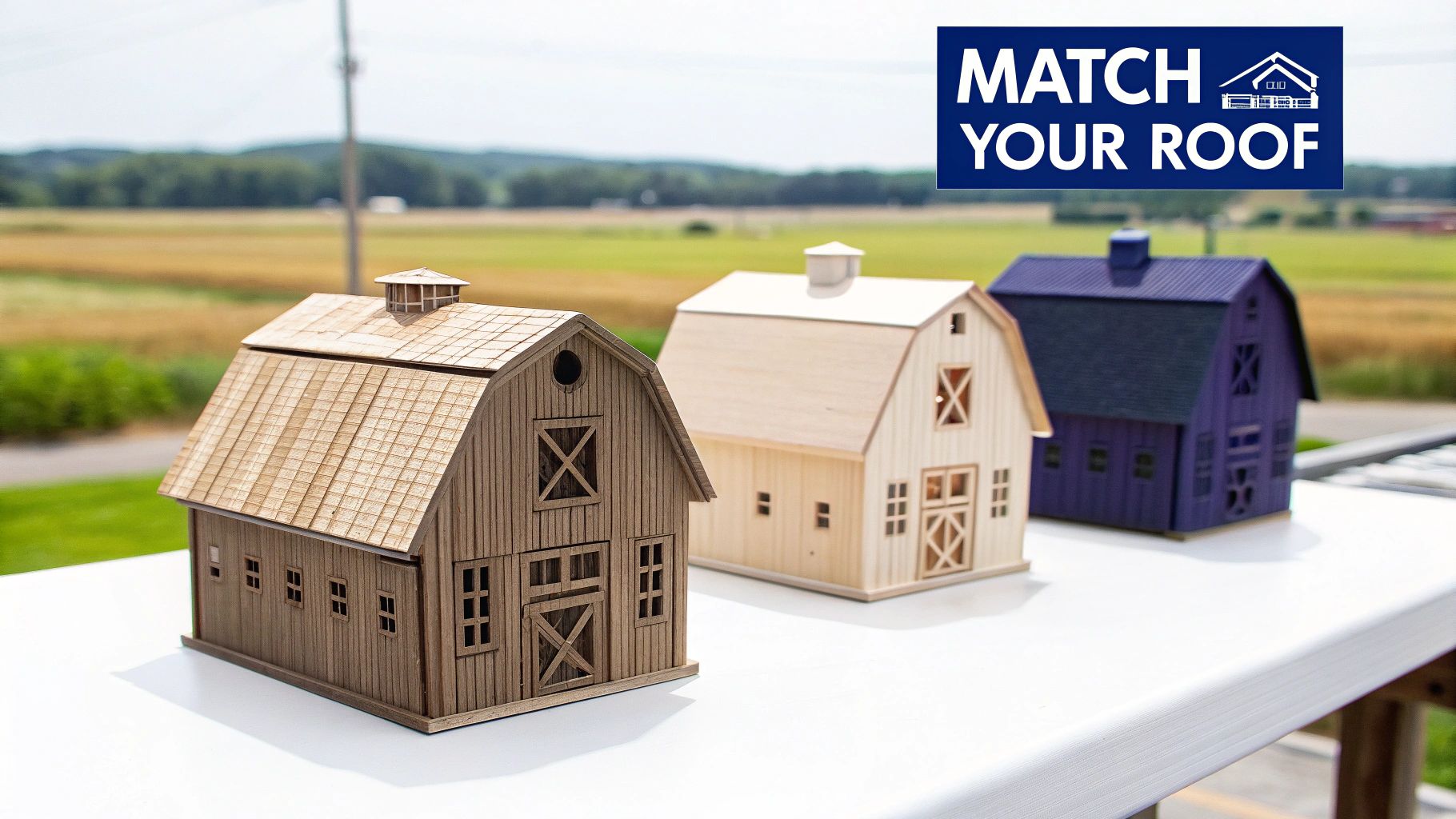
When you picture a classic American barn, chances are two timeless designs come to mind. These iconic barn roof styles weren’t picked out of a catalog; they were born from pure necessity, engineered to solve the real-world problems farmers faced for centuries.
Their staying power is a lesson in smart, simple design. The practical brilliance that made them work back then translates perfectly to today’s modern steel structures. Looking at the history behind these roofs shows you exactly why they’re still so popular—every curve and angle tells a story of a farmer needing a better way to work.
The Gambrel Roof: The Quintessential Barn Profile
The Gambrel roof is so iconic it’s often just called a "barn roof." You'd recognize it anywhere: a two-sided design with a shallow upper slope and a much steeper lower slope. This wasn't just for looks. It was a groundbreaking solution for one of agriculture’s biggest challenges: storage space.
The genius of the Gambrel is how it carves out a massive, wide-open loft. The steep lower pitch gives you plenty of headroom right up to the walls, while the gentler upper pitch maximizes the total volume overhead. Think of it this way—a simple triangle roof squeezes your attic space, but the Gambrel pushes the walls out and the ceiling up, creating a cavernous area perfect for stacking hay bales high.
This design really took off in the late 19th and early 20th centuries as farming became more mechanized. Farmers were producing and storing more hay than ever before, and the Gambrel roof was the answer to that demand. It’s a perfect example of how architecture adapts to technology.
A Gambrel roof is a masterclass in spatial efficiency. Its dual-pitch design was a game-changer for farmers, effectively turning the entire upper level of a barn into a high-capacity storage unit without needing a larger foundation.
Today, that same benefit makes the Gambrel a fantastic choice for modern steel barns. Whether you're building a "barndominium" and need a full second-story living area or just want maximum storage for equipment, the Gambrel design delivers unmatched interior volume. If you want to dive deeper into practical applications for modern ag, check out our farmer’s guide to steel farm buildings.
The Gable Roof: Simplicity and Strength
If the Gambrel is famous for its space, the Gable roof is celebrated for its straightforward, no-nonsense efficiency. It’s that classic A-frame design—two sloping sides meeting at a central ridge—and it's one of the oldest and most trusted roof forms in the world. Its appeal comes down to its simplicity, which brings some major advantages.
The Gable roof is:
- Cost-Effective: Its simple construction means fewer materials and less complex framing, making it one of the most affordable options out there.
- Excellent for Drainage: The steep pitch is perfect for shedding rain and snow, which reduces the risk of leaks and eases the load on the structure in tough climates.
- Versatile: You can adapt it to just about any building size and use a shallow or a super-steep pitch to handle specific weather conditions.
This combination of low cost and high function has made the Gable roof a workhorse for everything from backyard workshops and garages to massive agricultural buildings. It gives you solid, reliable protection without the extra cost or complexity of more elaborate designs.
For those working with older properties, blending this timeless look with modern standards is key. Getting advice from expert historic preservation architects can be invaluable for ensuring a project respects its roots while meeting today's codes.
Functional Roof Styles for Modern Barns
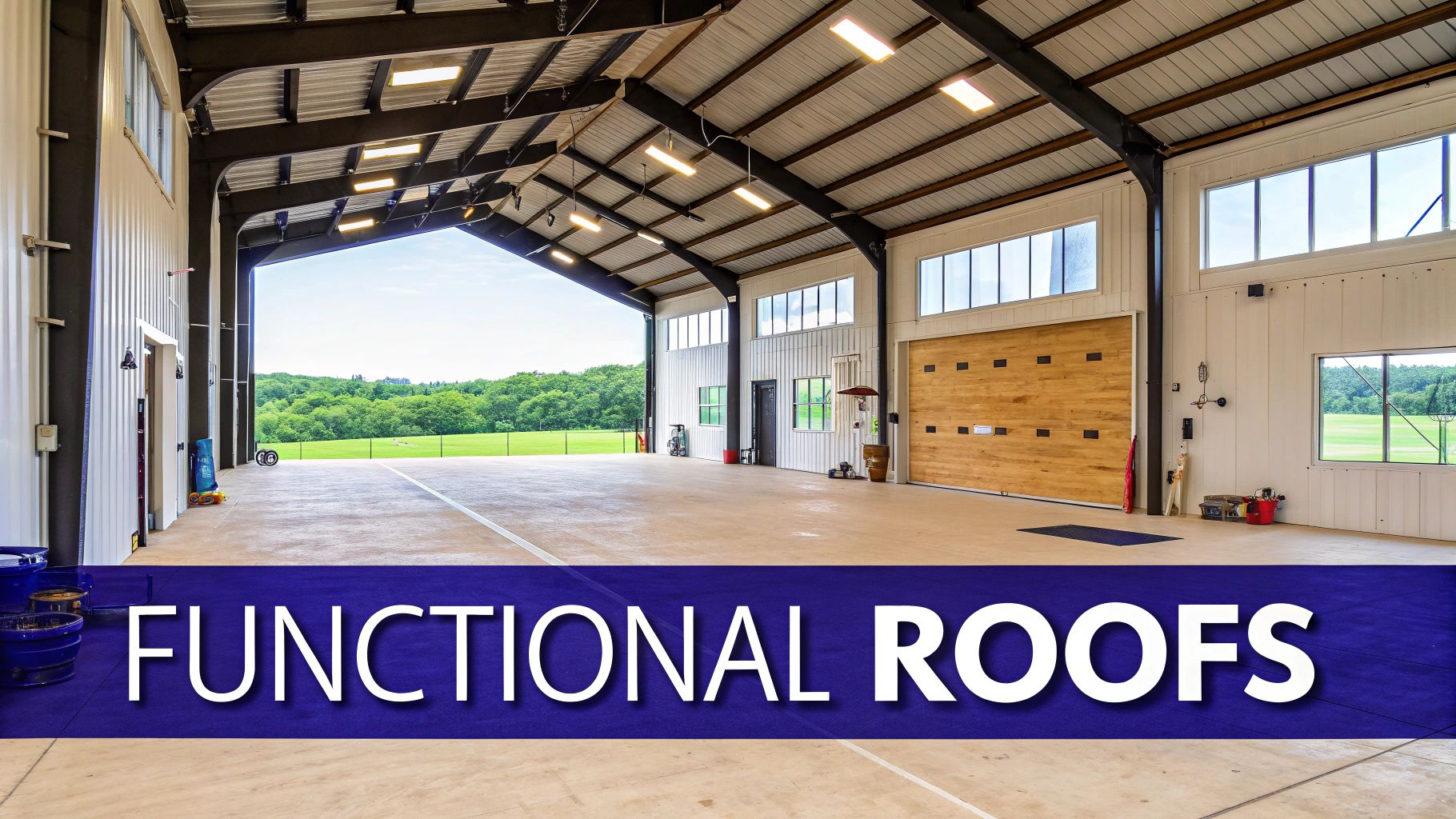
While the classic barn shapes have a timeless charm, today's agricultural and workshop demands have sparked some seriously smart innovations in roof design. These aren't just your grandfather's barn roofs. Modern styles are engineered for specific jobs, moving beyond simple shelter to actively boost a building's performance.
Instead of just putting a cap on a structure, these roofs are problem-solvers. They’re all about creating healthier air for livestock, flooding workspaces with natural light, and squeezing the maximum utility out of every single square foot.
The Monitor Roof: A Natural Airflow Engine
The Monitor roof is a brilliant bit of engineering, instantly recognizable by its raised center section—the "monitor"—that sits along the ridge of a standard gable roof. This isn't just for looks; it’s a powerful, built-in ventilation system that works entirely on its own.
Think of it like a chimney. The raised monitor has windows or louvers that give warm, stale air a place to go. As the air inside the barn heats up from livestock or machinery, it naturally rises and escapes through these high vents. This creates a constant, gentle cycle, pulling fresh, cooler air in from doors or windows below.
A Monitor roof essentially gives your barn a set of lungs. It breathes out hot, moist air and breathes in fresh, clean air, creating a healthier and more comfortable environment without relying on expensive mechanical fans. This natural convection is especially critical in equestrian arenas and livestock housing.
This style is a hands-down favorite for:
- Equestrian Arenas: Perfect for keeping horses cool and cutting down on respiratory irritants.
- Livestock Barns: A game-changer for maintaining great air quality and lowering humidity.
- Workshops: Vents fumes and heat while letting in a ton of natural light.
Those windows in the monitor do double duty, too. They bathe the center of the barn in sunlight, which means less money spent on electricity and a much more pleasant space to be in.
The Shed or Lean-To Roof: Simple and Efficient
When you need pure, no-nonsense function and economy, nothing beats the Shed roof, often called a Lean-To. This design is as simple as it gets: just a single sloping plane. That simplicity makes it one of the most cost-effective barn roof styles out there.
Its genius is its straightforwardness. With no complex ridges, valleys, or hips to worry about, it uses fewer materials and goes up incredibly fast. This makes it the perfect choice for adding onto an existing building or for standalone structures where time and budget are the biggest factors. You see them all the time attached to the side of a larger gable-roofed barn, creating a protected spot for tractors, firewood, or feed.
The Arched Roof: Unobstructed Interior Space
The Arched roof, sometimes called a Gothic arch, delivers a huge practical advantage: a completely wide-open interior with no need for trusses. The curved rafters create a self-supporting structure that spans the entire width of the building, giving you a massive, unobstructed space from wall to wall.
This design is ideal for any situation where interior columns or low-hanging supports would just get in the way. If you need to maneuver large equipment or stack bulky materials, the clear-span capability of an arched roof is a massive win. You can learn more about the engineering behind these open designs in our comprehensive guide to metal truss buildings.
The smooth, curved profile is also fantastic at shedding snow and resisting high winds, making it a seriously durable option for tough climates. While it has a distinct, modern look, its functional core is all about maximizing usable floor-to-ceiling volume, making it a powerful choice for warehouses, indoor sports facilities, and large-scale agricultural storage.
How Climate Shapes Your Roof Decision
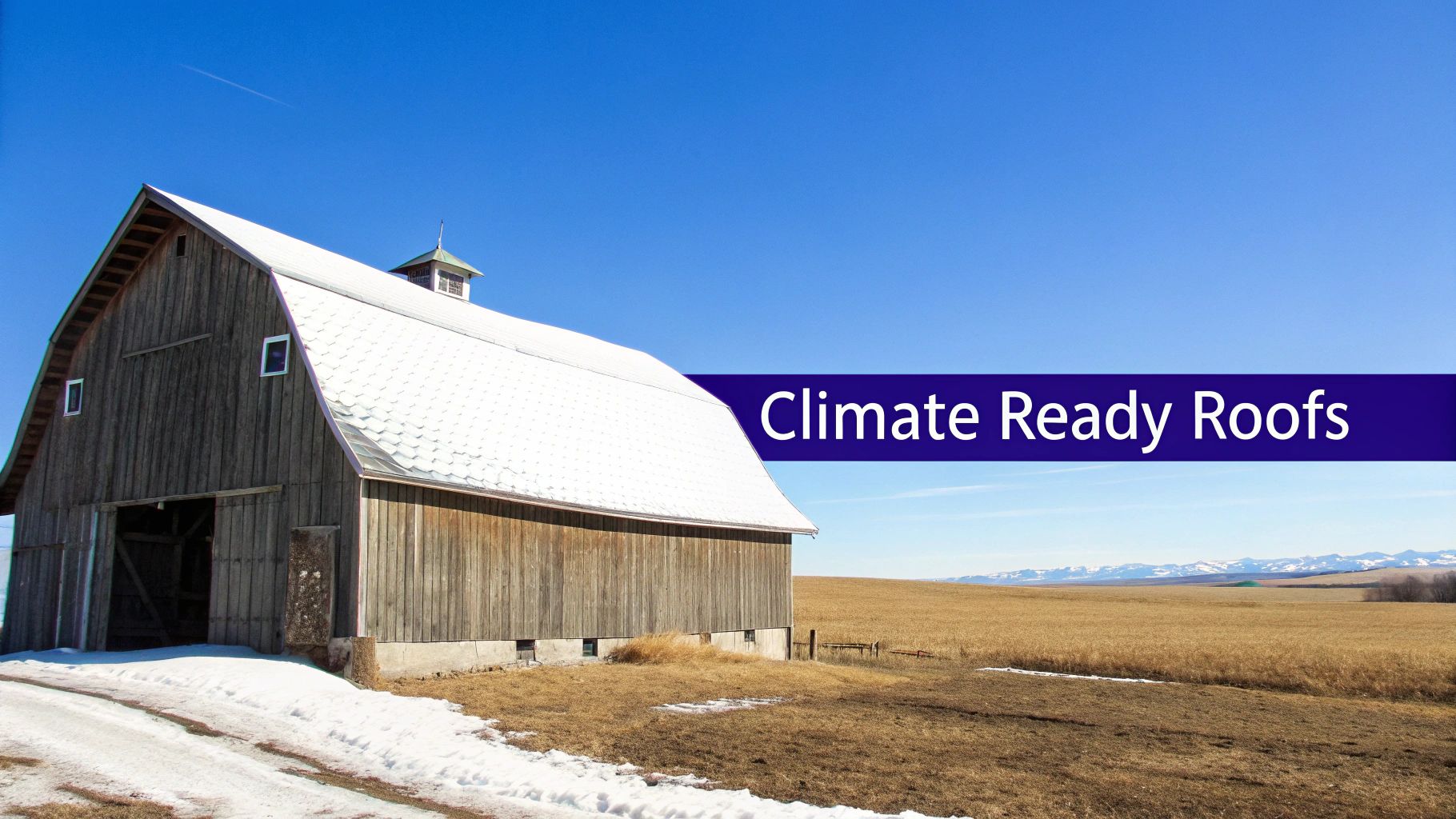
Before you fall in love with a particular look, you need to have a serious talk with your local weather. It’s the most important architect you’ll ever consult. The most beautiful barn roof is worthless if it can't handle a decade of regional wind, rain, and snow.
This isn't just about style—it's about safety and longevity.
Think of your roof's pitch (its steepness) as its first line of defense. A steep roof in a heavy snow region is like a natural slide, shrugging off weight before it can pile up and strain the structure. On the other hand, a low-slope roof might be the smarter, more cost-effective choice in a dry, sunny climate.
Matching the roof design to your local weather is the single most important step you can take to make sure your steel building remains a durable, safe asset for years to come.
Snow Loads and Steep Pitches
If your area gets blanketed in snow every winter, a steep roof pitch isn't a suggestion—it's a requirement. Snow gets heavy, fast. A single cubic foot of wet, packed snow can weigh over 20 pounds. Now, imagine that spread across your entire roof. That’s a serious structural threat.
This is where the classic, high-pitched barn roof styles really prove their worth.
- Gable Roofs: The timeless A-frame design is a master at shedding snow. Its clean, steep angles give snow nowhere to gather, encouraging it to slide right off.
- Gambrel Roofs: The steep lower slopes of a Gambrel are also incredibly effective at clearing snow away, protecting your eaves and walls from the immense weight.
It's no accident that certain barn styles became popular in specific regions. Dutch barns, first built in the 1700s in snowy New York and New Jersey, used broad gable roofs that came low to the ground for maximum protection. Later, in the 1920s, the arched-roof barns of the Midwest were designed with a curve to both maximize loft space and let snow slide off naturally.
For climates with punishing winters, a steep pitch isn't a feature—it's a necessity. It’s the difference between a roof that passively manages weather and one that is actively at risk of failure from accumulated weight.
Taking the right steps for protecting your roof system in winter is critical for maintaining its integrity season after season.
Wind Resistance and Low-Profile Designs
While steep roofs are great for snow, they can act like a giant sail in high-wind zones. If you live in an area prone to hurricanes, tornadoes, or just consistently strong gales, a lower-profile roof with multiple slopes is a much safer, more aerodynamic bet.
The Hip roof is the undisputed champion here. With slopes on all four sides instead of just two, it presents a far more stable profile to the wind. Air is deflected up and over the building from any direction, which drastically reduces the dangerous uplift forces that can literally tear a roof off its frame.
This makes a Hip roof the go-to choice for coastal regions or open plains where high winds are a constant threat. It might not shed snow quite as well as a steep Gable, but its built-in wind resistance is a non-negotiable layer of protection. This is just one of many ways an engineered structure provides superior defense—you can learn more in our detailed guide on the safety of steel buildings in storms.
Rain Drainage and Regional Considerations
Even in moderate climates without extreme snow or wind, managing water is everything. Every barn roof is designed to channel rain away from the foundation, but how much rain you get should influence your choice.
A simple Shed or Lean-To roof, with its single slope, provides fantastic, straightforward drainage for smaller buildings or additions. For larger structures in places that see heavy downpours, a Gable or Hip roof paired with a solid gutter system is essential for preventing foundation erosion, water damage, and moisture problems down the road.
Ultimately, the best barn designs work in harmony with their environment, turning potential weather challenges into predictable, manageable outcomes.
Why Steel Roofing Is the Modern Standard
While the shape of a roof gives a barn its character, the material sitting on top determines how long it will stand. For centuries, builders had limited options—wood shingles, thatch, and slate were the standard. Each came with major headaches, requiring constant upkeep and leaving structures vulnerable to fire, rot, and pests. The invention of metal roofing changed everything.
This wasn't just a minor upgrade; it was a fundamental shift in how we protect agricultural buildings. The move to metal really took off in the early 20th century. In fact, surveys from the 1930s showed that over 70% of barns built after 1920 had metal roofs, a massive jump from less than 10% before 1880. This rapid switch reflects a clear demand for stronger, more fire-resistant structures in modern farming. Today, steel is the undisputed king for nearly every barn roof style out there.
The Unmatched Durability of Steel Roofing
The number one reason for steel’s takeover? Pure, brute strength. Unlike old-school materials that break down with every passing season, a professionally installed steel roof is a long-term investment that can easily last for 50 years or more. That kind of longevity comes from its built-in resistance to just about anything a farm can throw at it.
Steel roofing gives you a "set-it-and-forget-it" peace of mind that older materials just can't deliver. It’s engineered to shrug off decades of harsh weather, freeing you from that endless cycle of patching, repairing, and replacing.
A steel roof puts an end to the problems that have frustrated barn owners for generations. It’s completely immune to termites and other wood-boring pests, and it will never rot, warp, or crack when exposed to moisture. This is why we are so confident in the material—you can learn more about why we only use US-made national steel for our buildings.
More Than Just Strong: Energy Efficiency and Cost Savings
Beyond its toughness, steel roofing delivers real financial benefits over the long haul, especially when it comes to energy savings. Modern steel panels can be treated with special reflective coatings—often called "cool roofs"—that bounce a huge portion of the sun's heat back into the sky instead of absorbing it.
The impact is powerful. On a sweltering summer day, a cool metal roof can stay up to 50-60 degrees Fahrenheit cooler than a standard asphalt shingle roof. That translates directly to a cooler barn, reducing the strain on expensive ventilation systems needed to keep livestock healthy or protect stored crops.
Over the life of your barn, these energy savings add up to a serious return on your initial investment. When you factor in the minimal maintenance and incredible lifespan, steel offers unbeatable value for any farm or property owner.
Common Questions About Barn Roof Styles
Choosing the perfect roof for your new steel barn can feel like a big decision with a lot of moving parts. To help clear things up, we’ve put together the most common questions our customers ask about barn roof styles. This is your quick-start guide with straightforward answers to help you feel confident in your choice.
We'll cut through the jargon and get right to the heart of what matters: cost, performance in your climate, and your customization options.
What Is the Most Cost-Effective Barn Roof Style?
For most projects, the classic Gable roof is the most budget-friendly option. Its simple A-frame design uses standard materials and is less labor-intensive to build compared to more complex shapes like the Gambrel or Monitor. It gets the job done reliably and affordably.
If you're building a smaller structure or an addition, the Shed or Lean-To roof is another champion of economy. Its single-slope design keeps both material and construction costs to a minimum, making it a go-to for simple, functional coverage.
But it’s crucial to think about long-term value, not just the upfront price tag. A Gambrel roof, for instance, costs more initially but gives you a massive amount of usable loft space. That extra storage or potential living area could deliver a much better return on your investment depending on your goals.
Which Barn Roof Is Best for Heavy Snow?
When you’re dealing with serious snowfall, a roof with a steep pitch isn't just a good idea—it's a necessity for safety and structural integrity. A steeply pitched Gable roof is one of the top contenders here. Its design naturally encourages snow to slide right off, preventing dangerous, heavy buildup.
The upper slopes of a Gambrel roof are also incredibly effective at shedding snow, making it another solid choice for cold climates. And don't overlook the Arched or Gothic roof; its smooth, curved shape offers no flat spots for snow to pile up.
In regions with heavy snow, the roof's main job is to get weight off the structure as fast as possible. The steep angles of a Gable or Gambrel roof act like a natural slide—a simple but critical feature for preventing structural overload.
As a general rule, low-slope roofs like a standard Shed style are not recommended for heavy snow areas unless they have been specifically engineered with extra reinforcement to handle the massive load.
Can I Customize the Pitch and Overhangs on a Steel Barn Roof?
Yes, absolutely. One of the best things about a pre-engineered steel building is the incredible degree of customization you get. This definitely includes adjusting key features like roof pitch and overhangs to meet your exact needs.
You can easily specify a steeper pitch on a Gable roof for better snow management, or go with a lower pitch to get a sleek, modern look in a milder climate. This flexibility means your barn is built to perform perfectly in your environment.
Overhangs are just as easy to tailor. You can choose to add:
- Wider Overhangs: These are great for providing extra protection for your walls, windows, and doorways from harsh sun and driving rain.
- Minimal or Flush Overhangs: This option creates a cleaner, more contemporary look and is often preferred for a streamlined design.
This level of control ensures your steel barn is a perfect match for both your climate's demands and your personal style.
How Does a Monitor Roof Improve Barn Ventilation?
A Monitor roof is specifically engineered for fantastic natural ventilation, and it all works on the simple principle of convection: hot air rises. It features a raised center section with windows or vents that act as a chimney for warm, stale air.
As heat and moisture rise from livestock, equipment, or daily work, the vents in the raised monitor let this air escape at the highest point of the barn. As the warm air exits, cooler, fresh air is naturally pulled in through lower windows and doors, creating a constant, passive cycle of air circulation.
This natural airflow is critical for a few key reasons:
- Maintains Healthy Air Quality: It's essential for animals, as it reduces ammonia buildup and other respiratory irritants.
- Reduces Moisture: It prevents the kind of condensation and dampness that can damage equipment, ruin stored hay, and promote mold.
- Keeps the Building Cooler: It achieves all this without relying on expensive, power-hungry mechanical fans.
A Monitor roof effectively turns your entire building into a self-regulating airflow system, making it the ideal choice for horse arenas, livestock housing, and workshops where air quality is a top priority.
Ready to design a steel building with the perfect roof for your needs? The team at Icon Steel Buildings is here to guide you through every option and customize a structure that's built to last. Explore our building options and get a free quote today!