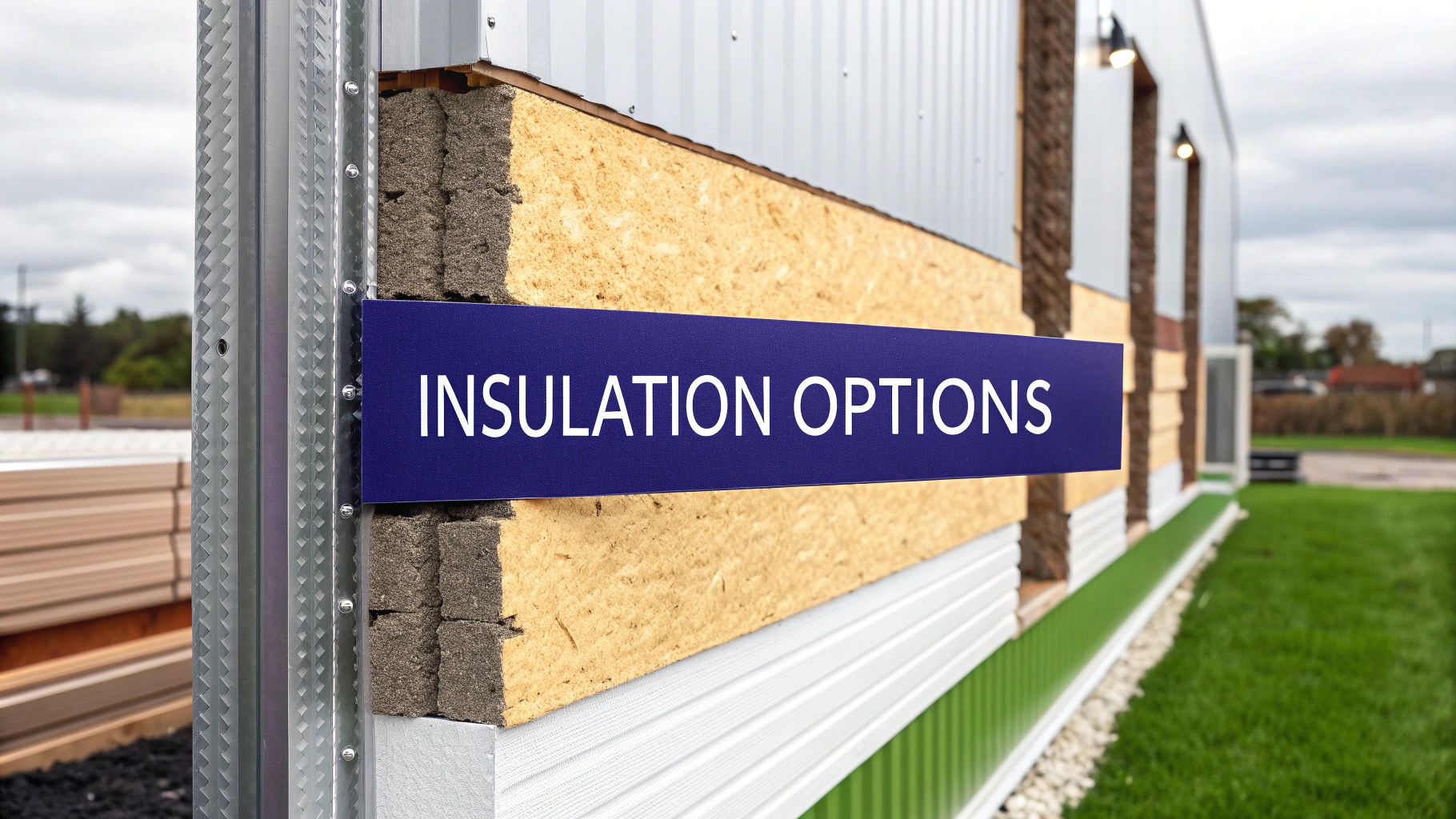
Figuring out the right steel building insulation options is one of the most important steps you'll take. It's not just about comfort; the right choice protects your building from moisture, slashes your energy bills, and makes the space genuinely usable year-round.
Why Insulating Your Steel Building Matters
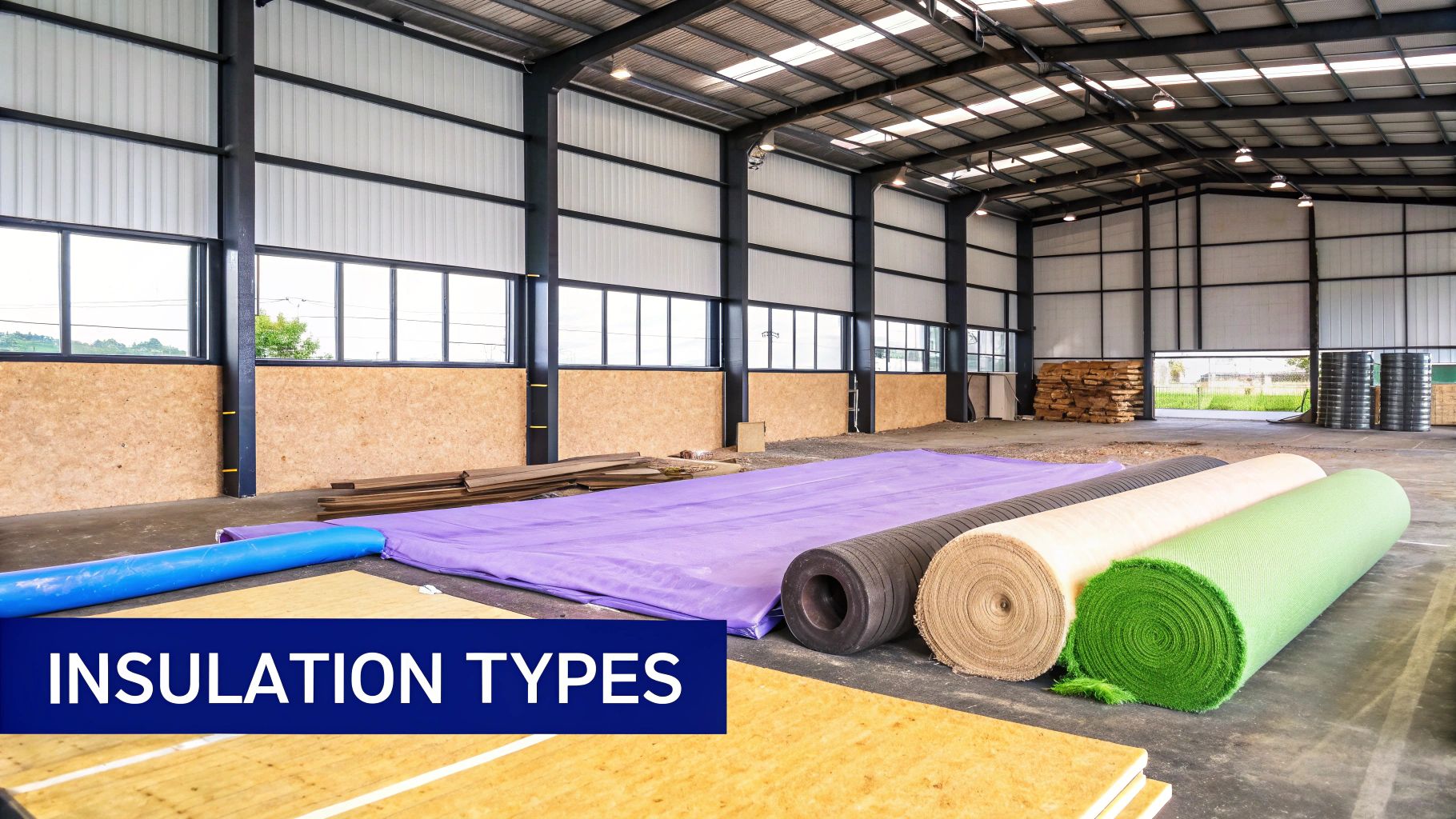
Imagine a steel building without insulation is like a metal thermos with a broken seal. On a scorching summer day, that heat blasts right through the walls, turning the inside into an oven. In the winter, all your precious heat escapes just as quickly, leaving you with a walk-in freezer.
Steel is a fantastic conductor of heat. That’s great for a frying pan, but terrible for a building. This rapid heat transfer does more than just make the space uncomfortable—it creates a huge, hidden problem: condensation.
When the warm, moist air inside your building hits the ice-cold steel panels, it cools down instantly. That cooling forces the air to release its moisture in the form of water droplets, just like you see on a cold glass of sweet tea. This isn't just a minor annoyance; it's a destructive force working against your investment.
Shielding Your Structure from Within
This constant moisture is the number one enemy of a steel building’s lifespan. We’re not talking about a few drips here and there. Over time, unchecked condensation leads to serious damage.
- Corrosion and Rust: Give steel a constant supply of water, and it will inevitably start to rust. This corrosion weakens the panels and structural components from the inside out.
- Mold and Mildew Growth: Damp, dark spaces behind your interior walls are the perfect breeding ground for mold and mildew. This creates health hazards and can ruin anything you have stored inside.
- Structural Damage: Eventually, that moisture can saturate building materials, compromise fasteners, and degrade the overall integrity of your entire structure.
Good insulation creates a protective barrier, stopping that warm interior air from ever making contact with the cold exterior metal. This barrier, often called a vapor retarder, is your frontline defense against condensation. For a deeper dive into structural integrity, check out our guide on the safety of steel buildings in storms and bad weather.
Enhancing Energy Efficiency and Comfort
Beyond protecting the building itself, insulation is your best friend when it comes to managing your monthly bills. A well-insulated building simply needs less energy to heat and cool, which means you see real, substantial savings.
This isn't just a smart move for your wallet; it reflects a major industry trend. The industrial building insulation market is set to grow from USD 10.2 billion in 2024 to USD 13.6 billion by 2029. This shows just how critical energy efficiency has become.
Insulation does more than just save money on energy bills; it transforms a loud, echo-prone metal shell into a quiet, functional, and comfortable space suitable for a workshop, office, or even a home.
Understanding the role of proper insulation is key for any building owner looking to cut costs and create a more sustainable structure. It aligns with the same principles for how to reduce overall energy consumption in your home. By investing in the right system, you're ensuring your building isn't just durable but also efficient and a pleasure to be in.
Understanding R-Value for Thermal Performance
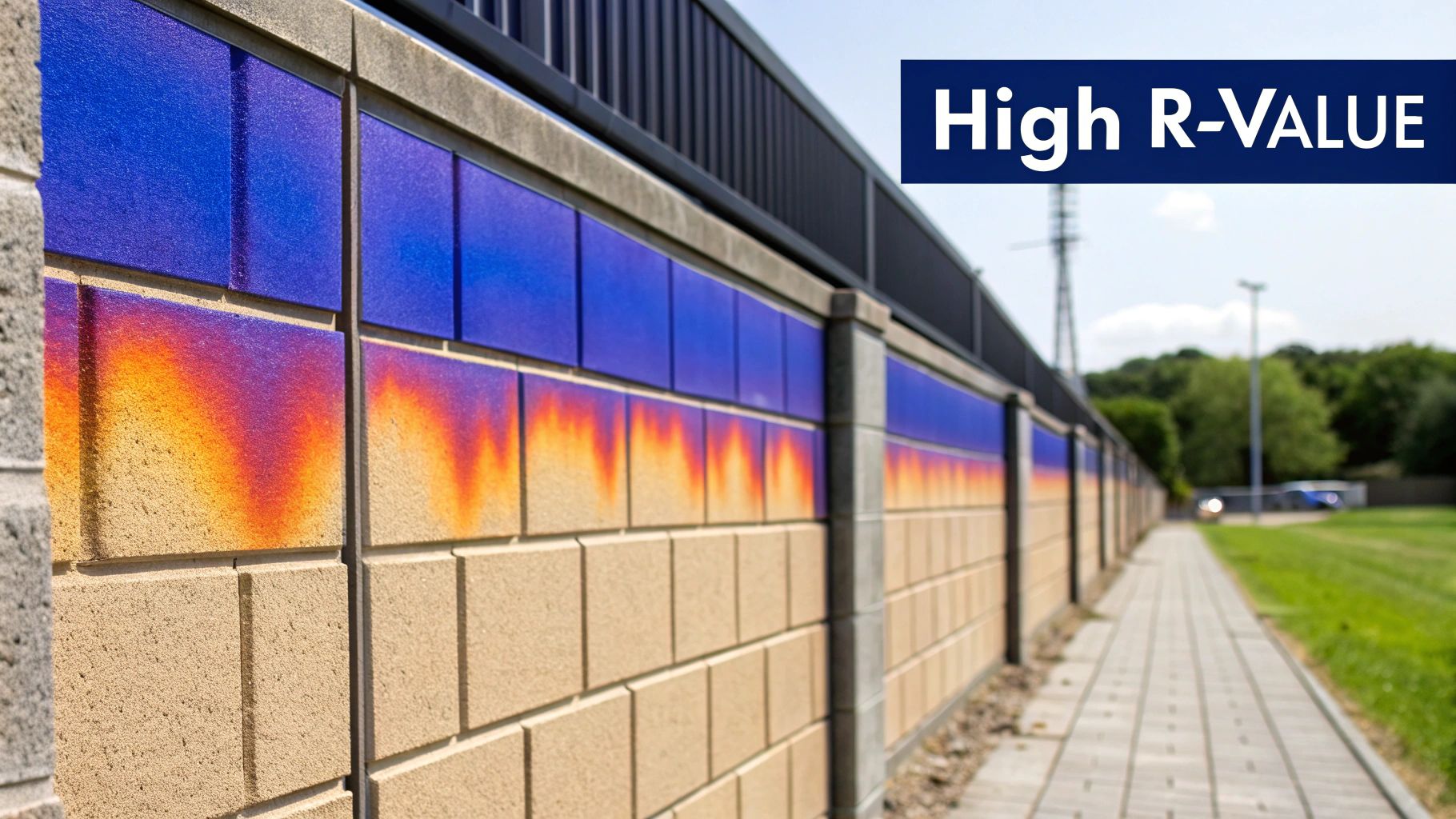
Before we jump into the different steel building insulation options, we need to talk about the language of thermal performance. The most important term you'll run into is R-value. In simple terms, R-value is a grade that tells you how well insulation can stop heat from moving through it.
Think of it like the SPF number on sunscreen or the tog rating on a winter duvet. A higher R-value means better insulation—it’s more effective at keeping your building comfortable. This works both ways: it traps heat inside during the winter and blocks it from getting in during the summer.
A common mistake is assuming that thicker insulation automatically means better performance. While there's some truth to it, the type of material is what really counts. Two inches of spray foam insulation, for example, will deliver a much higher R-value than two inches of a standard fiberglass blanket.
Why Your Climate Dictates Your R-Value Needs
The right R-value for your steel building isn't a one-size-fits-all number. It’s almost entirely dependent on your local climate. A workshop in the Arizona desert has completely different insulation needs than a garage in the snowy mountains of Colorado.
To make this simple, building codes use climate zones to set the baseline. These zones recommend the minimum R-value you’ll need to keep your building energy-efficient.
- Hot Climates (Zones 1-3): In places like Florida or Texas, the main goal is to block heat from the sun. This usually calls for a moderate R-value, often paired with radiant barriers that reflect heat away from the building.
- Mixed Climates (Zones 4-5): For areas with hot summers and cold winters, you need a balanced approach. The insulation has to be strong enough to perform well in both extremes.
- Cold Climates (Zones 6-8): In northern regions like Minnesota or Maine, preventing heat loss is the number one priority. These zones require the highest R-values to keep heating costs down and stop condensation from forming when it gets frigid.
Choosing the wrong R-value for your climate zone can mean a building that costs a fortune to heat and cool, or one where you’ve spent more than you needed to.
Introducing U-Value The Other Side of the Coin
While you’ll see R-value plastered on nearly every insulation product, you might also come across its counterpart: U-value. This term is more common when talking about windows and doors, but it’s also used for whole building assemblies.
U-value measures the rate of heat transfer—basically, how easily heat can pass through something. Unlike R-value, a lower U-value is better because it means less heat is getting through. Think of it this way: R-value is resistance, and U-value is transmittance.
You don't need to be an expert on U-value, but knowing what it is helps you make smarter choices. A product with a high R-value will always have a low U-value. This bit of knowledge lets you read any technical spec sheet with confidence and focus on what really matters: proven performance, not just marketing fluff.
Now that we’ve got a handle on R-values, let's get into the good stuff: the actual steel building insulation options you can choose from. Each material has its own personality, with a unique set of pros and cons. Getting to know them is the key to matching the right insulation to your building’s climate, what you’ll be using it for, and of course, your budget.
You'll mainly come across four players in this game: fiberglass, spray foam, rigid board, and radiant barriers. Think of them as different tools in a toolbox. They all insulate, but each one shines in a different situation. Let’s break them down.
Quick Comparison of Steel Building Insulation Options
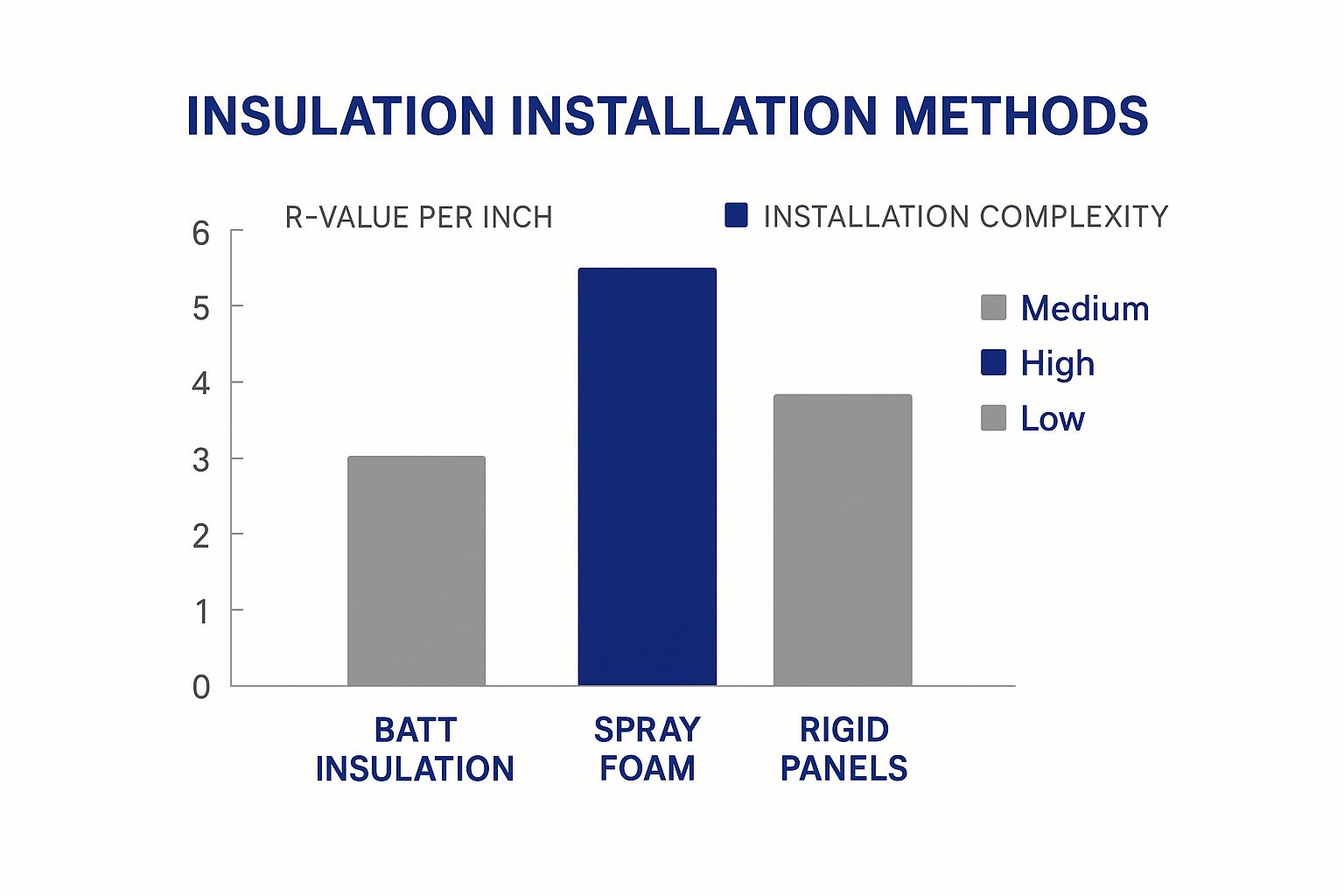
To give you a bird's-eye view, here's a quick table comparing the four heavy hitters. This will help you see at a glance how they stack up against each other.
| Insulation Type | Typical R-Value (per inch) | Relative Cost | Primary Benefit |
|---|---|---|---|
| Fiberglass | R-3 to R-4 | Low | Most budget-friendly upfront option. |
| Spray Foam | R-3.5 to R-7 | High | Creates a perfect airtight seal. |
| Rigid Board | R-4 to R-6.5 | Medium | Durable, moisture-resistant, and long-lasting. |
| Radiant Barrier | N/A | Low-Medium | Reflects radiant heat, ideal for hot climates. |
This table is just a starting point. The best choice always depends on the specifics of your project, so let's dig into the details for each one.
Fiberglass Insulation: The Familiar Favorite
If you picture insulation in your head, you’re probably thinking of fiberglass. It’s the pink or yellow stuff made from incredibly fine glass fibers, sold in big rolls or pre-cut batts. For a steel building, these blankets are made to fit perfectly between the wall girts and roof purlins.
How does it work? Simple. It traps countless tiny pockets of air within its fluffy structure, and it’s these air pockets that slow the movement of heat. For steel buildings, fiberglass insulation is almost always faced with a vinyl vapor barrier to keep condensation from reaching the metal panels.
- Typical R-Value: R-3 to R-4 per inch.
- Best For: Workshops, garages, and storage buildings where you need solid performance without breaking the bank.
- Key Advantage: It's one of the most budget-friendly options you can find, making it a go-to for a huge range of projects.
Spray Foam Insulation: The Airtight Champion
Spray polyurethane foam (SPF) is a totally different beast. It starts as a liquid that’s sprayed directly onto the interior of the steel panels. In seconds, it expands to fill every single crack, seam, and pinhole, creating a seamless, airtight barrier. That airtightness is its superpower—it stops drafts and air leaks in their tracks, which can be a massive source of energy loss.
You’ll have two main types to choose from:
- Open-Cell SPF: This version is lighter and feels a bit spongy. It’s a fantastic sound deadener and creates a good air seal, but it has a lower R-value (around R-3.5 per inch) and can absorb moisture.
- Closed-Cell SPF: This is the dense, rigid, and more powerful option. It boasts a much higher R-value (R-6 to R-7 per inch), acts as its own vapor barrier, and can even add some structural strength to the building panels.
Because it creates a single, unbroken layer, closed-cell spray foam is the undisputed king of condensation control. It prevents warm, humid indoor air from ever touching the cold steel, stopping moisture problems before they can start.
Rigid Foam Board Insulation: The Durable Defender
Rigid foam board insulation comes in large, sturdy sheets that you can get in various thicknesses. The most common types are expanded polystyrene (EPS), extruded polystyrene (XPS), and polyisocyanurate (polyiso). You simply cut the boards to size and fit them against the building's frame or attach them directly to the panels.
Unlike fiberglass, rigid board doesn't care about moisture. It won't compress, sag, or lose its insulating power if it gets damp. This durability makes it a fantastic long-term solution that also leaves a clean, finished look on the inside. It’s a popular pick for busy workshops, retail spaces, or any building that needs a tough interior finish.
Radiant Barriers: The Heat Reflector
Radiant barriers play by a completely different set of rules. Instead of slowing down heat transfer through materials (conduction), they reflect radiant heat away from your building. Think about how a silver sunshade keeps your car cool on a hot day—that’s exactly what a radiant barrier does for your building.
Usually made from a highly reflective material like aluminum foil, it’s most effective in hot, sunny climates where the main goal is to block the sun's heat. You’ll typically see it installed on the underside of the roof.
- Important Note: A radiant barrier doesn't really have an R-value. Its power comes from its ability to reflect heat, not absorb it.
- Best For: Buildings that aren't air-conditioned, like barns, agricultural storage, or garages in southern climates where keeping summer heat out is the top priority.
Often, you’ll see radiant barriers paired with other insulation types to create a hybrid system that tackles both radiant and conductive heat. Understanding how each of these materials works is just as crucial as knowing the components in the ultimate guide to steel building kits. Every piece has a specific job to do to ensure the whole system performs at its best.
Weighing the Costs and Benefits of Each Type

Choosing the right insulation really comes down to balancing three things: how well it performs, what your building actually needs, and of course, your budget. Each of the main steel building insulation options has its own unique strengths and weaknesses. Getting a handle on these trade-offs is how you make a smart investment that pays dividends for years to come.
This isn't just another line item on your project plan; it's a huge factor in the long-term comfort and running costs of your building. The global building thermal insulation market was valued at around USD 26.9 billion in 2024 and is expected to hit nearly USD 37.8 billion by 2030. That growth tells you just how critical this decision is in modern construction.
Let's break down the real-world pros, cons, and costs you can expect for each material.
Fiberglass The Budget-Friendly Workhorse
Fiberglass is the most common choice for one simple reason: it offers solid performance at a price that’s hard to beat. Think of it as the reliable sedan of the insulation world—it gets the job done without the premium sticker price. For most standard workshops, garages, and storage buildings, it hits that perfect sweet spot between effective and affordable.
The Benefits:
- Low Upfront Cost: Fiberglass is consistently the most budget-friendly option, typically running between $0.75 to $1.50 per square foot for materials and installation. This makes it a go-to for large buildings or any project with a tight budget.
- Easy Installation: Those familiar rolls or batts are pretty straightforward to install between the girts and purlins of a steel frame, especially for anyone with some DIY experience.
- Good Thermal Performance: While it's not the top performer in R-value per inch, a properly installed fiberglass system delivers more than enough thermal resistance for most climates and building uses.
The Drawbacks:
- Vulnerability to Moisture: This is its biggest weakness. If the vapor barrier facing gets torn or isn't sealed correctly, fiberglass will soak up moisture like a sponge. Once it's wet, it compresses, loses its R-value, and can become a breeding ground for mold.
- Potential for Air Gaps: It can be tricky to get a perfect, airtight fit around odd angles and obstructions, which can leave small gaps for air to leak through and lower your overall efficiency.
Spray Foam The High-Performance Sealant
If fiberglass is the reliable sedan, closed-cell spray foam is the high-performance sports car. You get unmatched airtightness and moisture control, but that premium performance comes with a higher price tag. It's the best choice when creating a completely sealed, climate-controlled environment is an absolute must.
The Benefits:
- Exceptional Airtight Seal: Spray foam expands to fill every single crack, seam, and cavity. This creates a solid, continuous barrier that completely eliminates drafts and air leaks.
- Superior Moisture Barrier: Closed-cell spray foam is impermeable to water and acts as its own vapor barrier, making it the ultimate defense against condensation.
- High R-Value: With an impressive R-value of R-6 to R-7 per inch, it packs maximum insulation into a relatively thin layer.
For projects where controlling humidity and stopping condensation are non-negotiable—like a premium workshop, a retail space, or a residential barndominium—closed-cell spray foam is often the best investment you can make.
The Drawbacks:
- Higher Cost: This is the most expensive option, usually falling between $2.00 to $5.00+ per square foot. Since the building itself is a major part of your total budget, it's smart to know how these costs add up. Check out our detailed guide on the average cost of a steel building from manufacturing to installation.
- Requires Professional Installation: Applying spray foam is a chemical process that demands specialized equipment and safety gear. This is definitely not a DIY job.
Rigid Foam Board The Durable and Versatile Defender
Rigid foam board offers a fantastic middle ground. It’s tougher and more moisture-resistant than fiberglass, but more affordable and easier for a DIYer to handle than spray foam. Its sturdiness and clean appearance make it a popular choice for buildings that will see a lot of interior activity.
The Benefits:
- Excellent Durability: The boards are tough, can handle impacts, and won't sag or compress over time. They provide a sturdy, long-lasting insulation solution.
- Moisture Resistance: Most rigid foam boards naturally resist moisture, so they won't lose their insulating power or support mold growth if they get damp.
- Clean Finish: Once installed, the boards can leave a smooth, finished interior wall that might not even need an additional covering.
The Drawbacks:
- Labor-Intensive Installation: Every board has to be cut precisely to fit, and all the seams need to be meticulously sealed with special tape or caulk to stop air leaks. This can take a lot of time.
- Moderate Cost: The price lands squarely between fiberglass and spray foam, usually in the range of $1.50 to $3.50 per square foot installed.
Radiant Barriers The Climate-Specific Specialist
Radiant barriers aren't really an all-around insulator. They're more of a specialized tool designed for one specific job: reflecting heat. In hot, sunny climates, they can be an incredibly effective and cheap way to keep a building cool.
The Benefits:
- Highly Effective Against Radiant Heat: In climates with intense sun, a radiant barrier can block up to 97% of radiant heat transfer, which can dramatically lower the temperature inside a non-air-conditioned building.
- Affordable and Lightweight: The material itself is inexpensive, and it’s so light that it's easy to handle and install. The cost is often between $0.50 and $1.25 per square foot.
The Drawbacks:
- Minimal R-Value: Radiant barriers do almost nothing to stop conductive heat loss (heat moving through solid materials). In cold climates, they provide little to no benefit on their own.
- Requires Air Space: To work correctly, a radiant barrier needs an air gap on at least one side. This can sometimes make the installation a bit more complicated.
How to Choose the Right Insulation for Your Building
You’ve seen the main steel building insulation options, from classic fiberglass to high-tech spray foam. Now, it's time to put it all together and figure out what’s right for your project. The best way to do that is by asking a few key questions about your climate, your building's job, and your budget.
Think of it like getting a custom-tailored suit—a generic, off-the-rack solution just won't cut it. Your goal is to find the perfect fit that gives you exactly the performance you need without paying for features you'll never use.
Start with Your Local Climate
Where your building stands is the biggest piece of the puzzle. The weather outside is the challenge your insulation has to meet, day in and day out. Are you fighting off scorching summer heat or fending off brutal winter cold?
-
Hot, Sunny Climates: In places like Arizona or Florida, the real enemy is radiant heat from the sun. That's why a radiant barrier is such a smart, cost-effective choice, especially for buildings without AC like barns or storage units. It works like a giant sunshade for your roof, reflecting heat away before it ever gets inside.
-
Cold, Snowy Climates: Up north, it’s all about preventing heat from escaping. A high R-value is non-negotiable if you want to keep heating bills from skyrocketing. This is where closed-cell spray foam shines, creating an airtight seal with an incredible R-6 to R-7 per inch to lock in every bit of warmth.
-
Mixed Climates: For those of us with four distinct seasons, you need an all-rounder. A properly installed fiberglass batt system or rigid foam board offers a solid thermal barrier that performs reliably whether it's hot or cold.
Define Your Building’s Purpose
What you plan to do inside your steel building completely changes the insulation game. A simple storage shed has far different needs than a workshop you'll be in year-round or a full-blown residential home.
The function of your building is the blueprint for its insulation needs. Are you protecting tools from rust, creating a comfortable workspace, or building a home? The answer determines whether you need basic condensation control or a complete thermal envelope.
Let’s look at a few common setups:
-
Simple Garage or Agricultural Barn: If it's a basic, unconditioned space, your biggest worry is condensation. A simple radiant barrier or a basic fiberglass system with a quality vapor retarder is often all you need to stop moisture from forming and protect what’s inside.
-
Active Workshop or Commercial Space: When you're spending real time in the building, comfort and energy bills matter. Rigid foam board is a tough, moisture-resistant option, while closed-cell spray foam delivers that ultimate airtight seal for total climate control and lower energy costs.
-
Residential Barndominium or Office: For any living space, you need top-tier performance, period. Closed-cell spray foam is usually the best investment here. It stops air leaks, acts as a powerful moisture barrier, and keeps the indoor environment stable and comfortable no matter the season. Knowing how you'll use the space is just as important as the floor plan for your custom steel buildings.
Balance Your Budget with Installation Realities
Last but not least, you have to square everything with your budget and decide if you're going the DIY route. The cost of materials and labor for the different steel building insulation options can vary wildly.
If your budget is the main driver, fiberglass batt insulation has the lowest upfront cost and is a project many people can tackle themselves.
But if long-term performance and energy savings are your priority, spending more upfront on professionally installed closed-cell spray foam will pay you back many times over during the life of the building. By thinking through your climate, use, and budget, you can confidently pick the right insulation to protect your investment and make your space truly work for you.
Common Questions About Steel Building Insulation
Even after digging into all the different steel building insulation options, you probably still have a few questions. And that’s a good thing. Getting these last few details right is often what separates a smooth project from a costly headache.
We've pulled together some of the most common questions we hear from clients. Think of this as your final gut-check before you pull the trigger, making sure you’ve covered every angle for a building that’s efficient, comfortable, and built to last.
Can You Insulate a Steel Building After It's Built?
Yes, absolutely! It’s a very common project to retrofit insulation into an existing steel building. While it’s definitely easier and cheaper to do it during the initial construction phase, it’s never too late to make this critical upgrade.
For a retrofit, your best bets are usually:
- Spray Foam: This is often the go-to for existing buildings. Why? Because it can be applied directly to the interior of the steel panels, creating a perfect airtight seal without having to tear anything apart.
- Rigid Foam Board: These boards are another solid choice. You can cut them to fit snugly between the girts and purlins and then fasten them in place. It's a great DIY-friendly approach.
- Fiberglass Batts: It’s possible, but this one can get a bit tricky in a finished building. You have to be extremely careful to get the vapor barrier installed and sealed perfectly.
Do I Really Need a Vapor Barrier?
For a steel building, the answer is a hard yes. A vapor barrier (sometimes called a vapor retarder) is your single most important defense against condensation. It's a non-negotiable part of the system that stops warm, moist air from inside your building from hitting the cold outer steel panels.
Without a proper vapor barrier, moisture will inevitably condense on the inside of your walls and roof. This leads to rust, mold, and soggy insulation that has lost all its insulating power. This isn't just a friendly suggestion—it's essential for protecting your entire investment.
Keep in mind, some materials like closed-cell spray foam do the job themselves, acting as their own vapor barrier. For fiberglass, the vinyl facing serves this purpose, but every single seam must be meticulously taped to create a continuous, unbroken shield.
Which Insulation Offers the Best Soundproofing?
Let's face it, steel buildings can be noisy. Rain, wind, and work going on inside can create a lot of echoes. If keeping things quiet is a top priority, some insulation types are star performers while others barely make a difference.
Open-cell spray foam is the hands-down champion for sound dampening. Its soft, almost spongy texture is fantastic at absorbing sound waves and killing noise transfer. Fiberglass also does a pretty good job thanks to its dense, fibrous makeup. On the other hand, rigid foam boards and radiant barriers offer next to nothing in terms of sound reduction.
For even more detailed answers about steel building construction and features, feel free to explore our comprehensive steel building FAQs page.
Ready to design a building that's energy-efficient, comfortable, and built to last? The experts at Icon Steel Buildings can help you select the perfect insulation and structure for your needs. Get your free quote today