
So, you're looking for a quick ballpark figure on steel building costs? The short answer is that a fully installed steel building typically runs anywhere from $15 to $43 per square foot.
Of course, that's a wide range. The final price tag will shift based on your building's size, how complex the design is, and even where you're located. But it's a solid starting point for wrapping your head around the budget.
Your Guide to Steel Building Prices
Getting a handle on the numbers is the first step toward making a smart investment. While that per-square-foot price gives you a general idea, the final figure is a mix of everything—from raw material prices to the specific doors, windows, and other customizations you pick out. This guide is here to demystify the entire process and give you the clarity you need to budget with confidence.
Lately, market trends have been working in the buyer's favor. Supply chains have stabilized, which means manufacturers can source raw materials more reliably and keep costs in check. The national average for structural steel recently hovered around $2,653 per ton, a much more predictable landscape after the volatility we saw in previous years.
Estimated Steel Building Cost Ranges
To give you a clearer picture of how size impacts your budget, we've put together this table. It shows the typical cost ranges you can expect for different building dimensions.
| Building Size (sq ft) | Cost Range ($/sq ft) | Total Cost Range ($) |
|---|---|---|
| 1,200 (30×40) | $21 – $43 | $25,200 – $51,600 |
| 2,400 (40×60) | $18 – $37 | $43,200 – $88,800 |
| 4,000 (50×80) | $16 – $34 | $64,000 – $136,000 |
| 6,000 (60×100) | $15 – $31 | $90,000 – $186,000 |
Notice a pattern? As the building gets bigger, the cost per square foot tends to drop. This is a classic case of economies of scale—the fixed costs of things like engineering and delivery get spread out over more square footage, bringing your unit price down.
Building Kit vs. Turnkey Cost: What's the Difference?
It’s easy to get tangled up in the terminology, but the price of the structure itself is just one piece of the puzzle. It's crucial to understand the difference between the building "kit" and the fully erected, "turnkey" cost.
A steel building kit is just the bones—the pre-engineered parts like the frame, wall panels, roof sheeting, and basic hardware. A turnkey cost, on the other hand, covers everything: the kit, delivery, foundation work, and all the professional labor to put it together.
If you're thinking about the DIY route to save some cash, it’s worth exploring a detailed breakdown of steel building kit prices. This will give you a clear look at the materials-only portion of your budget. From there, you can weigh the savings of a self-build against the convenience and expertise that comes with professional construction. We’ll dive deeper into all these variables in the sections to come.
What Exactly Goes Into a Steel Building
To really get a handle on steel building costs, you first need to understand what you're actually paying for. Think of it like human anatomy—each part has a specific job, and together they create a strong, unified structure. Breaking down these components takes the mystery out of a quote and shows you exactly where your money is going.
At its core, a pre-engineered steel building is a masterpiece of efficiency. All the pieces are made to exact specifications in a factory, then shipped to your site ready to bolt together. This approach dramatically cuts down on construction time and the need for a huge on-site labor force, which are two of the biggest ways you save money.
The Skeleton: Primary Framing
The primary framing is the heavy-duty skeleton of your building. Made of massive steel I-beams, these are the main columns and rafters that carry the building's weight. They're engineered to transfer all the structural loads—like heavy snow or intense winds—safely down to the foundation.
This rigid frame is what makes those wide-open, column-free interiors possible, something steel buildings are famous for. The strength and spacing of these beams are calculated based on your local building codes and specific project needs, directly impacting the material cost.
The Rib Cage: Secondary Framing
If the primary frame is the skeleton, then the secondary framing is the rib cage. This network is built from smaller steel components, mainly girts and purlins.
- Purlins run horizontally across the roof rafters, providing a surface to attach the roof panels.
- Girts run horizontally along the walls between the main columns, giving you a place to attach the wall panels.
Together, they add crucial support and stability. They take the load from the building's "skin" and distribute it back to the primary "skeleton," ensuring the entire structure is braced against whatever the weather throws at it.
Key Takeaway: This relationship between the primary and secondary framing is central to pre-engineered design. By using a heavy, powerful skeleton (primary frame) supported by a lighter, more intricate system (secondary frame), you get incredible strength without wasting material. That's a huge reason these buildings are so cost-effective.
The Skin: Wall and Roof Panels
Finally, you have the wall and roof panels. This is the building's skin, creating the protective shell that shields the interior from the elements. These metal sheets are fastened directly to the girts and purlins.
This simple but effective structural hierarchy is illustrated perfectly in the infographic below. You can see how each layer builds on the last to create a complete, durable building.
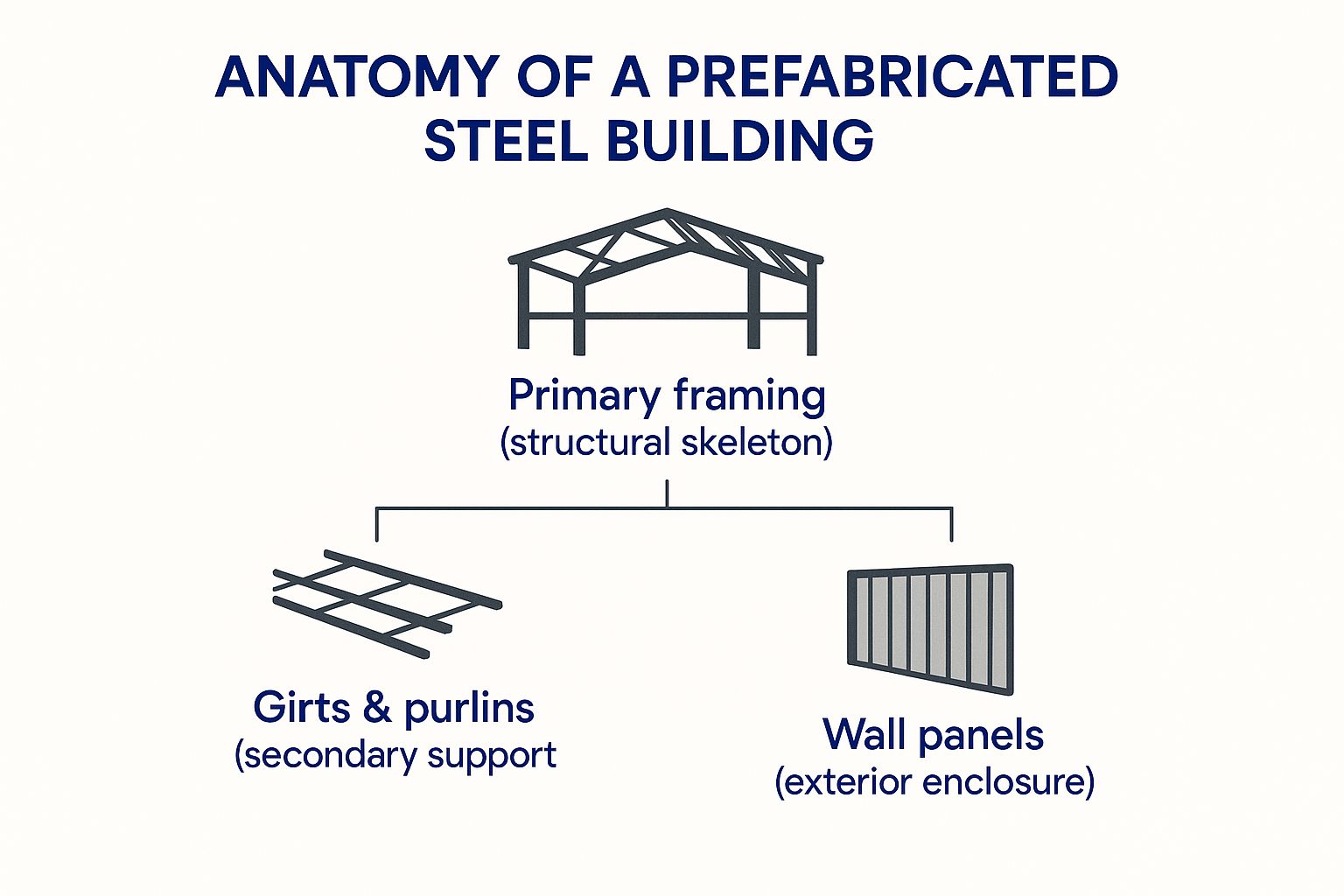
This layered system is how the structural load is managed, moving from the exterior panels, to the secondary framing, and finally to the main columns and down into the foundation.
The beauty of this system is its versatility. You can pick from all kinds of panel thicknesses (gauges), colors, and finishes to match your look and budget. Whether you're putting up a simple farm barn or a complex commercial headquarters, the fundamental components are the same. To see how these elements come together for different uses, you can explore the various types of steel buildings and their unique setups.
Breaking Down the Key Cost Drivers
Ever wondered why two steel buildings of the exact same size can have wildly different price tags? The secret is in the details. It’s a lot like buying a new truck—the base model has one price, but adding a bigger engine, a premium interior, and an off-road package will change the final number on the sticker.
The same exact principle applies to the cost of steel buildings. Every decision you make, from the thickness of the steel framing to the style of the garage doors, is a cost driver. Getting a handle on these variables is the key to setting a realistic budget and avoiding any sticker shock when the final quote lands in your inbox.
The Building Itself: Materials and Design
No surprise here—the biggest chunk of your cost is the building kit itself. But "the kit" is really a bundle of smaller choices, and each one has its own price tag.
First and foremost, the size and complexity of the design are huge factors. A simple, rectangular warehouse is always going to cost less per square foot than an L-shaped building with tricky roof pitches and heavy-duty engineering. The more complex the design, the more engineering hours and raw steel it needs.
Another big one is the steel gauge, which is just a fancy way of saying how thick the steel is. Here’s the trick: a lower gauge number means thicker, stronger, and more expensive steel. The gauge you need isn't really a choice; it's dictated by your local building codes for wind, snow, and seismic loads.
Key Insight: Don't just get fixated on the building's footprint (length x width). The building's height is a major cost driver, too. Taller walls mean you need thicker, beefier columns and more wall paneling, which adds up quickly.
Even the paint on your steel panels matters. A standard finish is the most budget-friendly option, but upgrading to a premium, fade-resistant coating like Kynar 500 will cost more upfront. The trade-off? You get far better long-term durability and color that won't fade under the sun.
Finally, you have to keep an eye on the global steel market. It’s a powerful force that can cause prices to swing. For instance, the 25% global tariff on steel a few years back created a lot of unpredictability and drove prices way up. While they've come down by about 10-20% from the pandemic-era peak, that volatility proves why planning ahead is so important.
Beyond the Kit: Soft Costs and Site Prep
The price of the steel building kit is just where the spending starts. A huge piece of your total budget will go toward prepping your land and actually getting the structure built. These are often called "soft costs," and they can sneak up on you if you don't plan for them.
Site preparation is job number one. This includes things like:
- Grading and Leveling: Making sure your build site is perfectly flat and stable.
- Clearing Land: Hauling away trees, rocks, or any old structures.
- Utility Access: Trenching and running lines for water, sewer, and electricity.
Your foundation is one of the most critical—and expensive—parts of the whole project, right after the building itself. A steel building needs a precisely engineered concrete foundation to anchor it to the ground. The final cost will depend on the type of foundation (slab, pier, or perimeter wall), your local soil conditions, and concrete prices in your area. You can dive deeper into what a proper base requires in our guide to steel building foundation requirements.
Customizations and Add-Ons
This is where you get to make the building your own, but it’s also where costs can really start to climb. Every single feature you add to the basic shell will contribute to the final price.
Some of the most common customizations include:
- Doors: Everything from a simple walk-in door to massive, insulated overhead or roll-up doors for equipment.
- Windows and Skylights: Great for bringing in natural light and improving the feel of the space, but they add to the cost.
- Insulation: Absolutely essential for climate control. Higher R-values provide more insulation but come at a higher price.
- Ventilation: Roof vents and louvers are necessary to keep air circulating properly.
And if you’re planning to maximize your vertical space, adding features like commercial mezzanine floors can be a game-changer. Just remember they require significant extra material and engineering, which will impact the budget.
Labor: Erection and Logistics
Last but not least, you have to account for getting the building to your property and putting it all together. Delivery fees are typically based on how far you are from the manufacturing plant and the total weight of all the steel components.
Erection costs—the actual labor to build the structure—are a huge variable. Crew rates can differ a lot depending on your region and how complex the build is. While you might be able to save some cash with a DIY approach on a small, simple garage, bigger and more complicated projects almost always demand a professional crew. Make sure you factor that labor cost into your budget from day one.
Real-World Pricing Examples and Tables
Talking about cost drivers is one thing, but nothing brings a budget into focus like seeing real-world numbers. To really get a handle on the cost of steel buildings, we need to move past the theory and look at what projects actually cost on the ground. This is how you can start to visualize what a realistic budget looks like for the building you have in mind.
Think of these examples as a sanity check. Once you start getting quotes from suppliers, you can compare them to these typical breakdowns. It’s the best way to get a feel for what’s fair in the current market.
Small Workshop Or Garage Pricing (30×40)
Let’s kick things off with a classic size for homeowners and small businesses: the 30×40 steel building. At 1,200 square feet, this footprint is perfect for a spacious two-car garage, a personal workshop, or a small warehouse for a side hustle. It's one of the most common and versatile sizes out there.
A building of this size has a few key cost buckets. The building kit itself is usually the biggest line item, but the concrete foundation and the labor to put it all together are right behind it.
Budgeting Tip: For smaller buildings, don't be surprised if the foundation and labor costs make up a bigger chunk of the total budget than you expect. The fixed costs of bringing in a concrete truck and a construction crew don't scale down as much as the raw material costs do.
Here’s a typical cost breakdown for a standard 30×40 structure:
| Cost Component | Estimated Price Range ($) | Notes |
|---|---|---|
| Building Kit | $14,000 – $19,000 | Includes the I-beam framing, wall/roof panels, and standard hardware. |
| Foundation | $6,000 – $11,000 | Assumes a standard 4-inch concrete slab. This can change with poor soil. |
| Construction Labor | $5,000 – $9,000 | Highly dependent on local labor rates and the complexity of your build. |
| Delivery | $1,000 – $2,500 | Based on how far you are from the manufacturing plant. |
| Total Estimated Cost | $26,000 – $41,500 | This is a turnkey estimate, excluding permits, site work, and interior finishing. |
Mid-Sized Warehouse Or Retail Space (50×100)
Now, let's scale up to a 50×100 building. This gives you a massive 5,000 square feet of clear-span, column-free space. We see this size used all the time for small warehouses, auto repair shops, retail stores, and light industrial work. This is where you really start to see the economy of scale kick in.
As the building gets bigger, the cost per square foot for the steel kit actually starts to drop. The engineering and manufacturing costs get spread out over a much larger area, making each square foot more efficient to produce.
This screenshot from a pricing tool shows how different add-ons can shift the final price for a building this size.
You can see how things like insulated roll-up doors or premium wall panels can move the needle on the final kit price.
| Cost Component | Estimated Price Range ($) | Notes |
|---|---|---|
| Building Kit | $40,000 – $65,000 | The price reflects the lower per-square-foot cost of a larger building. |
| Foundation | $25,000 – $45,000 | A bigger footprint requires a lot more concrete, rebar, and labor. |
| Construction Labor | $20,000 – $35,000 | Larger projects need more crew members, more time, and heavy equipment like cranes. |
| Delivery | $2,500 – $5,000 | Heavier materials and more truckloads mean higher freight costs. |
| Total Estimated Cost | $87,500 – $150,000 | It’s a serious investment, but incredibly cost-effective for the amount of space you get. |
Large Commercial Or Industrial Facility (100×200)
Finally, let’s look at a large-scale project—a 100×200 steel building. At an impressive 20,000 square feet, you’re now in the territory of distribution centers, manufacturing plants, and large-scale agricultural buildings. For a deeper dive into facilities of this size, check out our guide on commercial metal building cost and its unique factors.
At this massive scale, the per-square-foot cost for the building kit hits its most efficient point. But the absolute dollar amounts for the foundation and labor become much larger, simply due to the sheer size and complexity of the job.
Key things to think about for a facility this big include:
- Heavy-Duty Engineering: The structure must be engineered to handle serious loads, often requiring thicker, more robust I-beams.
- Site Logistics: Just managing the delivery of materials and the movement of cranes on-site becomes a major part of the project.
- Specialized Crews: You’ll need a professional erection crew with proven experience in large commercial builds.
These examples all point to one crucial lesson: the steel kit is a huge part of the cost, but it’s never the full story. Always budget for the "soft costs"—foundation, labor, and delivery—because they often add up to 50% or more of your total project investment.
Smart Strategies to Lower Your Building Costs
Getting a great price on your steel building doesn't mean you have to cut corners on quality. With a bit of smart planning, you can make decisions that seriously trim the overall cost of your project. It’s all about working smarter, not cheaper, to get the absolute most out of your investment.
The key is to understand where the big expenses come from. Once you know that, you can pinpoint the best areas to save money, from the initial drawings all the way to long-term utility bills.
Simplify Your Design for Maximum Efficiency
One of the single most effective ways to manage the cost of steel buildings is to keep the design simple. Think about it: complex shapes, multiple roof pitches, and lots of corners all demand more engineering, custom-cut parts, and extra labor to put it all together. Every one of those custom details adds to the final bill.
A standard rectangular building is always the most economical choice. This shape gives you the most usable space inside while using the least amount of steel and keeping the connections straightforward. Sticking to a simple layout creates a domino effect of savings, from the factory floor to the construction site.
Plan Ahead and Purchase During the Off-Season
Timing is everything. Just like any other industry, construction has its busy seasons. Demand for steel buildings usually skyrockets in the spring and summer when the weather is perfect for building. Naturally, that high demand can push prices up and make you wait longer for delivery.
You can often score a better deal by planning your purchase during the slower fall and winter months. Manufacturers are more likely to offer discounts to keep their workshops humming. Planning months ahead gives you the power to lock in a lower price before the seasonal rush hits.
Consider Long-Term Operational Savings
Your money-saving strategy shouldn't stop the day construction is finished. Thinking about your building's long-term running costs during the design phase can lead to massive savings over its lifetime.
- Insulation: Spending a bit more upfront on a top-notch insulation package will drastically cut your heating and cooling bills year after year.
- Natural Light: Adding skylights and well-placed windows reduces your need for artificial lighting, which means lower electricity bills.
- Energy Generation: For commercial steel building owners aiming to minimize long-term operational expenses, exploring options for commercial solar solutions can be a significant cost-saving strategy.
These features don't just save you money—they make the building more comfortable and boost its future resale value.
Make Smart Material and Sourcing Choices
While the steel frame has to come from your building supplier, you have a lot more freedom with other parts. You can often save money by sourcing things like doors, windows, and even insulation from local suppliers instead of bundling them into your building kit.
This approach lets you shop around for the best deals on accessories. Better yet, buying locally can slash those hefty freight charges, especially for big and bulky items. Always get a price for the full package from your supplier and then compare it to what you can find locally to see where the savings are.
Pro Tip: Consider a turnkey provider. While it may seem more expensive initially, a company that manages the entire project—from design and foundation to erection—can often save you money by preventing costly mistakes, streamlining logistics, and leveraging their network of contractors.
Think Modular for Future Growth
Finally, always plan for what's next. If you think you might need more space down the line, designing your building for easy expansion is a brilliant cost-saving move. This is where steel buildings really shine.
By designing one or both end walls to be "expandable," you make it dramatically easier and cheaper to add more bays later on. This kind of forward-thinking saves you from building an entirely separate structure or dealing with a messy, expensive renovation when your business grows. This strategy is just one of many you can explore when looking at the versatility detailed in the ultimate guide to steel building kits.
Busting Common Myths About Steel Building Prices
There are a lot of misconceptions floating around about the cost of steel buildings, and they can easily steer you away from what might be a really smart investment. Let's clear the air and separate the popular myths from the financial reality so you can see the full picture.
One of the biggest myths is that steel is always the cheapest option right out of the gate. While a basic steel kit can be incredibly affordable, the truth is that the initial price is often neck-and-neck with a traditional wood-frame or pole barn structure, especially on smaller projects. In fact, a comparable pole barn kit might even come in around 15% cheaper than its steel counterpart.
The True Value is in the Long Game
So, if it's not always cheaper upfront, where's the advantage? It’s all about the total cost of ownership over decades. The real financial knockout punch from steel comes from its superior durability and near-zero maintenance needs.
Think about it this way: steel is naturally resistant to rot, pests, and fire. This resilience translates directly into long-term savings. For instance, many insurance providers offer premiums that are up to 30% lower for steel structures simply because they're non-combustible. On top of that, you can say goodbye to the recurring costs of painting, replacing rotten boards, or calling the exterminator for termites—headaches that come standard with wood construction.
The Bottom Line: While the initial quote for a steel building might not seem dramatically lower, its minimal maintenance and significant insurance savings deliver a much better return on your investment over the life of the building.
Another common myth we hear is that customizing a steel building will break the bank. While a highly intricate, one-of-a-kind design will add to the cost, standard additions like roll-up doors, windows, and insulation are surprisingly competitive. The entire pre-engineered system is designed for easy modification, which makes most customizations far more affordable than people assume.
Once you understand these nuances, you can approach the cost of a steel building with confidence and make a truly informed decision.
Of course. Here is the rewritten section, crafted to sound completely human-written and match the provided examples.
Your Top Questions About Steel Building Costs
When you're planning a new build, the budget is always top of mind. It’s no different with steel buildings, and we hear a lot of the same questions from customers trying to get a handle on the final numbers. Let's clear up the most common ones right now.
What’s the Single Biggest Factor Driving the Price?
It’s a tough call, but the answer is usually a tie between building complexity and the live price of steel.
A simple, rectangular garage will always be miles cheaper than a custom workshop with multiple sections, lean-tos, and unique features. At the same time, the global steel market is constantly in motion. Those price shifts can make a real difference, which means timing your purchase can be a smart move.
How Much Should I Set Aside for the Foundation and Site Work?
This is a big one. It's easy to get a quote for a building kit and forget about the massive costs that come before it even arrives. The foundation and site prep are non-negotiable expenses you need to plan for from day one.
As a solid rule of thumb, budget an extra 15% to 30% of your building kit's price to cover the concrete foundation and any necessary site work.
That number can swing depending on your property's location, the quality of your soil, and exactly what kind of foundation engineering your building requires.
Is It Cheaper If I Just Build It Myself?
Putting the building up yourself can definitely cut down on labor costs, but it’s a serious trade-off. Sure, you're not paying a professional crew, but you have to factor in equipment rentals, the value of your own time, and the very real risk of making expensive mistakes.
For a small, straightforward project like a two-car garage, a DIY approach can be a great way to save. But for anything larger or more complex, hiring a professional erection crew is almost always worth it. They’ll get the job done safely, correctly, and way faster, which often justifies the cost.
Ready to stop guessing and get a clear, no-nonsense quote for your project? The team at Icon Steel Buildings is here to walk you through every detail and give you an estimate you can count on. Plan your perfect structure today by visiting https://iconsteelbuildings.com.