Let's get straight to the point. When you're trying to budget for a new structure, you need a solid number to work with. On average, a fully installed metal building will run you somewhere between $18 and $25 per square foot.
This means a smaller garage might land around $26,000, while a large commercial workshop could push past $75,000. Think of this range as the sticker price—it gives you a clear baseline before we start digging into all the factors that can shift that number up or down.
Your Quick Answer to Metal Building Costs
When people ask, "how much does a metal building cost," they're really looking for a straightforward number to anchor their budget. While the final price tag depends on a dozen different things, we can definitely give you a solid starting point.
The cost is tied to everything from the current price of raw steel to how complex your final design is. For instance, costs have stabilized recently but at a higher point than a few years ago. A standard 30×40 building that might have been closer to $20,000 back in 2023 now averages between $26,000 and $32,000 installed. In the same way, a bigger 50×100 building can now easily top $75,000 once it's fully put up.
Estimated Metal Building Costs by Size (Installed)
To make things even clearer, here’s a quick breakdown of the estimated installed costs for some of the most popular building sizes. This table helps translate that per-square-foot average into a real-world project total, giving you a much better financial snapshot for your planning.
| Building Size (Width x Length) | Average Installed Cost Range |
|---|---|
| 30×40 (1,200 sq ft) | $26,000 – $32,000 |
| 40×60 (2,400 sq ft) | $43,200 – $60,000 |
| 50×100 (5,000 sq ft) | $75,000 – $125,000 |
| 60×100 (6,000 sq ft) | $108,000 – $150,000 |
These numbers typically cover the building kit itself, delivery to your site, and the standard installation labor. What they don't include are major site-specific costs like pouring a concrete foundation, running electrical, or plumbing. We'll break all those down in the sections to come.
For a more detailed look into what drives these numbers, check out our complete guide on how much metal buildings are.
Key Takeaway: The "turnkey" or fully installed cost is the most realistic number to have in mind. While a DIY kit might look cheaper upfront, it doesn't account for the foundation, labor, and finishing work, which are all significant expenses you can't avoid.
Deconstructing the Price: What You Are Really Paying For
When you first ask, "how much does a metal building cost," you'll almost always see an appealingly low "kit price." But thinking of this as the final cost is like assuming a car's sticker price includes gas, insurance, and maintenance for life. It’s just not the whole story.
The reality is, the building kit is just one piece of a much larger puzzle. The true expense is the turnkey cost—the all-in price to get your building fully constructed and ready to use. This includes several non-negotiable expenses that are rarely part of that initial advertised price. Understanding these separate costs is the key to creating an accurate budget and avoiding nasty surprises down the road.
From Kit Price to Turnkey Reality
The journey from a steel kit sitting on a truck to a finished, usable building involves three core financial components. Each one plays a critical role and accounts for a significant portion of your total investment. In fact, the initial kit itself usually makes up less than half of the final cost.
Let's break down where the money really goes.
Breakdown of Total Metal Building Project Costs
The table below gives you a clear picture of how the total project cost is typically divided. As you can see, the foundation and labor are major expenses that can't be overlooked when planning your budget.
| Cost Component | Typical Percentage of Total Cost | Description |
|---|---|---|
| Metal Building Kit | 40% – 50% | The prefabricated steel framing, roof and wall panels, and necessary hardware. |
| Concrete Foundation | 15% – 20% | A professionally poured concrete slab, essential for structural stability and longevity. |
| Labor & Erection | 20% – 30% | The cost of a professional crew to assemble and erect the building safely and correctly. |
This breakdown highlights why the initial kit price is only the starting point. The real-world cost to get your building operational is significantly higher once you factor in these essential services.
The following infographic illustrates average costs for popular building sizes, which helps put these percentages into a real-world perspective.
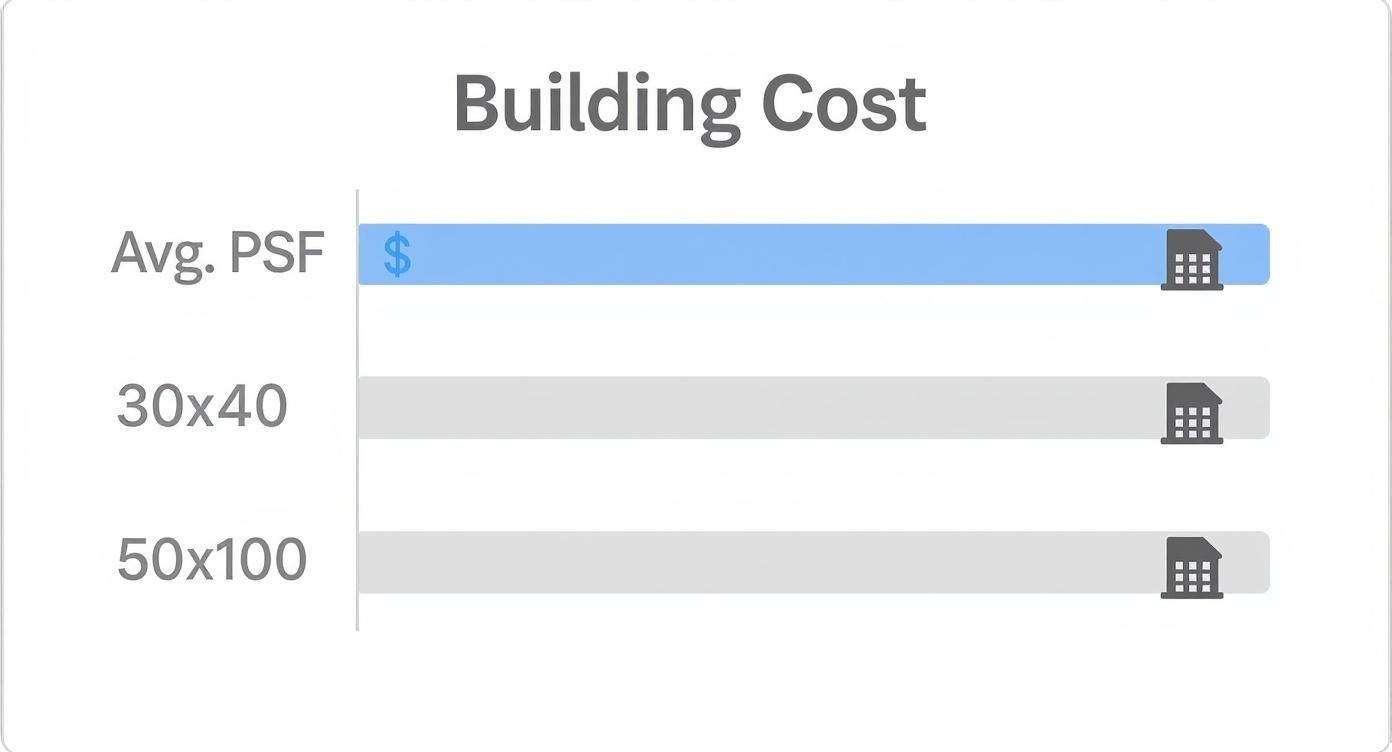
As the data shows, larger buildings often have a lower cost per square foot thanks to economies of scale, but the total project price still climbs significantly with size.
Essential "Hidden" Costs
Beyond those big three, other factors will absolutely contribute to your final bill. For instance, a critical component that protects your project during construction is Builders Risk Insurance. This is what protects your investment from things like theft, vandalism, or damage before the job is officially complete.
Budgeting Tip: A good rule of thumb is to add 60% to 100% to the kit price to estimate your final turnkey cost. So for a $20,000 kit, you should realistically budget between $32,000 and $40,000 for the finished project.
For a deeper dive into these figures, you can explore a more detailed breakdown of the cost of steel buildings and see exactly how each element impacts your bottom line.
Key Variables That Drive Your Final Building Price
The first quote you get for a metal building is a great starting point, but it's rarely the final number. Think of it like buying a base model truck—the sticker price looks good, but every add-on changes the final cost. Several key variables can swing your budget up or down, and getting a handle on them is the key to accurate planning.
These factors go way beyond just the building's footprint. Your design choices, custom features, and even the zip code where you plan to build play a huge role in the total investment. Let’s break down the most impactful variables you need to have on your radar.
Customizations and Design Complexity
The most direct way to move the price tag is through the features you add. A simple, four-walled shell will always be the most affordable path. But let's be realistic—most projects need more than that, and every addition comes with a cost.
Here are some of the most common customizations that add to the bottom line:
- Doors and Windows: Adding a few standard walk-in doors or windows is a modest expense. But if you need large, insulated overhead or roll-up doors for vehicles, you can expect to add $1,000 to $3,000 or more for each one.
- Insulation: This is a big one for climate control and long-term energy savings. Good insulation can add $1 to $3 per square foot. Higher-performance options cost more upfront but pay you back over time on heating and cooling bills.
- Roof Pitch: A steeper roof pitch doesn't just give your building a more traditional look; it's also better for shedding heavy snow and rain. This design requires more steel and more complex engineering, which drives up both material and labor costs.
Pro Tip: When you're budgeting, make two lists: "must-haves" and "nice-to-haves." This little exercise helps you prioritize your spending and shows you exactly where you can pull back if the total starts creeping up.
The Powerful Influence of Location
Where you build is just as important as what you build. Your project's location introduces a set of non-negotiable costs dictated by local rules and the environment. Overlooking these regional factors is one of the biggest budgeting mistakes people make.
Local building codes are there to make sure your structure is safe for its specific environment. For instance, in areas with heavy snowfall, your building will need a higher snow load rating. This means using stronger, thicker-gauge steel and maybe more support columns, which directly increases material costs. The same goes for coastal or high-wind regions, which require specific wind load ratings that add to the structural requirements—and the price.
On top of that, labor rates can be wildly different from one area to another. The cost of hiring a professional crew for site prep, pouring the foundation, and erecting the building will be much higher in a major city than in a rural town. When figuring out the total price, you have to account for all professional fees, including the crucial role of general contractor services to manage these local complexities. You can see how these factors get priced out by exploring different metal building kit prices online.
How Global Market Forces Affect Your Building Quote
You got a quote for your project last month, but when you called back to finalize it, the price had changed. It’s a frustratingly common experience, and it often has very little to do with your specific building. The truth is, the answer to "how much does a metal building cost?" can change from one week to the next, thanks to economic forces happening thousands of miles away.
Think of the steel market like the stock market—it’s always in motion. A major event on the other side of the world, a new trade policy, or a sudden spike in construction demand can send ripples that directly impact the price you pay right here at home. These aren't just tiny shifts, either; they can seriously alter your project's bottom line.
The Ripple Effect of Tariffs and Trade
One of the biggest drivers of price volatility is international trade policy, especially steel tariffs. When tariffs get slapped on imported steel, they act like a tax, making foreign steel more expensive. This shrinks the competition from overseas, which in turn allows domestic steel producers to raise their own prices. The result? An almost immediate and very noticeable jump in the cost of raw steel for everybody.
For instance, recent steel tariffs completely reshaped the cost landscape for metal buildings. The announcement of a 25% global tariff on steel, followed by an even bigger 50% tariff, sent U.S. steel prices soaring and created a shockwave through the entire supply chain.
The quote you receive for a metal building is a snapshot in time. Because the market is so volatile, most suppliers can only honor a price for a short period—often just 30 days or even less.
Supply Chains and Market Demand
Beyond tariffs, it often comes down to simple supply and demand. When there's a global construction boom, everyone wants more steel, and prices naturally go up. On the flip side, disruptions like port closures or transportation bottlenecks can choke the supply chain, making it harder and more expensive to get raw materials. These are factors completely out of your local supplier’s control, but they directly hit their costs—and, by extension, your quote.
Understanding these forces is key. It helps explain why locking in a price is so critical and why choosing domestically sourced materials can sometimes offer more stability. You can learn more about the benefits of using U.S.-made steel for your building to see how it can help buffer your project from some of this global chaos.
Real World Cost Examples for Common Building Uses
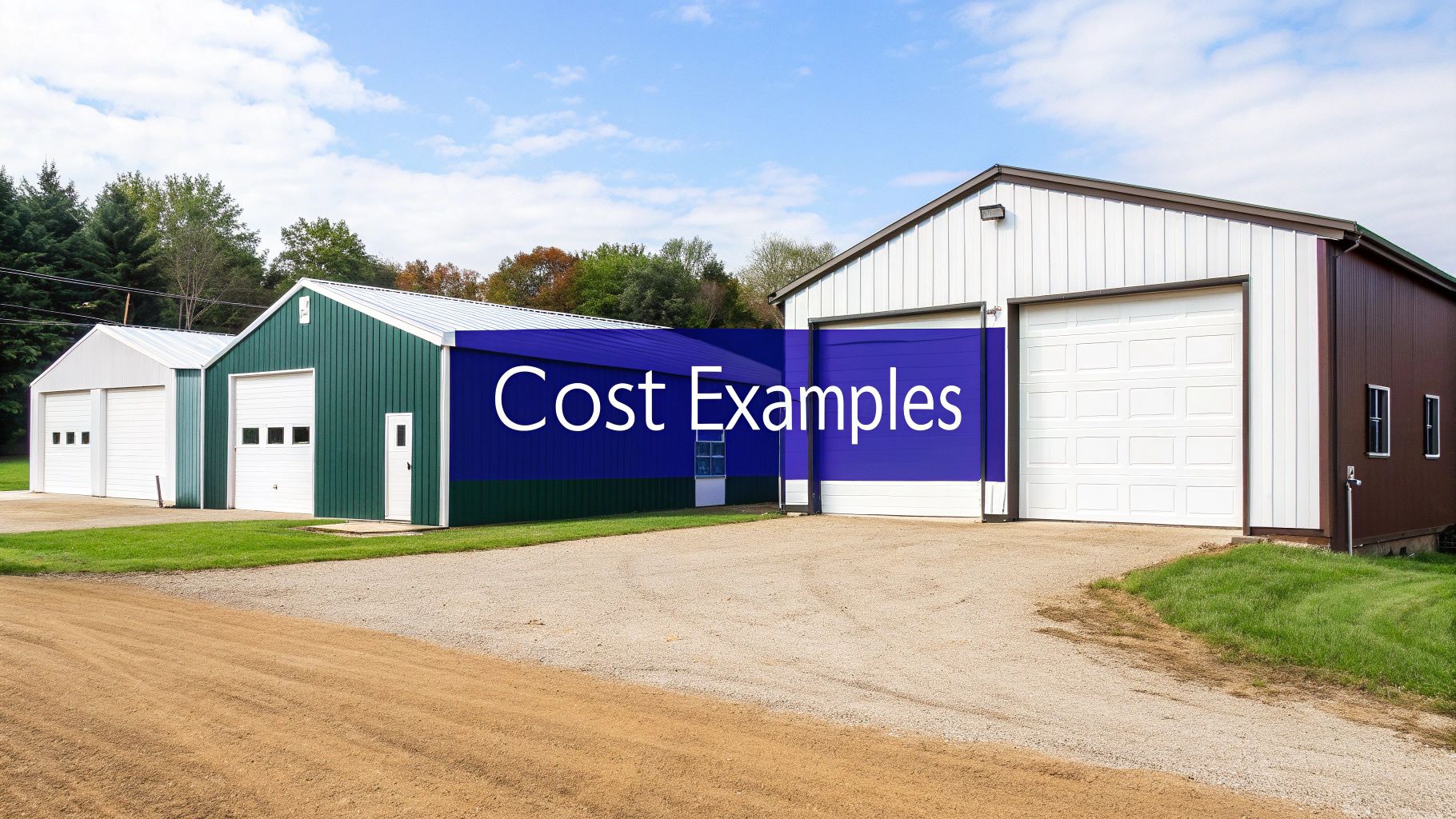
Understanding costs per square foot is a great starting point, but those numbers really come into focus when you attach them to a specific project. How much does a metal building actually cost for a simple garage versus, say, a climate-controlled workshop? The difference can be huge.
To bring these figures to life, let’s walk through some real-world cost ranges for the most common projects. This will help you get a much better feel for your own budget by seeing how different features and requirements stack up.
Residential Garages and Workshops
Hands down, one of the most popular uses for a metal building is for a home garage or personal workshop. This is where you see a ton of variation, all depending on what you want to do inside the building. A simple, non-insulated two-car garage will naturally be on the lower end, while a workshop with full electrical and insulation is a bigger investment.
Here’s a look at typical turnkey costs you can expect:
- Two-Car Garage (24×30): All-in, you should expect a total cost of $18,000 to $25,000. This generally covers the foundation, the building kit, and standard installation for a basic, no-frills structure.
- Insulated Workshop (30×40): For a space you can comfortably use year-round, you’re looking at $30,000 to $45,000. That higher price tag accounts for insulation, electrical wiring, and probably larger overhead doors for projects or equipment.
Agricultural and Commercial Structures
When you scale up to farm or business use, the requirements—and the costs—grow right along with the building's size. These structures are often much larger and have to meet very specific demands, whether it’s storing heavy combines or running a full-scale commercial operation.
For example, a simple barn for hay storage is a completely different animal than a commercial warehouse that needs loading docks, office space, and a heavy-duty concrete floor. That warehouse requires way more site prep, interior finishing, and specialized features that drive up the total investment. For a closer look at these variables, check out our guide to commercial metal building cost.
Key Insight: A building's intended use is the single biggest factor in its final cost. A climate-controlled commercial space with plumbing and electrical can easily cost double what a simple agricultural storage barn of the same size would.
Let's compare two common large-scale buildings:
- Agricultural Barn (40×60): For basic equipment storage without a lot of interior finishing, the total project cost usually lands between $45,000 and $65,000. This assumes a standard foundation and minimal work on the inside.
- Commercial Warehouse (50×100): A turnkey warehouse of this size typically ranges from $80,000 to $130,000 or more. That price includes a much thicker foundation for heavy loads, insulation, large roll-up doors, and the basic electrical needed for lighting and equipment.
Looking Ahead at Market Growth and Price Trends
Trying to pin down the future of metal building costs can feel a lot like forecasting the weather—there are just so many moving parts. But if you look closely at the current market trends and economic signs, a clear picture starts to emerge about where prices are heading. This is the kind of insight that helps you decide whether to buy now or if waiting it out makes more sense.
After a few wild years of price swings, the market is finally settling into a new rhythm. While we're not seeing the dramatic, sharp spikes of the recent past, the underlying forces at play suggest costs aren't dropping back to old lows anytime soon. Strong demand, paired with a recovering economy, is essentially creating a new price floor for the industry.
What Is Driving Future Prices
The global metal building market is on a serious upswing, especially as we head deeper into 2025. Projections show U.S. construction starts are set to climb by 9%, thanks in large part to lower interest rates and a fresh focus on infrastructure projects.
The pre-engineered metal building sector is doing even better. It's on track to grow at a compound annual rate of 8.4%, with manufacturing leading the pack with 9.2% growth. This surge is putting real pressure on both pricing and production capacity after a relatively quiet period. You can find more insights on these steel building kit trends over at Accio.com.
All this renewed activity has created what economists call "pent-up demand." A ton of projects that were put on the back burner are suddenly moving forward, and that has a few key consequences for anyone looking to buy:
- Increased Lead Times: With more orders flooding the system, the time it takes to get your building from the factory to your site is likely to get longer.
- Reduced Negotiating Power: When demand is this high, suppliers don't have much reason to offer big discounts.
- Stable to Rising Prices: The combination of strong demand and steady material costs makes any significant price drops highly unlikely.
Strategic Takeaway: The data is pretty clear—waiting around for a major price drop is a gamble. The market's current stability, combined with strong growth forecasts, tells us that today's prices are probably the new normal. Locking in a quote now could be the smartest move to protect your budget from the inevitable increases that come with rising demand.
Common Questions About Building Costs
By now, you’ve got a good handle on the big-picture items that drive the cost of a metal building. To tie it all together, let's tackle a few of the most common questions that come up when people are in the planning stage. These quick answers should help clear up any final details.
Is It Cheaper to Build with Metal or Wood?
While the upfront kit price for metal and wood can sometimes look similar, metal buildings are almost always the winner when it comes to long-term value.
Their incredible durability means you'll spend far less on maintenance over the decades. Steel is naturally resistant to pests, rot, and fire—and that resilience often earns you a discount on your insurance premiums, too.
Most importantly, the pre-engineered nature of a steel building means it goes up much, much faster. That speed directly slashes expensive on-site labor hours, often making the total installed cost of a metal structure cheaper than a traditional wood-frame building of the same size.
How Much Does a Concrete Foundation Cost?
Your concrete foundation is a separate but non-negotiable expense. You can expect this to cost anywhere from $4 to $8 per square foot. The final price tag hinges on your slab's required thickness, local labor rates, and whether your soil conditions require extra reinforcement like rebar.
For a standard 30×40 foot building (1,200 sq ft), a solid budget estimate for the foundation would be between $4,800 and $9,600. It's a critical line item to factor into your total project cost from day one.
Key Reminder: The cost of the foundation is never included in the initial building kit price. You have to budget for it separately to get an accurate picture of your total investment.
Do Permits Add to the Total Project Cost?
Yes, they absolutely do. Building permits are a necessary expense that can run from a few hundred to several thousand dollars, depending entirely on your local municipality. On top of the permit fee itself, you’ll likely need to purchase certified engineering plans to prove your building meets local codes.
And if your area has specific snow or wind load requirements, your building kit may need structural upgrades to comply. These necessary modifications will also add to the final cost of your project.
Ready to get a clear, no-nonsense quote for your project? The team at Icon Steel Buildings can provide a detailed estimate based on your exact needs, helping you budget with confidence. Plan your perfect building by visiting us at https://iconsteelbuildings.com.