
If you're just starting to look into metal buildings, the first number you'll probably see is the kit price. For a basic kit, you can expect to pay somewhere between $10 to $30 per square foot. But that initial price is really just the starting line—the total cost for a fully constructed, or turnkey, project is going to be quite a bit higher.
Your Quick Guide to Metal Building Costs
When you ask, "how much are metal buildings," it helps to think in two distinct categories: the kit price and the turnkey price.
The kit price is exactly what it sounds like. It covers the essential components—the steel frames, wall panels, roof, and all the nuts and bolts—delivered right to your job site. It’s the core of your structure, but it doesn't account for the foundation, the labor to put it all together, or any interior finishing.
The turnkey price, on the other hand, is the all-in cost to get your building move-in ready. This figure bundles in the kit, the concrete foundation, all the construction labor, and sometimes even basic utilities. It's the number that reflects your total investment to take a project from an empty lot to a fully functional space.
Understanding the Price Spectrum
So why is there such a wide price range? It really comes down to the details. A simple, standard-sized garage kit will always be more affordable per square foot than a highly customized commercial building that needs multiple doors, windows, and special engineering for heavy snow loads. The complexity of your design and the current price of steel are the biggest drivers behind that initial kit cost.
The crucial takeaway here is that the 'sticker price' of a metal building kit often represents only 40-60% of your total project budget. You absolutely have to plan for foundation work, labor, and finishing costs to get an accurate financial picture.
To give you a clearer idea of what to expect, the table below breaks down some estimated costs for common building sizes. It compares the baseline kit price against a more realistic turnkey cost, helping you see how the budget grows once all the necessary construction elements are factored in.
Estimated Cost of Common Metal Building Sizes
This table provides estimated price ranges for popular metal building sizes, comparing the cost of the basic kit against the approximate cost for a fully constructed (turnkey) building.
| Building Size (Width x Length x Height) | Estimated Kit Price Range | Estimated Turnkey Price Range (Erected) |
|---|---|---|
| 30' x 40' x 12' (1,200 sq ft) | $13,200 – $27,600 | $30,000 – $54,000 |
| 40' x 60' x 14' (2,400 sq ft) | $24,000 – $48,000 | $60,000 – $108,000 |
| 50' x 80' x 16' (4,000 sq ft) | $38,000 – $76,000 | $100,000 – $180,000 |
| 60' x 100' x 18' (6,000 sq ft) | $54,000 – $102,000 | $150,000 – $270,000 |
| 80' x 120' x 20' (9,600 sq ft) | $81,600 – $153,600 | $240,000 – $432,000 |
As you can see, the final erected cost is a significant jump from the kit price alone.
This guide will break down every factor that influences these numbers. We’ll get into everything from steel gauge and local building codes to foundation requirements and interior finishes, making sure you understand exactly where your money is going. For a deeper dive into how these structures stack up against traditional construction, check out our comparison of a steel building vs wood building.
Deconstructing Your Total Project Cost
So, you're asking, "how much are metal buildings?" It’s a great question, but the sticker price on a building kit is just the beginning of the story. Think of it like buying a car—the price you see on the window isn’t what you'll actually pay to get it on the road. You still have to factor in the "road" itself (your foundation) and the "mechanic" to put it all together (construction labor).
To avoid any nasty surprises down the road, it’s crucial to break your budget down into three core pieces: the building kit, the foundation, and the construction crew. Getting a handle on these three pillars is the key to creating a realistic budget and a smooth project.
The Three Pillars of Your Metal Building Budget
Let's unpack how these three elements stack up to form your final investment. It’s a simple formula, but each part is just as important as the next.
- The Building Kit: This is the heart of your project—the steel frame, wall panels, roofing, and all the nuts and bolts delivered to your property. The cost here is driven by size, design complexity, and the current price of steel.
- The Foundation: Every great building needs a solid base. This is the concrete slab or pier system it sits on. The price tag for your foundation will depend on local concrete costs, the condition of your soil, and how much site prep is needed.
- Construction Labor: This is the cost of actually putting the building up. It can vary widely based on your crew’s experience, how complex your building is, and whether you hire a professional team or decide to tackle some of it yourself.
This infographic really drives the point home, showing the huge difference between the kit-only price and the final "turnkey" cost.
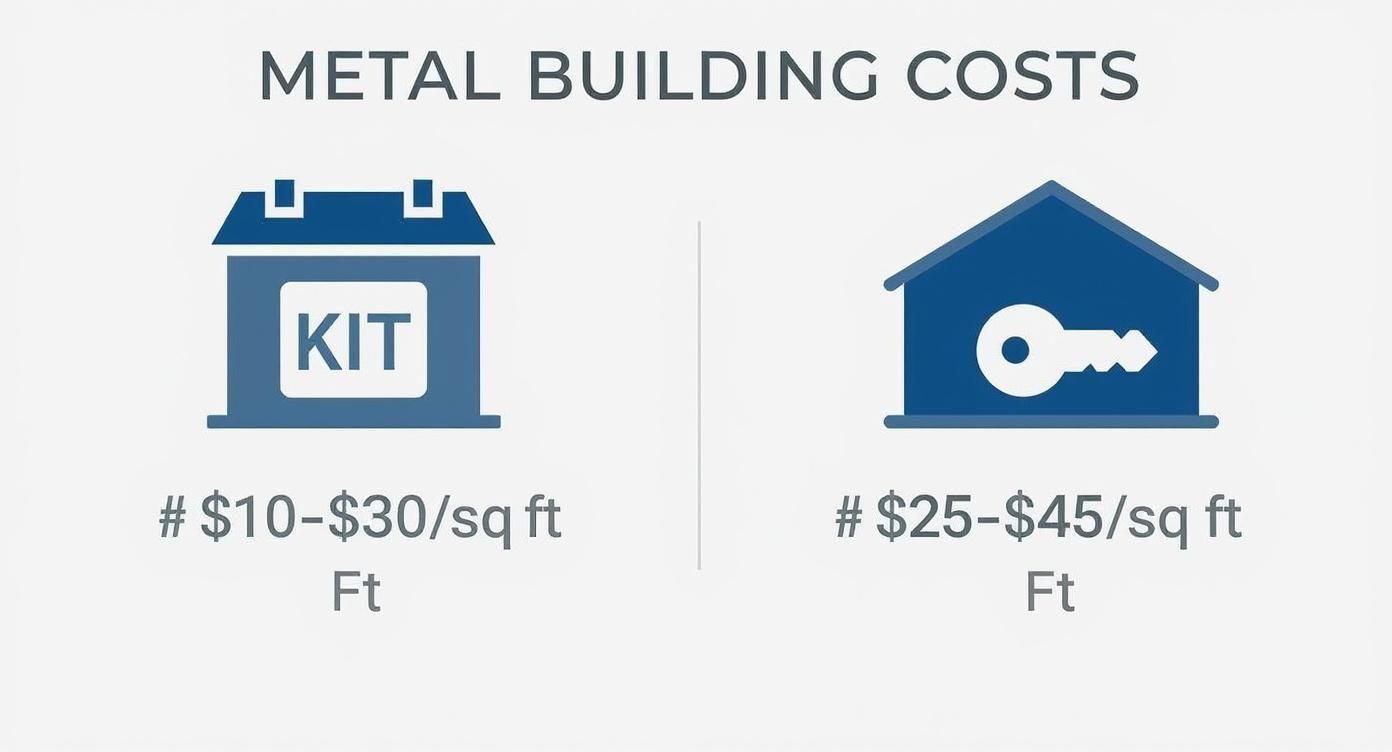
As you can see, the fully installed price can easily be double what you pay for the kit alone. That’s exactly why budgeting for the whole shebang from day one is so important.
Understanding Market Influences on Price
It's not just about your project's specifics; the wider market has a say in your final cost, too. The demand for buildings that are both affordable and quick to construct is pushing the steel building industry to new heights.
The global market for metal building materials is on a serious upward trend, fueled by urbanization and the need for more efficient construction. In 2025, the market was valued at $124.98 billion, and it's projected to hit $150.73 billion by 2033. This isn't just a random statistic—it shows just how much industries are relying on prefabricated steel structures. You can read more about these metal building materials market trends to get a feel for where things are headed.
This growth means the market is competitive, which is good for you, but it also means steel prices can swing. Planning your project in advance helps you lock in your costs and sidestep those unexpected price hikes.
Assembling the Total Cost Picture
Alright, let's put it all together with a practical example. Say you’re planning a 40×60 workshop.
- Your Kit ($24,000 – $48,000): This is your base price. You’ve picked a standard size with one garage door and one regular door.
- Your Foundation ($12,000 – $36,000): Your land is pretty level, but you still need some light grading and a standard 4-inch concrete slab. The going rate for concrete in your area is about $150 per cubic yard.
- Your Labor ($12,000 – $36,000): You've found a local crew that knows their way around metal buildings. They’re charging a fair rate and figure they can get it done in about a week.
Add it all up, and your total project estimate lands somewhere between $48,000 and $120,000. That range gives you a much clearer financial picture than the kit price alone and lets you plan with real confidence.
This simple breakdown turns a fuzzy question like "how much are metal buildings" into a clear, manageable budget. Nailing this down is the most important first step you can take. For a deeper dive, check out our complete guide on buying a metal building to make sure you've covered all your bases. In the next sections, we’ll get into the nitty-gritty of what drives the costs for each of these components.
Understanding What Drives Your Kit Price
Ever looked at two metal building kits that seem identical but have wildly different price tags? It’s a common point of confusion. The truth is, a handful of critical, often unseen, factors shape the final cost. Think of it like buying a car: a base model and a fully-loaded version might look similar from a distance, but the engineering, materials, and features under the hood create that price gap.
This section pulls back the curtain on those "under-the-hood" elements. Once you understand exactly what you’re paying for, you can make smarter decisions and find the perfect balance between your vision and your budget.
The Foundation of Cost: Steel Gauge and Quality
The first and most important factor is the steel itself. The gauge, or thickness, of the steel framing and panels directly impacts both the strength and the cost of your building. It’s a simple rule: lower gauge numbers mean thicker, stronger, and more expensive steel. A 12-gauge frame, for example, is far more robust than a 14-gauge frame.
While it’s tempting to go with the thinnest, cheapest option, this is one corner you really don’t want to cut. The right gauge isn't about saving a few bucks; it's about matching the building to your location and how you plan to use it.
- Standard Use: For a simple garage or workshop in a mild climate, a standard 14-gauge frame might be perfectly fine.
- Heavy-Duty Needs: If you live in an area with heavy snow or high winds, your local building codes will likely mandate a thicker 12-gauge frame to ensure the necessary structural integrity.
Choosing a thicker gauge is an investment in long-term durability and safety. It ensures your building can handle whatever Mother Nature throws at it and will stand strong for decades.
How Your Location Influences Price
Where you build is just as critical as what you build. Your specific geographic location comes with a set of rules—local building codes—that dictate the minimum strength requirements for any new structure.
These codes exist to protect you and your property from regional weather threats.
A building designed for the calm weather of Arizona will have vastly different engineering requirements—and a different price tag—than one built to withstand the heavy snow loads of Colorado or the hurricane-force winds of the Florida coast. This isn't just a suggestion; it's a legal requirement that directly impacts steel thickness and frame design.
This means a manufacturer must engineer your kit to meet specific snow load and wind load ratings for your zip code. Higher ratings demand more steel and more complex engineering, which naturally increases the kit price. This is a non-negotiable cost that makes sure your building is both safe and compliant.
Design Complexity and Customization Costs
The jump from a standard, box-like structure to a fully custom building is where you'll see the biggest price variations. A simple, rectangular building is always the most cost-effective because it uses standardized parts and requires minimal engineering.
However, the moment you start adding custom features, the price begins to climb. Every modification you make, from adding a window to changing the roofline, adds to the engineering and material costs.
How Customizations Impact Your Building Kit Cost
This table shows how different design choices and customizations can affect the final price of a metal building kit, helping you budget for specific features.
| Customization Feature | Typical Impact on Cost | Reason for Cost Change |
|---|---|---|
| Adding Framed Openings | Moderate Increase | Each door or window requires additional steel framing for support, adding material and labor costs. |
| Increasing Roof Pitch | Moderate to High Increase | A steeper roof requires longer panels and more complex truss engineering to handle wind and snow loads effectively. |
| Custom Dimensions | High Increase | Moving away from standard sizes (e.g., 30'x40') requires custom engineering, cutting, and fabrication, which is more expensive than mass-produced components. |
| Adding a Lean-To | Moderate Increase | A lean-to requires extra columns, rafters, and roofing materials, essentially adding a smaller, attached structure to your main building. |
For instance, a standard 40’x60’ workshop kit with one walk-in door and one garage door is a straightforward order. But if you decide to add five large windows, a second garage door, and a steep 6:12 roof pitch for a more residential look, you've just introduced significant complexity. Each of those changes requires precise engineering to maintain the building's structural integrity, which adds to the bottom line.
Understanding these variables is the key to balancing your vision with your budget. For a deeper dive, our comprehensive guide on metal building kit prices offers even more insights to help you plan effectively. When you know what drives the price, you can prioritize the features that matter most and get the best possible value for your project.
Calculating Foundation and Construction Expenses
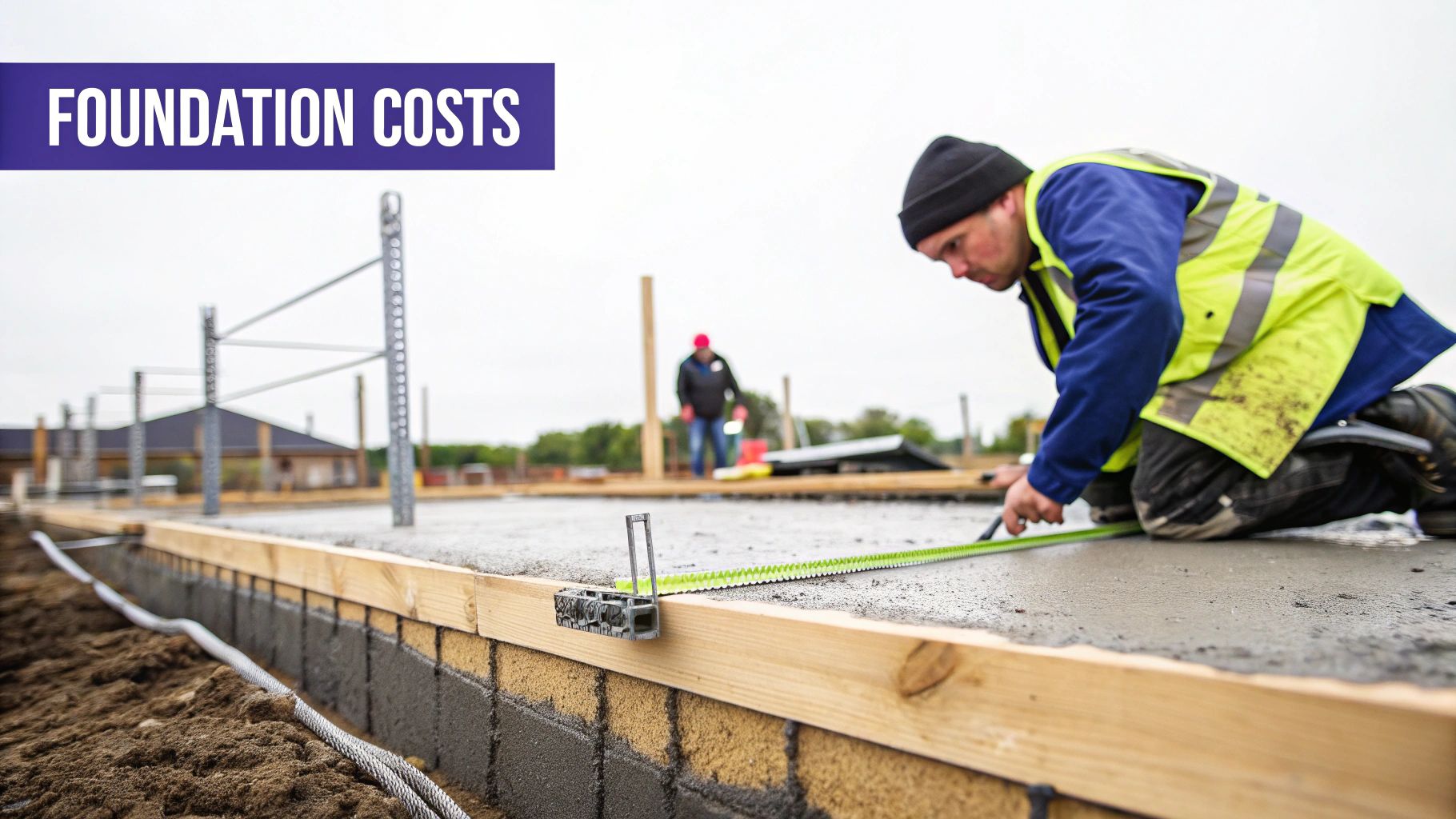
Once your metal building kit arrives, you're holding the bones of your project. But the journey from a stack of steel to a finished structure involves two more major investments: the foundation it sits on and the labor to put it all together.
These two pieces are huge variables that can dramatically swing the final answer to "how much are metal buildings?" Think of the foundation as the anchor for your entire investment. Without a solid, properly engineered base, even the best steel building is at risk.
You can generally expect foundation costs to run from $5 to $15 per square foot, but that number is heavily tied to your specific property and the kind of foundation you need.
Laying the Groundwork: The Cost of a Solid Foundation
For many metal buildings, the most common and budget-friendly foundation is a floating slab—a single, solid pour of concrete that serves as both the floor and the footing. It's a great solution, but it isn't right for every location or building design.
Several factors can drive that price tag up:
- Site Preparation: Before a drop of concrete is poured, the ground has to be perfectly prepped. This means grading the land to be level, digging out footings, and ensuring water drains away properly. If you're dealing with poor soil or a sloped lot, expect these prep costs to climb.
- Concrete Prices: The cost of concrete itself changes a lot depending on where you are. You'll likely pay more per cubic yard in a busy urban area than you would in a more rural spot.
- Foundation Type: If you live in an area with deep frosts, you'll need a frost-protected foundation with deeper footings, which means more concrete and more labor. Heavier buildings might also need a more complex system with reinforced piers.
Getting a handle on these variables is key. For a much deeper dive into this critical step, check out our guide on steel building foundation requirements.
The Erection Decision: DIY vs. Hiring Professionals
With the foundation cured and ready, your next big expense is the construction labor. This cost also tends to fall in the $5 to $15 per square foot range, and how you approach it is a major financial decision.
The pre-engineered metal building market is absolutely booming in the United States. Valued at USD 14.03 billion in 2025, it's on track to hit USD 27.10 billion by 2033. This surge, fueled by needs from e-commerce and industrial storage, shows just how much people are relying on these efficient structures.
This industry growth is good news—it means more experienced crews are available. While a DIY build is a tempting way to save cash, it's a serious commitment of time and requires the right equipment and a solid grasp of construction.
Hiring a professional crew gets the job done quickly, safely, and correctly, often with a warranty on their work. And don't forget, when you're adding up the total build cost, you need to account for labor for specialized jobs like professional metal roofing services.
A Real-World Cost Scenario: 40×60 Workshop
Let's break this down for a common project: a 40' x 60' (2,400 sq ft) workshop.
- Foundation (Low End): $5/sq ft x 2,400 sq ft = $12,000. This assumes you have a simple slab on a level, cleared lot where concrete prices are low.
- Foundation (High End): $15/sq ft x 2,400 sq ft = $36,000. This reflects a project that needs major grading, deep frost footings, and is in a region with higher material costs.
- Construction Labor (Low End): $5/sq ft x 2,400 sq ft = $12,000. This could be a very efficient, non-union crew in an area with lots of competition.
- Construction Labor (High End): $15/sq ft x 2,400 sq ft = $36,000. This might be the cost for a union crew, a complex building design needing special equipment, or work in a high-cost area.
If you add these numbers to a mid-range kit price of around $36,000, your total project cost could land anywhere from $60,000 on the low end to $108,000 or more on the high end. This clearly shows that the foundation and labor aren't afterthoughts—they're equal partners with the building kit in shaping your final budget.
Budgeting for Interior Finishing and Utilities
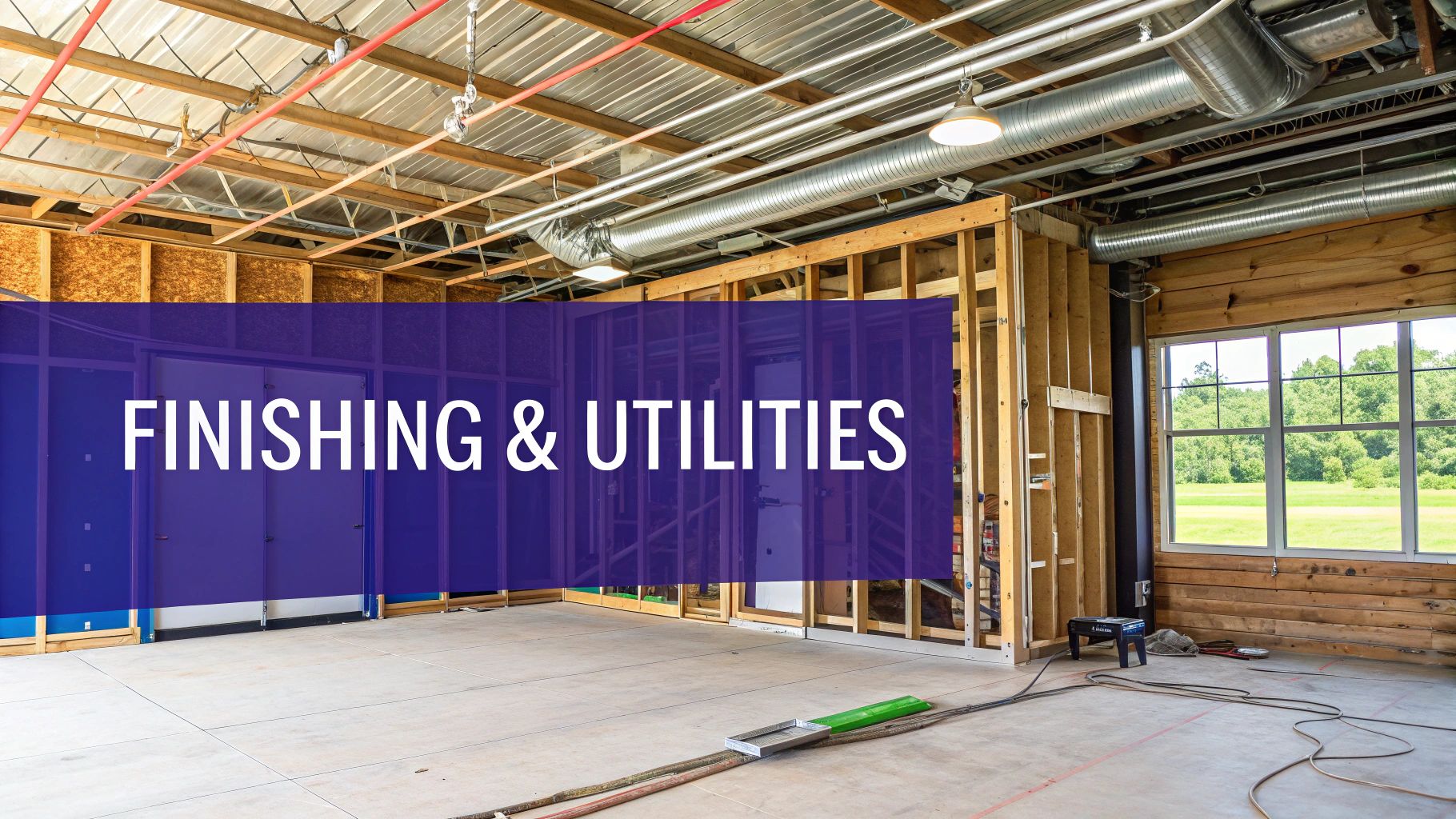
Getting your weatherproof shell up is a huge milestone, but it’s definitely not the finish line. The next big step is turning that empty steel space into something you can actually use, and that's where finishing costs come into play. These expenses can seriously impact the final answer to "how much are metal buildings?"
Think of your building kit like an empty house. It has great bones, but you still need to add the insulation, wiring, plumbing, and walls to make it livable. The level of finish you choose comes down to one thing: your building's purpose. A simple farm barn won't need much, but a commercial office or a "barndominium" will have finishing costs that look a lot like traditional construction.
Planning for Essential Utilities
Before you start picking out paint colors, you need to bring your building to life with the basics. These are the non-negotiable costs for any building that people will be spending time in, and they absolutely require licensed pros.
- Electrical Work: This covers everything from running conduit and installing breaker boxes to wiring outlets and lights. You can expect costs to run from $3 to $7 per square foot, depending on how complex the job is. A few overhead lights in a garage will be on the low end, while a fully wired office space will be much higher.
- Plumbing: If your building needs a bathroom, kitchen, or even just a wash station, plumbing will be a major expense. Plan for $5 to $10 per square foot or even more, once you factor in fixtures, pipes, and connecting to a septic or sewer line.
- HVAC Systems: Heating, ventilation, and air conditioning are what make a space comfortable. A simple space heater might do the trick for a small workshop, but a commercial space needs a full system. That can cost anywhere from $2 to $8 per square foot.
These utility costs are the bedrock of your interior budget. You have to plan for them early on, since most of this work needs to happen before any walls or insulation go up.
Crucial Insulation and Interior Framing
With your utilities mapped out, it's time to make the interior comfortable and energy-efficient. This all starts with insulation—and it’s probably one of the smartest investments you can make in your building.
Proper insulation is the key to long-term savings on your utility bills. It doesn't just regulate temperature; it also helps control moisture and dampen sound. In fact, many people find huge value in insulating your metal building's roof for better comfort as a first priority.
You've got a few options, each with its own price tag:
- Fiberglass Batts: This is the most common and budget-friendly choice, usually costing $1.00 to $2.50 per square foot installed.
- Spray Foam: It offers the best thermal performance and creates a tight air seal, but it's a bigger investment at $2.50 to $5.00 per square foot.
To get a full rundown of different materials and what they offer, it’s worth exploring various steel building insulation options to see what makes sense for your climate and budget. After insulation, if you plan on dividing the space into rooms, you’ll need to frame out the interior walls, which adds more material and labor costs.
Remember: The level of interior finish is directly tied to your building's function. A basic storage shed may only need minimal electrical work, costing an extra $3,000-$5,000, while a fully finished 2,400 sq ft office space could easily add $50,000-$100,000 or more in finishing costs.
Final Touches and Flooring
The final elements are what give your building its polished, complete look. This is everything from the drywall and paint on the walls to the floor under your feet.
Drywall installation and painting usually run between $2 to $4 per square foot. When it comes to flooring, your options are all over the map. You could go with a simple sealed concrete floor for a workshop ($2-$5 per sq ft), durable vinyl for a commercial space ($4-$8 per sq ft), or even high-end finishes if you're building a barndominium. These are the choices that truly complete the transformation from a bare steel shell into a fully functional space.
Smart Strategies for a Cost-Effective Project
Keeping your metal building project from running over budget all comes down to smart planning and making the right choices early on. The first step is to look beyond the sticker price of the kit itself.
A few key strategies can help you sidestep those frustrating hidden costs without ever sacrificing the quality of your build. For instance, opting for a standard-sized design is a classic move that helps you skip custom engineering fees right out of the gate.
Another pro tip? Try scheduling your construction during the off-peak seasons. You'll often find that labor rates are much more competitive when contractors aren't slammed with work. And never, ever settle on the first offer—always get at least three quotes to see how the pricing and services really stack up.
How to Secure Best Pricing
Choosing a stock building kit is one of the easiest ways to keep costs down. It eliminates the need for unique steel cuts and custom-fabricated beams, which can add up quickly.
On top of that, scheduling your installation during the slower months can lead to serious savings, often up to 15% on labor alone. This approach keeps your project moving efficiently without cutting corners on structural integrity.
To put it in perspective, a straightforward 40×60 workshop ordered in the winter might come in 10% cheaper than the exact same building scheduled for the peak spring construction rush. Getting multiple bids also gives you powerful leverage to negotiate and find the best overall value. When contractors know you're shopping around, they're much more likely to put their best foot forward on price and terms.
When you get those quotes, make sure you:
- Request detailed line items for all materials, labor, and permits
- Check with local suppliers to see if you can get more competitive steel pricing
- Confirm all warranty details and ask directly about any potential hidden fees
It also helps to understand the bigger picture. The global market for prefabricated steel building systems hit USD 2.01 billion in 2024 and is projected to climb to USD 2.79 billion by 2032. That’s a compound annual growth rate of 4.20%, a clear signal that more people are turning to these cost-effective and sustainable building solutions. You can dig deeper into the prefabricated steel building systems market growth here.
“Standardization and timing are your best tools for cutting metal building costs without compromise,” says industry expert Jane Doe.
Maximize Long-Term Savings
Thinking beyond the initial price tag is where you find the real, lasting value. A well-built metal building pays you back over time with incredibly low maintenance, lower insurance premiums, and excellent energy efficiency.
Investing in high-quality roof and wall insulation, for example, will dramatically cut your heating and cooling bills for decades to come. The same goes for choosing durable, weatherproof coatings—they extend the life of the steel panels and save you a fortune on repainting.
Sure, these upgrades might add 5–10% to your upfront cost, but they can easily save you thousands over the life of the building.
- Invest in high-performance insulation to slash your future utility bills.
- Choose corrosion-resistant finishes for minimal upkeep and a longer lifespan.
- Schedule annual inspections to catch any minor wear and tear and protect your warranty.
By taking this proactive approach to budgeting, you'll have a much clearer picture of what a metal building really costs from start to finish. Staying on top of your contract and project milestones ensures there are no financial surprises along the way.
These tactics will help you put up a structure that delivers both immediate savings and reliable performance for years. Partnering with an experienced supplier like Icon Steel Buildings can take even more risk off the table. Their team knows how to navigate permit requirements and design choices, leading to smoother timelines and a budget that stays on track.
Answering Your Top Questions About Metal Building Costs
When you start digging into the cost of a new metal building, a few key questions always come up. Getting these sorted out early is the best way to plan your budget and know exactly what to expect. Let's tackle the questions we hear most often.
Think of this as your cheat sheet for moving forward with confidence.
Is It Cheaper to Build With Metal or Wood?
In most cases, yes—a metal building kit usually has a lower upfront cost than a traditional wood-framed building. This becomes even more obvious with larger structures, where steel's incredible strength-to-weight ratio translates into major material savings.
But the real savings come in the long run. While interior finishing and utility costs can be similar for both, metal buildings are hands-down winners for long-term value. Thanks to their durability, minimal maintenance needs, and even potential for lower insurance premiums, they keep saving you money for decades.
What Is the Average Cost Per Square Foot for a Turnkey Project?
For a fully finished, move-in-ready metal building, you can expect a pretty wide range—anywhere from $25 to over $100 per square foot. The final price tag really hinges on what you’re using the building for and how you decide to finish it.
A simple agricultural barn or a basic workshop might fall into the $25-$45 per square foot range. On the flip side, a fully decked-out commercial space or a high-end barndominium with custom interiors, a full HVAC system, and complex plumbing can easily climb past $80-$100 per square foot.
How Long Does the Entire Building Process Take?
The timeline can vary quite a bit, but here's a general breakdown. Just getting the kit manufactured and delivered to your site typically takes between 4 and 12 weeks.
Once the materials are on your property, a professional crew can often get the main structure of a standard building up in just a few days to a week. The full project, however—which includes pouring and curing the foundation, hooking up utilities, and completing all the interior work—can take anywhere from several weeks to a few months to wrap up.
Ready to get a clear, accurate price for your project? The team at Icon Steel Buildings provides detailed quotes that cover every aspect of your build, ensuring there are no surprises. Plan your project with confidence by visiting Icon Steel Buildings to get started today.