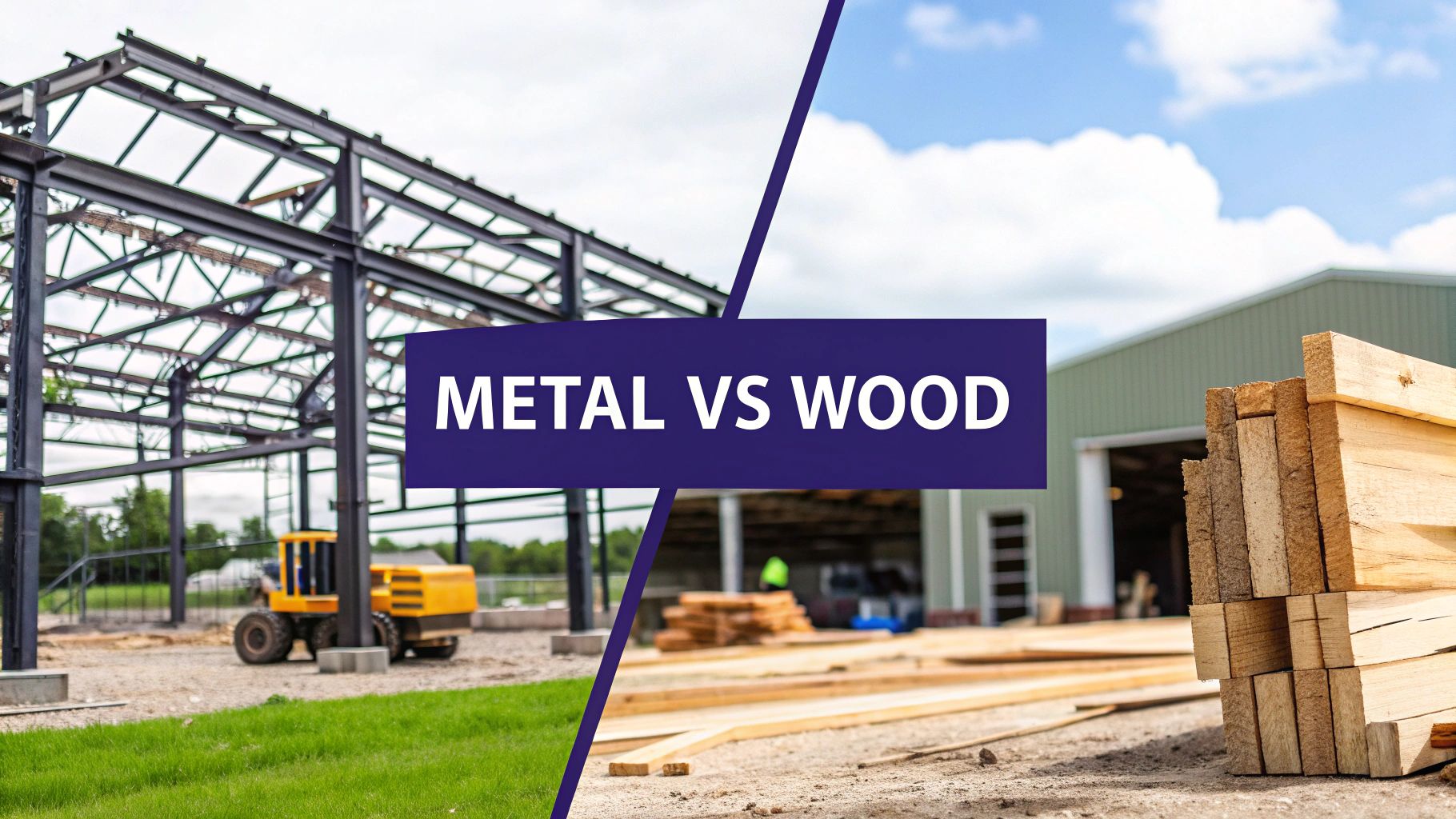
When you're weighing a metal building against a wood one, the decision boils down to your priorities. At its core, steel delivers unmatched durability, lightning-fast construction, and wide-open interior spaces, which is why it's the go-to for commercial and industrial projects. Wood, on the other hand, offers that classic, traditional look and a construction process most builders are familiar with, making it a frequent choice for custom homes.
So, the real question is: are you focused on long-term resilience and efficiency, or is a specific architectural style your main goal?
Choosing Between Metal and Wood Buildings
The metal versus wood debate is one of the most fundamental choices in construction today. Each material brings its own set of powerful advantages to the job site. For decades, wood framing has been the default for most residential homes, while steel has absolutely taken over the commercial and industrial worlds for a reason. To see how these materials stack up in other applications, this in-depth comparison of wood vs. metal for driveway gates offers some great insights that apply here, too.
The market trends tell a clear story. In the United States, pre-engineered metal buildings make up roughly 70% of all new non-residential construction, from warehouses to retail storefronts. That figure skyrockets to about 95% for new industrial buildings. Why the dominance? It's simple: pre-fabrication slashes on-site construction time by nearly a third compared to building with traditional wood framing.
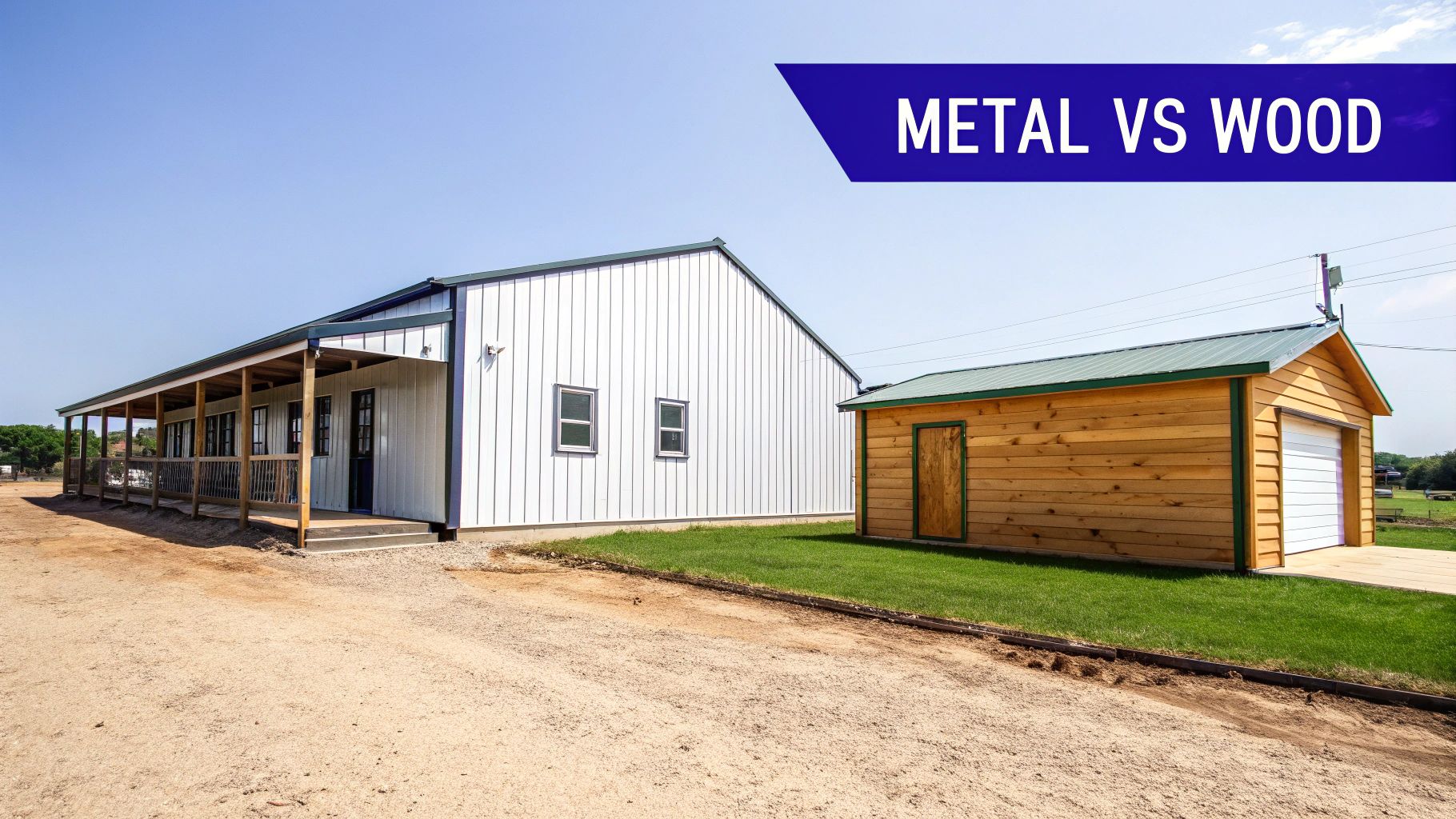
Quick Look Metal vs Wood Buildings
To get a clearer picture right from the start, this table cuts through the noise and lays out the most critical differences. Think of it as your high-level cheat sheet for understanding the fundamental trade-offs between metal and wood.
| Factor | Metal Buildings | Wood Buildings |
|---|---|---|
| Upfront Cost | Often lower for the basic structure, especially for large buildings. | Can be lower for smaller, simple structures but increases with complexity. |
| Construction Time | Significantly faster due to pre-engineered, bolt-together components. | Slower due to on-site cutting, framing, and assembly. |
| Long-Term Durability | Highly resistant to fire, pests, rot, and extreme weather. | Susceptible to termites, rot, fire, and moisture damage without treatment. |
| Maintenance Needs | Minimal; typically requires occasional cleaning and inspections. | Requires regular painting, staining, and sealing to prevent decay. |
| Design Versatility | Excellent for open, clear-span interiors; exterior can mimic traditional looks. | Offers traditional aesthetics and flexibility for intricate, custom designs. |
This quick snapshot highlights the core strengths of each material. If your project demands efficiency, lifetime resilience, and expansive, column-free interior space, the advantages of modern metal buildings are hard to ignore.
Comparing Upfront Costs and Lifetime Value
When you’re weighing a metal building against a wood one, the initial price tag is just the first chapter of a much longer financial story. The real number to watch is the total cost of ownership, which includes not just the upfront investment but all the long-term expenses that follow. While a simple wood-framed shed might look like a bargain at first, the math changes dramatically as your project gets bigger and more complex.
For larger buildings like workshops, warehouses, or commercial spaces, pre-engineered metal buildings often come with a lower initial price for the core structure. This is a direct result of factory precision. Every component is manufactured to exact specs, which slashes on-site labor time and material waste—two of the biggest expenses in any construction project.
On the flip side, traditional wood construction is an on-site craft. It demands more hours for measuring, cutting, and assembling, which drives up labor costs. Foundations are another big factor. A stick-built structure usually needs a continuous concrete foundation, but many metal buildings can be put up on simpler, more affordable options like pier or slab foundations. For a deeper look at these initial costs, check out our detailed guide on the average cost of a steel building.
Deconstructing the Upfront Investment
To get a true apples-to-apples comparison, you have to look beyond the sticker price of a kit or a lumber package. It's about breaking down the entire budget.
- Materials: Steel benefits from efficient, large-scale production. This often makes the frame and panels more cost-effective per square foot than lumber, especially when you need clear spans over 40 feet.
- Labor: This is where steel really pulls ahead. A pre-engineered kit is basically a giant erector set with pre-drilled holes and bolt-together parts. It requires a smaller crew and far fewer days to assemble. Wood framing, however, is a skilled trade that takes more time and expertise on site.
- Foundation: As we touched on, wood buildings often require more extensive—and expensive—foundation work. The engineered design and lighter weight of steel buildings can significantly cut down your concrete and excavation costs.
- Finishing: While interior finishing costs can be similar, the wide-open interior of a steel building gives you total freedom for custom layouts. There are no load-bearing walls to get in the way of your vision.
Analyzing Long-Term Lifetime Value
The real economic gap between metal and wood opens up over the life of the building. Lifetime value is all about the ongoing costs: maintenance, insurance, and energy bills. This is where the tough, low-maintenance nature of steel delivers serious long-term savings.
Wood structures need constant attention. You have to regularly paint or stain them to stop rot, seal them against moisture, and treat them for termites and other pests. These aren't one-time tasks; they're a continuous drain on your time and money for decades.
A building's true cost isn't what you pay on day one—it's what you pay over 30 years. Factoring in lower insurance premiums, near-zero structural maintenance, and superior energy efficiency reveals the powerful long-term economic advantage of steel construction.
Metal buildings, on the other hand, are practically inert. Steel is inorganic, so it won’t rot, warp, or get eaten by termites. The factory-applied finishes on today’s metal panels are often warrantied for up to 40 years against chipping, fading, and peeling. That means the headache and expense of repainting are virtually eliminated.
The 20-Year Financial Picture
Let’s put this into a real-world context. Imagine a 5,000 sq. ft. commercial workshop. While the upfront price can vary, the long-term financial story is pretty clear. Over a 20-year span, the total cost for a traditional wood or concrete commercial building can climb to between $670,000 and over $1.1 million.
In contrast, a comparable steel building often lands at a significantly lower total cost when you add up materials, labor, energy, and maintenance over that same period. A well-insulated metal building can also generate annual energy savings of $1,000 to $2,500 compared to its conventional counterparts. It’s a difference that goes beyond just dodging repair bills. You’re also looking at lower insurance premiums because steel is fire-resistant, plus substantial savings from better energy performance, making steel the smarter financial choice over the building’s life.
Evaluating Durability and Maintenance Demands
When you're weighing a metal building vs. an all-wood structure, one of the biggest factors is how it’s going to hold up over the long haul. A building is a serious investment, and its ability to fend off mother nature, pests, and time itself will ultimately define its real value. This is where steel and wood really show their differences, not just in how long they last, but in how much work and money you’ll pour into them over the years.
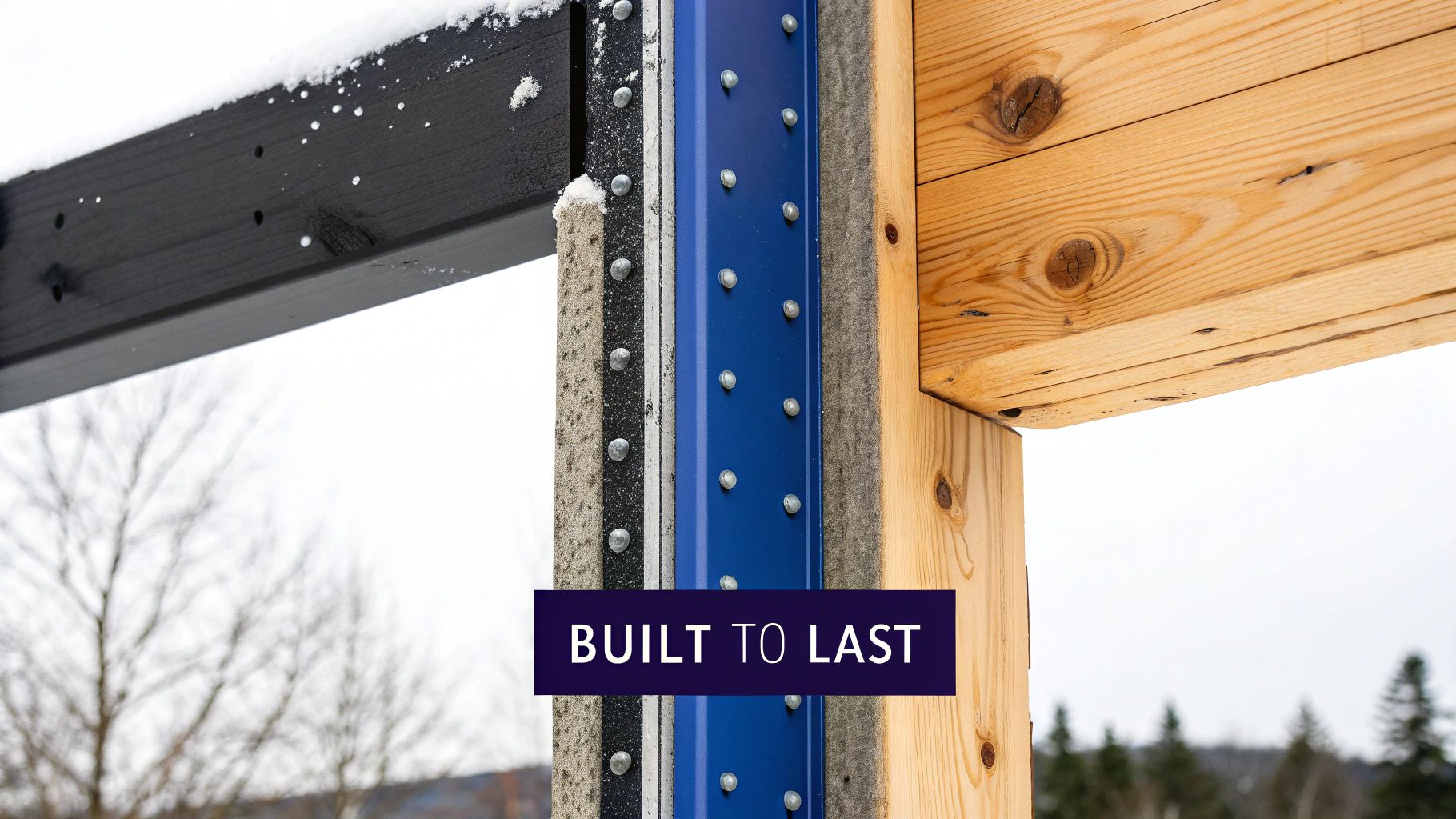
It all comes down to their basic makeup. Steel is an inorganic, manufactured material. It won't burn, and pests like termites can't eat it. Wood, on the other hand, is organic. That makes it a natural target for a whole host of threats unless it’s constantly treated and maintained.
Resilience Against Fire and Pests
Fire safety is a top-of-mind concern for any property owner, influencing everything from peace of mind to your insurance bill. In this category, steel has a decisive edge.
- Steel's Performance: As a non-combustible material, steel won't ignite or add fuel to a fire. This can be the difference between a small, contained incident and a total loss, giving you more time to get to safety. Insurance companies often recognize this, rewarding steel building owners with lower premiums.
- Wood's Performance: Wood burns. While certain heavy timber designs can char and resist collapse for a time, standard wood-frame construction is highly flammable. Fire-retardant treatments and special drywall help, but you can't change the fundamental nature of the material.
Then there are the pests. Termites alone cause billions in property damage every year, and a wood-framed building is an open invitation.
Because steel is inorganic and inedible, it provides a structural guarantee against termites, carpenter bees, and other wood-boring insects. This eliminates the need for costly and recurring chemical treatments required to protect a wood frame.
This built-in pest resistance means you can sidestep the endless cycle of inspections, exterminations, and repairs that often come with owning a wood structure. It's a foundational benefit that saves you headaches and money for decades.
Withstanding Moisture and Weather Extremes
Moisture is the universal enemy of buildings, but wood and steel react to it very differently. For a wood building, long-term moisture exposure means rot, mold, and mildew—problems that weaken the structure and ruin indoor air quality.
Steel, on the other hand, doesn't rot or grow mold. While raw steel can rust, today’s metal buildings are protected with advanced galvanized coatings (like Galvalume®) and durable paint systems that are often warrantied for up to 40 years. These layers create a barrier that keeps the structure solid, even in humid or coastal climates.
When it comes to severe weather, the precision engineering of steel really shines.
- Wind and Snow Loads: Every pre-engineered steel building is designed to meet the specific wind and snow load codes for its exact address. This isn't a one-size-fits-all approach; it's a guarantee that your structure is built to handle everything from hurricane-force winds to heavy blizzards.
- Seismic Activity: Steel has a natural ductility that allows it to bend under stress without breaking. This makes it a far better choice in earthquake-prone areas, as it can absorb and dissipate seismic energy more effectively than a rigid, brittle wood frame.
Sure, you can engineer a wood building to handle extreme weather, but it almost always requires extra bracing, specialized connectors, and more complex designs, driving up both cost and construction time. To see just how resilient these structures are, check out our guide on the safety of steel buildings in storms and bad weather.
The Long-Term Maintenance Commitment
At the end of the day, the durability debate really boils down to maintenance. A wood building is a long-term commitment. You're signing up for:
- Regular Painting or Staining: Every few years, you'll be out there scraping and refinishing to protect the wood from sun and rain.
- Pest Inspections and Treatments: At least once a year, you’ll need to check for termites and other pests to catch an infestation before it causes major damage.
- Repairing Rot and Warping: Any boards that have warped or started to rot must be replaced immediately to keep the building structurally sound.
A metal building, in contrast, asks for very little. You might wash the panels every couple of years to keep them looking fresh and do a quick check on the sealants. That's about it. This low-maintenance reality doesn't just save you money—it gives you back your time, year after year.
Exploring Design Flexibility and Customization
Let's clear the air: the old idea of a metal building being a clunky, windowless box is completely outdated. Today's steel structures offer an incredible amount of aesthetic freedom that easily rivals—and in many cases, beats—traditional wood construction. The whole metal vs. wood building debate has moved way beyond function and is now all about sophisticated form.
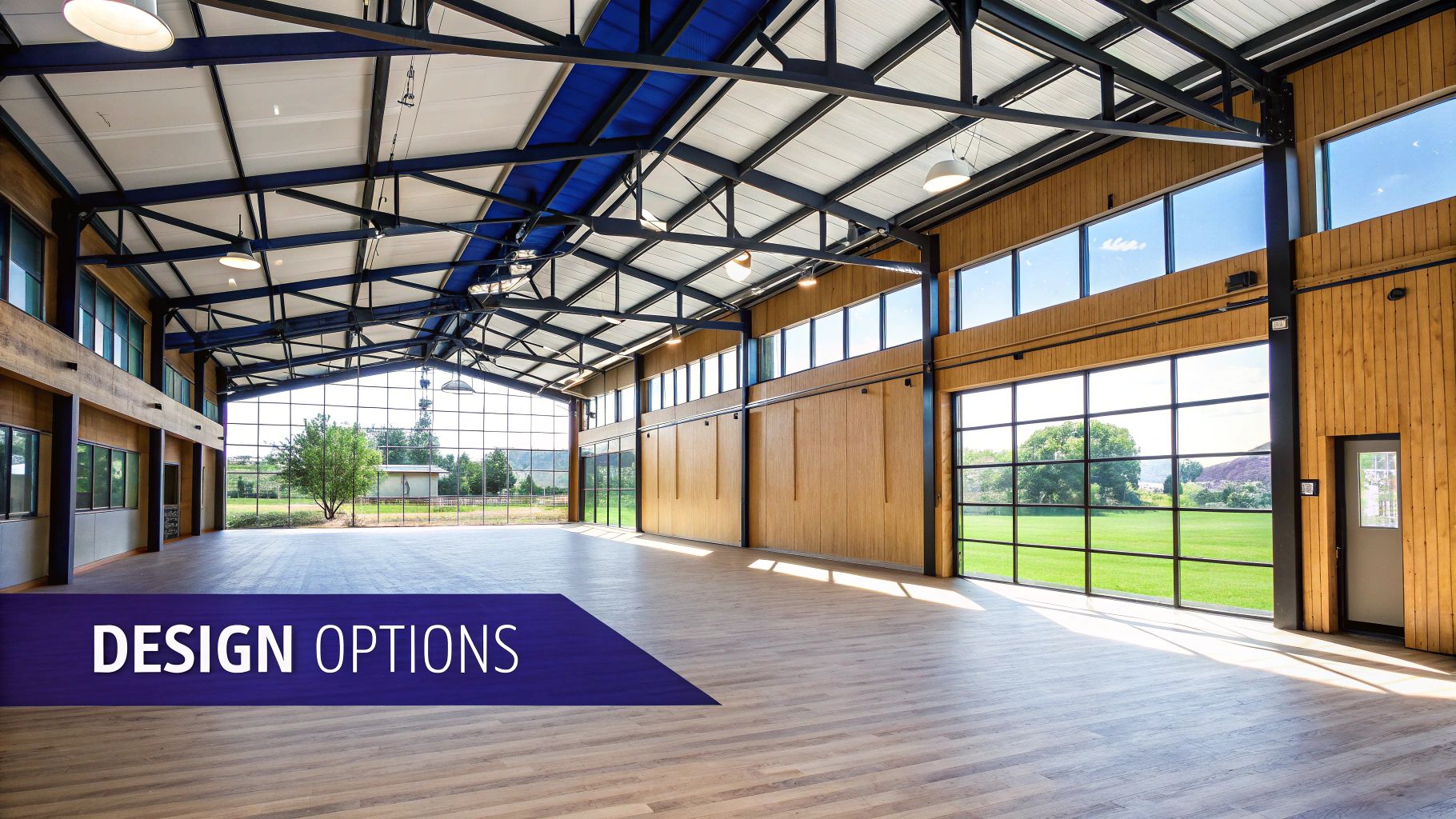
Modern steel building systems give you a massive palette to work with, from colors and panel profiles to unique finishes. This means you can design anything from a sleek, modern commercial space to a rustic barndominium that looks like it's been part of the landscape for years.
The Power of Unobstructed Space
One of the biggest design advantages of a metal building is its raw structural power. Steel framing lets you create enormous, column-free interiors. We're talking clear spans that can easily push past 100 feet, giving you a floor plan that's completely open and adaptable.
Steel’s superior strength-to-weight ratio is the key to achieving vast, open-concept interiors. This structural freedom is nearly impossible to replicate with wood framing without significant cost increases and cumbersome interior supports.
This is a true game-changer for certain applications:
- Commercial Warehouses: Open space is everything. It maximizes your storage and lets you move heavy machinery and inventory without a single column in the way.
- Recreational Facilities: Think about indoor sports complexes, gyms, or event centers. They all depend on wide-open areas for both function and sightlines.
- Agricultural Barns: Storing large equipment or managing livestock is so much simpler when you don't have to navigate around interior supports.
Sure, wood-framed buildings like post-frame or "pole barns" can offer open layouts, but they typically hit their limit around 100 feet or less. Pushing past that with wood requires heavy, complex trusses or pricey engineered lumber, which piles on cost and complexity.
Achieving Your Desired Aesthetic
Wood has that classic, warm look that a lot of people love, and for good reason. But steel has become a master of disguise. Thanks to modern finishing technology, metal panels can convincingly mimic the look of almost any other material.
You are definitely not stuck with a "metal" look. You can explore a huge range of custom steel buildings that offer exterior finishes like:
- Faux Wood Grain: Get that rustic charm you want without ever worrying about rot, pests, or repainting.
- Simulated Stone or Brick: Add a timeless, high-end finish to your building's wainscoting or the entire facade for way less than traditional masonry.
- Stucco-Style Panels: Perfect for creating that clean, modern vibe for a commercial or residential project.
This versatility means you don't have to trade your architectural vision for the durability and cost savings of steel. You can have both.
Contrasting Interior Finishing
When it comes time to finish the interior, wood framing does have a slight home-field advantage in terms of familiarity. Since the studs are already wood, it can feel more intuitive for DIYers or residential contractors to attach drywall, hang cabinets, and install shelving with their standard tools.
But finishing the inside of a steel building is a straightforward and well-established process. We simply fur out the steel frame with wood or light-gauge steel studs. This creates a standard wall cavity that’s ready for insulation, wiring, and plumbing.
Once that interior framing is up, the rest of the process is identical to a conventional building. You get the best of both worlds: an industrial-strength exterior protecting a traditionally finished, comfortable interior.
Analyzing Construction and Environmental Impact
The real story behind a metal or wood building starts long before a single wall is raised. It begins with how the materials are made, flows through the on-site construction process, and continues for decades into its environmental lifecycle. The differences you’ll see at the job site are particularly revealing.
A pre-engineered steel building kit arrives at your property like a giant, perfectly organized puzzle. Every single component—from the heavy-duty primary frames down to the secondary girts and purlins—is already cut, drilled, and ready to be bolted together. This factory-level precision slashes on-site labor and virtually eliminates material waste, leading to a much faster and more predictable build.
Traditional wood framing, on the other hand, is a craft performed almost entirely on-site. It’s a labor-intensive process of measuring, cutting, and nailing together countless individual pieces of lumber. This method naturally creates more waste and demands more skilled labor hours, a difference that becomes glaringly obvious on larger, more complex structures.
The Construction Site Footprint
The on-site experience with steel versus wood couldn't be more different, and it affects everything from your labor budget to your final project timeline. The sheer efficiency of a pre-engineered system is hard to beat.
- Speed of Assembly: The bolt-together design of a steel kit means a small crew can have the main frame standing in just days, not the weeks it would take for a comparable wood structure. This speed is a massive advantage for any project, especially commercial ones where opening your doors faster means making money sooner.
- Reduced Material Waste: With steel, what you order is what you use. The typical 10-12% material waste that’s common in stick-built wood projects is almost completely gone. That saves you money and keeps unnecessary debris out of the landfill.
- Foundation Simplicity: Many steel buildings are lighter than their wood counterparts and can be erected on simpler foundations. For instance, certain designs work perfectly with pier foundations instead of a continuous concrete footing, which cuts down on both time and cost. To see how this compares to another efficient method, you can explore the details of what post-frame construction entails and how it stacks up.
Evaluating the Environmental Footprint
When you ask which material is "greener," the answer isn't simple. It really depends on what part of the building's life you're looking at. Both wood and steel have strong environmental arguments, but neither one is a perfect solution.
Wood gets a lot of credit for being a renewable resource that naturally stores carbon as it grows. A building made from sustainably harvested timber starts with a lower embodied carbon footprint, which is a major environmental plus. But global demand for building materials creates its own set of problems.
The "greener" building isn't just about the material itself; it's about responsible sourcing, construction efficiency, and long-term performance. A building that lasts longer and requires fewer resources over its lifetime ultimately has a smaller environmental impact.
This is where the conversation gets interesting. While wood often wins on initial embodied carbon, our global forests simply can't supply enough timber for all new construction sustainably. At the same time, steel and concrete production account for a huge chunk of global CO2 emissions. The good news is that the steel industry is making real progress toward near-zero-emission manufacturing. This just goes to show that both materials have their place, and the best choice is guided by the building's entire life-cycle and responsible sourcing.
A Life Cycle Perspective
Steel tells a different kind of sustainability story—one built on incredible longevity and recyclability. North American steel is one of the most recycled materials on the planet, with a recycling rate soaring over 80%. The steel in your building today is likely made with a high percentage of recycled content, and at the end of its very long life, it can be fully recycled once again.
This "circular economy" aspect is a powerful counterpoint to wood's renewability. A steel building’s extreme durability means it won't need to be torn down and replaced for decades, avoiding the resource drain of rebuilding. Because it’s resistant to rot, pests, and fire, it stays standing strong without needing chemical treatments or frequent repairs, further shrinking its long-term environmental footprint.
Ultimately, the most sustainable choice comes down to your priorities: lower initial carbon (wood) or superior longevity and recyclability (steel).
Making the Right Choice for Your Project
So, how do you decide between a metal building and a wood one? It all boils down to matching your project's top priorities with the material that shines in those areas. There's no single "best" choice, just the right one for your goals—whether you're putting up a commercial warehouse, a family barndominium, or a weekend workshop.
The key is looking beyond the sticker price and thinking about the entire life of your investment.
To cut through the noise, ask yourself what your main driver is. Are you after speed and bulletproof durability, or is a specific look and a lower carbon footprint more important? This simple flowchart helps frame the decision based on what you value most.
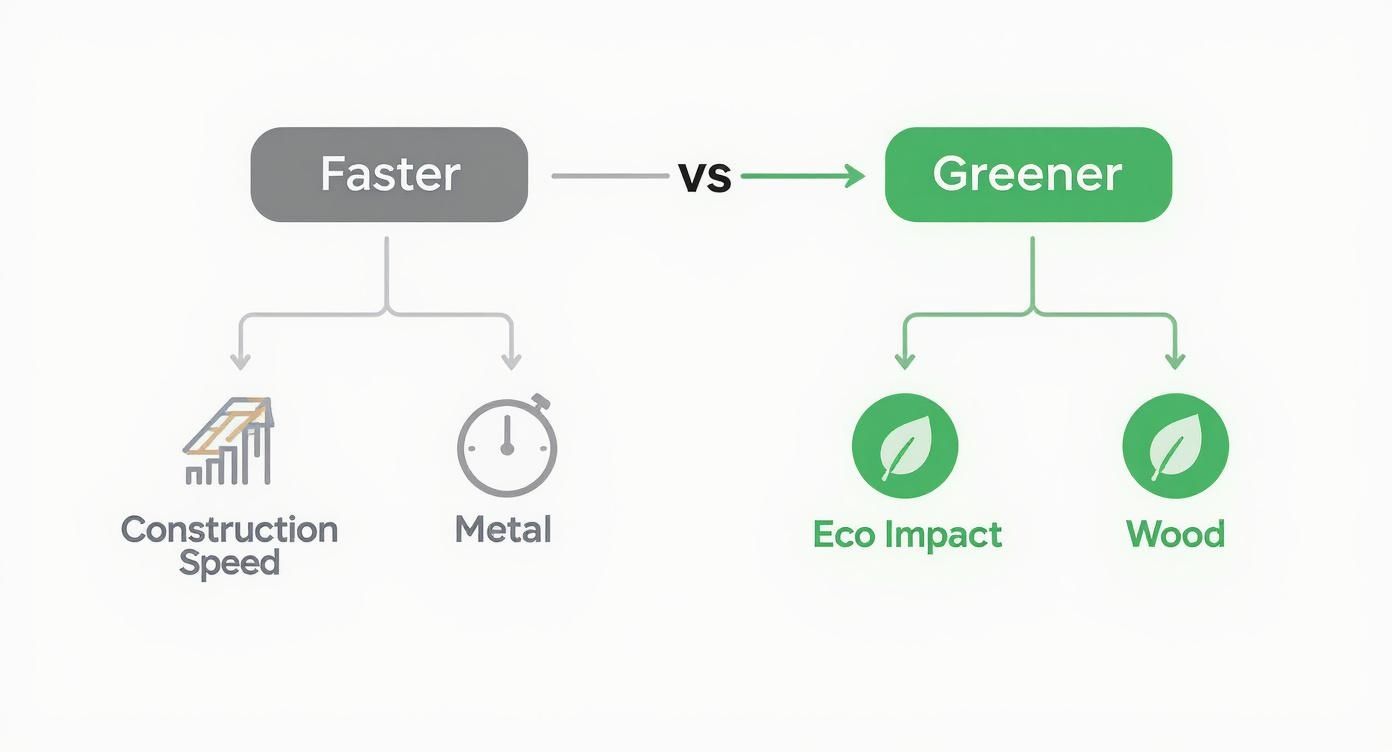
This visual shows the fundamental trade-off. If getting your building up and running as quickly as possible is the name of the game, the pre-engineered efficiency of steel is unbeatable. But if you’re prioritizing a renewable material with a lower initial carbon footprint, sustainably sourced wood takes the lead.
Matching the Material to the Mission
Let's walk through a few common scenarios. Each one has its own set of demands that naturally favors one material over the other.
-
Commercial Warehouse or Workshop: For big, open spaces, metal is the clear winner. You need vast, column-free interiors for machinery, inventory, and forklifts, and steel delivers with clear spans of 100+ feet or more. Plus, the fast construction gets your business operational and generating revenue that much sooner.
-
Agricultural Barn: Just like a warehouse, a farm building is all about function and toughness. A metal building gives you superior resistance to pests, moisture, and fire, which is critical for protecting expensive equipment and livestock. Its low-maintenance finish handles the dirt, dust, and grime of a working farm way better than wood, which would need constant painting and repairs.
When your project's success hinges on unobstructed space, rapid deployment, and minimal long-term maintenance, a pre-engineered steel building consistently delivers the highest return on investment.
- Residential Barndominium: This is where things get interesting, and a hybrid approach often makes the most sense. The main structural frame and roof are perfect for steel, giving you that signature open-concept "barndo" style along with incredible durability. For the interior, you can frame out the rooms with traditional wood studs, making it easy for electricians, plumbers, and drywallers to create a comfortable, conventional living space. It's truly the best of both worlds.
Decision Matrix Metal vs Wood
Still on the fence? This decision matrix is a great tool to quantify what matters most to you. Rate each factor based on your project's priorities from 1 (Not Important) to 5 (Absolutely Critical). Then, score how well each building type meets that need. The highest total score points you in the right direction.
| Decision Factor | Your Priority (1-5) | Metal Building Score (1-5) | Wood Building Score (1-5) |
|---|---|---|---|
| Upfront Cost | 4 | 5 | |
| Long-Term Maintenance | 5 | 2 | |
| Construction Speed | 5 | 3 | |
| Durability (Weather/Pest) | 5 | 2 | |
| Interior Span Freedom | 5 | 3 | |
| DIY Friendliness | 3 | 5 | |
| Energy Efficiency | 4 | 4 | |
| Aesthetic Flexibility | 4 | 5 | |
| Fire Resistance | 5 | 1 | |
| Sustainability (Recycled vs. Renewable) | 4 | 5 |
Once you've filled it out, tally the scores. This isn't about finding a "perfect" score but about gaining clarity on which material’s strengths are the best match for your specific vision and practical needs. It provides a logical, personalized path forward for your project.
A Few Final Questions
When you're weighing metal vs. wood, a few common questions always seem to pop up right at the end. These final details can make all the difference in your decision, so let's tackle them head-on.
Can a Metal Building Actually Look Like a Traditional Home?
You bet. The old image of a steel building looking like a plain industrial box is long gone. Modern customization options are so extensive that you can achieve just about any architectural style you can dream up.
Exterior finishes can be chosen to perfectly mimic traditional materials like wood grain, brick, and even stucco. Plus, you can add features like porches, custom roof pitches, and decorative wainscoting to create a home that blends right into a residential neighborhood—all while giving you the superior strength of steel.
Is the Permitting Process Harder for a Metal Building?
Not at all. In fact, it's often simpler. The heart of any permit approval is proving that your structure meets all local building codes, and that’s a game of documentation, not materials.
We provide professionally engineered blueprints that are stamped and sealed for your specific location. This package clearly outlines all the critical data your local officials need, like wind and snow load ratings. By showing clear compliance from the start, you're handing them everything they need for a straightforward approval.
The key to a smooth permitting process isn’t the material—it’s the quality of the engineering plans. A complete set of stamped blueprints for a steel building often makes the approval journey faster and more predictable than it is for a custom stick-built frame.
How Does Insulation in a Metal Building Compare to a Wood One?
This is where steel really shines. Metal buildings can achieve incredible energy efficiency, often outperforming their wood counterparts. It all comes down to how the insulation is installed. In a wood-framed building, every single stud creates a "thermal bridge"—a weak spot where heat can easily escape, which compromises the overall R-value.
Steel buildings, on the other hand, are perfect for continuous insulation systems like spray foam or insulated metal panels (IMPs). This approach creates a nearly airtight thermal envelope with none of the gaps caused by studs. The result? Better energy performance, a more comfortable interior, and lower heating and cooling bills for years to come. In the metal building vs wood debate, steel is the clear winner for thermal efficiency.
Ready to see how the design flexibility and long-term value of a custom steel structure can work for you? The team at Icon Steel Buildings is here to help you design the perfect building for your needs. Get a free quote today!