
Metal truss buildings are prefabricated structures prized for their incredible strength and their ability to create huge, open interior spaces without needing any pesky support columns. Their entire framework is built on trusses—a series of interconnected triangles—that masterfully distribute weight. This makes them a top pick for everything from agricultural barns to massive industrial warehouses, giving them an unmatched strength-to-weight ratio and versatility.
What Makes Metal Truss Buildings So Effective
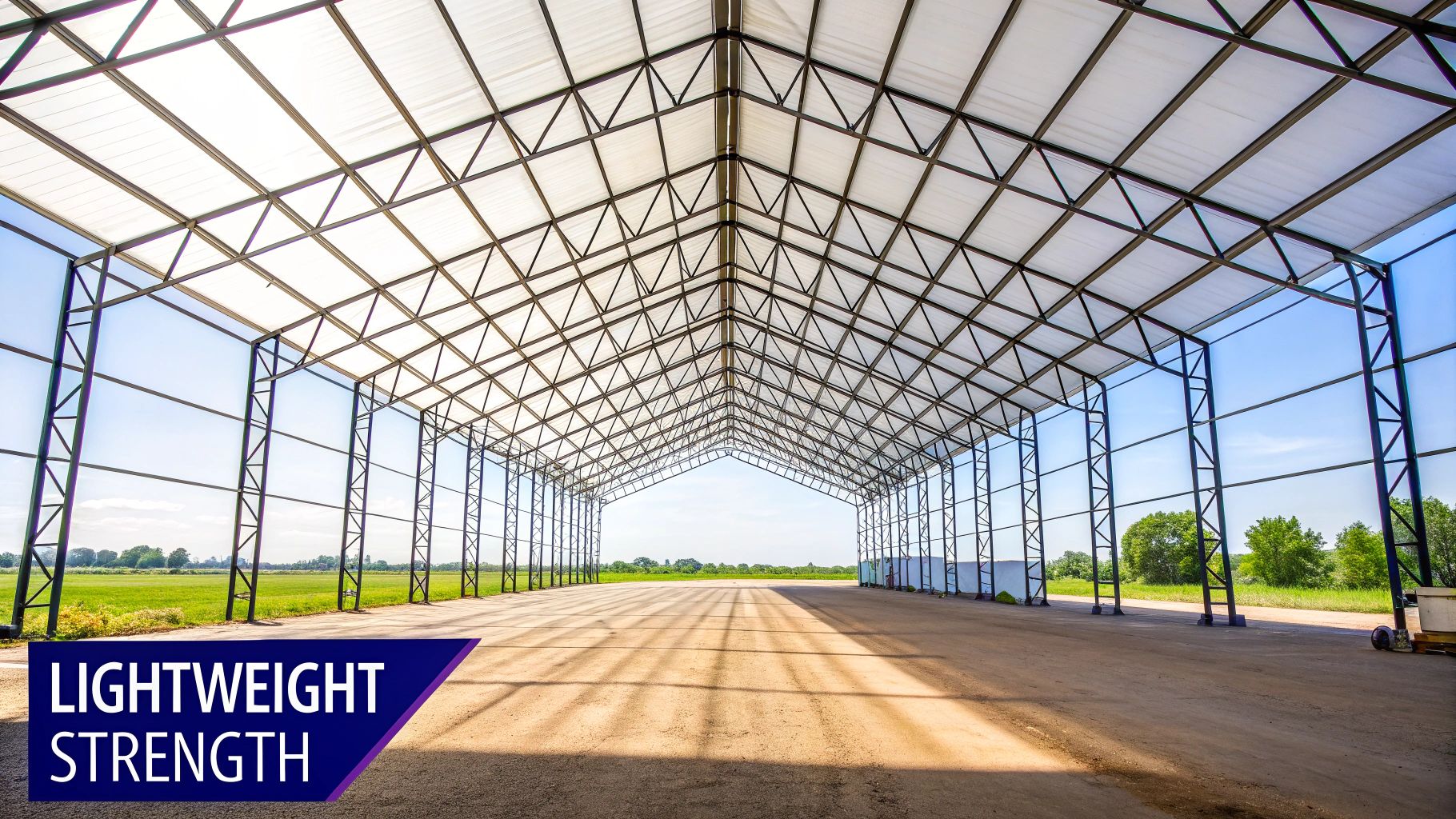
To really get what makes a metal truss building so powerful, picture the skeleton of a bird's wing. It's shockingly lightweight, yet it's strong enough to handle the massive forces of flight. A metal truss works on that same idea, using smart engineering instead of sheer bulk to deliver superior strength.
The secret sauce is the humble triangle. Geometrically speaking, a triangle is the most rigid shape out there; it simply refuses to distort under pressure. A metal truss is just a framework built from a whole series of these super-strong triangles.
This design brilliantly takes any load—whether it’s heavy snow piling up on the roof or the force of a hurricane-force wind—and spreads it out evenly across the whole structure. The forces are channeled through the truss members as either tension (pulling apart) or compression (pushing together), which prevents any single point from ever taking on too much stress.
The Power of Clear Span Design
The most incredible result of this structural genius is the ability to create enormous, wide-open interior spaces. This is what we call clear span design, and it means you don't need any obstructive support columns cluttering up your floor.
This feature is an absolute game-changer for so many applications:
- Aviation: Airplane hangars demand unobstructed space to move massive aircraft around.
- Agriculture: Farmers need open areas for parking bulky equipment and managing livestock.
- Commerce: Warehouses and distribution centers depend on open floor plans for efficient racking and forklift operations.
- Recreation: Indoor sports complexes and equestrian arenas need column-free space for games and events.
While you'll also see wood trusses, steel can deliver significantly larger clear spans. Steel can easily exceed 200 feet, whereas wood typically maxes out around 100 feet. This makes steel the clear winner for truly expansive projects. You can check out more about the various types of metal buildings and see how their framing supports their specific uses.
Core Components Working in Harmony
A metal truss building is much more than just the truss itself. It’s a complete system where every single component plays a critical role. The main parts include the columns for vertical support, the trusses that create the roof’s framework, and the girts and purlins that connect everything to support the wall and roof panels.
A well-engineered metal truss system ensures that every piece works in perfect concert, transferring loads seamlessly from the roof all the way down to the foundation. This synergy is what gives the building its exceptional durability and resilience against the elements.
Ultimately, all these components come together to create a framework that's durable, efficient, and remarkably adaptable. Once you understand how a simple triangle can be used to build such a powerful and stable structure, it’s easy to see why metal truss buildings are a leading choice for countless modern construction needs.
The Engineering Journey of Steel Trusses
The sleek, sophisticated metal truss buildings we see today didn't just pop up out of nowhere. They stand on the shoulders of centuries of engineering breakthroughs, with each big idea building on the last. The story actually starts not with steel, but with its heavier, more brittle ancestor—iron. Early industrial structures were framed with cast and wrought iron, which pushed the limits of construction but also showed their weak spots under heavy stress and fire.
Engineers knew they needed a stronger, more reliable material to build the massive bridges, train sheds, and factories that a rapidly expanding world demanded. This necessity set the stage for a monumental shift in how we build.
The rise of metal truss buildings is woven into the history of steel construction itself, which started transforming architecture back in the mid-19th century. A huge moment came with the invention of the Bessemer process in 1856, a method that finally allowed for the mass production of strong, affordable steel. This was a game-changer. It slashed costs and made steel a practical choice for large-scale projects.
During the Second Industrial Revolution (1850-1920), steel quickly took over from iron because it was just plain better—stronger and far more versatile. This new material allowed buildings to soar to heights never seen before, like the Home Insurance Building in Chicago. Finished in 1885, it’s often called the first skyscraper because of its revolutionary steel skeleton.
From Industrial Revolution to Digital Precision
With mass-produced steel readily available, a new era of construction was born. Engineers could now design and build truss systems that were not only stronger but also lighter and more predictable than anything made of iron. This opened the door to structures with enormous clear spans, fundamentally changing the look and feel of public and industrial buildings.
Still, the design process was a slow, painstaking manual job. Engineers were hunched over drafting tables with slide rules and complex calculations, hand-drawing every blueprint to make sure every angle and connection was perfect.
The core principles of truss engineering—distributing loads through a web of triangles—remained the same, but the tools used to apply those principles were about to get a massive upgrade. The next step would take design from the drafting table to the computer screen.
The Impact of Modern Technology
The arrival of computer-aided design (CAD) software in the late 20th century was the next great leap forward. CAD completely replaced manual drafting with digital precision, empowering engineers to model trusses with an incredible degree of accuracy.
This shift to digital brought some major advantages:
- Stress Analysis: Engineers could now simulate exactly how a truss would react to snow, wind, and seismic forces before a single piece of steel was even cut.
- Optimization: Designs could be fine-tuned for maximum efficiency, using the least amount of material to achieve the greatest strength—a change that directly lowers costs.
- Flawless Blueprints: Digital plans eliminated the risk of human error and ensured every single component was manufactured to exact specifications.
Of course, it's not just steel trusses that benefit from modern engineering. Understanding how components like aluminium extrusion profiles are made gives you a peek into the broader world of modern metal fabrication.
The final piece of the modern puzzle is prefabrication. Thanks to those ultra-precise CAD blueprints, every component of a metal truss building can be manufactured off-site in a controlled factory environment. These perfectly engineered pieces are then shipped to the construction site, ready for assembly like a giant, high-strength erector set.
This process is exactly how you can get a fully custom steel building that meets your exact needs. This method doesn't just speed up construction time dramatically; it also guarantees a level of quality and consistency that’s nearly impossible to achieve with on-site fabrication. Today’s metal truss buildings are the incredible result of this long engineering journey, combining a timeless structural concept with truly cutting-edge technology.
Understanding Common Truss Designs
Walk into any large, open-span steel building, and you'll see them crisscrossing the ceiling—the intricate skeletons that hold everything up. But not all trusses are created equal. An engineer’s choice of truss is a very deliberate decision, factoring in the building’s span, the specific loads it needs to handle, and sometimes even the final look.
Think of it like choosing the right tool for the job. You wouldn't use a tiny screwdriver on a massive bolt, right? In the same way, the unique shape and pattern of a truss are precisely engineered for its function. Knowing a few of the most common designs helps you see the genius behind the structure of the metal truss buildings you encounter every day. Each one tells a story about the forces it's built to conquer.
This infographic gives a great visual of how the materials and methods behind steel trusses have evolved over the years.
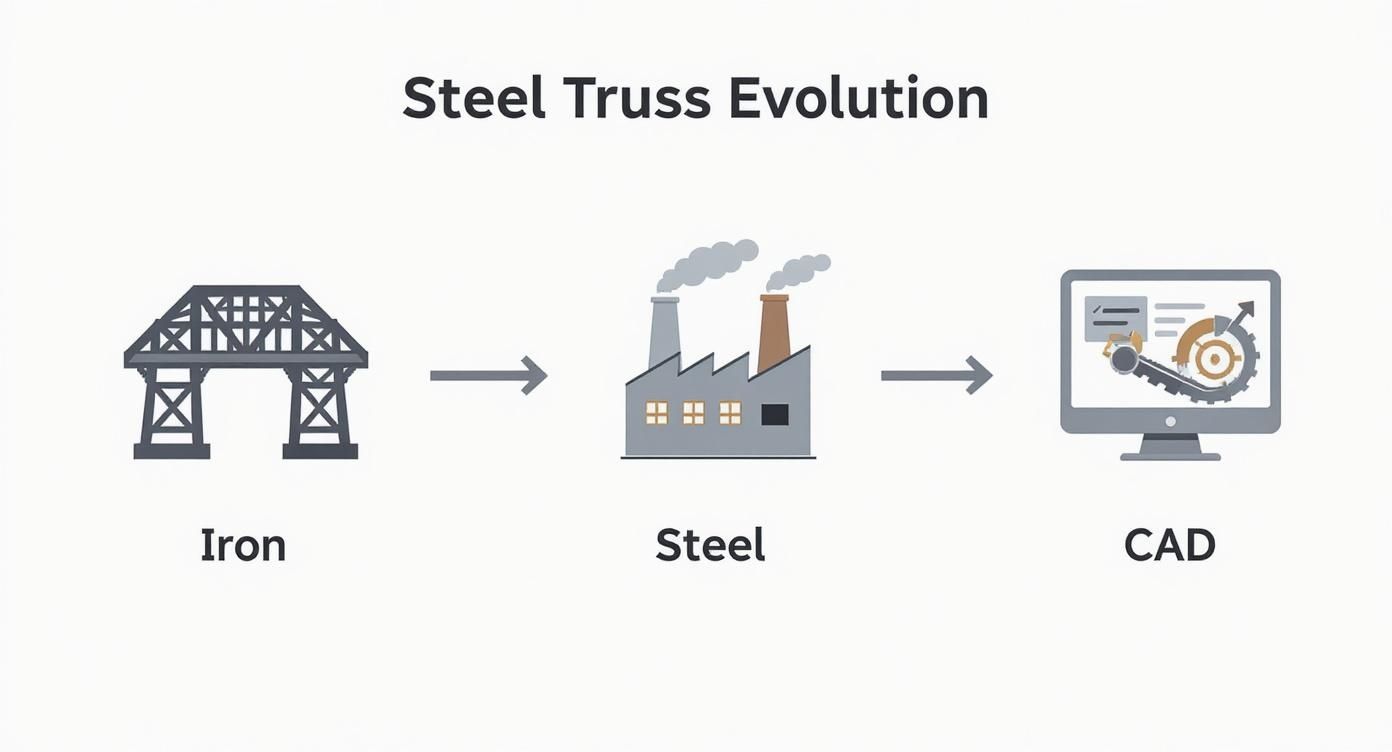
You can really see the journey from basic iron frameworks to mass-produced steel and, finally, to the hyper-precise world of computer-aided design. It’s a snapshot of the major technological leaps that made modern steel construction possible.
The Pratt Truss
The Pratt truss is one of the most recognizable and classic designs out there. Its signature feature is a series of diagonal members that all slant down and inward toward the center. This specific arrangement is a masterclass in handling tension.
Imagine a long bridge with heavy trucks rolling across. That weight pushes down, trying to pull the bottom of the truss apart—that's tension. The Pratt design cleverly puts its long diagonal members into tension, which is exactly what steel handles best, while the shorter vertical members take on the compression. This efficiency makes it a go-to choice for long spans where strength is paramount.
The Warren Truss
If the Pratt truss is a specialist, the Warren truss is the versatile workhorse of the bunch. It’s built from a series of equilateral triangles, creating a simple and clean repeating "W" or "V" pattern. This straightforward design is incredibly efficient to fabricate and a breeze to analyze.
A Warren truss is fantastic at distributing loads evenly across its members, with the forces alternating between tension and compression from one diagonal beam to the next. This perfect balance makes it a favorite for a huge range of applications, from simple roof supports in smaller metal truss buildings to massive, heavy-duty bridge structures.
The simplicity of the Warren truss is its greatest strength. Fewer components and straightforward connections often translate to lower fabrication costs and faster assembly on-site, making it a cost-effective and reliable option for many projects.
The Fink Truss
Look up at the ceiling of almost any modern home, and you’re probably looking at a Fink truss. It’s one of the most common designs for residential and light commercial roofing because it’s incredibly economical for shorter spans.
Its web of internal members forms a distinct "W" shape, which provides excellent roof support without needing a ton of material. This design is highly efficient for standard roof pitches and has become a true staple in the construction industry. While often built with wood, the Fink design is easily adapted for steel in smaller-scale metal buildings.
The Bowstring Truss
When a project demands a dramatic, wide-open ceiling, the Bowstring truss is the star of the show. It features a beautifully curved top chord that looks just like an archer's bow, connected by a straight bottom chord. But that elegant arch isn't just for looks—it's structurally brilliant.
The arch naturally redirects vertical loads outward and downward along its curve, putting the bottom chord (the "string") in constant tension. This creates an exceptionally strong and stable structure that’s perfect for buildings needing a high, column-free ceiling, like:
- Aircraft hangars
- Gymnasiums and indoor sports arenas
- Large auditoriums and event centers
To help visualize how these different designs stack up against one another, here’s a quick comparison.
Comparison of Common Metal Truss Designs
This table breaks down the key features, ideal uses, and main advantages of the truss types we've just covered.
| Truss Type | Structural Design Feature | Ideal Span Length | Common Applications |
|---|---|---|---|
| Pratt Truss | Diagonals slant toward the center; verticals in compression | Long spans (60-200 feet) | Bridges, long-span roofs, industrial buildings |
| Warren Truss | Equilateral triangles form a repeating 'W' or 'V' pattern | Medium to long spans (50-300+ feet) | Roofs, bridges, and general structural support |
| Fink Truss | 'W' shaped webbing provides high strength-to-weight ratio | Short to medium spans (20-60 feet) | Residential roofs, light commercial buildings |
| Bowstring Truss | Arched top chord with a straight bottom chord in tension | Very long clear spans (50-250+ feet) | Aircraft hangars, gymnasiums, auditoriums |
Each of these designs represents a unique and effective solution to a specific structural challenge.
Of course, the truss is just one part of the puzzle. To see how these powerful components fit into the bigger picture, you can learn more about the complete metal building frame and how all the pieces work together in harmony. The choice of truss is a critical decision that directly impacts a building’s strength, cost, and ultimate functionality.
The Core Advantages of a Metal Truss System
So, why are so many industries banking on metal truss buildings for their most important projects? It really comes down to a powerful mix of benefits that make them a remarkably smart investment. From massive interior space to pure, brute strength, these advantages solve the biggest challenges in modern construction, saving you time, money, and future headaches.
The most famous benefit of a metal truss system is its ability to create enormous, unobstructed interiors. We call this clear-span design. It means the entire roof is supported by the exterior walls, getting rid of the need for any interior support columns.
Picture a warehouse where forklifts can zip around without dodging poles, or an arena where every single seat has a perfect line of sight. That’s what a clear span delivers. For many businesses, that wide-open floor space isn't just a nice-to-have; it's essential for operations, safety, and efficiency.
Unmatched Strength and Lightweight Efficiency
Steel has an incredible strength-to-weight ratio. Think of it like a champion weightlifter who is also a world-class sprinter—it delivers immense power without being bogged down by extra bulk. A steel truss can support tremendous loads over huge distances using a surprisingly small amount of material.
This efficiency creates a positive ripple effect across the entire project. Because the frame itself is lighter than old-school materials like concrete or heavy timber, you don't need a massive, deep foundation. This leads directly to some serious perks:
- Reduced Foundation Costs: Pouring less concrete and digging less dirt means real savings on both materials and labor.
- Faster Site Preparation: Simpler foundations get done quicker, which helps shorten your overall project timeline.
- Greater Versatility: Lighter structures can often be built on sites with less-than-ideal soil conditions, opening up more possibilities.
This powerful duo of strength and efficiency is a huge reason why metal truss buildings are so cost-effective right from the start.
Durability That Stands the Test of Time
When you put your money into a building, you expect it to last. Metal truss buildings are built to be resilient against all sorts of threats that give other construction types nightmares. Unlike wood, steel is completely immune to rot, termites, and other pests.
On top of that, steel is non-combustible, giving it a massive advantage in fire resistance. This built-in durability means fewer maintenance worries and a much longer functional life for your structure. For even greater longevity, especially against the elements, applying durable and flexible elastomer coatings is a smart move.
You can also check out our guide on the safety of steel buildings in storms and bad weather to see just how tough these structures really are.
Rapid Construction Through Prefabrication
Another game-changing advantage is the sheer speed of construction, and that's all thanks to prefabrication. Every single component of a metal truss building is engineered and manufactured to precise specifications in a controlled factory setting. These pieces show up on your job site ready to be put together, almost like a giant, high-strength building kit.
This method isn't new; it has roots in post-war innovation. The metal truss system got a major upgrade in the 1950s with the invention of the metal truss connector plate. By the early 1960s, prefabricated roof trusses using these plates were everywhere, allowing builders to create larger open spaces that could carry heavier loads—all faster and cheaper than ever before.
This factory-first approach takes unpredictable variables like weather delays out of the equation and ensures a higher level of quality control. The result is a faster, more predictable, and often more affordable building process.
Finally, steel is one of the most recycled materials on Earth. Choosing a metal truss building is an environmentally responsible decision. The steel used often has a high percentage of recycled content and is 100% recyclable at the end of its life. When you combine this sustainability with all the structural and financial benefits, a metal truss system becomes an overwhelmingly compelling choice for any forward-thinking project.
How Different Industries Use Metal Truss Buildings
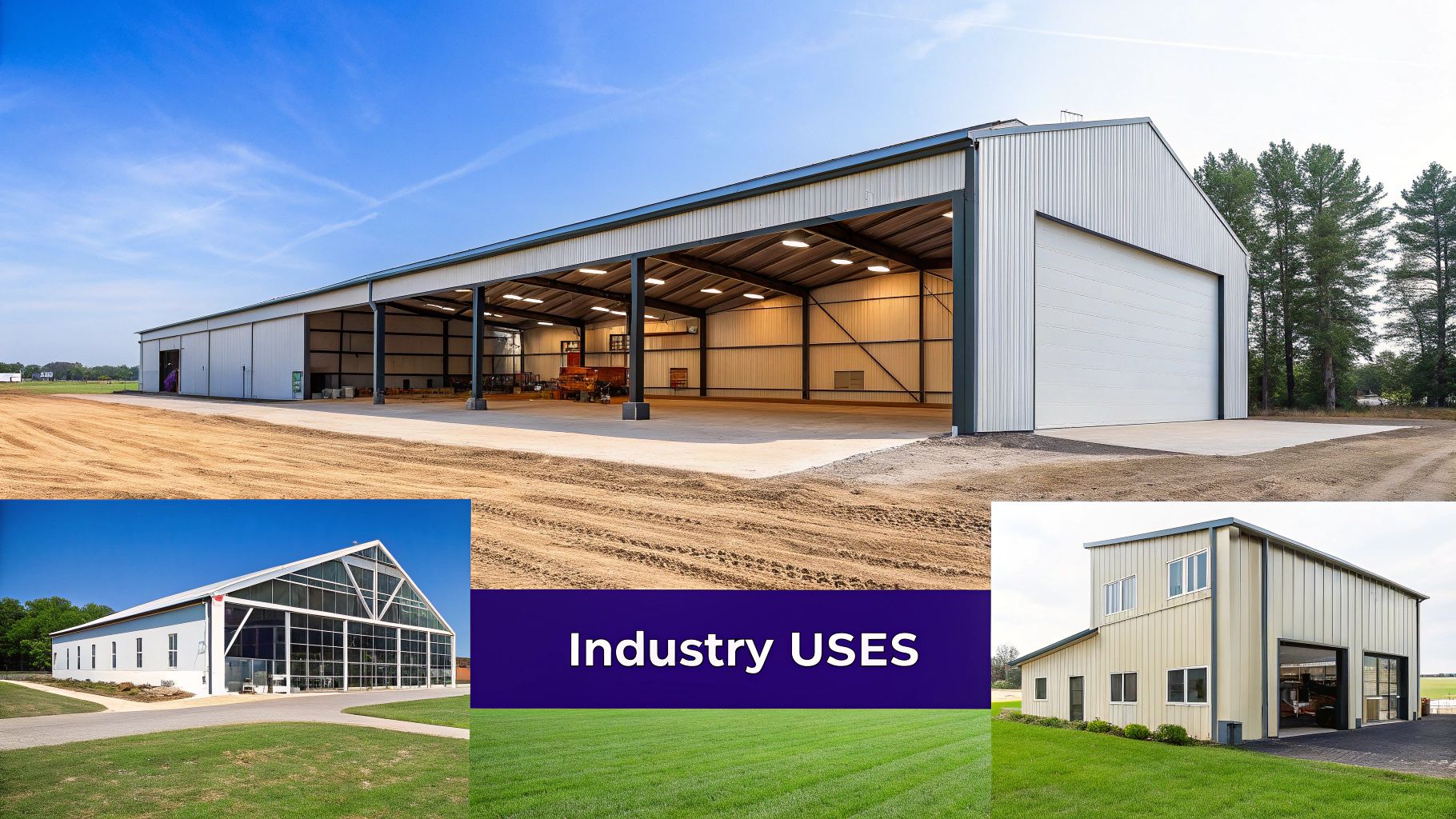
The real magic of a metal truss building isn't just its strength—it's how incredibly adaptable it is. This one core concept can be stretched, scaled, and shaped to solve problems for almost any industry you can think of. From sprawling farms to sleek commercial hubs, the fundamental benefits of a wide-open, column-free space are universally valuable.
Think about it. A farmer needs to park a fleet of massive combines out of the weather, and a big-box retailer needs a flexible, open sales floor. Both have different goals, but the metal truss system is the perfect answer for each. It’s this chameleon-like ability to fit any need that has made it such a powerhouse in modern construction.
This isn’t some new trend, either. Steel framing really took off after World War II, when there was a huge demand for buildings that were both tough and affordable. As cold-formed steel framing technology improved, it grew to account for 30-35% of all nonresidential construction in the U.S. by the end of the 20th century. For a deeper dive into this history, check out this in-depth historical overview from sfia.memberclicks.net.
Agricultural and Farming Operations
Out in the country, space and durability are non-negotiable. Metal truss buildings nail both, giving farmers structures they can count on to handle harsh weather and the daily grind of agricultural life.
You’ll see them used for all sorts of things on the farm:
- Equipment Storage: Those huge, unobstructed interiors are a dream for parking and servicing tractors, harvesters, and balers without having to navigate around support poles.
- Hay and Crop Storage: A dry, secure building is essential for protecting valuable harvests from the elements, preventing spoilage, and keeping products in top condition.
- Livestock Barns: The open design promotes great ventilation and makes it easy to set up flexible pen layouts for cattle, horses, or other animals.
Plus, steel’s natural resistance to rot, pests, and fire gives it a huge leg up over traditional wood barns, meaning it will last longer with a whole lot less upkeep.
Commercial and Industrial Hubs
In the business world, efficiency is money. The clear-span design of a metal truss building is like a blank canvas, letting companies arrange their space for maximum productivity without any limitations.
That unobstructed floor space is a complete game-changer for logistics and manufacturing. It lets you create the perfect workflow, build tall racking systems for streamlined inventory, and move heavy equipment like forklifts around safely.
It’s no surprise you see these buildings everywhere, serving as:
- Warehouses and Distribution Centers: They’re perfect for storing massive amounts of goods with easy access for trucks.
- Manufacturing Plants: They provide the wide-open areas needed for assembly lines and heavy industrial machinery.
- Retail Centers and Showrooms: They offer flexible, inviting spaces that can be reconfigured in a snap to match new inventory or displays.
Aviation and Recreational Facilities
Nowhere is the need for enormous, open space more obvious than in aviation and large-scale sports. For jobs like these, metal truss buildings are often the only practical solution for housing everything from a jumbo jet to an entire soccer field under one roof.
The ability to create clear spans well over 200 feet wide makes them the top choice for specialized uses, including:
- Aircraft Hangars: Protecting multimillion-dollar aircraft while leaving plenty of room for maintenance crews to work.
- Indoor Sports Complexes: Housing basketball courts, tennis courts, and turf fields without a single column to block the view.
- Equestrian Arenas: Giving riders and horses the massive, open space they need for training, events, and competitions.
From the farm to the airport, the smart, simple design of a metal truss building delivers the strength, space, and flexibility that today’s industries rely on.
Budgeting for Your Metal Truss Building Project
Figuring out the budget for a metal truss building is about more than just the price of the kit. You need a solid financial roadmap to avoid surprises. The good news is that while every project is different, the costs are driven by a handful of key factors, from raw materials to the final coat of paint.
The price of steel is always the starting point. It's a global commodity, so its price swings with supply and demand. But honestly, the real cost driver for your project comes down to the building's size.
Core Cost Drivers
It's simple math: the bigger your building—we're talking width, length, and eave height—the more steel you'll need for the frame, panels, and supports. A wider clear span or a taller structure demands beefier trusses and columns to meet engineering specs, and that directly impacts your material costs.
Beyond just the basic footprint, the complexity of your design is a major player. A standard rectangular building is always the most budget-friendly option. Once you start adding custom touches, the price tag will adjust.
These custom design elements often include:
- Unique Roof Pitches: Steeper or more intricate rooflines need more engineering and more material.
- Custom Features: Things like lean-tos, big overhangs, or unique building shapes add to both fabrication and labor costs.
- Load Requirements: If you're building in an area with heavy snow or high winds, your frame needs to be stronger. That extra steel and engineering adds to the bottom line.
Additional Budget Considerations
Where you're building matters, too. Your distance from the manufacturing plant will affect shipping costs. And don't forget that local labor rates for the construction crew and foundation work can vary wildly from one region to the next. This is one line item you'll definitely want to research for your specific area.
The foundation itself is another significant expense. Whether you need a simple pier system or a full concrete slab depends entirely on your building's size, what you plan to use it for, and the soil conditions on your property.
Remember that the initial building kit is just one part of the total project cost. Factoring in delivery, foundation, construction labor, and finishing touches is essential for creating a comprehensive and accurate budget.
Finally, think about all the components that turn a steel shell into a usable building. For a detailed breakdown, you can explore current metal building kit prices to get a feel for how different sizes and options stack up. These essential add-ons—like insulation, walk-in doors, roll-up garage doors, and windows—all contribute to the final cost but are crucial for the building's function and long-term value.
Common Questions About Metal Truss Buildings
When you're getting serious about a project, a few key questions always pop up. Getting straight answers is the only way to feel good about your decision, so this last section is all about tackling the most common things people ask when they're looking at metal truss buildings.
We'll cover everything from how long they last and how much you can tweak the design to what the actual construction process looks like. Think of this as filling in the final pieces of the puzzle, so you can move forward knowing exactly what you’re getting into.
How Long Does a Metal Truss Building Last?
Longevity is always a big one. The short answer? A well-engineered and properly maintained metal truss building can easily stand for 50 to 100 years. Unlike wood, steel doesn't have to worry about rot, decay, or termites, which takes some of the most common structural weak points completely off the table.
Of course, a few things influence that lifespan:
- Protective Coatings: High-quality paint and galvanized coatings are your building's first line of defense against rust and corrosion.
- Environmental Conditions: A building right on the coast or near an industrial zone might need tougher coatings or specialized steel to fight off the elements.
- Regular Maintenance: This is the easy part. Simple annual check-ups to spot scratches, clean debris from gutters, and make sure fasteners are tight will go a long way in extending your building's life.
With just a little bit of upkeep, your steel structure will be standing strong for decades to come.
How Much Can I Customize My Building?
You can customize it a lot more than you might think. While the core truss system relies on proven engineering for its strength, almost every other part of the building can be adjusted to fit your needs and your style. Just think of the steel frame as a blank canvas.
The real flexibility of metal truss buildings comes from their adaptability. The basic engineering principles provide the strength, while the design options provide the character and function tailored to your vision.
You can customize everything from the building's core dimensions—width, length, and height—to where every single door and window goes. You also get a huge palette of colors for the wall panels, roof, and trim, which makes it easy to match other buildings on your property or create a look that’s all your own.
What Does the Construction Timeline Look Like?
Thanks to prefabrication, the construction process for metal truss buildings is a whole lot faster than traditional building methods. Once your design is locked in and engineered, every component is manufactured in a factory and shipped right to your site, ready to go.
The whole timeline breaks down into a few main phases:
- Design and Engineering: This is the planning stage where blueprints are created and approved. It usually takes a few weeks.
- Fabrication: Actually making the steel components takes several weeks, depending on how complex your building is.
- Foundation and Erection: Here's the best part. While the kit is being made, your foundation can be poured. Once the materials show up, a small crew can often get the main frame up in just a few days—not weeks.
This streamlined process really shrinks the overall project timeline, getting you up and running much faster.
Ready to bring your project to life with a structure built to last? Icon Steel Buildings offers high-quality, American-made metal buildings designed for any application. Get a quote today and see how our durable and customizable solutions can work for you.