When you hear "steel building," what comes to mind? A massive warehouse? A towering skyscraper? While those are great examples, the world of steel construction is far more diverse. Steel buildings aren't a one-size-fits-all solution. They're broken down into distinct categories based on how they're designed, manufactured, and put together on-site.
The three heavy hitters you’ll run into are pre-engineered, conventional, and modular steel buildings. Each has its own playbook and brings a unique set of advantages to the table, depending on what your project demands.
Exploring the World of Steel Buildings
To really get a handle on the differences, let's use an analogy we all know: LEGOs.
Think of pre-engineered metal buildings (PEMBs) as complete LEGO kits. Every single piece is designed and fabricated in a factory to fit together perfectly. When the kit arrives on-site, assembly is fast and straightforward.
Conventional steel frames are like using a giant bin of individual LEGO bricks. You're building a totally custom, one-of-a-kind creation from the ground up, piece by piece. It offers maximum design freedom but requires more on-site work.
Finally, modular buildings are like snapping together large, pre-built LEGO sections—like a whole pre-made room or wing. You combine these big blocks to form a complete structure in record time.
This simple breakdown helps clarify the different construction methods available. Each one excels in different scenarios, from fast-turnaround workshops to architecturally complex high-rises. Knowing these fundamental distinctions is the first step to picking the right structure for your needs.
Core Steel Building Categories
Steel buildings are primarily categorized by their structural DNA and construction method, with three major types leading the market: pre-engineered, conventional steel frame, and modular buildings. If you want to dive deeper into the latest market trends, be sure to check out our detailed guide on steel buildings.
The image below gives you a clear visual of how these main categories break down.
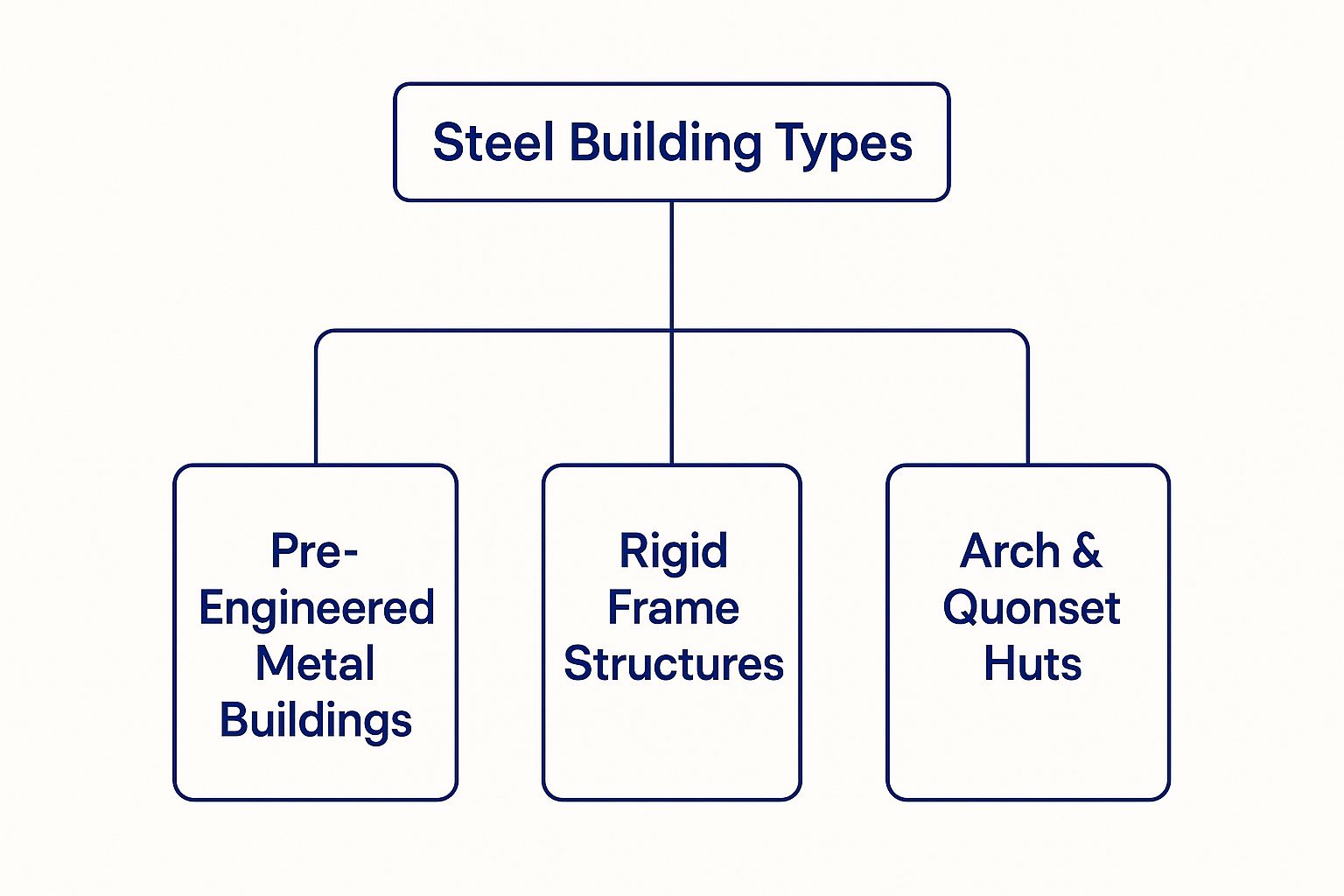
As you can see, different styles like arch buildings and rigid frames fit within these broader classifications. Each represents a different trade-off between cost, speed, and customization. The right choice for you will hinge entirely on your project's specifics—your budget, your timeline, and what you plan to use the building for.
The biggest difference comes down to one thing: where the bulk of the work happens. Pre-engineered and modular systems push as much fabrication as possible into a controlled factory setting. Conventional frames, on the other hand, rely heavily on skilled labor for on-site cutting, welding, and assembly.
To help you get started, we've put together a quick comparison table that lays out the core differences at a glance.
Quick Comparison of Steel Building Types
This table offers a high-level overview of the main steel building categories, highlighting what makes each unique, where it shines, and how quickly it can be constructed.
| Building Type | Key Feature | Best For | Construction Speed |
|---|---|---|---|
| Pre-Engineered | All components are factory-made to fit perfectly. | Warehouses, workshops, retail, agricultural buildings. | Very Fast |
| Conventional | Built from raw steel beams and columns on-site. | High-rises, complex architectural designs, stadiums. | Slower |
| Modular | Constructed from large, pre-built volumetric sections. | Offices, schools, clinics, multi-family housing. | Extremely Fast |
This comparison makes it clear that your project's goals will steer you toward the best option. Whether you need the rapid deployment of a modular building or the bespoke design of a conventional frame, understanding these fundamentals is key to making a smart decision for your next project.
The Unmatched Efficiency of Pre-Engineered Buildings
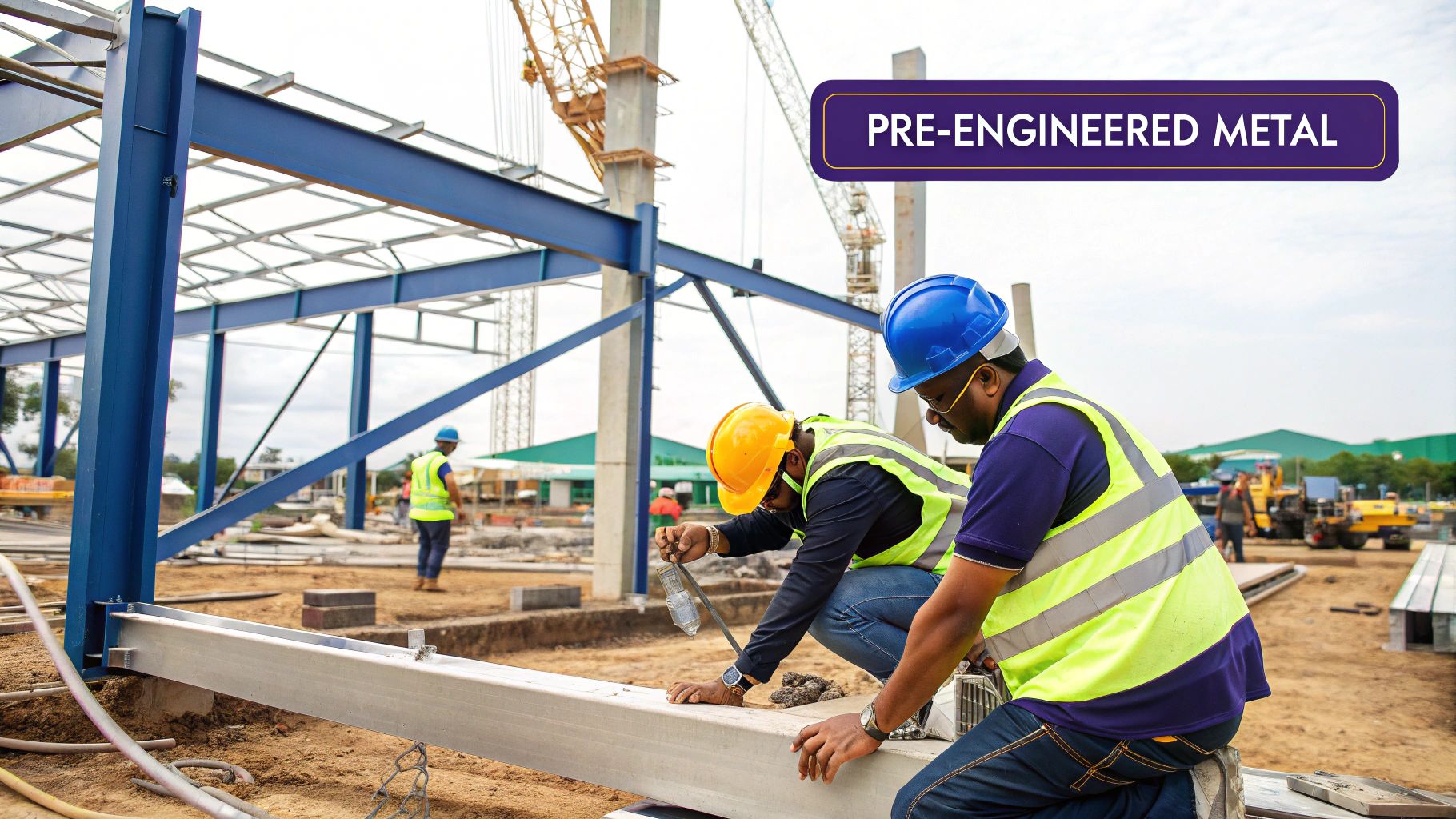
When you look at the different types of steel buildings, Pre-Engineered Buildings (PEBs) really stand out for their incredible efficiency. It’s helpful to think of a PEB less like a building constructed from scratch and more like a sophisticated kit that’s assembled with absolute precision.
Every single piece—from the massive main frames all the way down to the last nut and bolt—is designed and fabricated in a controlled factory setting. This process is a lot like putting together a high-end furniture set. Each component shows up at your job site perfectly cut, drilled, and ready to be bolted together.
This systematic approach practically gets rid of any need for on-site cutting or welding. What does that mean for you? It drastically cuts down construction time, minimizes material waste, and almost always leads to a lower total project cost compared to traditional construction.
The Anatomy of a PEB System
A PEB isn't just a pile of steel beams; it's a complete, engineered system where every single part has a specific job to do.
The heart of the structure is its primary framing, which includes the main columns and rafters. These are usually I-beams that are tapered—meaning they are strategically thicker and deeper in areas under high stress and leaner where less support is needed. This smart design uses steel optimally without ever compromising on strength.
Connecting these main frames are the secondary components, which give the roof and walls crucial support.
- Purlins: These are horizontal beams that run the length of the roof. They support the roofing panels and transfer all the loads to the primary frames.
- Girts: Just like purlins but for the walls, girts run horizontally to support the wall cladding and handle wind loads.
- Bracing: A network of steel rods or cables provides essential lateral support against forces like wind and seismic activity, making sure the entire structure stays stable and rigid.
This integrated design ensures that every piece works together in harmony, creating an incredibly strong and durable building envelope.
Where PEBs Deliver Maximum Value
The speed and cost-effectiveness of PEBs make them the undisputed champion for projects needing large, open interior spaces. The sheer efficiency of the pre-engineered approach is why so many businesses turn to these types of steel buildings for their needs.
The core advantage of a pre-engineered building is its predictability. Because components are manufactured in a factory, costs, timelines, and quality are all managed with a much higher degree of certainty than with on-site construction.
You'll see PEBs excelling in applications like these:
- Warehouses and Distribution Centers: PEBs can achieve enormous clear spans, creating vast, column-free interiors perfect for logistics, racking, and storage.
- Retail Centers and Showrooms: The design flexibility allows for wide-open layouts that can be easily configured for retail displays and customer traffic.
- Aircraft Hangars: The ability to accommodate massive hangar doors and create incredibly wide, unobstructed spans makes PEBs ideal for aviation.
- Agricultural Buildings: From barns to equipment storage, their durability and low maintenance make them a perfect fit for farm life.
By standardizing the design and fabrication process, PEBs offer a powerful combination of speed, strength, and savings. If you want to dive deeper into this topic, you can find a ton of great information about prefabricated buildings on our blog. This building method provides a reliable and efficient solution for countless commercial, industrial, and agricultural needs.
Custom Designs with Conventional Steel Frames
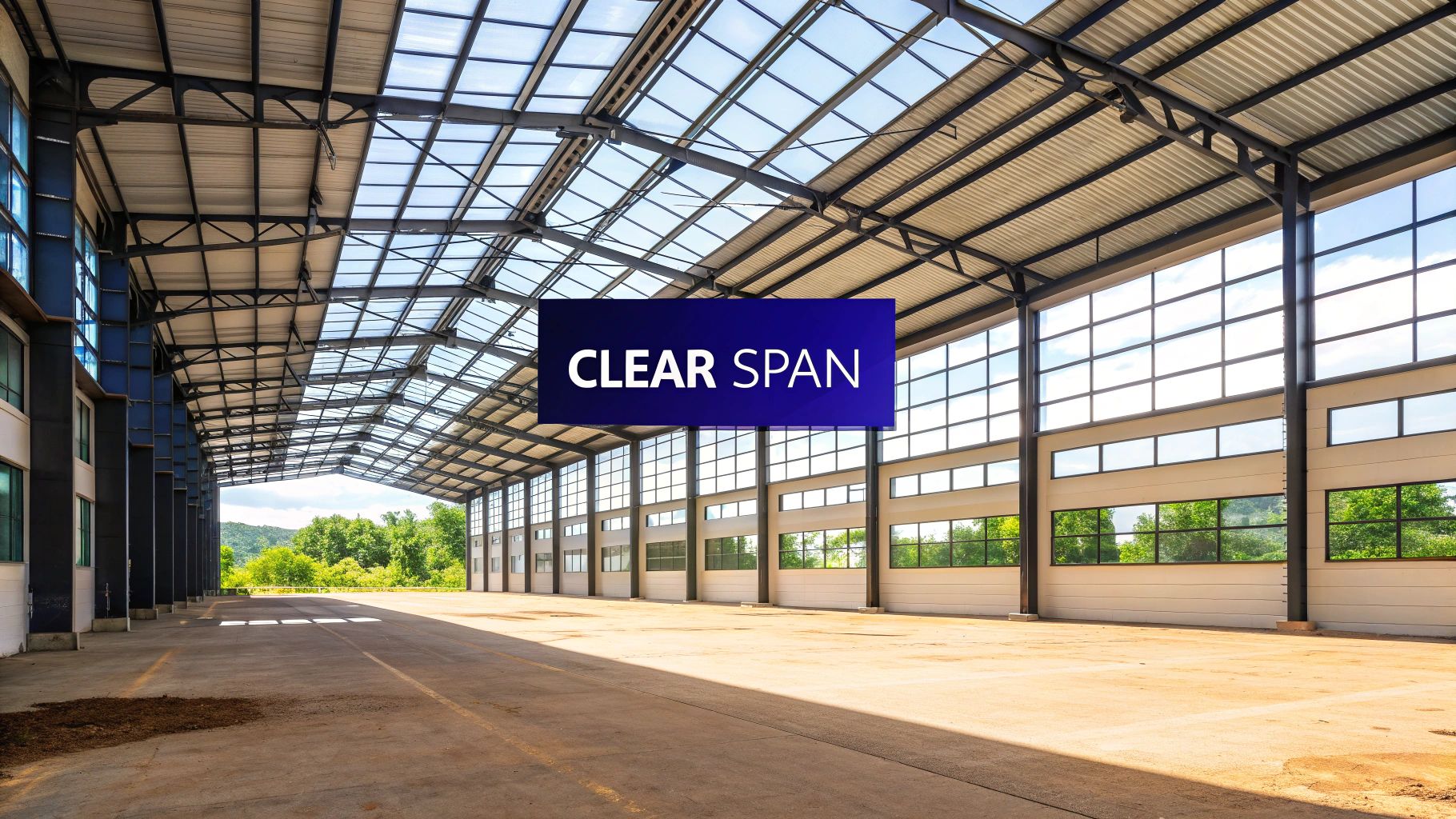
Sometimes, a project's vision is so unique that a pre-engineered kit simply won't do. When you need complete architectural freedom and highly specific structural solutions, conventional steel framing is the only way to go.
If you think of pre-engineered buildings as high-end, customizable kits, then conventional framing is the equivalent of a bespoke, custom-tailored suit. There are no pre-set designs or standard parts. Instead, every single beam, column, and girder is individually designed, cut from raw steel, and assembled piece by piece on-site.
This “stick-built” method is what allows architects and engineers to create the one-of-a-kind steel skeletons needed for today's most complex structures. It’s the technique that has quite literally shaped modern city skylines.
The Process from Blueprint to Build
It all starts on the architect's drawing board. Once the vision is set, an engineer takes over, translating the design into a structural plan. They meticulously calculate the exact size, grade, and placement for every steel component required to handle the building's massive loads.
From there, these individual pieces are fabricated—often at different steel mills—and shipped to the construction site. Skilled ironworkers then get to work, methodically erecting the frame piece by piece, bolting and welding each connection to create an incredibly rigid structure. It's a labor-intensive process that demands serious coordination and heavy machinery.
Conventional steel framing is the traditional "stick-built" approach. Steel columns, beams, and girders are used to create the building's skeleton, which is then filled in with materials like concrete, glass, or brick. This method is the standard for large-scale commercial, institutional, and high-rise construction.
When to Choose Conventional Framing
You turn to conventional framing when the design is non-negotiable and the structural demands are extreme. Among the different types of steel buildings, this method is reserved for projects that require unparalleled strength and total design flexibility above all else.
You’ll see conventional steel frames in projects like:
- Skyscrapers and High-Rises: Their immense height and intricate layouts demand a custom-engineered steel skeleton.
- Stadiums and Arenas: These venues need to support colossal roofs, cantilevered seating, and unique, sweeping architectural curves.
- Hospitals and Universities: These institutions often have non-standard floor plans, heavy equipment loads, and very specific infrastructure needs.
- Unique Industrial Facilities: A manufacturing plant with specialized machinery or complex multi-level processing lines requires a custom structural solution.
Balancing Flexibility and Practicality
The single biggest advantage of conventional framing is its near-limitless design potential. Architects are free to create complex shapes, irregular layouts, and soaring open interiors without being boxed in by standardized components. This is how truly iconic structures are born.
Of course, that level of freedom comes with trade-offs. Project timelines are significantly longer due to the custom design, fabrication, and on-site assembly. The intensive labor and specialized engineering also mean higher initial costs compared to system-built approaches. Still, steel's dominance in major construction is clear, accounting for over 38.5% of the market share in the building sector.
If your project's vision calls for this degree of architectural control, exploring custom steel buildings can give you a better idea of what's possible when a truly bespoke solution is required. At the end of the day, conventional steel framing remains the gold standard for any project where uniqueness and structural integrity are the absolute top priorities.
Modular Steel Buildings for Rapid Construction
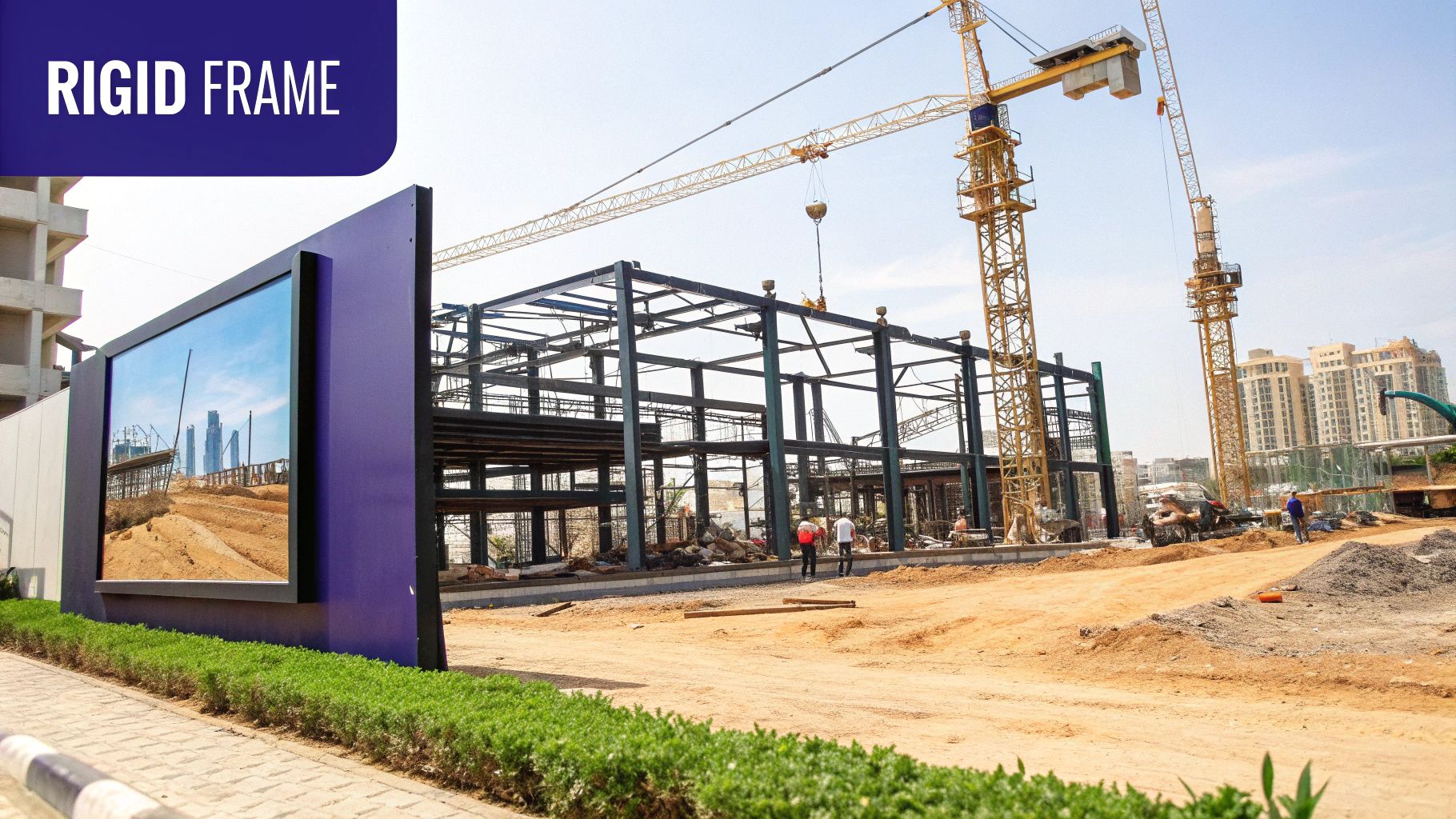
For projects where the clock is ticking and speed is everything, modular construction is an absolute game-changer. This isn't about assembling a simple frame; it's about fabricating complete, three-dimensional sections of a building—called "modules"—in a factory.
Think of it less like building with individual bricks and more like connecting massive, pre-finished LEGO blocks.
These modules are far more than empty steel boxes. They often show up on-site with plumbing, electrical wiring, insulation, and even interior finishes like drywall and flooring already good to go. Once they arrive, cranes lift these giant sections into place, and crews connect them to create a fully functional building in a surprisingly short amount of time.
This factory-first approach completely flips the traditional construction timeline on its head. While crews are busy prepping the foundation at your build site, your building's modules are being constructed simultaneously in the factory. This parallel workflow is the secret sauce, often cutting project schedules by as much as 50%.
The Advantages of Factory-Built Quality
Building indoors, away from the elements, brings huge benefits beyond just speed. The factory setting eliminates weather delays and allows for a degree of quality control that's incredibly tough to match on a traditional, chaotic job site.
Every single module is built to exact specifications using consistent, repeatable processes. This precision reduces material waste and elevates the overall quality of the build. It’s a manufacturing mindset that’s gaining serious momentum, especially for projects where consistency and minimal on-site disruption are non-negotiable.
A huge plus for modular steel construction is how quiet the job site becomes. With up to 90% of the work done off-site, you get far less noise, traffic, and waste. This makes it a perfect choice for building in crowded urban areas or on sensitive sites like hospital and school campuses.
You don't have to take our word for it—the numbers tell the story. The global market for prefabricated buildings hit USD 248 billion in 2024 and is expected to climb to nearly USD 396.6 billion by 2033. This growth is fueled by rapid urbanization and the undeniable efficiencies of modular methods.
Ideal Applications for Modular Construction
The unique advantages of modular buildings make them a perfect fit for certain industries and project types. Because they can be up and running so quickly, they've become the go-to solution for:
- Schools and Classrooms: Districts can add brand-new facilities over a summer break, causing zero disruption for students.
- Healthcare Clinics: Urgent care centers and medical offices can be built and start seeing patients much faster than with traditional construction.
- Hotels and Multi-Family Housing: The repetitive layout of hotel rooms or apartment units is perfectly suited for module-based construction.
- Remote Workforce Housing: Companies can rapidly deploy high-quality living quarters in isolated areas where construction resources are scarce.
While the logistics of trucking and craning huge modules require careful planning, the payoff is huge. Modular is hands-down one of the most efficient types of steel buildings out there today. To see how it stacks up against other options, check out our ultimate guide to steel building kits for a broader look at various applications.
The Anatomy of a Steel Building: What Really Goes Into It?
A steel building is a lot more than just its big red-iron frame. Think of it as a complete system, where every single part is engineered to work together. Understanding these key components is what separates a basic structure from a high-performance building that's efficient, functional, and built to last.
The main frame provides the skeleton, sure, but it's the roofing, walls, and interior framing that truly bring the building to life. These are the elements that protect it from the weather, keep it comfortable, and make the space usable day in and day out.
Advanced Metal Roofing Systems
The roof is your building's first and most important line of defense against the elements. Modern metal roofing systems are engineered to be incredibly tough—we're not talking about simple sheets of tin here. These are advanced systems designed to last 50 years or more, easily outliving traditional roofing materials like asphalt shingles.
Many of these are "cool roofs," which come with special reflective coatings. These coatings bounce a surprising amount of solar radiation away from the building, which can dramatically lower your air conditioning bills in hot climates. It's a smart feature that pays for itself over time.
The market for metal roofing is booming for a reason. It's currently valued at around USD 22.5 billion and is expected to grow at a compound annual growth rate of nearly 11.9%, potentially hitting almost USD 49.4 billion by 2032.
Insulated Metal Panels for Walls
When it comes to the walls, Insulated Metal Panels (IMPs) are a massive leap forward in construction efficiency. The best way to picture an IMP is like a high-tech sandwich: two durable sheets of steel with a core of rigid foam insulation bonded between them. This single panel does it all—it provides the structure, the insulation, and the finished surface in one go.
IMPs completely change the game for on-site assembly. Instead of the old-school method of building a wall layer by layer (framing, sheathing, insulation, vapor barrier, and then cladding), crews just lift and install one complete panel. It's faster, requires less labor, and gets the building sealed up in a fraction of the time.
This all-in-one design also creates an incredibly energy-efficient building envelope. With fewer gaps and superior thermal performance, you'll minimize heat loss in the winter and keep the heat out in the summer.
Light-Gauge Steel Interior Framing
While the heavy-duty I-beams handle the main structure, the interior walls and partitions are typically built with light-gauge steel framing. Made from cold-formed steel, these studs and tracks are a lightweight but incredibly strong alternative to wood framing.
One of the biggest wins with light-gauge steel is that it's non-combustible, which instantly improves the building's fire safety rating. It's also completely resistant to problems like rot, termites, and warping, so your interior walls stay perfectly straight and true for the entire life of the building. To see how these interior elements fit within the larger structure, check out our guide on the complete https://iconsteelbuildings.com/metal-building-frame/.
Of course, a building isn't complete without windows and doors. Once you have the main structure figured out, you'll need to consider how to fill the openings. For commercial projects, looking into high-performance commercial glass and window solutions is a crucial step to ensure the entire building envelope is secure and efficient.
How to Choose the Right Steel Building Type
Alright, so you’ve seen what’s out there. Now comes the most important part: connecting the dots between these different steel building types and your actual project. Getting this right means finding that sweet spot where your budget, timeline, and design dreams all meet.
Let's cut through the noise. Start by asking yourself a few straightforward questions. Your answers will immediately start pointing you in the right direction.
- How much creative freedom do I need? If you’re working with an architect on a one-of-a-kind design with unusual dimensions, a conventional frame is probably your only real option. But if you need a standard layout with some room to tweak things, a PEB is perfect.
- How fast does this need to be built? When time is the enemy, nothing beats modular construction. For projects that need to move quickly but aren't quite that rushed, PEBs offer impressively fast assembly times. Conventional builds will always be the slowest of the bunch.
- What’s this building actually for? A simple warehouse, a backyard workshop, or a basic storage facility is the ideal job for a cost-effective PEB. On the flip side, if you're planning a multi-story hotel or a complex public venue, the project is screaming for a conventional frame.
Matching Priorities to Building Types
Think of it as a simple matching game. If you're building a new distribution center on a tight budget and an even tighter deadline, a pre-engineered building is the obvious winner. But if an architect has handed you a stunning, unique vision for a new corporate headquarters, only the total flexibility of a conventional steel frame will do.
Your decision really boils down to what you value most. Speed, cost, and customization are the three big levers you can pull. The catch? You can usually have two, but getting all three is incredibly rare. A highly custom building, for example, is going to take longer and cost more. It’s a trade-off.
Don't forget that your choice of roofing material also plays a huge role in the building's final cost and longevity. For a deep dive into that topic, check out resources comparing metal roofs and shingles to see how different options stack up over the long haul.
Matching Your Project Needs to the Right Steel Building
Use this table to determine the best steel building type based on your primary project priorities and constraints. It's a quick way to see which option aligns best with what matters most to you.
| Project Priority | Pre-Engineered (PEB) | Conventional Frame | Modular/Prefabricated |
|---|---|---|---|
| Speed | Excellent | Fair | Best |
| Budget | Best | Fair | Good |
| Customization | Good | Best | Fair |
| Site Disruption | Good | Fair | Best |
This simple breakdown should give you the clarity you need to move forward with confidence, knowing you've picked the right foundation for your project's success.
Common Questions About Steel Buildings
Even after getting familiar with the different types of steel buildings, a few practical questions almost always pop up. Let's tackle the most common ones about cost, customization, and how these buildings hold up over the long haul.
Are Steel Buildings Cheaper Than Wood or Concrete?
While the price of raw materials can swing back and forth, steel buildings almost always deliver a lower total project cost. The real savings aren't just in the materials themselves—they come from needing less labor on-site, dramatically faster construction times, and incredible long-term durability.
What this means is your investment really pays off over the life of the building. With less maintenance to worry about and typically lower insurance premiums, steel quickly proves itself as the smart, cost-effective choice.
Can a Pre-Engineered Steel Building Be Customized?
Absolutely. Don't let the "pre-engineered" name fool you. Modern steel buildings offer a massive range of customization options that go way beyond a simple metal box.
- Aesthetics: You can pick from a huge palette of colors, different panel profiles, and all sorts of accessories like doors, windows, and skylights.
- Facades: If you're going for a more traditional look, it’s easy to add exterior finishes like brick, stone, or stucco to match just about any architectural style you can imagine.
The biggest misconception is that "pre-engineered" means one-size-fits-all. What it really means is that the system is pre-designed for maximum efficiency, but the final look and function can be completely tailored to what you need.
How Well Do Steel Buildings Handle Extreme Weather?
When it comes to resilience, steel is one of the toughest construction materials out there, making it perfect for standing up to harsh weather. Every single building is engineered to meet or blow past local building codes for high winds, heavy snow loads, and seismic activity.
It has a unique combination of strength and flexibility that allows it to absorb energy from events like earthquakes without cracking. That's the kind of reliable protection you want when it matters most.
Ready to explore a steel building for your project? The team at Icon Steel Buildings is here to help you design a durable, cost-effective structure that perfectly fits your needs. Get a custom quote by visiting https://iconsteelbuildings.com today.