Your Guide to Getting a Metal Building Installed
Getting a metal building installed is an exciting milestone, but the real key to a smooth project is knowing what comes before the crew ever shows up. It’s a journey that starts with careful planning and ends with a structure built to last. Success isn’t about just watching it go up; it’s about being prepared for every step—before, during, and after installation day. Your Metal Building Installation Journey From Start to Finish When you know what to expect, having a metal building installed is a pretty straightforward process. Think of this guide as your complete roadmap. We’ll walk you through every critical phase, from locking in your design to the final walkthrough and even long-term care. Our goal is to give you the confidence and know-how to manage your project without any surprises. The journey begins long before the first steel panel is unloaded from the truck. In fact, success is built on a foundation of solid preparation. Laying the Groundwork for Success The initial stages are all about turning your vision into a workable plan. This is where you translate your ideas—whether it’s for a simple workshop, a two-car garage, or a massive RV storage building—into a concrete design. Rushing this part of the process is a recipe for expensive changes down the road or ending up with a building that doesn’t quite fit your needs. To get started on the right foot, you’ll want to focus on a few core areas: Defining Your Purpose: First things first, what are you using this building for? The answer to that question drives every other decision, from the building’s dimensions to where you place the doors. Site and Foundation Prep: A level, clear site isn’t just a friendly suggestion—it’s a non-negotiable requirement for a stable and secure installation. Navigating Local Rules: Taking the time to understand and pull the necessary permits saves you from major legal headaches and ensures your building is 100% compliant with local codes. From Blueprint to Reality Once all the prep work is done, the physical installation can finally kick off. The process itself is surprisingly efficient, but knowing the sequence of events helps you get everything ready for the big day. Our installation crews work methodically to assemble the structure, turning a collection of steel components into a fully functional building—often in just a day or two. The most overlooked step by first-time buyers is confirming site access. A massive delivery truck and an installation crew need a clear, unobstructed path to your build site. Forgetting this simple detail can cause significant—and costly—delays on installation day. After the last screw is tightened, you’ll do a final walkthrough with the crew. This is your chance to inspect every detail and make sure everything is perfect. With just a little bit of ongoing maintenance, your new metal building will give you decades of reliable service, protecting your valuable assets and serving its purpose flawlessly. Planning Your Perfect Building Before Installation Here’s something I’ve learned over the years: the most successful installations are locked in long before our crew ever sets foot on your property. This planning phase is where your vision gets translated into a practical, detailed blueprint. It’s truly the difference between a building that just “works” and one that perfectly serves your needs for decades. Getting these details right upfront is the single best way to guarantee a smooth process, helping you sidestep the frustration of last-minute changes or unexpected costs. Defining Your Building’s Purpose and Dimensions First things first, what is this building actually for? That one question drives every single decision that follows. A structure designed to store a classic car has completely different requirements than a commercial workshop or an agricultural barn. For example, an RV garage needs a tall roll-up door—often 14 feet high or more—and enough depth to comfortably house the vehicle. On the other hand, a home workshop might prioritize window placement for natural light and multiple walk-in doors for easy access. Nailing down the primary use helps you lock in the ideal width, length, and height from the get-go. Choosing the Right Materials and Structural Options With your purpose clear, we can move on to the bones of the building—the materials and structural elements. This isn’t just about looks; it’s about making sure your building can stand up to your specific environment for the long haul. A few key choices you’ll need to make include: Steel Gauge: This determines the building’s overall strength. A standard 14-gauge frame is great for many applications, but if you’re in an area with heavy snow or high winds, upgrading to the thicker, more robust 12-gauge steel is a wise investment. Roof Style: Your roof does more than keep you dry. We highly recommend a vertical roof, where the panels run from the ridge down to the eaves. It’s far superior at shedding water, snow, and debris, making it a must-have for tough climates. Insulation: If you plan on working inside the building or storing anything sensitive to temperature swings, insulation is non-negotiable. It helps regulate the climate, stops condensation in its tracks, and can make a huge difference in your heating and cooling bills. It’s no surprise that steel is booming. The global market for metal building materials was valued at around $177.55 billion in 2021 and is expected to climb over $225.2 billion by 2025. People are catching on to how reliable and versatile it is. Customizing for Functionality and Curb Appeal Once the core structure is dialed in, it’s time for the fun part: adding the custom touches that make the building truly yours. These are the features that boost both usability and appearance, and the small details here can make a world of difference in your day-to-day use. Think about how you’ll actually move around and use the space. Do you need more than one way to get in and out? Is natural light a top priority? How will the new building look next to your house? Before you
Metal Building vs Wood A Complete Comparison Guide
When you're weighing a metal building against a wood one, the decision boils down to your priorities. At its core, steel delivers unmatched durability, lightning-fast construction, and wide-open interior spaces, which is why it's the go-to for commercial and industrial projects. Wood, on the other hand, offers that classic, traditional look and a construction process most builders are familiar with, making it a frequent choice for custom homes. So, the real question is: are you focused on long-term resilience and efficiency, or is a specific architectural style your main goal? Choosing Between Metal and Wood Buildings The metal versus wood debate is one of the most fundamental choices in construction today. Each material brings its own set of powerful advantages to the job site. For decades, wood framing has been the default for most residential homes, while steel has absolutely taken over the commercial and industrial worlds for a reason. To see how these materials stack up in other applications, this in-depth comparison of wood vs. metal for driveway gates offers some great insights that apply here, too. The market trends tell a clear story. In the United States, pre-engineered metal buildings make up roughly 70% of all new non-residential construction, from warehouses to retail storefronts. That figure skyrockets to about 95% for new industrial buildings. Why the dominance? It's simple: pre-fabrication slashes on-site construction time by nearly a third compared to building with traditional wood framing. Quick Look Metal vs Wood Buildings To get a clearer picture right from the start, this table cuts through the noise and lays out the most critical differences. Think of it as your high-level cheat sheet for understanding the fundamental trade-offs between metal and wood. Factor Metal Buildings Wood Buildings Upfront Cost Often lower for the basic structure, especially for large buildings. Can be lower for smaller, simple structures but increases with complexity. Construction Time Significantly faster due to pre-engineered, bolt-together components. Slower due to on-site cutting, framing, and assembly. Long-Term Durability Highly resistant to fire, pests, rot, and extreme weather. Susceptible to termites, rot, fire, and moisture damage without treatment. Maintenance Needs Minimal; typically requires occasional cleaning and inspections. Requires regular painting, staining, and sealing to prevent decay. Design Versatility Excellent for open, clear-span interiors; exterior can mimic traditional looks. Offers traditional aesthetics and flexibility for intricate, custom designs. This quick snapshot highlights the core strengths of each material. If your project demands efficiency, lifetime resilience, and expansive, column-free interior space, the advantages of modern metal buildings are hard to ignore. Comparing Upfront Costs and Lifetime Value When you’re weighing a metal building against a wood one, the initial price tag is just the first chapter of a much longer financial story. The real number to watch is the total cost of ownership, which includes not just the upfront investment but all the long-term expenses that follow. While a simple wood-framed shed might look like a bargain at first, the math changes dramatically as your project gets bigger and more complex. For larger buildings like workshops, warehouses, or commercial spaces, pre-engineered metal buildings often come with a lower initial price for the core structure. This is a direct result of factory precision. Every component is manufactured to exact specs, which slashes on-site labor time and material waste—two of the biggest expenses in any construction project. On the flip side, traditional wood construction is an on-site craft. It demands more hours for measuring, cutting, and assembling, which drives up labor costs. Foundations are another big factor. A stick-built structure usually needs a continuous concrete foundation, but many metal buildings can be put up on simpler, more affordable options like pier or slab foundations. For a deeper look at these initial costs, check out our detailed guide on the average cost of a steel building. Deconstructing the Upfront Investment To get a true apples-to-apples comparison, you have to look beyond the sticker price of a kit or a lumber package. It's about breaking down the entire budget. Materials: Steel benefits from efficient, large-scale production. This often makes the frame and panels more cost-effective per square foot than lumber, especially when you need clear spans over 40 feet. Labor: This is where steel really pulls ahead. A pre-engineered kit is basically a giant erector set with pre-drilled holes and bolt-together parts. It requires a smaller crew and far fewer days to assemble. Wood framing, however, is a skilled trade that takes more time and expertise on site. Foundation: As we touched on, wood buildings often require more extensive—and expensive—foundation work. The engineered design and lighter weight of steel buildings can significantly cut down your concrete and excavation costs. Finishing: While interior finishing costs can be similar, the wide-open interior of a steel building gives you total freedom for custom layouts. There are no load-bearing walls to get in the way of your vision. Analyzing Long-Term Lifetime Value The real economic gap between metal and wood opens up over the life of the building. Lifetime value is all about the ongoing costs: maintenance, insurance, and energy bills. This is where the tough, low-maintenance nature of steel delivers serious long-term savings. Wood structures need constant attention. You have to regularly paint or stain them to stop rot, seal them against moisture, and treat them for termites and other pests. These aren't one-time tasks; they're a continuous drain on your time and money for decades. A building's true cost isn't what you pay on day one—it's what you pay over 30 years. Factoring in lower insurance premiums, near-zero structural maintenance, and superior energy efficiency reveals the powerful long-term economic advantage of steel construction. Metal buildings, on the other hand, are practically inert. Steel is inorganic, so it won’t rot, warp, or get eaten by termites. The factory-applied finishes on today’s metal panels are often warrantied for up to 40 years against chipping, fading, and peeling. That means the headache and expense of repainting are virtually eliminated. The 20-Year Financial Picture Let’s put this into a real-world context.
Hiring Steel Building Installers A Practical Guide
Choosing the right steel building installers is arguably the most critical decision you'll make for your project. They aren't just a crew; they're the partners who turn a kit of parts into a functional, durable structure. Getting this choice right directly impacts your timeline, your budget, and the quality of the finished building. How to Find Qualified Steel Building Installers Finding top-tier professionals means looking beyond a simple online search. The best, most reliable installers are often found through industry networks and solid referrals, not just the first page of Google. Before you even start making calls, it helps to understand the value of professional installation services. While that link is about garage doors, the core principles of safety, expertise, and getting the job done right the first time apply everywhere in construction. Your best first step? Tap into your local building supply networks. The folks who sell steel building kits work with installation crews every single day. They know exactly which teams are reliable, efficient, and consistently deliver quality work. A solid recommendation from a trusted local supplier is often worth more than a dozen online reviews. Differentiating Between Crew Types It's important to know that not all construction crews are the same. You need to distinguish between a general contractor and a specialized steel erection crew. A general contractor oversees the entire project—foundation, finishing, plumbing, the works. A steel erection specialist, on the other hand, focuses exclusively on assembling the building's frame and shell. For a straightforward building assembly, hiring a specialist is usually more efficient and cost-effective. A specialized steel crew brings focused experience that helps them avoid common mistakes unique to pre-engineered buildings. Things like improper panel alignment or over-tightening fasteners might seem small, but they can seriously compromise your building's weatherproofing and structural integrity down the line. Verifying Credentials and Experience Once you have a shortlist of potential installers, the real vetting process begins. This is where you protect yourself from liability and ensure the job will be done correctly. Whether you're searching online for a "https://iconsteelbuildings.com/metal-shop-building-near-me/" or working off referrals, you absolutely must verify these key items: License and Insurance: Always, always ask for proof of current general liability insurance and worker's compensation. An uninsured crew on your property puts your entire project and your finances at massive risk. No exceptions. Relevant Experience: Don't just look at their portfolio—scrutinize it. You want to see projects similar to yours in size, scope, and complexity. A team that specializes in simple agricultural barns might not be the best fit for a complex industrial warehouse with multiple bays. Certifications: Ask if they hold any manufacturer-specific or industry certifications. These credentials aren't just pieces of paper; they show a commitment to professional standards and staying current with the best installation practices. To make this process easier, use this quick checklist when you're talking to potential installers. Installer Vetting Checklist Use this table as a quick reference to make sure you're covering all your bases when evaluating a potential steel building installer. Vetting Criteria What to Look For Red Flags License & Insurance Current, valid general liability and worker's comp certificates. Hesitation to provide proof, expired policies, or no insurance at all. Relevant Experience A portfolio with projects similar in size and complexity to yours. Vague project descriptions, no photos, or only experience with sheds. References At least 3 recent clients you can call to ask about their experience. Unwilling to provide references or providing only very old contacts. Professionalism Clear communication, a detailed written quote, and a professional demeanor. Unreturned calls, vague answers, or pressure to sign immediately. Certifications Any credentials from building manufacturers or industry associations (e.g., MBMA). Dismissing certifications as unnecessary or irrelevant. This checklist isn't foolproof, but it will help you quickly weed out the less-than-reputable crews and focus on the true professionals who will get your project built right. Key Questions to Ask Every Installer Once you have a shortlist of potential steel building installers, it’s time to dig in. This is where you separate the real pros from the rest. Going beyond a simple "How much will this cost?" is critical if you want to gauge their professionalism and avoid expensive headaches later. Your goal is to get a feel for their process, their real-world experience, and their commitment to safety. A great place to start is their safety record. Don't just ask if they're "safe"—ask for their Experience Modification Rate (EMR). An EMR below 1.0 means they have a better-than-average safety record. Anything above 1.0 is a major red flag. This single number tells you a lot about their crew's training and how they operate on-site. Digging into Project Specifics Next, you need to confirm they have direct experience with your kind of building. After all, putting up a simple agricultural barn is a whole different ballgame than erecting a multi-bay commercial warehouse. Get specific with your questions to see what they’re really made of: "Can you show me three projects similar to mine that you've completed in the last two years?" This proves they have recent, relevant experience—not just something they did a decade ago. "What’s your formal process for handling change orders?" A true professional will have a clear, documented system. If they just say "we'll figure it out," be wary. "Who will be my single point of contact on-site, and what’s their experience level?" You need one dedicated, qualified supervisor running the show day-to-day, not a revolving door of people. Getting this level of detail is non-negotiable for any project. It helps set a clear standard for quality from day one. In fact, having a good framework for oversight can make or break a project, which is why we always suggest reviewing a construction quality control checklist before you get started. A common mistake is assuming every crew works on the same timeline. Always insist on a detailed schedule, from the foundation pour to the final inspection. A vague timeline is often a sign of inexperience or sloppy
12 Creative Metal Buildings Ideas for 2025
When you hear "metal building," you might picture a simple, utilitarian warehouse. But the reality is far more exciting. Modern engineering has transformed steel structures into versatile, customizable, and surprisingly beautiful solutions for nearly any application. From sprawling agricultural complexes to sleek commercial storefronts and ultra-secure data centers, the possibilities are vast and varied. This guide explores 12 innovative metal buildings ideas that showcase the true potential of steel. We'll dive into specific designs, practical applications, and actionable tips to help you envision and plan your own project. Instead of generic concepts, you will find concrete examples that demonstrate how to maximize space, efficiency, and durability. Whether you're a business owner planning an expansion, a farmer needing reliable storage, or an entrepreneur launching a new venture, these concepts provide the inspiration you need. Forget the outdated notion of a simple box. This list will help you understand how to build bigger, better, and smarter with steel, unlocking creative designs that meet precise functional demands. We'll cover everything from massive clear-span sports facilities to energy-efficient green buildings and disaster-resistant structures, offering a comprehensive look at what's possible. 1. Clear Span Design A clear span design is a foundational concept in metal building construction, offering an interior completely free of support columns. This uninterrupted space is achieved by a structural system where the roof is supported by massive frames that span the entire width of the building, transferring all loads directly to the foundation. This design is one of the most versatile metal buildings ideas for applications requiring maximum usable floor space. Why Choose a Clear Span Design? This approach is ideal for operations that need large, open areas for machinery, inventory, or large-scale activities. Think of aircraft hangars, indoor sports arenas, or agricultural storage facilities where interior columns would obstruct movement and limit functionality. For commercial use, it allows for complete flexibility in laying out floor plans, from manufacturing lines to retail showrooms. Implementation Tips Load Calculation: Accurately calculate regional snow and wind load requirements. A wider span requires a stronger frame to handle environmental stress. Future-Proofing: Consider potential future uses. A clear span design makes it easier to reconfigure the interior as your needs change. Ventilation: Plan for adequate ventilation systems. Large, open interiors can have challenges with air circulation and temperature regulation if not addressed during the design phase. The integrity of this design hinges on the quality and engineering of its structural framework. For a deeper understanding of the components involved, you can learn more about the different types of metal building frames. 2. Agricultural Metal Buildings Agricultural metal buildings are structures engineered specifically for the demands of modern farming. They provide durable, low-maintenance solutions for everything from equipment storage and livestock housing to crop protection. Designed to withstand harsh weather and the wear and tear of daily farm operations, these buildings are a cornerstone of efficient agricultural infrastructure. This application is one of the most practical metal buildings ideas for the farming sector. Why Choose an Agricultural Metal Building? These structures are ideal for protecting valuable assets like combines, tractors, and harvested crops from the elements. For livestock, metal barns offer a safe, clean, and well-ventilated environment that can be easily sanitized. Their adaptability makes them suitable for diverse needs, including dairy operations, hay storage, and equipment maintenance shops. The integration of technology, like agriculture GPS tracking solutions, further enhances operational efficiency within these modern farm buildings. Implementation Tips Ventilation is Key: Install ridge vents and sidewall louvers to ensure proper airflow, which is critical for livestock health and preventing crop spoilage. Control Condensation: Use high-quality vapor barriers in the roof and walls to manage moisture and protect stored goods and equipment from rust. Plan for Growth: Design the building with future expansion in mind. Position doors and frame end walls to simplify adding new sections as your operation grows. The versatility of these structures makes them a valuable investment for any agricultural enterprise. To explore the options available, you can learn more about how steel building kits are used for agricultural purposes. 3. Industrial Warehouse with Mezzanine Levels An industrial warehouse with mezzanine levels is one of the most efficient metal buildings ideas for maximizing vertical space. This design involves installing intermediate floor platforms within a building's high ceilings, effectively creating a second or third story for storage or operations without expanding the physical footprint. These semi-permanent structures leverage the vertical volume that often goes unused in tall warehouse buildings. Why Choose a Warehouse with Mezzanine Levels? This configuration is a game-changer for businesses that need more room but are constrained by land availability or cost. It is perfect for e-commerce fulfillment centers that require dense storage solutions, manufacturing facilities needing overhead office space, or automotive parts depots organizing vast inventories. By building up instead of out, you can dramatically increase your usable square footage at a fraction of the cost of new construction. Implementation Tips Load Distribution: Work closely with a structural engineer to ensure the mezzanine’s weight and its intended load are safely supported by the building frame and foundation. Accessibility: Plan for efficient access with stairs, lifts, or conveyors. Ensure that pathways comply with OSHA safety standards for workers. Forklift Clearance: Design the layout with adequate vertical and horizontal clearance for forklifts and other machinery to operate safely underneath the mezzanine. The strategic addition of mezzanines transforms a standard structure into a high-density operational hub. To explore purpose-built structures designed for this kind of vertical expansion, you can find more information about warehouse steel buildings. 4. Retail and Commercial Storefronts Transforming a basic steel structure into an attractive commercial storefront is one of the most practical metal buildings ideas for business owners. This approach combines the cost-effectiveness and durability of steel with sophisticated facade systems, large glass windows, and professional interior finishes. The result is a modern, inviting space that can be customized for retail stores, office buildings, or even quick-service restaurants, challenging the traditional image of metal buildings. Why Choose a
A Guide to Metal Truss Buildings
Metal truss buildings are prefabricated structures prized for their incredible strength and their ability to create huge, open interior spaces without needing any pesky support columns. Their entire framework is built on trusses—a series of interconnected triangles—that masterfully distribute weight. This makes them a top pick for everything from agricultural barns to massive industrial warehouses, giving them an unmatched strength-to-weight ratio and versatility. What Makes Metal Truss Buildings So Effective To really get what makes a metal truss building so powerful, picture the skeleton of a bird's wing. It's shockingly lightweight, yet it's strong enough to handle the massive forces of flight. A metal truss works on that same idea, using smart engineering instead of sheer bulk to deliver superior strength. The secret sauce is the humble triangle. Geometrically speaking, a triangle is the most rigid shape out there; it simply refuses to distort under pressure. A metal truss is just a framework built from a whole series of these super-strong triangles. This design brilliantly takes any load—whether it’s heavy snow piling up on the roof or the force of a hurricane-force wind—and spreads it out evenly across the whole structure. The forces are channeled through the truss members as either tension (pulling apart) or compression (pushing together), which prevents any single point from ever taking on too much stress. The Power of Clear Span Design The most incredible result of this structural genius is the ability to create enormous, wide-open interior spaces. This is what we call clear span design, and it means you don't need any obstructive support columns cluttering up your floor. This feature is an absolute game-changer for so many applications: Aviation: Airplane hangars demand unobstructed space to move massive aircraft around. Agriculture: Farmers need open areas for parking bulky equipment and managing livestock. Commerce: Warehouses and distribution centers depend on open floor plans for efficient racking and forklift operations. Recreation: Indoor sports complexes and equestrian arenas need column-free space for games and events. While you'll also see wood trusses, steel can deliver significantly larger clear spans. Steel can easily exceed 200 feet, whereas wood typically maxes out around 100 feet. This makes steel the clear winner for truly expansive projects. You can check out more about the various types of metal buildings and see how their framing supports their specific uses. Core Components Working in Harmony A metal truss building is much more than just the truss itself. It’s a complete system where every single component plays a critical role. The main parts include the columns for vertical support, the trusses that create the roof’s framework, and the girts and purlins that connect everything to support the wall and roof panels. A well-engineered metal truss system ensures that every piece works in perfect concert, transferring loads seamlessly from the roof all the way down to the foundation. This synergy is what gives the building its exceptional durability and resilience against the elements. Ultimately, all these components come together to create a framework that's durable, efficient, and remarkably adaptable. Once you understand how a simple triangle can be used to build such a powerful and stable structure, it’s easy to see why metal truss buildings are a leading choice for countless modern construction needs. The Engineering Journey of Steel Trusses The sleek, sophisticated metal truss buildings we see today didn't just pop up out of nowhere. They stand on the shoulders of centuries of engineering breakthroughs, with each big idea building on the last. The story actually starts not with steel, but with its heavier, more brittle ancestor—iron. Early industrial structures were framed with cast and wrought iron, which pushed the limits of construction but also showed their weak spots under heavy stress and fire. Engineers knew they needed a stronger, more reliable material to build the massive bridges, train sheds, and factories that a rapidly expanding world demanded. This necessity set the stage for a monumental shift in how we build. The rise of metal truss buildings is woven into the history of steel construction itself, which started transforming architecture back in the mid-19th century. A huge moment came with the invention of the Bessemer process in 1856, a method that finally allowed for the mass production of strong, affordable steel. This was a game-changer. It slashed costs and made steel a practical choice for large-scale projects. During the Second Industrial Revolution (1850-1920), steel quickly took over from iron because it was just plain better—stronger and far more versatile. This new material allowed buildings to soar to heights never seen before, like the Home Insurance Building in Chicago. Finished in 1885, it’s often called the first skyscraper because of its revolutionary steel skeleton. From Industrial Revolution to Digital Precision With mass-produced steel readily available, a new era of construction was born. Engineers could now design and build truss systems that were not only stronger but also lighter and more predictable than anything made of iron. This opened the door to structures with enormous clear spans, fundamentally changing the look and feel of public and industrial buildings. Still, the design process was a slow, painstaking manual job. Engineers were hunched over drafting tables with slide rules and complex calculations, hand-drawing every blueprint to make sure every angle and connection was perfect. The core principles of truss engineering—distributing loads through a web of triangles—remained the same, but the tools used to apply those principles were about to get a massive upgrade. The next step would take design from the drafting table to the computer screen. The Impact of Modern Technology The arrival of computer-aided design (CAD) software in the late 20th century was the next great leap forward. CAD completely replaced manual drafting with digital precision, empowering engineers to model trusses with an incredible degree of accuracy. This shift to digital brought some major advantages: Stress Analysis: Engineers could now simulate exactly how a truss would react to snow, wind, and seismic forces before a single piece of steel was even cut. Optimization: Designs could be
A Guide to the Types of Metal Buildings
When you hear "metal building," what comes to mind? For a lot of people, it's a simple, utilitarian grey box. But that’s like saying all vehicles are just sedans. The reality is a whole world of structures, each designed for a specific job—from a bustling retail storefront to a quiet backyard workshop or even a high-tech modern farm. Each style offers its own unique mix of benefits in cost, space, and sheer toughness. Breaking Down the World of Metal Buildings "Metal building" is an incredibly broad term. Think of it like the word "vehicle." A zippy little two-door and a massive 18-wheeler are both vehicles, right? But you wouldn’t try to haul lumber in a sports car. It’s the same with metal buildings. The structure you'd need for a massive commercial warehouse is a completely different beast from a personal two-car garage or an agricultural barn. Getting a handle on these key differences is the first step toward making a smart investment. The perfect choice boils down to what you’ll be using it for, your budget, and what you need it to do for you down the road. Nail this decision, and your building will perform exactly as you need it to for decades. Get it wrong, and you could be facing unnecessary costs and frustrating limitations. This hierarchy diagram shows how the main categories—commercial, agricultural, and personal—branch out into more specific uses. As you can see, your project's function is what really drives the design choice. Whether it's for business, farming, or your own backyard, that’s where you start. To give you a quick lay of the land, here’s a table that breaks down the main building types and where you’ll most often see them in action. Metal Building Types at a Glance Building Type Primary Use Key Feature Commercial Warehouses, retail, offices Large clear-span interiors Agricultural Barns, equipment storage High resistance to weather/pests Residential/Personal Garages, workshops, homes Design flexibility and affordability Recreational Gyms, indoor sports arenas Tall ceilings and open layouts These aren't just niche structures anymore; their popularity is exploding. The global market for metal building materials hit USD 124.98 billion back in 2025 and is on track to reach USD 150.73 billion by 2033. That’s some serious, steady growth. If you want to get into the nitty-gritty of market trends, you can check out this detailed market report. For a closer look at specific projects and to get some fresh ideas, our steel building blog is packed with real-world examples. Powering Business with Commercial Steel Buildings When it comes to business, you need a space that works as hard as you do. That’s where commercial steel buildings come in. Think of them as the ultimate blank canvas, ready to be shaped into whatever your operation needs, whether that’s a bustling warehouse, a sleek retail storefront, or a high-tech manufacturing facility. What really sets them apart is their clear-span interior. With no columns cluttering the floor, you have total freedom. You can set up robotic assembly lines, line up rows of retail displays, or stack inventory to the ceiling without anything getting in your way. And if your needs change? Reconfiguring the layout is a breeze. Time is money, and this is where steel buildings really shine. Because the components are prefabricated, a commercial structure goes from blueprint to reality way faster than traditional construction. A mid-sized warehouse, for instance, can be up and running in as little as 8 weeks. Compare that to the months you'd wait for a concrete building, and you can see why so many businesses are making the switch. You're open for business sooner, which means revenue comes in faster. Here's a quick look at the major perks: Clear-span design for complete layout flexibility Rapid assembly gets your doors open faster High load capacity to handle heavy machinery and inventory Minimal maintenance, saving you money for years to come “A steel warehouse cut our build time by 40% and allowed us to scale operations faster,” reports one mid-sized distributor. These advantages hit your bottom line directly. That’s why you see so many logistics companies, retailers, and manufacturers turning to steel. They need that wide-open space to maneuver forklifts and manage massive shipments without being boxed in by interior walls. Designing for Heavy Machinery If you're in manufacturing, your building has to handle some serious weight. Steel framing is more than up to the task. When paired with a reinforced concrete slab, it can easily support loads over 500 pounds per square foot. Need to install an overhead crane or add a second-story mezzanine for more office space? It’s far simpler with a steel frame that’s engineered from the start to handle those extra stresses. Getting your facility ready for heavy equipment involves a few key steps: Work with an engineer to figure out your exact load requirements. Choose thicker steel columns or add reinforcements where needed. Pour a specialized concrete foundation with anchors integrated right into the slab. Once the groundwork is laid, the steel frame is bolted down and raised. With smart engineering, you get a rock-solid plant floor that's ready for anything you can throw at it—from welding stations to CNC machines. Of course, a durable building also needs top-notch security. If you're looking to protect your new facility, you might be interested in learning about the best commercial security systems to complement your structure. Loading Docks and Logistics Features A commercial building is only as good as its ability to move goods in and out. Steel buildings can be easily designed with all the features a logistics-heavy business needs, like large bay doors, dock-height access, and drive-in ramps. These aren't just add-ons; they're essential for a smooth workflow. A well-designed distribution center might include: Three dock-level doors with insulated seals to keep the elements out. A separate drive-in ramp for handling oversized shipments. Integrated LED lighting over each station for safety and efficiency. This kind of setup keeps trucks moving and operations flowing, even during the busiest seasons.
Metal Building Warehouse: Durable, Customizable Solutions
A modern metal building warehouse isn't just a structure; it's a strategic asset built for speed, durability, and serious financial efficiency. Think of it less like old-school construction and more like a high-performance industrial system where every single piece is precision-made. This approach dramatically slashes on-site construction time and labor costs right from the start. Why Smart Businesses Choose Metal Warehouses The days of seeing steel buildings as just simple tin sheds are long gone. Today, a pre-engineered metal warehouse gives you a real competitive edge. In industries like e-commerce and logistics where every second counts, being able to get a fully functional facility up and running in a fraction of the time it takes for traditional construction is a complete game-changer. That speed means you can open your doors and start generating revenue much, much faster. So, how is this possible? It’s all in the manufacturing. The building’s components are made off-site in a controlled factory environment. While your foundation is being prepped, the steel framing, wall panels, and roof systems are already being built with incredible precision. When everything arrives on-site, it’s more of an assembly job than a ground-up build, which cuts down on weather delays and trims those labor hours. Unlocking Long-Term Financial Efficiency The financial upside goes way beyond just the initial build time. A metal warehouse is a solid investment in long-term savings and operational stability. Steel is naturally tough, which translates to lower maintenance costs over the life of the building. Pest and Rot Resistance: Unlike wood, steel is completely immune to termites, rot, and mold. That means no expensive chemical treatments or repairs down the road. Fire Resistance: Steel doesn't burn. This simple fact can lead to significantly lower insurance premiums compared to conventional buildings. Structural Integrity: A metal building won’t warp, crack, or split over time. You can count on the structure staying solid for decades with very little upkeep. All these factors add up to a much lower total cost of ownership, making a metal warehouse a smart financial move for any growing business. The building’s longevity and minimal maintenance protect your investment and free up your cash for other things that matter. By choosing a steel structure, you are investing in a building designed to last 50-100 years. This long-term durability ensures a stable asset that supports business growth for generations. The Advantage of Design Flexibility One of the most overlooked benefits of a metal building warehouse is its incredible design flexibility. The era of boring, boxy structures is over. Modern engineering allows for massive, wide-open interiors without any annoying support columns getting in the way—a feature known as clear-span design. This unobstructed space is a huge plus for warehouse operations. It lets you maximize every square foot of floor space for racking systems, machinery, and forklift traffic. For a deeper look at how different structural options can be customized, you can learn more about warehouse steel buildings and see how they can be tailored to fit specific operational needs. On top of that, the exterior can be customized to match any company's brand or look. You have options ranging from colored steel panels and brick facades to stucco finishes and large glass entryways. This versatility means your warehouse doesn't just have to be functional—it can also be a sharp, professional reflection of your company. It's this blend of practicality and modern design that makes steel a top choice for forward-thinking businesses. Understanding Your Structural Design Options The real magic of a metal building warehouse lies in its structural skeleton. This internal framework is what determines the layout, the workflow, and ultimately, how efficiently your entire operation runs. Getting the design right is like choosing the perfect chassis for a race car—it has to be built for its specific purpose. This is where the engineering behind your building truly shines. Different frame types offer unique advantages, and understanding them is the first step toward creating a space that works for you, not against you. Let's break down the most common designs and see where they fit. The Power of Clear-Span Design Imagine a massive, wide-open space with zero interior columns. Not a single pillar in sight. That’s the essence of a clear-span design. This approach uses powerful overhead trusses to carry the entire weight of the roof across the building's full width, creating a completely unobstructed interior. This design is the undisputed champion for any facility that needs maximum maneuverability and a totally flexible floor plan. It’s perfect for operations like: Large distribution centers where forklifts and other machinery need to move freely. Aircraft hangars built to house planes with massive wingspans. Indoor sports arenas that need wide-open fields for soccer, tennis, or equestrian events. With no columns to work around, you have total freedom to arrange your racking, equipment, and production lines exactly as you need them. Every last square foot is usable space. The core benefit of a clear-span metal building warehouse is its totally unhindered floor space. This design can stretch up to 200 feet or more without needing a single interior support column, offering unmatched operational freedom. When Multi-Span Makes Sense Now, let's picture that same huge building, but this time with a handful of interior columns placed in strategic locations. This is a multi-span design. While adding columns might seem counterintuitive, it's actually a brilliant, cost-effective solution for exceptionally wide buildings. For a massive warehouse—say, something over 200 feet wide—a clear-span design would require enormous, heavy, and expensive steel trusses. A multi-span frame breaks up that distance with interior supports, which allows for a lighter and much more economical structure. This makes it the go-to choice for: Mega-warehouses and enormous manufacturing plants. Facilities with fixed layouts that can easily incorporate columns. Projects where the main goal is achieving maximum width for the best possible price. The key is smart placement. The columns are integrated right into the layout, often lining up perfectly with racking aisles or separating different work zones so they never
The True Cost of Steel Buildings
So, you're looking for a quick ballpark figure on steel building costs? The short answer is that a fully installed steel building typically runs anywhere from $15 to $43 per square foot. Of course, that's a wide range. The final price tag will shift based on your building's size, how complex the design is, and even where you're located. But it's a solid starting point for wrapping your head around the budget. Your Guide to Steel Building Prices Getting a handle on the numbers is the first step toward making a smart investment. While that per-square-foot price gives you a general idea, the final figure is a mix of everything—from raw material prices to the specific doors, windows, and other customizations you pick out. This guide is here to demystify the entire process and give you the clarity you need to budget with confidence. Lately, market trends have been working in the buyer's favor. Supply chains have stabilized, which means manufacturers can source raw materials more reliably and keep costs in check. The national average for structural steel recently hovered around $2,653 per ton, a much more predictable landscape after the volatility we saw in previous years. Estimated Steel Building Cost Ranges To give you a clearer picture of how size impacts your budget, we've put together this table. It shows the typical cost ranges you can expect for different building dimensions. Building Size (sq ft) Cost Range ($/sq ft) Total Cost Range ($) 1,200 (30×40) $21 – $43 $25,200 – $51,600 2,400 (40×60) $18 – $37 $43,200 – $88,800 4,000 (50×80) $16 – $34 $64,000 – $136,000 6,000 (60×100) $15 – $31 $90,000 – $186,000 Notice a pattern? As the building gets bigger, the cost per square foot tends to drop. This is a classic case of economies of scale—the fixed costs of things like engineering and delivery get spread out over more square footage, bringing your unit price down. Building Kit vs. Turnkey Cost: What's the Difference? It’s easy to get tangled up in the terminology, but the price of the structure itself is just one piece of the puzzle. It's crucial to understand the difference between the building "kit" and the fully erected, "turnkey" cost. A steel building kit is just the bones—the pre-engineered parts like the frame, wall panels, roof sheeting, and basic hardware. A turnkey cost, on the other hand, covers everything: the kit, delivery, foundation work, and all the professional labor to put it together. If you're thinking about the DIY route to save some cash, it’s worth exploring a detailed breakdown of steel building kit prices. This will give you a clear look at the materials-only portion of your budget. From there, you can weigh the savings of a self-build against the convenience and expertise that comes with professional construction. We’ll dive deeper into all these variables in the sections to come. What Exactly Goes Into a Steel Building To really get a handle on steel building costs, you first need to understand what you're actually paying for. Think of it like human anatomy—each part has a specific job, and together they create a strong, unified structure. Breaking down these components takes the mystery out of a quote and shows you exactly where your money is going. At its core, a pre-engineered steel building is a masterpiece of efficiency. All the pieces are made to exact specifications in a factory, then shipped to your site ready to bolt together. This approach dramatically cuts down on construction time and the need for a huge on-site labor force, which are two of the biggest ways you save money. The Skeleton: Primary Framing The primary framing is the heavy-duty skeleton of your building. Made of massive steel I-beams, these are the main columns and rafters that carry the building's weight. They're engineered to transfer all the structural loads—like heavy snow or intense winds—safely down to the foundation. This rigid frame is what makes those wide-open, column-free interiors possible, something steel buildings are famous for. The strength and spacing of these beams are calculated based on your local building codes and specific project needs, directly impacting the material cost. The Rib Cage: Secondary Framing If the primary frame is the skeleton, then the secondary framing is the rib cage. This network is built from smaller steel components, mainly girts and purlins. Purlins run horizontally across the roof rafters, providing a surface to attach the roof panels. Girts run horizontally along the walls between the main columns, giving you a place to attach the wall panels. Together, they add crucial support and stability. They take the load from the building's "skin" and distribute it back to the primary "skeleton," ensuring the entire structure is braced against whatever the weather throws at it. Key Takeaway: This relationship between the primary and secondary framing is central to pre-engineered design. By using a heavy, powerful skeleton (primary frame) supported by a lighter, more intricate system (secondary frame), you get incredible strength without wasting material. That's a huge reason these buildings are so cost-effective. The Skin: Wall and Roof Panels Finally, you have the wall and roof panels. This is the building's skin, creating the protective shell that shields the interior from the elements. These metal sheets are fastened directly to the girts and purlins. This simple but effective structural hierarchy is illustrated perfectly in the infographic below. You can see how each layer builds on the last to create a complete, durable building. This layered system is how the structural load is managed, moving from the exterior panels, to the secondary framing, and finally to the main columns and down into the foundation. The beauty of this system is its versatility. You can pick from all kinds of panel thicknesses (gauges), colors, and finishes to match your look and budget. Whether you're putting up a simple farm barn or a complex commercial headquarters, the fundamental components are the same. To see how these elements come together for different uses, you
A Practical Guide to Buying a Metal Building
Before you even think about suppliers or cool features, the most important work happens right at your desk with a pen and paper. Getting this first part right will save you a world of headaches and unexpected costs down the road. Defining Your Needs and Setting a Realistic Budget It all starts with a simple question: What is this building's main job? A structure meant for storing an RV has a completely different set of needs than a commercial workshop or a barn for housing livestock. The answer to that one question will shape every decision you make, from the building's size and door placement to whether you need insulation. Thinking through these details from the start is the best way to prevent expensive changes halfway through the project. Pinpoint Your Core Requirements Now, let's turn that "main job" into a practical checklist. This isn't just a thought exercise—it gives your potential suppliers the exact information they need to give you a quote that's actually accurate. Dimensions and Layout: How much wide-open, column-free space do you need? Don't just think about the footprint, like a 40' x 60' space. Remember to consider ceiling height, especially if you plan on installing equipment like a vehicle lift. Access Points: Figure out the number, size, and type of doors you'll need. A commercial garage absolutely requires large roll-up doors, but a small personal workshop might be perfectly fine with just a single walk-in door. Climate Control: Will the building need to be heated or cooled? This is a huge factor, as it determines the R-value of the insulation you'll need. Skimping here can lead to sky-high energy bills later on. Budgeting Beyond the Sticker Price Here’s where many people get into trouble. They see the price for the building kit and base their entire budget on that number. In reality, a successful project budget accounts for all the other expenses, which can easily add 30-50% or more to your total cost. This image really drives home the long-term value of a metal building. While the upfront cost is one piece of the puzzle, the incredibly long lifespan and minimal maintenance make it a smart financial move over the long haul. To build a budget you can actually stick to, you have to include these other costs. Crucial Insight: Your total project cost will almost always be higher than the price of the building kit. A complete budget includes site prep, foundation, labor, permits, and finishing touches to avoid unexpected financial strain. So, what should you expect? Here's a quick look at some typical cost ranges to help you get started. Estimated Cost Per Square Foot by Building Type This table gives you a breakdown of what you might expect to pay for different types of metal buildings. Remember, these are estimates—your final cost will depend on your specific design, location, and finishes. Building Type Kit Only (per sq. ft.) Fully Installed (per sq. ft.) Basic Garage/Carport Kit $15 – $25 $24 – $38 Workshop/Storage Building $18 – $28 $30 – $43 Agricultural Barn $20 – $30 $35 – $48 Small Commercial/Retail $22 – $35 $40 – $55+ As you can see, the price for a fully installed building is significantly higher than just the kit alone. Prefabricated steel building kits often run from $15 to $25 per square foot for just the materials. But a fully turnkey structure, which includes labor and site work, typically falls between $24 and $43 per square foot. For more specialized industrial buildings, the costs can climb even higher. For a deeper dive into financial planning, our guide on commercial metal building costs provides a ton of valuable information. Making the Critical Design and Customization Choices Once you've nailed down the purpose and general dimensions for your building, the real fun begins: tailoring its features to your exact needs. This is where a metal building project gets exciting. You get to choose the components that directly impact how your structure functions, holds up over time, and affects your long-term costs. Every decision, from the roof style to where you place the windows, is a critical piece of the puzzle. The true strength of a pre-engineered structure is its adaptability. You aren't just picking a size from a catalog; you're designing a purpose-built tool. Choosing the Right Roof Style The roof does a lot more than just keep the rain out. Its design is fundamental to how well your building handles the local weather, making this one of the most important decisions you'll face. Regular Roof: This is your most economical option, easily identified by its rounded eaves. It’s a solid choice for areas with mild weather and not much rain or snow. A-Frame (Boxed-Eave): If you're looking for a more traditional, residential look, the A-Frame is it. It features squared-off, overhanging eaves and performs better than a regular roof in moderate weather. Vertical Roof: This is the premium choice for a reason. The vertical roof has panels that run from the ridge to the eaves, allowing rain, snow, and debris to slide right off. This design is essential for places with heavy snowfall or frequent rain, as it dramatically reduces stress on the structure and cuts down on maintenance. Honestly, for most applications, investing in a vertical roof is a smart move, especially if your climate sees anything more than light, occasional rain. Doors, Windows, and Insulation Beyond the roof, your choices for access and climate control will define how you use the building every single day. Think about your workflow. A mechanic needs high-clearance roll-up doors to get vehicles in and out, while a woodworker might want a wall of windows to flood the space with natural light. Let's look at a couple of real-world examples: A classic car enthusiast might spec a large 10'x10' roll-up door for easy vehicle access but also add a separate walk-in door for grabbing tools without opening the main bay. Someone building a home gym or workshop will get huge
Choosing Your Metal Building Frame
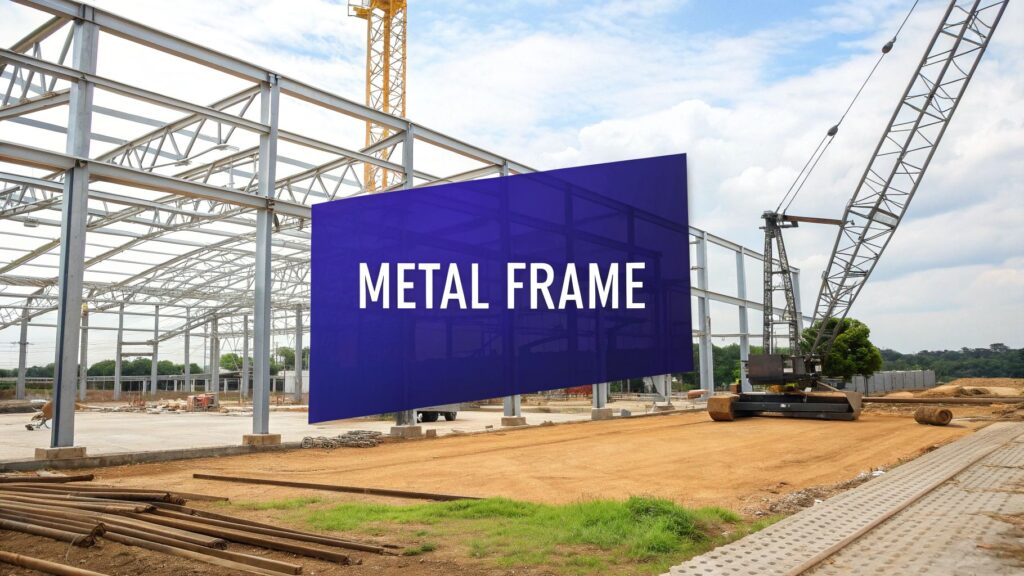
Think of a metal building frame as the skeleton of the structure. It’s the core system of beams and columns that gives the building its shape, holds everything up, and provides the strength to withstand the elements. Just like our bones, this frame is the essential foundation that everything else is built upon. Why a Metal Frame Is Your Building’s Backbone Every strong structure needs a solid core to hold it all together, and for modern buildings, that core is the metal building frame. It's far more than just a random assortment of steel beams; it's a meticulously engineered system designed to transfer every load—from the roof's weight to heavy snow—safely down to the foundation. This system is built from two key types of components working in harmony: primary and secondary framing. The primary frame handles the heavy lifting with massive columns and rafters that define the building's shape. Then, secondary framing like girts and purlins runs between those main supports, creating a sturdy grid to attach the roof and wall panels. The Raw Power of Steel There’s a good reason steel is the go-to material for these frames. Its incredible strength-to-weight ratio allows for massive, wide-open interior spaces without a forest of support columns getting in the way. This is a total game-changer for warehouses, airplane hangars, and indoor sports facilities where you need as much clear-span space as possible. And when you compare it to traditional wood, steel is in a league of its own. A steel frame is: Pest-Proof: Termites have nothing to chew on here. Rot-Resistant: Steel won't mold, decay, or warp when exposed to moisture. Naturally Fire-Resistant: It has an extremely high melting point and won't add fuel to a fire. At its heart, a metal building frame provides a durable, reliable, and incredibly long-lasting structural backbone. It's the permanent architecture ensuring the building stays stable and safe for decades, no matter what Mother Nature throws at it. The Economic Engine of Construction The impact of metal building frames goes well beyond just one construction site. The industry is a powerhouse for the U.S. economy, with the metal building structure manufacturing sector projected to hit sales of around $66.7 billion in 2024. That figure covers everything from the raw steel to the finished framing components that are the focus of any project. To put it in another context, think about the internal structure of a massive distribution center. Systems like industrial pallet racking, often considered the steel skeleton of a warehouse, demonstrate the same principle of engineered strength on a different scale. The building's frame does the exact same job, but for the entire structure that houses it. It's the unsung hero, providing the quiet strength that makes everything else inside possible. Matching The Right Frame To Your Project Choosing the perfect metal building frame is a lot like picking the right tool for a complex job—it sets the stage for efficiency, structural soundness, and long-term success. Before we dive into the specifics, let’s take a quick side-by-side look at how the most popular frame types stack up. Comparing Common Metal Building Frame Types This table compares key features, best-use cases, and typical span capabilities of different metal building frame designs. Frame Type Primary Feature Ideal Application Typical Clear Span Range Clear-Span Frame Unobstructed Interior Sports arenas, aircraft hangars, large warehouses Up To 200 Feet Modular Frame Easy Expansion Distribution centers, self-storage facilities, manufacturing plants 80–150 Feet Single-Slope Frame Simple, One-Way Drainage Retail storefronts, small office complexes, strip malls 30–60 Feet With this overview in hand, you’ll see at a glance which frame aligns with your project goals. This diagram highlights how metal frames branch into systems like Pre-Engineered Buildings and Rigid Frame Systems, each optimized for different needs. Clear-Span Frames For Unobstructed Space Think of a massive basketball court or an aircraft hangar—what they share is a need for vast, uninterrupted floor space. That’s where the clear-span frame earns its stripes. • It uses beefy rafters to carry the entire roof load directly to the foundation.• You eliminate interior columns, giving you 100% usable floor area.• Clear-span designs can often extend over 200 feet wide, making them perfect for: Agricultural buildings storing oversized equipment Indoor sports facilities like tennis courts or riding arenas Aviation hangars that must clear wide wingspans The biggest payoff? Total layout flexibility. No columns ever get in the way of your workflow or how you arrange equipment. Modular Frames For Future Growth Imagine your business booming next year—and needing more square footage. A modular frame anticipates that growth. • Interior columns share the roof load, lightening the stress on individual rafters.• Endwalls are non-load-bearing, so extending the building is as simple as swapping out a wall panel.• You save on initial costs and keep expansion options wide open. This approach is a strategic choice for anything from self-storage units to sprawling distribution centers. If you plan for the long haul, modular framing offers a cost-effective path to grow at your own pace. A modular frame lets you build boldly now and expand seamlessly later. Single-Slope Frames For Simplicity And Drainage A single-slope frame is exactly what it sounds like—one continuous roof pitch that makes one side taller than the other. It’s the go-to for retail shops, small offices, and strip malls where smart water management and curb appeal matter. • The taller front wall becomes a natural billboard for signage.• Rain and snow flow off the lower rear roof, away from customer entrances.• Its straightforward geometry keeps construction and material costs in check. If you’re eyeing an addition to an existing building, the single slope easily ties into higher adjacent walls. For a clean, modern look without breaking the bank, it’s hard to beat this simple frame. For more creative rooflines and layouts, explore how https://iconsteelbuildings.com/custom-steel-buildings/ can adapt steel frames to nearly any vision. The Real-World Benefits of Building with Steel When you're deciding on a building frame, you're not just making a technical choice—you're making a long-term investment