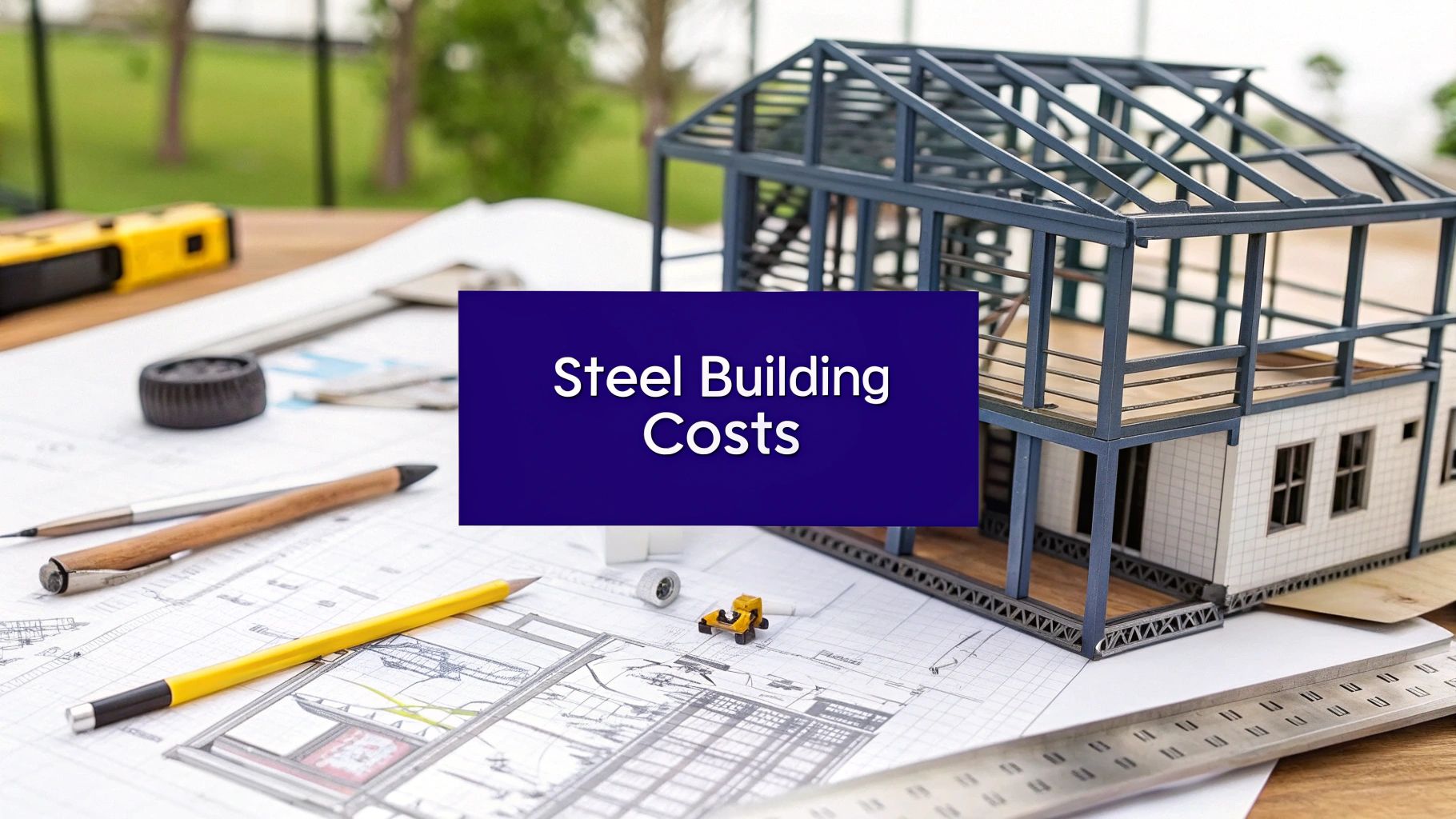
If you're looking for a straight answer on what a prefabricated steel building costs, you'll find that a fully installed structure typically lands somewhere between $15 and $43 per square foot.
That price gets you the building kit, the foundation, and the labor to put it all together. But think of that range as a starting point, not a final, locked-in number. The final price tag can shift based on how you customize it, where you're building, and even what's happening in the global steel market at the moment.
Your Quick Guide to Steel Building Prices
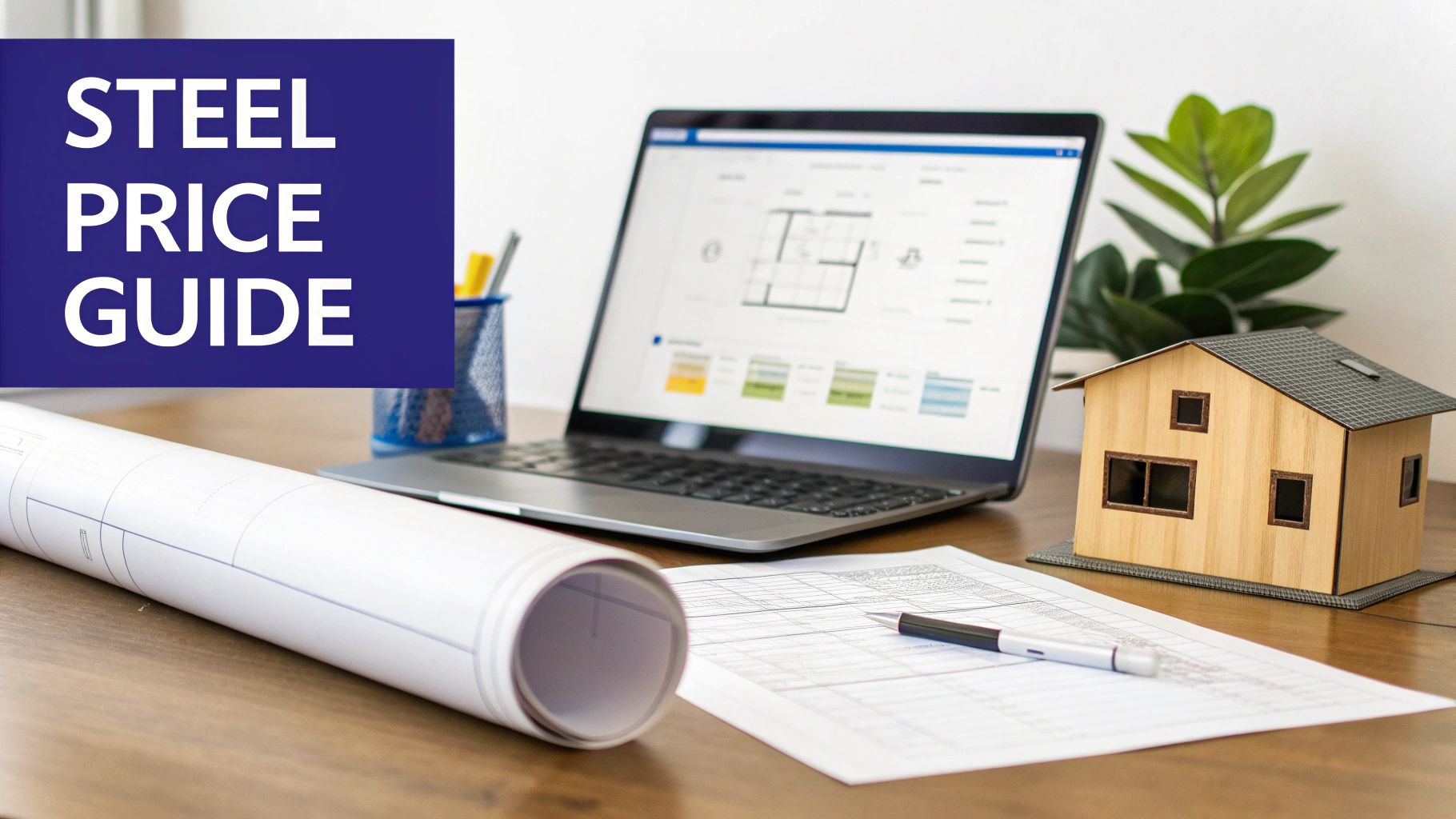
Trying to pin down a single price for a prefabricated steel building is a bit like trying to guess the cost of a car without knowing the make, model, or features. The final number is really a sum of its parts. It’s shaped by everything from the building's size and design complexity to the specific doors, windows, and finishes you choose. It’s less of an off-the-shelf purchase and more of a custom project built just for you.
This flexibility in design and cost is a big reason the industry is taking off. The global prefabricated building market was valued at around USD 248.0 billion in 2024 and is expected to climb to about USD 396.6 billion by 2033. That kind of growth shows just how much demand there is for efficient and adaptable construction solutions.
To give you a realistic idea of where your money goes, let's break down the core components that make up the total investment.
Core Cost Components
Knowing what you’re paying for is the first step to smart budgeting. The total cost isn't just about the steel frame; it involves several key stages, and each one has its own price tag. These are the main things that contribute to your project's final cost:
- The Building Kit: This is the heart of your project. It includes all the pre-engineered steel parts like the main frames, wall panels, and roofing. Our detailed guide on steel building kit prices dives deeper into what's included here.
- Foundation and Site Prep: Before any steel goes up, the ground needs to be ready. This involves clearing and grading the land and pouring a solid concrete foundation. This part of the job usually runs between $4 and $8 per square foot.
- Labor and Erection: This is the cost for the crew and equipment needed to assemble your building on-site. Labor rates can change quite a bit depending on where you're located.
- Custom Features: This is where you make the building your own. Things like windows, doors, insulation, and any interior finishing work will all add to the base price.
Key Takeaway: Looking at your project as a collection of these individual parts, rather than one big purchase, makes budgeting much more accurate. It also helps you see exactly where you can adjust things to save money.
To make this even clearer, here’s a quick breakdown of how these components typically contribute to the overall cost.
Quick Look at Steel Building Cost Components
| Cost Component | Average Price Range (Per Square Foot) | Description |
|---|---|---|
| Building Kit | $10 – $25 | The core pre-engineered steel structure, including frames, panels, and roofing. |
| Foundation | $4 – $8 | The concrete slab and site prep needed to support the building. |
| Labor/Erection | $3 – $10 | The cost to hire a crew to assemble the building kit on your foundation. |
| Customizations | Varies | Includes additions like doors, windows, insulation, and interior finishes. |
Remember, these figures are averages. A simple garage kit will be on the lower end, while a complex commercial building with high-end finishes will naturally cost more. The key is understanding how each choice impacts your bottom line.
The Real Cost Per Square Foot Explained
When you see a price per square foot for a prefabricated steel building, it's best to think of it as a starting point—not the finish line. That number is a foundational estimate, much like the base price of a new car. It gets you a solid, functional structure, but it doesn't include all the unique features that will make the building truly yours.
That initial cost per square foot is a helpful benchmark, but several key variables can push that number up or down. The biggest factors are the raw cost of steel, your building's specific dimensions, and even subtle design choices like the pitch of your roof. Getting a handle on these elements is the first step toward building a realistic budget and avoiding any surprises down the road.
The Ever-Changing Price of Steel
The price of steel is the bedrock of your building's cost, and it's constantly on the move. Global supply and demand, trade policies, and even raw material availability create ripples that affect the final price of your building kit. It’s a lot like how gas prices fluctuate; factors happening halfway around the world can influence what you pay.
Because of this, a quote you receive in January might look different from one you get in June. This market volatility is why it's so important to act on a quote you're comfortable with, as manufacturers can only lock in prices for a limited time. It's also a key reason the prefabricated metal building market continues to grow so quickly. Industry analysis projects a market size of roughly USD 209 billion in 2025, with strong demand driven by these efficient building solutions.
How Building Dimensions Affect the Price Per Square Foot
It’s easy to think a bigger building automatically means a higher cost per square foot, but it's a bit more nuanced than that. While the total price tag will definitely go up with size, the price per square foot often goes down as the building gets larger. This is all about economies of scale—engineering and manufacturing become more efficient on bigger projects.
Let’s look at a few key dimensional factors:
- Width: Making a building wider often requires heavier steel frames and more complex engineering to support a clear span, which can nudge the per-square-foot cost upward.
- Length: Adding length, on the other hand, is usually more cost-effective. It just means adding more of the same framing sections—a much simpler process.
- Height: Taller walls mean more steel for the vertical supports and more material for the wall panels, which directly increases the total price.
A wider building may require more structural reinforcement than a longer one of the same total square footage, impacting the final cost. Digging into how steel building costs are calculated can give you a much deeper insight into this.
Comparing Two Common Building Sizes
To put this into perspective, let's compare two common projects: a 40×60 workshop and a much larger 100×200 warehouse.
Example 1: The 40×60 Workshop (2,400 sq. ft.)
This is a go-to size for personal workshops, multi-car garages, or small storage facilities.
- Base Price Per Square Foot: You might see a starting price around $22 per square foot.
- Key Cost Drivers: The 40-foot width is a standard, efficient size. The cost is tied directly to the amount of steel needed for its simple rectangular design.
- Estimated Kit Cost: 2,400 sq. ft. x $22/sq. ft. = $52,800
Example 2: The 100×200 Warehouse (20,000 sq. ft.)
This size is common for commercial storage, manufacturing plants, or large-scale agricultural operations.
- Base Price Per Square Foot: Thanks to economies of scale, the price here might drop to around $18 per square foot.
- Key Cost Drivers: While the 100-foot clear span requires beefier steel frames, the efficiency gained from manufacturing such a large, simple structure helps drive down the per-square-foot cost.
- Estimated Kit Cost: 20,000 sq. ft. x $18/sq. ft. = $360,000
As you can see, the larger building has a much lower cost per square foot, even though its total price is significantly higher.
Roof Pitch and Other Design Details
Finally, don't forget that smaller design details add up. A steeper roof pitch, for example, needs more steel for the framing and more material for the roofing panels. It might be essential for handling heavy snow, but it will add to your bottom line. Your choice of roofing material also plays a big role, and you can explore the best metal roofing materials and their costs to get a better idea of those expenses.
By understanding these core components—steel market shifts, building dimensions, and design specifics—you can look past a simple square footage number and start building a truly accurate financial plan for your project.
How Upgrades and Customizations Shape Your Budget
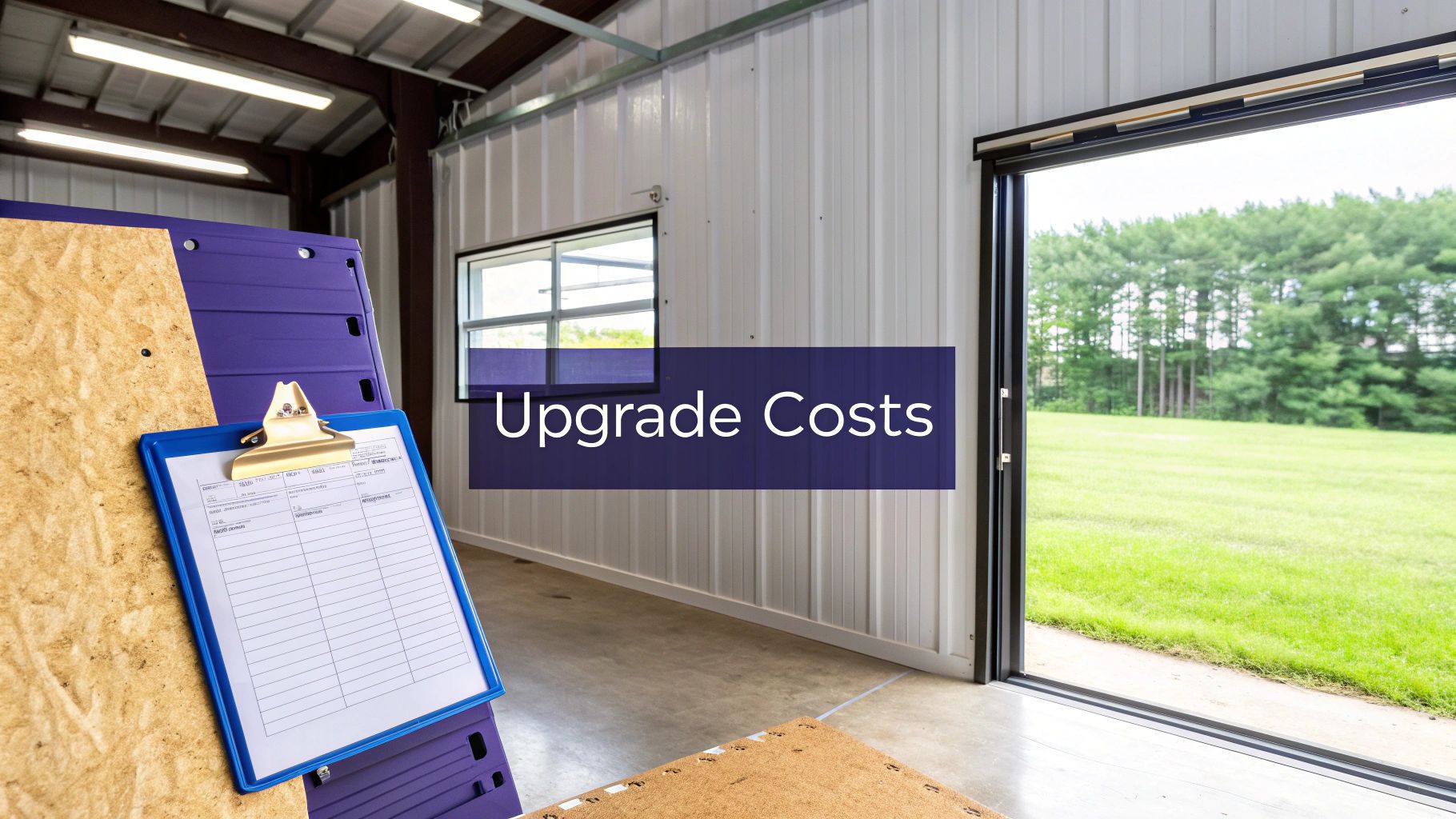
Once you've locked in the basic size of your building, it's time for the fun part. This is where your structure really starts to take on its own personality and, not surprisingly, where the final price tag begins to change based on your choices. Every upgrade you select, from the doors to the insulation, impacts both the building's function and your bottom line.
Think of your basic steel building kit as a blank canvas. It's tough and functional right out of the box, but it's the features you layer on top that make it yours. Adding windows for natural light, heavy-duty doors for security, or premium finishes for curb appeal—these aren't just costs. They're smart investments in your building's comfort, efficiency, and long-term value.
Doors and Windows: From Basic to High-Performance
Your building's entry points are one of the first places people look to customize. A standard kit will probably come with a simple man door and a basic roll-up door, but upgrading these can make a world of difference in price and performance.
For instance, a lightweight roll-up door is perfectly fine for a backyard shed. But if you’re running a commercial shop, you'll want a heavy-duty, insulated, and wind-rated door for security and climate control. That kind of upgrade can add anywhere from $1,500 to over $5,000 per door, depending on its size and features.
Windows are another key area. They bring in light and improve airflow, but the type you pick really matters.
- Standard Windows: Basic single-pane windows are easy on the wallet but don't offer much in the way of insulation.
- Upgraded Windows: Double-pane or low-emissivity (Low-E) windows cost more at the outset but can seriously cut down your heating and cooling bills.
- Skylights: These are fantastic for lighting up big interior spaces but need to be installed perfectly to avoid leaks, which adds to the labor cost.
The Critical Role of Insulation
Insulation is easily one of the most important upgrades you can make. It transforms a simple steel shell into a comfortable, year-round space. Without it, a metal building will feel like an oven in the summer and an icebox in the winter. The cost is tied to its R-value, which is just a measure of how well it resists heat—the higher the R-value, the better the insulation.
Investing in good insulation is a textbook case of spending more now to save a whole lot more later. The U.S. Department of Energy figures that proper insulation can save property owners up to 15% on heating and cooling costs.
A basic fiberglass blanket insulation might add $1.50 to $3.00 per square foot to your project. Bumping up to a more advanced option like spray foam or insulated metal panels (IMPs) is a bigger upfront investment, but you get top-tier thermal performance and a clean, finished interior. The right choice really comes down to what you'll be doing inside the building.
To help visualize how these choices affect your budget, here's a look at some common upgrades.
Standard vs. Upgraded Feature Cost Comparison
| Feature | Standard Option & Estimated Cost | Upgraded Option & Estimated Cost | Value Proposition |
|---|---|---|---|
| Roll-Up Door | Basic, non-insulated door. $800 – $1,500 | Insulated, wind-rated door. $1,500 – $5,000+ | Better security, climate control, and long-term energy savings. |
| Insulation | R-10 fiberglass blanket. $1.50/sq. ft. | R-30 spray foam or IMPs. $3.50+/sq. ft. | Superior energy efficiency, comfort, and a more professional interior finish. |
| Windows | Single-pane vinyl window. $200 – $400 | Double-pane, Low-E window. $500 – $900+ | Significantly lower heating/cooling bills and improved comfort. |
| Exterior Finish | Standard color panels. Included in kit | Premium colors or wainscoting. $500 – $2,500+ | Enhanced curb appeal and potential for higher property value. |
As you can see, the "better" option often pays for itself over time through lower operating costs and increased durability.
Aesthetic Upgrades and Finishes
Beyond pure function, how your building looks also influences the final price. Standard steel panels come in a variety of colors, but you can always choose premium finishes or different panel styles to get a specific architectural look.
Wainscoting—using a different color or material on the lower part of the walls—is a popular and relatively affordable way to add some visual flair. You could also add an interior liner panel to give the inside walls a clean, finished look, which also protects your insulation and brightens the space. Checking out different options for custom steel buildings is a great way to see the huge range of design possibilities out there.
By thinking through each of these upgrades, you can strike the perfect balance between your budget and your building’s needs, creating a structure that’s built to serve you well for years.
Planning for Costs Beyond the Building Kit
It's easy for first-time buyers to get laser-focused on the price tag of the prefabricated steel building kit. That makes sense—it’s the main event, after all. But the kit is just one part of a much bigger financial picture. The total cost of your project will include a whole range of essential services and materials that come into play before, during, and after that steel frame ever goes up.
Think of it like buying an engine for a car. The engine is the heart of the vehicle, but you still need a chassis, wheels, and a skilled mechanic to turn it into something you can actually drive. In the same way, your building project needs site work, a foundation, and labor to become a complete, functional structure.
Forgetting to budget for these "beyond the kit" costs is one of the most common mistakes we see new buyers make. Getting a handle on these expenses from day one is the best way to keep your project from going over budget and derailing your plans. Let's break down these critical, and often overlooked, cost centers.
Site Preparation and Foundation Work
Before a single piece of your building can be put in place, the land itself needs to be ready. This initial phase, called site preparation, is the literal groundwork for everything that follows. It involves a few key steps.
- Clearing and Grading: This is all about removing trees, rocks, and any other debris, then leveling the building pad to create a flat, stable surface. The cost here can vary wildly depending on what your property looks like to begin with.
- Excavation: If your plans include any below-ground features or specialized foundation footings, you'll need to dig out those areas.
- Utility Hookups: You also have to factor in connecting water, sewer, and electricity to the site. This can involve trenching and working directly with your local utility companies.
Once the site is prepped, the next big job is pouring the concrete foundation. This is the solid base your building will be anchored to, and its cost can run anywhere from $4 to $8 per square foot. The final price will hinge on how thick and complex the foundation needs to be. For a closer look at this crucial step, you can learn more about specific steel building foundation requirements and what they involve.
Shipping and Delivery Fees
Your prefabricated steel building kit is made at a manufacturing facility and then shipped directly to your property. These delivery costs are almost never baked into the initial per-square-foot price of the kit, so you have to budget for them separately.
Shipping fees are typically calculated based on two things: the total weight of your building's components and the distance from the factory to your job site. It stands to reason that a massive, heavy building shipped clear across the country will cost more to transport than a smaller kit delivered just a few towns over. Always make sure to ask your supplier for a detailed shipping quote so there are no surprises when the truck arrives.
Labor and Erection Costs
Unless you’re tackling a smaller, DIY-style project, you’ll need to hire a professional crew to put your building together. Labor is a major expense, often making up a huge chunk of the total installed cost.
Erection costs can swing up or down based on:
- Building Complexity: A simple, rectangular barn is going to be faster and cheaper to erect than a building with a tricky roofline or several different sections.
- Required Equipment: Big projects often need heavy machinery like cranes or forklifts, which will add to the daily labor bill.
- Local Labor Rates: What you pay for a skilled construction crew can vary dramatically from one part of the country to another.
Expert Tip: To get a real sense of what it will cost, get at least three quotes from experienced local contractors who specialize in putting up steel buildings. This helps you find a competitive price and ensures you’re hiring a team that knows the local building codes inside and out.
The demand for these efficient construction methods is definitely on the rise. The prefabricated steel building market is expected to grow from USD 94.8 billion in 2025 to nearly USD 146.9 billion by 2032, driven by rapid urbanization and infrastructure needs. When you're mapping out the finances for your own project, securing the right construction business loans can be a vital piece of your overall strategy.
Real-World Steel Building Price Examples
It’s one thing to talk about per-square-foot estimates and another to see how those numbers shake out on a real job site. To make sense of kit prices, customizations, and all those "beyond the kit" costs, let's walk through four actual project scenarios.
These examples tell the story of four very different builds, from a simple homeowner’s garage to a hardworking commercial warehouse. We’ll break down the pricing for each one so you can see exactly where the money went and get a clearer picture of how your own budget might come together.
Case Study 1: The Two-Car Residential Garage
A homeowner needed a solid, secure spot for two cars plus a small workshop area. They went with a simple, functional design where durability was the main goal, not fancy aesthetics.
- Building Dimensions: 30’ x 40’ (1,200 sq. ft.)
- Key Customizations: One insulated roll-up door, a single man door, and two standard windows to let in some natural light. They also added a simple wainscoting finish to give it a bit more curb appeal.
- Total Project Cost: Approximately $41,000
So, how did they get to that number? The steel building kit itself was about $24,000. Pouring the concrete foundation and prepping the site added another $7,200 (which works out to $6 per sq. ft.). Finally, hiring a professional crew to put it all together cost $9,800, a figure that included their equipment rental.
This infographic really drives home how quickly those post-kit costs can add up.
As you can see, the foundation, shipping, and labor costs often combine to match or even blow past the price of the building kit. That's a critical detail to remember when you're budgeting.
Case Study 2: The Agricultural Barn
A small farm needed a versatile barn for hay and equipment storage, plus shelter for a few animals. The design had to be open, airy, and tough enough to handle the daily grind of farm life.
- Building Dimensions: 50’ x 80’ (4,000 sq. ft.)
- Key Customizations: Two huge sliding doors for easy tractor access, skylights for natural light without running up the electric bill, and one open-wall side for ventilation.
- Total Project Cost: Approximately $95,000
For this one, the bigger but simpler kit ran about $64,000 ($16 per sq. ft.). They needed a heavy-duty foundation that could handle tractors and equipment, which was poured for $20,000. Labor for this larger structure came in at just $11,000, mostly because the open-wall design made the build a bit less complex.
Case Study 3: The Commercial Retail Space
A local business owner was building a small retail storefront from the ground up. Not only did it need to look great for customers, but it also had to meet a laundry list of strict commercial building codes.
- Building Dimensions: 60’ x 100’ (6,000 sq. ft.)
- Key Customizations: A full glass storefront system, premium insulation for energy efficiency, multiple entry doors, and a decorative roof overhang. The inside also needed steel framing for partition walls.
- Total Project Cost: Approximately $216,000
This project is a perfect example of how customizations can really drive up the final price. A basic 6,000 sq. ft. shell would have been far cheaper, but the features needed to create a safe, welcoming commercial space added significantly to the investment.
The heavily customized kit alone was $132,000. The commercial-grade foundation and major site work (including all the plumbing and electrical rough-ins) cost $48,000. Labor was a hefty $36,000 because of the complexity of installing the storefront and framing the interior.
Sometimes, you can catch a break by choosing standard sizes; our guide on the massive clearance on steel buildings explains how that can really help your budget.
Case Study 4: The Small Industrial Warehouse
A logistics company needed a small warehouse for storing and distributing products. The must-haves were high ceilings to accommodate pallet racking and a tough structure that could handle daily forklift traffic.
- Building Dimensions: 80’ x 120’ (9,600 sq. ft.) with a 24’ eave height.
- Key Customizations: Four commercial-grade roll-up doors, high R-value insulation, and flooring that was reinforced in the loading bay areas.
- Total Project Cost: Approximately $328,000
The building kit, which had to be engineered for the extra height and local snow load requirements, cost $192,000. The reinforced industrial foundation was a huge expense at $76,800. Finally, labor costs and the crane rental needed for the tall structure came to $59,200.
As these examples show, prefabricated steel building prices are always a direct reflection of a project's unique demands.
Smart Strategies for a Budget-Friendly Build
Controlling the final cost of your steel building isn't about cutting corners—it’s about making smart, strategic decisions right from the start. With a bit of planning and insider knowledge, you can seriously lower the overall prefabricated steel building prices without ever compromising on quality.
One of the simplest ways to save a chunk of change is by sticking to standard building dimensions. Manufacturers churn out popular sizes like 30×40 or 40×60 all the time, which means their engineering and fabrication processes are already dialed in. When you choose a common footprint, you sidestep the premium costs that come with custom designs and complex engineering, which can easily add thousands to your final bill.
Timing Your Purchase and Keeping it Simple
Another savvy move is to plan your purchase during the off-season. Like any other industry, steel building manufacturers have their busy seasons and their slow spells. Buying during those off-peak months, usually in late fall or winter, can open the door to better pricing as demand dips. You'll often find that manufacturers are more willing to negotiate just to keep their production lines humming.
You can also keep costs in check by simplifying your design. Every fancy feature, from a complicated roofline to a ton of door and window openings, drives up both material and labor costs. A clean, rectangular design is almost always the most wallet-friendly choice, giving you the most space for your dollar.
Pro Tip: When you're gathering quotes, always ask suppliers if they have any pre-designed or overstocked building kits on hand. These are typically standard-sized models that are ready to ship and might come with a hefty discount.
The DIY Route and Thinking Long-Term
For smaller, more straightforward projects like a backyard garage or a personal workshop, a Do-It-Yourself (DIY) erection can be a total game-changer. Assembling the building yourself or with a small crew cuts out the cost of hiring a professional erection team, which can save you thousands in labor. This approach definitely requires the right tools and a bit of construction know-how, but it offers the single biggest opportunity for direct savings.
Finally, don't forget to think about long-term financial wins. Investing a little more upfront in energy-efficient features can pay you back for years.
- High R-Value Insulation: Upgrading your insulation might cost more initially, but it will slash your monthly heating and cooling bills for the life of the building.
- Reflective Roofing: A roof with a reflective coating can significantly lower your building's internal temperature, a huge advantage in warmer climates.
Making these kinds of smart choices ensures your building is not only affordable to put up but also cheap to own and operate for decades to come.
Common Questions About Steel Building Costs
As you get closer to making a decision, a few final questions always seem to pop up. It's completely normal. Getting these last details ironed out is what gives you the confidence to move forward. Let’s tackle some of the most common things people ask about.
How Much Does a Concrete Foundation Cost?
A solid foundation isn't just important—it's everything. Think of it as a non-negotiable part of your budget that falls outside the building kit itself. On average, you can expect a standard concrete slab foundation to run between $4 and $8 per square foot. That price usually covers site prep, materials, and the labor to pour and finish the slab.
Of course, that's just a starting point. If your building will house heavy machinery, you'll need a thicker, reinforced foundation, which will push that cost up. The same goes for your land—if it needs a lot of grading or excavation before the crew can even think about pouring concrete, that will add to the final bill.
Are Financing Options Available?
Absolutely. In fact, most people use financing to manage the investment. Instead of a typical home mortgage, you’ll most likely be looking at a construction loan. It's a common route, and many steel building manufacturers have established relationships with third-party lenders who are experts in this kind of project financing.
Securing financing is a standard step for projects of all sizes, from a backyard workshop to a large commercial facility. It's a smart way to spread the cost out over time, making it possible to get the exact building you need without draining your cash reserves.
What Are the Long-Term Maintenance Costs?
This is where steel buildings really pull away from the competition. Compared to wood or brick, the long-term upkeep costs for a steel structure are incredibly low. It's one of their biggest selling points.
- Forget Repainting: The steel panels we use today come with high-tech finishes designed to resist fading, chipping, and chalking for decades. You can cross "paint the building" off your to-do list for a very long time.
- No Pests, No Rot: Termites can’t eat steel, and it won’t rot or grow mold. You’ll never have to spend a dime on pest control or replacing rotten boards.
- Built to Last: Your main maintenance tasks will be simple check-ups. Just an occasional walk-around to make sure fasteners are tight and a quick wash to keep the exterior looking sharp is all it takes.
When you add it all up, the total cost of ownership is tough to beat. You get to avoid all those recurring expenses that slowly drain your budget with traditional construction.
Ready to turn your vision into a durable, cost-effective reality? The experts at Icon Steel Buildings are here to provide a clear, no-obligation quote tailored to your exact needs. Start planning your project today by visiting us at https://iconsteelbuildings.com.