So, you're wondering how much steel buildings actually cost. Let's cut right to the chase: there's no single price tag. You might see a simple kit advertised for around $15 per square foot, but a fully finished commercial building can easily top $50 per square foot. That’s a huge range, and for good reason.
The True Cost of a Steel Building Explained
Think of it like buying a new truck. You have the base price for the standard model, but that number climbs once you start adding the bigger engine, the premium interior, and the off-road package. A steel building works the exact same way. The price you see advertised is just the starting point.
The final cost is a blend of several key expenses, not just the building itself.
- The Building Kit: This is your core package—the steel frame, wall panels, and roofing materials.
- The Foundation: Every building needs a solid base. A concrete slab or pier foundation is a major, and separate, expense.
- Construction Labor: You need a skilled crew to put it all together, and their labor is a significant part of the budget.
- Customizations and Add-Ons: Things like doors, windows, insulation, and interior finishes will all add to your bottom line.
Understanding these pieces from the get-go is the key to building an accurate budget and avoiding sticker shock down the road. That online price calculator? It's likely just quoting the kit, which often only makes up 40-60% of your total project cost.
A Starting Point for Your Budget
To give you a more realistic idea of what to expect for the building kit alone, it helps to look at costs by building type. Different uses demand different engineering, materials, and features, and that directly shapes the price.
A simple residential garage just doesn't have the same complex requirements as a massive industrial warehouse designed to support heavy cranes and meet strict commercial codes.
To help you get started, here's a quick look at typical price ranges for the steel building kit based on how it'll be used. Think of this as your baseline before we get into the details that can move these numbers up or down.
Estimated Steel Building Cost Per Square Foot by Use Case
This table breaks down the typical cost for just the building kit, so you have a solid starting point for your budget. These numbers don't include foundation, delivery, or construction labor.
| Building Type | Typical Size Range (Sq. Ft.) | Estimated Cost Per Sq. Ft. (Kit Only) |
|---|---|---|
| Residential Garage/Workshop | 500 – 2,000 | $18 – $28 |
| Agricultural Barn/Storage | 2,000 – 10,000 | $15 – $25 |
| Commercial Retail Space | 5,000 – 20,000 | $22 – $35 |
| Industrial Warehouse | 10,000 – 50,000+ | $16 – $26 |
| Recreational Facility | 15,000 – 60,000+ | $20 – $40 |
As you can see, the bigger the building, the lower the cost per square foot tends to be. This is thanks to economies of scale in manufacturing and materials—it's just more efficient to produce a larger structure.
This demand for efficient construction is clear when you look at the market. The global prefabricated building and structural steel market was valued at USD 248.0 billion in 2024 and is on track to hit USD 396.6 billion by 2033. This boom is driven by the need for faster, smarter building methods where steel’s incredible strength and durability make it the perfect choice.
For a deeper dive, check out our detailed guide on the average cost of a steel building to see how manufactured, delivered, and installed prices all come together.
Core Factors That Determine Your Steel Building Price
https://www.youtube.com/embed/jRqi-ayeT8g
Trying to answer "how much are steel buildings?" is a lot like asking how much a custom car costs. There's no single sticker price. Instead, the final number is a blend of several key ingredients that shape your project from the ground up.
Think of it this way: your final quote is built from four core factors. Once you understand what they are and how they work together, you'll see why a simple online calculator can only give you a ballpark estimate and how you can make smarter decisions to get the most building for your budget.
Building Size and Dimensions
This one’s the most obvious. The sheer size of your building—its length and width—is the biggest driver of cost. A larger footprint means more steel, more wall panels, and more roofing materials. It's simple math.
But it’s not just about square footage. The eave height, which is the height from the floor to where the walls meet the roof, plays a massive role. Taller buildings need thicker, beefier steel columns and a more robust frame to handle the extra stress and maintain their structural integrity. That all adds to the material costs.
So, a 40×60 building with a 12-foot eave height will always be more affordable than a 40×60 building with a 20-foot eave height, even though they cover the exact same amount of ground.
Steel Market Fluctuations
The price of steel itself is a moving target. It’s best to think of the global steel market like the stock market—it goes up and down based on worldwide supply and demand.
Things like international trade policies, the cost of raw materials like iron ore, and even energy prices can make steel prices shift, sometimes week to week. When construction booms and demand for steel is high, prices climb, and that increase gets passed on to the cost of your building kit.
The market is a direct reflection of global economic health. In 2024, the global steel market was valued at roughly USD 1.47 trillion, and it’s projected to hit USD 1.92 trillion by 2030. This growth is fueled by huge infrastructure projects and a construction sector that eats up over 45% of all steel produced.
Key Takeaway: A quote for a steel building is almost always time-sensitive, usually good for about 30 days. Suppliers have to do this to protect themselves against the constant swings in raw steel prices.
Geographic Location and Local Codes
Where you plan to put your building has a huge impact on the final price tag, and it has nothing to do with shipping costs. It’s all about the local building codes, which are specifically designed to handle the weather and geological events common to your area.
A building going up in a calm, inland region has completely different engineering needs than one on the hurricane-battered coast of Florida or in the heavy snow country of Colorado.
- Wind Loads: Coastal areas require buildings engineered to handle intense, high-velocity winds. This means a stronger frame, more secure connections, and a higher cost.
- Snow Loads: Northern climates need roofs that can bear the crushing weight of feet of accumulated snow, which calls for thicker steel and specific roof pitches.
- Seismic Codes: If you're building near a fault line, strict seismic codes demand specialized engineering to ensure the structure can survive an earthquake.
Meeting these local codes isn’t optional. It requires a tougher, more resilient—and therefore more expensive—design and materials. For a different perspective on how location and specs affect installation pricing, check out our guide to bollard installation costs, which shows how similar factors apply even on a smaller scale.
Design Complexity and Customization
Finally, the complexity of your building’s design plays a major role. A simple, rectangular box with a standard gable roof will always be your most cost-effective option. Why? It uses standardized parts and requires the most straightforward engineering.
The moment you start adding custom features, the price starts to tick upward. Complex designs demand more detailed engineering, specialized manufacturing processes, and more skilled labor to put it all together.
These are some of the features that can significantly bump up the final cost:
- Complex Rooflines: Anything beyond a simple gable or single-slope roof, like a multi-level design, adds to the engineering and material bill.
- Irregular Shapes: An L-shaped or T-shaped building is far more complex to frame than a standard rectangle.
- Multiple Bays: The number of bays—the space between the main frame columns—and how you space them out impacts the entire frame design. To get this right, it helps to understand how to choose your metal building frame.
- Support for Heavy Equipment: If your building needs to hold up heavy machinery like an overhead crane, the entire frame has to be seriously reinforced, which adds significant cost.
Each of these factors—size, steel prices, location, and design—weaves together to create your final quote. It’s the reason why two buildings with the exact same square footage can end up with wildly different price tags.
Customization and Add-Ons That Impact Your Budget
Once you've nailed down the basic footprint of your steel building, the real fun begins. This is where you start turning a simple shell into a fully functional space. Think of the basic building kit as your blank canvas; the doors, windows, insulation, and other add-ons are the details that truly bring your vision to life.
Every one of these choices directly shapes the final answer to "how much are steel buildings?" They transform a baseline estimate into a hard, final number. These features aren't just for show—they define how you'll actually use the building. A simple storage barn might just need a single roll-up door, but a commercial auto shop? That's a different story. You'll need multiple bay doors, personnel doors, windows for light, and serious insulation to keep the temperature steady.
Essential Access: Doors and Windows
A building isn't much use if you can't get in and out. Doors and windows are the most fundamental add-ons, but the variety of options—and their price tags—is massive. The choices you make here come down to one thing: your building's purpose.
A standard walk-in door, just like one you'd find on a house, is a pretty small investment, usually adding just a few hundred dollars. But the costs climb fast when you start looking at larger, more specialized openings.
- Roll-Up Doors: These are the workhorses for garages, warehouses, and barns. A light-duty, manual door might run you $800 to $1,500. Need a heavy-duty, commercial-grade door that's wind-rated and motorized? You can easily expect to pay $3,000 to $7,000, sometimes more.
- Windows: Simple single-pane windows are a great, low-cost way to let in natural light. But if you're building a climate-controlled office or workshop, you’ll want energy-efficient, insulated, or even impact-rated windows, and the price per window will jump accordingly.
The trick is to match the feature to the function. Don't over-engineer it. Putting a high-wind-rated door on a shed in a calm climate is just wasted money. On the flip side, skimping on an insulated door for a heated workshop will come back to bite you on your energy bills.
Climate Control: Insulation and Ventilation
Insulation is one of the most important decisions you'll make, especially if your building is for anything other than cold storage. This isn't just about being comfortable. Good insulation can slash your heating and cooling costs over the life of the building, offering a huge return on your initial investment.
Key Insight: A properly insulated steel building can cut energy costs by up to 50%. While it adds to the upfront price, the long-term savings on utility bills often pay for the insulation itself in just a few years.
You've got a few insulation options, each with a different price and R-value (its thermal performance). Fiberglass blanket insulation is a solid, cost-effective choice for most projects. For buildings that need strict temperature control, like a commercial freezer or a comfortable office, you might look at spray foam or insulated metal panels (IMPs). They offer top-tier performance but come with a higher price tag.
Don't forget about ventilation. It's another key player in managing your building's interior climate and air quality. Ridge vents, louvers, and powered fans all help stop condensation from building up, which can cause moisture problems down the road. They're relatively cheap additions that deliver a major benefit.
Aesthetic and Functional Finishes
Beyond the nuts and bolts, a range of finishes can boost both the look and the utility of your building. Some of these are "nice-to-haves," but others can add serious value and curb appeal. These are just a few of the ways you can dive into the world of custom steel buildings to create the perfect structure for your needs.
To help you see how these choices stack up, here’s a quick breakdown of common add-ons and their general budget impact.
Cost Impact of Common Steel Building Add-Ons
| Add-On Feature | Typical Cost Range | Primary Benefit |
|---|---|---|
| Wainscoting | $5 – $10 per linear foot | Adds a polished, two-tone look and protects the building's base from damage. |
| Gutters & Downspouts | $8 – $20 per linear foot | Manages rainwater, preventing foundation erosion and water damage. |
| Overhangs & Canopies | $1,000 – $5,000+ | Provides architectural style and protects entryways from sun and rain. |
| Skylights & Wall Lights | $200 – $800 per panel | Floods the interior with natural light, reducing electricity usage. |
| Walk-In Doors | $400 – $1,200 each | Provides standard personnel access, just like in a traditional building. |
| Upgraded Insulation | $1.50 – $4.00 per sq. ft. | Dramatically improves energy efficiency and long-term utility savings. |
As you can see, each element brings its own layer of cost but also a distinct layer of utility and style. The final step is to weigh what you absolutely must have against what would be nice to have. By doing that, you can customize a building that perfectly fits both your operational needs and your budget.
Beyond the Kit: Understanding Total Project Costs
One of the biggest mistakes I see people make is confusing the sticker price of a steel building kit with the final, turn-key cost. It's an easy trap to fall into, but it can blow your budget out of the water if you're not careful.
Think of it like this: the building kit is just one slice of the pie. A big slice, for sure, but it often only accounts for 40% to 60% of your total project cost. To truly answer the question, "how much are steel buildings," you have to account for everything else needed to take that kit from a pile of steel on a truck to a finished, functional structure.
It's like buying a car but forgetting to budget for tax, title, and insurance. Those aren't optional extras; they're essential costs to actually get on the road.
Deconstructing the Complete Project Budget
So, where does the rest of the money go? It’s not just fluff. There are several major, non-negotiable costs that every project has. Getting a handle on these is the first step to creating a realistic budget that won't give you any nasty surprises.
- Concrete Foundation: This is literally the base of your entire project. Steel buildings need a precisely engineered concrete foundation—either a slab or piers—to anchor them securely. The cost can swing quite a bit depending on your soil conditions, required slab thickness, and local labor rates, but it's a major expense you need to plan for from day one.
- Shipping and Delivery: Your building components are big, heavy, and need specialized freight to get to your site. Delivery fees will depend on how far you are from the factory and the sheer size of your order, often adding a few thousand dollars to the bill.
- Construction and Labor: Unless you’re a pro tackling a small, simple DIY kit, you’re going to need a crew. Labor is a huge chunk of any construction budget, and rates can vary dramatically based on your location and how complex the build is.
- Equipment Rentals: You can't put up a steel building with just hand tools. Your erection crew will almost certainly need to rent heavy machinery like a crane, forklift, or scissor lift to safely and efficiently assemble the main frame and wall panels.
Visualizing the Add-Ons
The infographic below does a great job of showing how even standard features like doors, windows, and insulation start adding up, turning that basic kit into a building you can actually use.
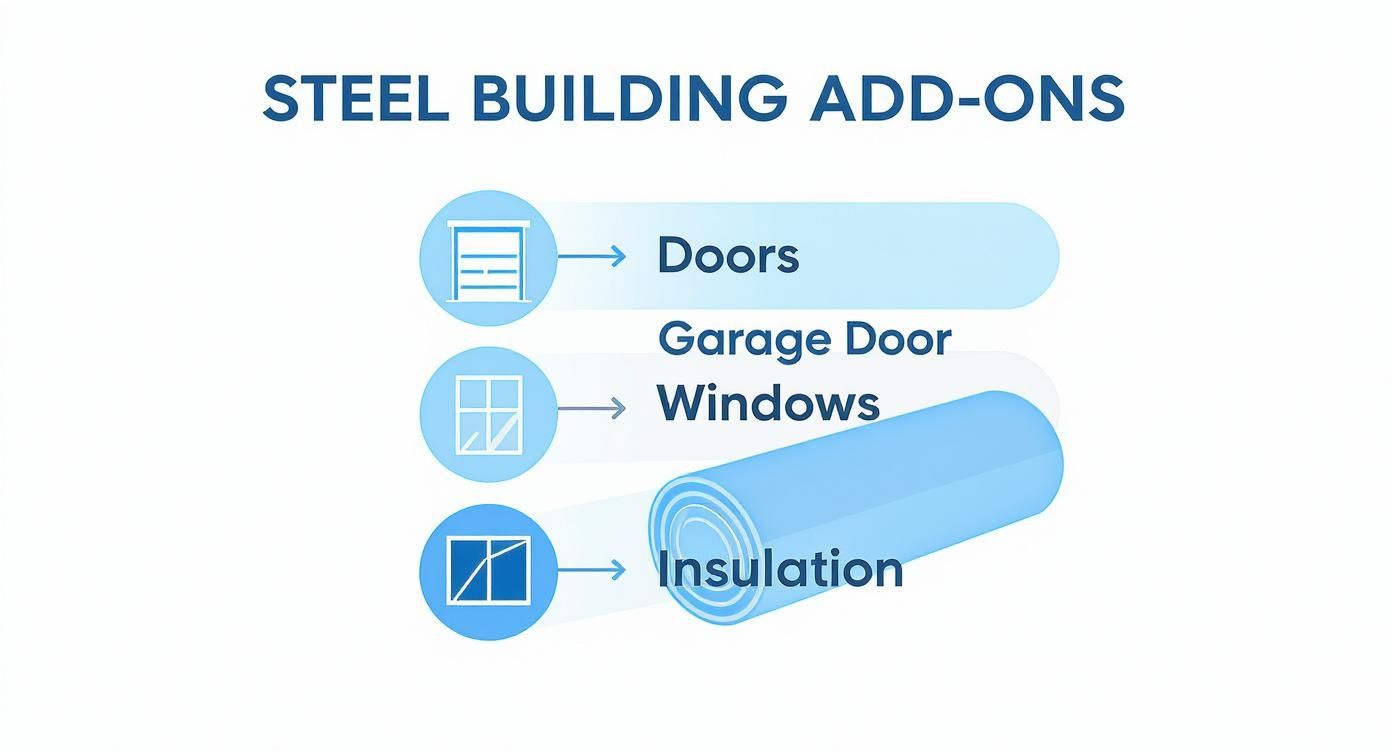
Every one of these items—from a simple walk-in door to high-R-value insulation—adds another layer to your total investment, pushing the final number well beyond that initial kit price.
Hidden Costs and Market Trends
And it doesn't stop there. When you're looking at the full financial picture, you've got to be aware of potential hidden roofing costs and other line items that can sneak up on you. Think permits, extensive site prep, or bringing utilities to a rural lot. This is exactly why a detailed, line-by-line budget is so crucial.
The demand for faster, more efficient construction is also shaping the market. The prefabricated steel building systems market was valued at USD 2.01 billion in 2024 and is projected to hit USD 2.79 billion by 2032. This tells us that while costs fluctuate, the industry is definitely leaning into the speed and sustainability of steel.
Ultimately, building a comprehensive budget means looking past the advertised kit price. By accounting for the foundation—which you can learn more about in our guide to steel building foundation requirements—as well as delivery, labor, and equipment, you can create a realistic financial roadmap and avoid those costly surprises down the line.
Smart Strategies to Optimize Your Steel Building Budget
Knowing what drives the cost of a steel building is one thing. Using that knowledge to your advantage is where the real savings happen. With a few smart decisions, you can cut your final project cost significantly without sacrificing an ounce of quality or function.
It’s a bit like grocery shopping. You could grab everything at full price, or you could be strategic—using coupons, buying what's in season, and choosing store brands to make the same quality meal for less. The same logic applies here. A few practical choices can make your budget stretch further than you ever imagined.
Plan for Standard Dimensions and Colors
One of the easiest ways to keep costs down is to work with your manufacturer, not against their process. Steel is produced in standard lengths and sizes. When you design your building to align with those standards, you minimize scrap material and completely sidestep the extra costs that come with custom fabrication.
It's the same story with paint. Manufacturers offer a lineup of standard colors they produce in huge batches, which makes them incredibly cost-effective. A custom color might seem like a minor detail, but it requires a special production run that can add a surprising amount to your final invoice.
- Stick to Standard Sizes: Chat with your supplier about common building dimensions. They can point you to the pricing sweet spots.
- Choose Standard Colors: Opting for a standard color for your walls, roof, and trim can easily save you hundreds, if not thousands, of dollars.
Time Your Purchase Wisely
Like a lot of industries, the steel building market is seasonal. Demand for new construction naturally skyrockets in the spring and summer when the weather is perfect for building. This surge in demand often drives prices up.
On the flip side, if you can order your building during the off-season—think late fall or winter—you can often lock in some serious savings. Manufacturers want to keep their production lines moving, and they're more likely to offer better pricing to earn your business. It's a simple timing strategy that can trim your costs without changing a single thing about your building.
Pro Tip: Ask suppliers about their production schedule. If you can place your order during one of their slower periods, you’ll have much more leverage to negotiate a better deal.
Invest Upfront to Save Long-Term
It might sound strange to spend more to save more, but certain upfront investments deliver an incredible return over the life of your building. The perfect example? Insulation.
Adding a high-quality insulation package does increase your initial cost, but the payoff is massive. It can slash your heating and cooling expenses by as much as 50%. Over a decade or two, those energy savings will far exceed the initial investment, putting money back into your pocket year after year. For a deeper dive into your options, our guide on steel building kit prices offers some great insights.
Always Get Multiple Quotes
Finally, the single most powerful tool in your budget-optimizing toolkit is comparison shopping. Never, ever settle for the first quote you get. Make it a rule to reach out to at least three or four reputable suppliers for competitive bids.
This process does more than just ensure you're getting a fair price. It also gives you a much clearer picture of what different companies include in their standard packages, helping you make a truly informed decision.
Got Questions About Steel Building Costs? We’ve Got Answers.
When you first start pricing out a steel building, the quotes can feel like they're all over the map. One supplier comes in high, another seems suspiciously low, and it's tough to know what you’re actually paying for. It’s a common frustration, but we’re here to clear the air.
Let's tackle the biggest questions head-on. We'll break down why those quotes vary so much, settle the age-old steel versus wood debate, and give you a simple checklist to get the most accurate price right from the start.
Why Do Quotes Vary So Much Between Suppliers?
You did your homework. You sent the exact same building specs to three different companies, but the numbers that came back are miles apart. What gives? It's a classic scenario, and the answer rarely boils down to one company being "cheap" and another being "expensive."
The real difference almost always comes down to three things: the quality of the steel, the rigor of the engineering, and what’s actually included in the kit.
- Steel Quality and Gauge: Let's be clear: not all steel is created equal. A lower quote might be using a lighter gauge (thinner) steel for the secondary framing or wall panels. While that saves a few bucks upfront, it can seriously compromise your building's ability to stand up to heavy wind or snow, not to mention its overall lifespan.
- Engineering Standards: A reputable supplier delivers a building that is fully engineered for your specific location, designed to meet the local building codes for wind, snow, and seismic loads. A cheaper quote might be based on a generic, one-size-fits-all design that won’t pass inspection in your county, leaving you with a very expensive problem.
- What's in the Box?: One quote might include premium fasteners, heavy-duty trim, and beefy door frame-outs as standard. Another company might list those as pricey upgrades. You have to ask for a line-by-line breakdown to see what you're truly getting for your money.
Crucial Insight: An unusually low quote is almost always a red flag. It’s often a sign of corner-cutting—think lower-grade materials, uncertified engineering, or a bare-bones package that will nickel-and-dime you with expensive "extras" down the road. A good quote is a balance of fair price and high-quality, code-compliant materials.
Is It Cheaper to Build with Wood or Steel?
This is the big showdown in construction. At first glance, a wood-framed pole barn often looks like the cheaper option. In fact, the initial kit price for a pole barn can be about 15% less than a comparable steel building. But that upfront price tag is only one chapter of a much longer story.
When you zoom out and look at the total cost of ownership over the building's lifetime, steel pulls ahead almost every time.
- Maintenance: Wood is needy. It has to be painted or stained, and you're always on watch for rot, termites, and warping. Steel, on the other hand, is practically maintenance-free. Set it and forget it.
- Insurance: Here’s a big one. Because steel is non-combustible and immune to pests and rot, insurance premiums for a steel building can be up to 30% lower than for a similar wood structure. Those savings stack up, year after year.
- Durability and Lifespan: A steel building is engineered to last, with warranties often running up to 40 years. Wood is just more vulnerable to the elements and has a much shorter functional lifespan before major repairs or replacement are needed.
So while the first check you write for a pole barn might be smaller, the long-term savings on maintenance, insurance, and replacement make steel the smarter financial move.
What Information Do I Need for an Accurate Quote?
Want a fast, reliable quote that you can actually take to the bank? The key is to come prepared. The more details you can give the supplier, the less they have to guess, and the more precise your pricing will be. It saves everyone from a frustrating game of phone tag.
Before you call or fill out that online form, get these key details sorted out:
- Building Dimensions: You need to know your desired length, width, and eave height. This is the absolute starting point.
- Job Site Location: The full address or at least the zip code is essential. This lets the supplier calculate the engineering loads required by your local building codes.
- Building Use: What’s it for? A simple storage barn has very different requirements than a commercial workshop, a retail space, or an equestrian facility.
- Doors and Windows: Get a rough count of how many you need, along with their sizes and types (e.g., walk-in doors vs. roll-up doors).
- Desired Features: Make a list of any special add-ons you want, like insulation, skylights, gutters, or specific color schemes.
Having this information ready makes the entire process incredibly smooth and ensures you’re comparing apples to apples when you get different quotes.
At Icon Steel Buildings, we believe in total transparency. Our team is here to walk you through every step, helping you design the perfect American-made structure that fits your vision and your budget. Get your free, no-obligation quote today!