
So, you're trying to nail down the answer to the big question: **how much do metal buildings cost?So, you're trying to nail down the answer to the big question: how much do metal buildings cost? The short answer is that the price for just the building kit typically lands somewhere between $15 to $30 per square foot. If you're looking for a fully installed or "turnkey" project, you can expect to pay between $35 and $60 per square foot.
But of course, there's more to it than that.
Your Quick Guide to Metal Building Costs
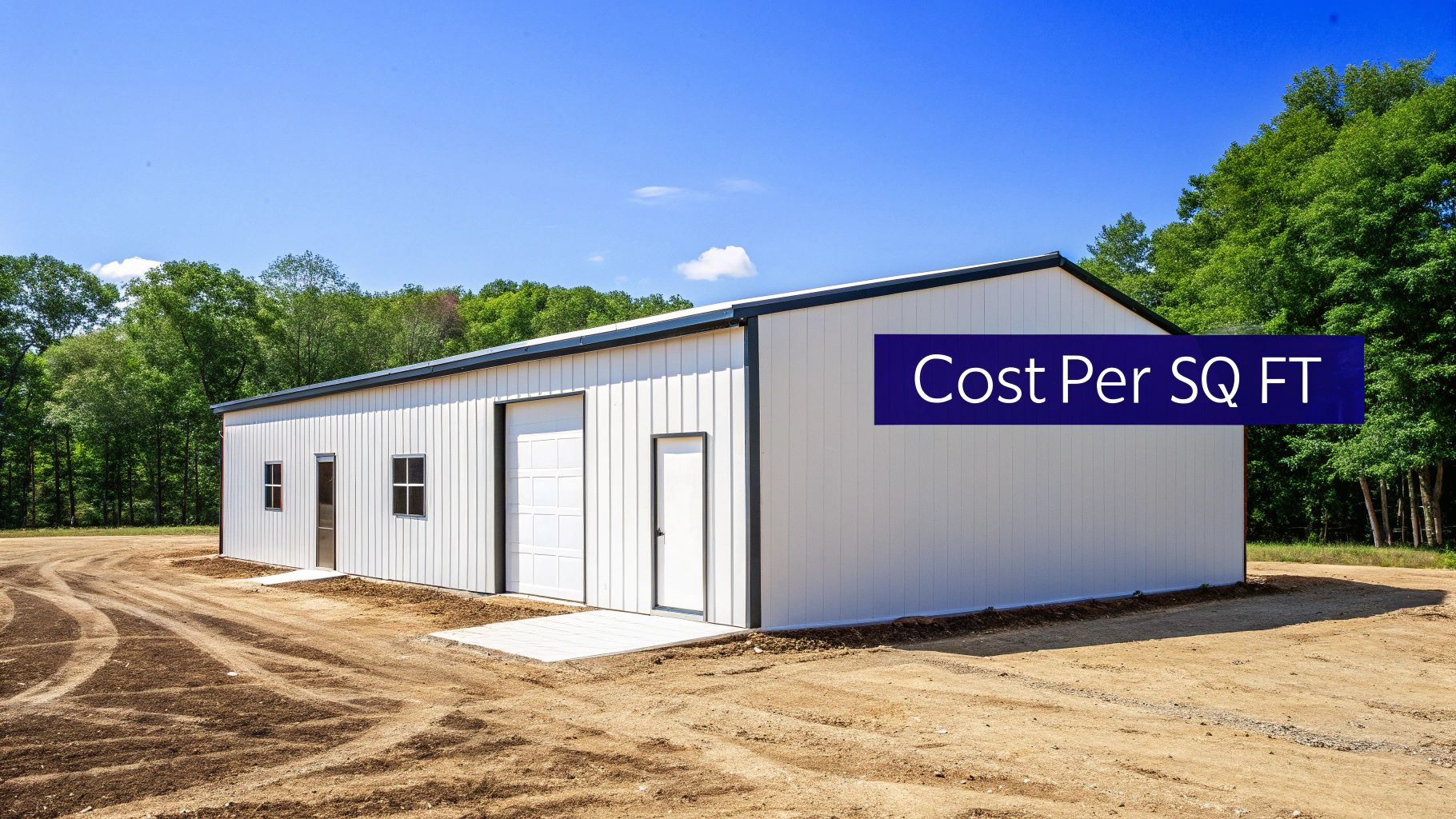
To really wrap your head around the total investment, you have to look at two completely different paths: buying a do-it-yourself kit or going for a complete turnkey installation. The price gap between these two is pretty wide, and for good reason—one includes just the materials, while the other covers everything from the foundation to the final bolt being tightened.
Think of a metal building kit like a giant, industrial-strength LEGO set. You get all the essential pieces delivered right to your property: the primary steel frame, wall panels, roofing materials, and all the nuts and bolts to put it together. This is a fantastic route for seasoned builders or anyone looking to roll up their sleeves and manage the construction themselves to cut down on labor costs.
A turnkey solution, on the other hand, is the full-service, hands-off package. It includes the building kit plus the concrete foundation, professional assembly, and sometimes even basic interior finishing. This is the ideal choice if you want a streamlined experience where a pro handles everything from start to finish.
Breaking Down the Price Per Square Foot
The cost of any metal building is tied directly to the price of raw materials, especially steel, which can fluctuate with the market. That said, the industry has some reliable ballpark figures you can use for budgeting.
To give you a clearer financial snapshot, we've put together a quick-reference table.
Estimated Metal Building Cost At A Glance
This table breaks down the typical price ranges and shows you exactly what you're paying for, whether you go with a basic kit or a full installation.
| Project Type | Average Cost Per Square Foot | What's Included |
|---|---|---|
| Metal Building Kit | $15 – $30 | Steel framing, wall & roof panels, fasteners, basic plans. |
| Turnkey Installation | $35 – $60 | The kit, concrete foundation, delivery, and professional labor. |
As you can see, the initial kit price is just the starting line. A turnkey project often doubles that cost because it folds in the essential foundation and labor needed to bring the structure to life.
These figures are a solid baseline for your initial budget. As you start planning, you can use these ranges to estimate the potential investment for your dream building. For a more detailed look, you can dig deeper into specific metal building kit prices and see how different sizes impact the bottom line.
Next, we'll get into the nitty-gritty factors—from design choices to your location—that can push these numbers up or down.
Decoding the Core Cost Drivers of Your Project
Trying to understand why one metal building costs more than another is a bit like comparing a standard pickup truck to a fully loaded, custom-built dually. They're both trucks, sure, but the final price tag is a direct result of size, power, and all the features you add on. It's the same exact story when you ask, "how much do metal buildings cost?" The answer always comes down to a few core variables that have a massive impact on your budget.
Think of these factors as the main ingredients in your building's recipe. Tweak any one of them, and you'll change the final result—and the final price. The good news is, once you get a handle on these key drivers, you're in complete control of your project's bottom line.
Building Size: The Foundation of Your Budget
The most straightforward cost driver is, without a doubt, building size. A bigger footprint—meaning more length, width, and height—requires more steel for the frame, the walls, and the roof. That directly translates to higher material costs.
But here’s where it gets interesting. As a building gets bigger, the cost per square foot often goes down. Think about painting a tiny closet versus a large, open living room. The room needs more paint overall, but the time and effort you spend setting up per square foot is way less. The same principle applies to metal buildings. Larger projects benefit from economies of scale during manufacturing and installation, which makes them more efficient on a per-foot basis.
So, while a massive 50×100 warehouse will have a higher total price than a 30×40 workshop, that larger structure is almost certainly a better value from a square footage perspective.
Key Takeaway: Total cost goes up with size, but the price per square foot typically drops. This efficiency is a huge reason why steel is the number one choice for large-scale commercial and agricultural buildings.
Steel Gauge and Design Complexity
Not all steel is the same. The steel gauge, which is just a fancy term for its thickness, is a critical cost factor. A lower gauge number actually means thicker, stronger—and yes, more expensive—steel. For example, 22-gauge steel is significantly more robust and pricier than the standard 26-gauge steel.
What determines the gauge you need? Your building's location and how you plan to use it.
- Heavy Snow Loads: If you're building in a snowy climate, you'll need thicker steel and a reinforced frame to handle all that weight.
- High Wind Ratings: Buildings in coastal areas or storm-prone regions require stronger structures to stand up to powerful winds.
- Specific Uses: A building designed to hold heavy machinery or an overhead crane needs a much beefier frame than a simple storage shed.
Beyond the steel itself, design complexity plays a huge part in the final cost. A simple, rectangular "box" design will always be your most affordable option. Every customization from there adds to the price tag.
- Complex Rooflines: Adding multiple peaks, dormers, or a steep roof pitch requires more materials, specialized engineering, and a lot more installation time.
- Clear-Span Interiors: An open interior with zero support columns is one of the best features of steel. But achieving a really wide clear span (think over 100 feet) means using bigger, heavier beams, which drives up the price.
- Custom Openings: Need several large garage doors, custom windows, or framed openings for future expansion? Each one complicates the engineering and adds to the material list.
Unpacking Other Important Cost Factors
While size and design grab the headlines, several other details will shape your final quote. Think of each choice as a lever you can pull to dial your budget up or down. To truly get a grip on what your project will cost, it's always a good idea to consider professional quantity surveying for accurate cost estimation and management.
Here's a closer look at how some of these other key factors can influence your final building price.
How Key Factors Influence Your Final Building Price
The table below breaks down how different choices and specifications directly impact the overall cost of a metal building project. From the ground up, every decision matters.
| Cost Factor | Low-Cost Option | High-Cost Option | Typical Price Impact |
|---|---|---|---|
| Foundation | Standard slab-on-grade | Thickened-edge or pier foundation | Can add $6-$15 per sq. ft. |
| Insulation | Basic fiberglass blankets | High R-value spray foam | Increases cost by 15-25% |
| Doors & Windows | Standard roll-up doors, non-insulated windows | Commercial-grade overhead doors, insulated windows | Varies widely based on quantity and quality |
| Exterior Finishes | Standard color panels (PBR) | Premium finishes, wainscoting, or brick facades | Can add $3-$10+ per sq. ft. |
The foundation, especially, is a major expense that isn't included in the building kit price but is absolutely essential for your building's stability and longevity. For a deeper dive into this critical step, our guide covers key steel building foundation requirements you’ll need to plan for. By carefully weighing each of these drivers, you can make smart decisions that perfectly align your building's design with your budget.
Comparing Real World Prices by Building Size
Theory and percentages are helpful, but nothing brings a budget into focus quite like seeing real-world numbers. To really get a handle on what a metal building will cost, we need to move past the abstract and look at some concrete examples for the most popular sizes out there.
These figures will give you a solid foundation for your initial planning. It’s one thing to talk about cost per square foot, but seeing the actual price tags for common dimensions helps you visualize the investment. After all, a small workshop has a completely different price point than a large commercial warehouse.
This infographic breaks down the main factors—building size, steel thickness, and design choices—that all add up to your final project price.
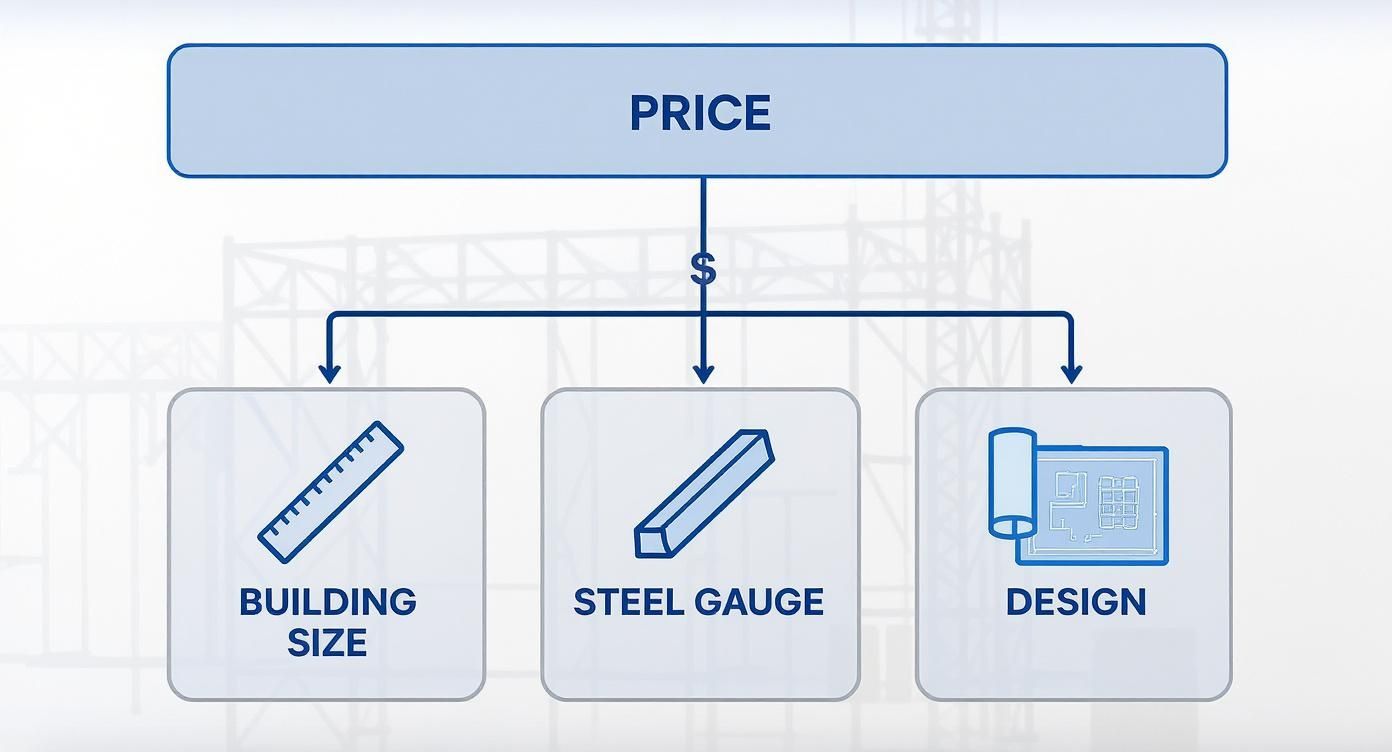
As you can see, the overall cost is a series of decisions, but the building's dimensions are always the most significant starting point for any budget.
Cost Estimates for Common Building Dimensions
To give you a practical baseline, let's break down the typical costs for three standard building sizes. These cover a huge range of uses, from personal garages to serious commercial operations.
In the North American market, pricing for common metal building kits scales up predictably with size. For example, a 30×40 foot kit often lands around $24,000. A larger 40×60 foot kit is about $43,200, while a substantial 50×100 foot building can run up to $75,000.
Just keep in mind, these numbers are for the building kit only—that means the steel frame, panels, and fasteners. They don’t include extras like the concrete foundation, delivery, or construction labor.
The 30×40 Metal Building: A Versatile Starting Point
A 30×40 metal building gives you 1,200 square feet of usable space, which is why it's an incredibly popular choice for all sorts of applications. It’s the perfect size for a roomy two-car garage, a personal workshop, or even a small retail storefront.
- Common Uses: Large garages, woodworking shops, hobbyist spaces, small business storage.
- Typical Kit Cost: $17,000 – $25,000
- Cost Per Square Foot: Approximately $14 – $21
The 30×40 footprint really hits that sweet spot between affordability and function, offering plenty of room without the cost of a massive structure. If you're leaning toward this size, our detailed guide on 30 x 40 metal building kits is a great resource for digging into customization options and project planning.
The 40×60 Metal Building: The Commercial Sweet Spot
When you step up to a 40×60 building, you get 2,400 square feet—doubling the space of the previous example. This size is a true workhorse in the commercial and agricultural worlds, perfect for things like equipment storage, light manufacturing, or an auto repair shop.
At this size, the principle of economies of scale really starts to kick in. While the total price is higher, the cost per square foot is often lower than smaller buildings, offering better value for your investment.
- Common Uses: Agricultural storage, auto body shops, small warehouses, community centers.
- Typical Kit Cost: $36,000 – $48,000
- Cost Per Square Foot: Approximately $15 – $20
The 50×100 Metal Building: For Large-Scale Needs
A 50×100 metal building delivers a massive 5,000 square feet of clear-span interior space. This is the go-to dimension for serious commercial, industrial, or agricultural operations that need wide-open floor plans for machinery, inventory, or large-scale activities.
This size is perfect for:
- Warehousing and Distribution: Plenty of room for pallet racking, forklifts, and managing inventory.
- Manufacturing Facilities: The open space allows for efficient production line layouts.
- Large Equipment Storage: Easily houses combines, tractors, RVs, and other big vehicles.
- Typical Kit Cost: $65,000 – $80,000
- Cost Per Square Foot: Approximately $13 – $16
Notice how the cost per square foot continues to drop? It makes these larger buildings a much more efficient investment for those who truly need the space. Hopefully, these real-world examples give you a much clearer picture of what to expect as you start budgeting for your project.
Uncovering the Hidden Costs Beyond the Kit
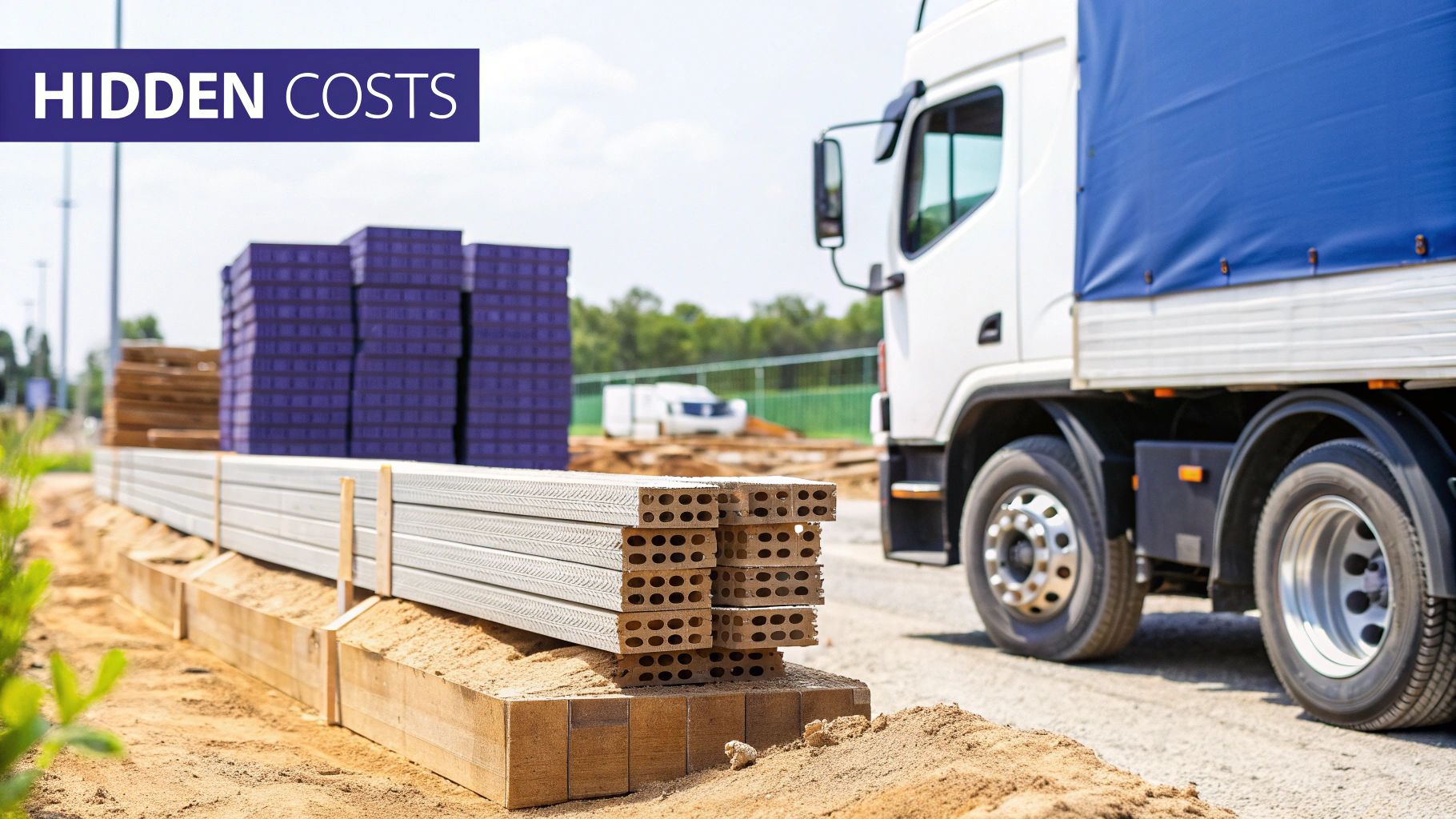
It’s easy to get excited about the sticker price of a metal building kit, but that number is really just the tip of the iceberg. To truly understand your total investment, you have to look beyond the shiny steel panels and see the full picture. The kit price is your starting point, not your finish line.
Think of it like buying a powerful engine for a custom car. You’ve got the heart of the machine, but you still need a frame, wheels, wiring, and a hundred other parts to get it on the road. The same logic applies here; the final cost of a fully functional building includes a series of crucial "hidden" costs that many first-time buyers don't see coming.
These additional expenses are what transform a pile of steel into a finished, usable structure. Planning for them upfront is the single best way to keep your budget on track and avoid major headaches down the road.
Breaking Down the Hard Costs
Before any steel even arrives at your property, the land needs to be ready. These initial "hard costs" are the non-negotiable expenses tied directly to the physical prep and construction of your building. They form the literal foundation of your project and are just as critical as the building itself.
- Site Preparation: Your land might look flat, but it’s rarely construction-ready. This step involves clearing trees, grading the land for proper drainage, and leveling the building pad. This can run from a few thousand dollars to much more if you're dealing with a heavily wooded or sloped lot.
- Concrete Foundation: This is one of the biggest expenses outside the kit. A steel building needs a robust concrete slab to anchor it securely. Depending on your location and soil conditions, this can add $6 to $15 per square foot to your total budget.
- Delivery and Freight: The building kit has to get from the factory to your site. When you're dealing with large, heavy components, always be prepared for potential unexpected freight surcharges that can sneak up and inflate your budget.
Factoring in Labor and Erection Costs
Unless you’re a seasoned builder with your own heavy machinery, you're going to need a professional crew to put your building together. This process is called "erection," and it’s a major line item in any steel building budget.
Hiring a pro team ensures the building is constructed safely, meets all warranty requirements, and complies with local codes. The price for this service varies widely based on your building's size, complexity, and local labor rates, but it's a vital investment in the structure's long-term strength. To get a better feel for everything involved, it helps to understand the full scope of professional metal building installation services.
Budgeting Guideline: A good rule of thumb is to plan for erection labor to cost roughly 40-60% of your building kit's price. So, for a $20,000 kit, that means budgeting an additional $8,000 to $12,000 just for assembly.
Don't Forget the Interior Finishing Costs
Once the shell is up, you still have an empty box. Turning it into a functional space requires finishing the interior, and these costs can add up fast, depending on how you plan to use the building.
Think about what you need inside the structure to make it operational. These are the systems that bring your building to life, providing comfort, safety, and utility.
Essential Interior Systems:
- Insulation: This is absolutely crucial for climate control and energy efficiency. Options range from affordable fiberglass blankets to high-performance spray foam, which can increase the total building cost by 15-25%.
- Electrical Work: This covers everything from running wires and installing outlets to putting in lighting fixtures and connecting to the main power grid.
- Plumbing: If your building needs restrooms, sinks, or any kind of drainage, you'll need to budget for a complete plumbing system.
- HVAC Systems: Heating, ventilation, and air conditioning are essential for almost any workspace or residential building to ensure a comfortable environment year-round.
By accounting for all these necessary additions—from the dirt work to the drywall—you can create a realistic, all-in budget that reflects the true cost of your finished metal building.
How Global Market Trends Impact Your Final Price
The price you get for a metal building isn’t just pulled out of thin air. It’s tied directly to a massive web of global economic forces that can make prices swing, sometimes with very little warning. Getting a handle on these big-picture trends is the key to understanding why a quote you get today might look totally different from one you got six months ago.
Think of the global steel market as a giant reservoir that all manufacturers draw from. When something big happens—like a new trade policy or a major shipping bottleneck—it creates ripples that eventually find their way to your local supplier. These things are way outside of any single company's control, but they absolutely affect the final number on your estimate.
When you understand these dynamics, you're in a much better position to anticipate market shifts, time your purchase, and recognize the real value of locking in a good price when you see one.
The Major Influence of Steel Tariffs
One of the biggest factors driving the cost of metal buildings is government trade policy, especially steel tariffs. A tariff is really just a tax on imported goods. When that tax is slapped on raw steel, it instantly makes the core material for your building more expensive for everyone down the line.
And this isn't just a tiny price bump; it's a major shock to the market. For example, recent U.S. steel tariffs have triggered immediate price jumps of 10-12% on metal building projects, with more hikes possible as those costs work their way through the supply chain. This pressure gives manufacturers no choice but to raise their prices to cover their own new expenses.
This is exactly why a quote you got just before a new tariff was announced could be completely out of date a few weeks later. The fundamental cost of the raw material has changed overnight.
Supply Chain and Raw Material Volatility
Beyond official government policies, the simple laws of supply and demand are always at play. The global supply chain is a surprisingly delicate system, and a disruption anywhere can have a huge domino effect.
Things like international conflicts, a shortage of shipping containers, or even a natural disaster can jam up the production and transport of steel coil. When the supply gets tight but demand stays high, prices have nowhere to go but up.
The Ripple Effect: A slowdown at a port on the other side of the world can cause a steel coil shortage for a U.S. manufacturer weeks later. That shortage, in turn, means a higher price for you, the customer. It’s a perfect example of how your local project is connected to the global economy.
This volatility actually highlights why steel is often one of the most affordable construction choices in today's economy. Its pricing is transparent and reflects real-time market conditions, unlike other materials that might have hidden markups baked in.
Using Seasonal Demand to Your Advantage
While global trends can feel completely out of your hands, there’s one factor you might be able to use to your advantage: seasonal demand. The construction industry has a natural rhythm with clear peaks and valleys throughout the year.
- Peak Season (Spring and Summer): This is when everyone is building. Demand for materials and labor skyrockets, which can easily lead to higher prices and longer waits.
- Off-Peak Season (Late Fall and Winter): Construction naturally slows down in colder weather, causing demand for metal buildings to dip.
If your project timeline has some wiggle room, buying your building during this off-peak season can often land you a better deal. Manufacturers and suppliers are keen to keep their crews and production lines busy, which can translate into significant savings for you. Timing your purchase for the fall or winter could be a seriously smart financial move.
Answering Your Top Questions About Metal Building Costs
Once you start digging into the numbers, a few key questions always pop up. Answering "how much do metal buildings cost" is never just a simple square-foot price; it’s about understanding the real-world choices that shape your final investment.
This section is all about giving you direct, no-nonsense answers to the most common questions we hear every day. We'll tackle the age-old wood vs. steel debate, break down what "turnkey" actually means for your wallet, and show you how your zip code and a little DIY spirit can completely change the final price tag. Let's clear up the confusion so you can move forward with confidence.
Is It Cheaper To Build With Wood Or Metal?
This is the classic construction showdown, and the answer isn’t always black and white. At first glance, a metal building kit often looks much cheaper, especially for large, open-span designs like a warehouse or a big workshop. To get that same column-free space with wood, you’d be looking at complex, expensive engineering with laminated beams.
Metal's prefabricated design also slashes on-site labor time and material waste, which saves you a chunk of change. However, the costs can start to level out when you add in the heavy-duty concrete foundation a steel building needs. For smaller, more traditional residential-style structures, wood can sometimes have a lower upfront cost.
The Long-Term View: The real savings with metal often show up over the building's life. Steel is incredibly durable, needs far less maintenance, and won't be bothered by rot, termites, or fire. Those benefits often lead to lower insurance premiums and fewer surprise repair bills down the road.
What Does a Turnkey Price Actually Include?
The term "turnkey" is supposed to mean the project is 100% finished—you just "turn the key" and move in. In the world of metal buildings, a turnkey price usually covers everything needed to get the shell of your building standing and weatherproof.
A standard turnkey package almost always covers:
- The complete building kit.
- Delivery of all materials to your property.
- The concrete foundation slab.
- Full professional construction of the building shell.
- Installation of standard doors and windows.
What’s critical to understand is what’s usually left out. Interior finishing is almost never part of a base turnkey price. That means you’ll still need to budget separately for things like electrical wiring, plumbing, HVAC systems, drywall, and flooring. Always ask for an itemized contract to see exactly what is—and isn't—included in your quote to avoid any costly surprises.
How Much Does My Location Affect the Final Cost?
Your geographic location plays a huge role in the final cost of your building, often in ways that surprise people. It’s not just one thing; it’s a combination of factors all tied directly to your property’s address.
First, shipping costs are a simple matter of distance from the manufacturing plant. The farther away you are, the more you'll pay in freight. Second, local labor rates for concrete and construction can vary wildly. A crew in a rural area might charge a lot less than one in a major city.
Most importantly, your location determines the local building codes. An area with heavy winters will require a higher "snow load" rating, which means a stronger (and more expensive) frame. Likewise, a coastal region at risk for hurricanes will need a much higher "wind load" rating. These engineering demands directly increase the amount of steel required, pushing up the price.
Can I Save Money by Erecting the Building Myself?
Absolutely. You can save a significant amount of money with a DIY installation, but you need to go into it with your eyes wide open. For smaller, simpler kits—like a two-car garage or a personal workshop—putting the building up yourself can save you thousands in labor. It's often the single biggest way to cut your budget.
However, this is only a realistic path if you have the right tools, a few capable friends to help, and some real construction experience. You'll need access to heavy equipment, like a lift, to safely get the steel beams into place. A small mistake during assembly could compromise the building's structural integrity, void your warranty, or lead to fixes that cost way more than hiring a pro crew from the start.
Before you commit to a DIY build, be honest about your skills, your tools, and the complexity of the building. For larger or more intricate structures, professional erection is almost always the smarter, safer bet.
Ready to turn your vision into a reality with a building that’s built to last? The experts at Icon Steel Buildings are here to provide a clear, detailed quote that covers all your project needs. Get Your Free Quote Today!