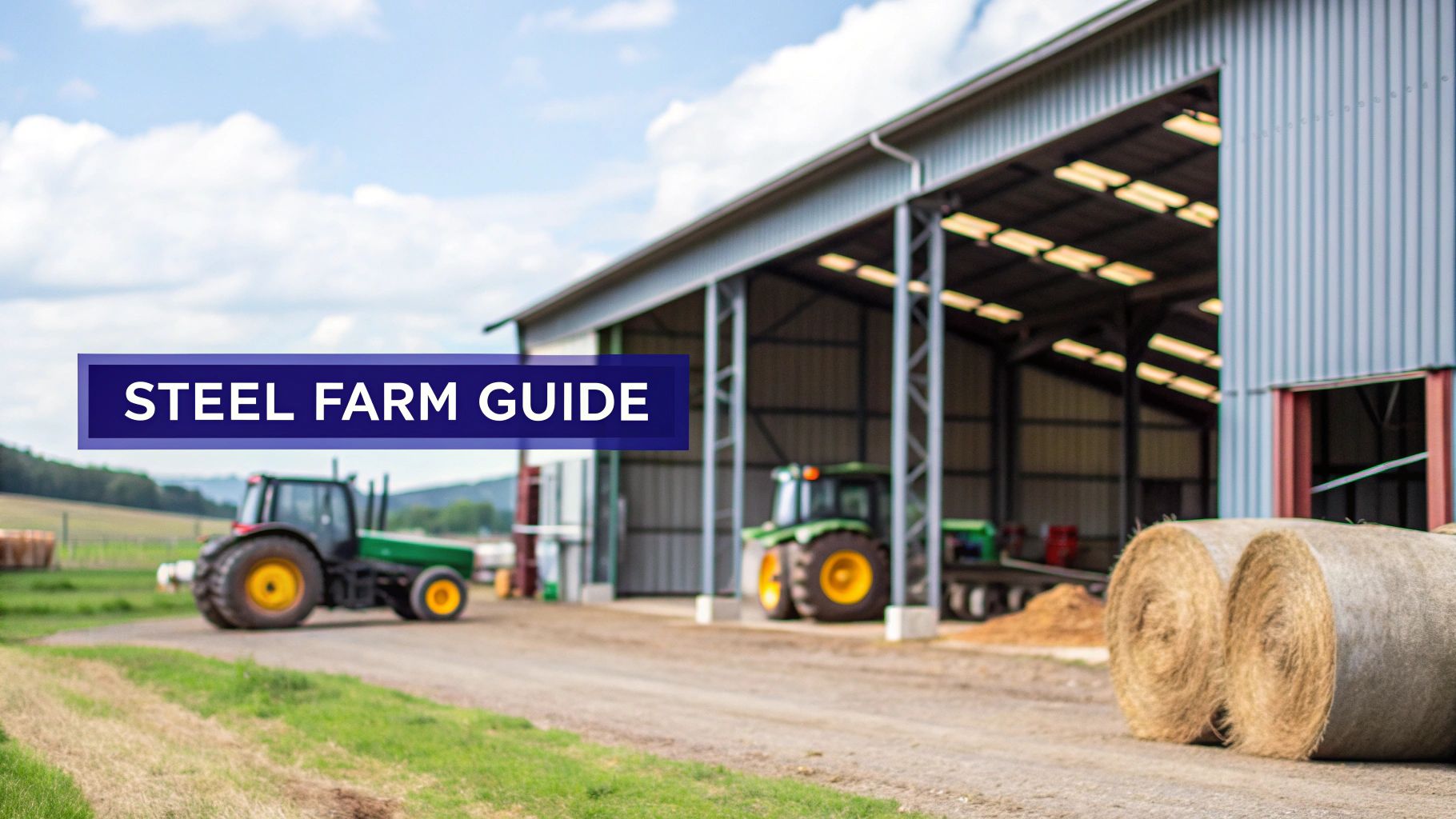
Metal agricultural buildings are so much more than just a place to park a tractor. Think of them as a strategic upgrade for your entire operation—like swapping a hand plow for a modern GPS-guided tractor. It's a fundamental leap forward in how you protect your assets and run your farm. These structures are the new foundation for a secure, efficient, and profitable agricultural business.
The Modern Backbone of Farming Operations
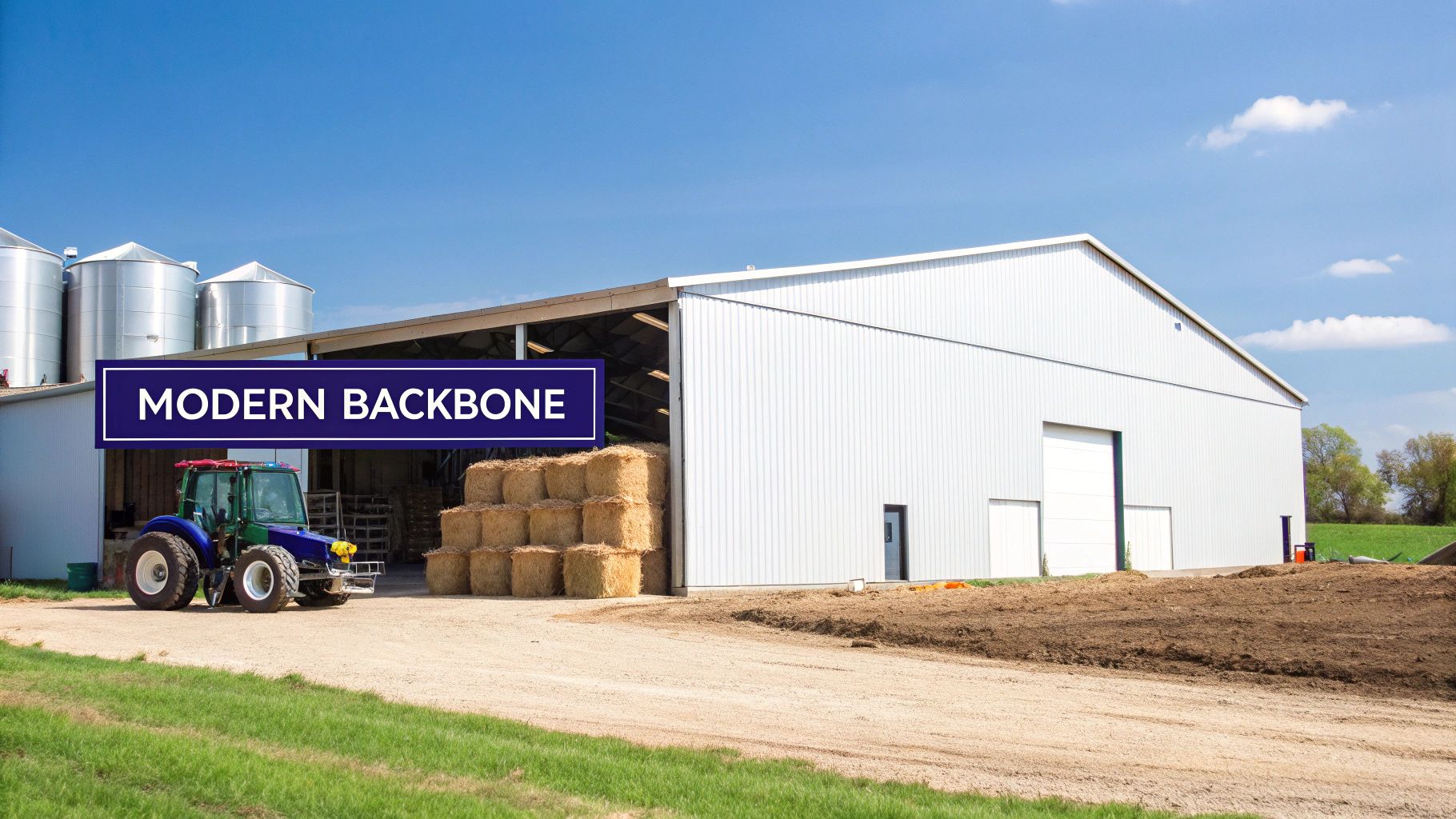
In today's farming world, every single decision you make hits the bottom line, and choosing your infrastructure is one of the biggest. Metal agricultural buildings have become the go-to choice, not just because they look clean and modern, but because they serve as a powerful shield for a farm's most valuable assets. These buildings are specifically engineered to safeguard everything from a million-dollar combine to your livestock and harvested crops.
This move toward steel is a huge step up from the old wooden barns. Wood has served farmers for generations, but let's be honest—it comes with a long list of headaches. Rot, termites, fire risk, and moisture damage are constant battles. A steel building, on the other hand, is a non-combustible, pest-proof, and weather-tight solution that requires a whole lot less maintenance over its lifetime.
A Strategic Investment in Your Farm's Future
It's critical to see these buildings as a long-term investment, not just another farm expense. The payoff goes far beyond simple storage; it's woven into your daily workflow, your biosecurity, and your ability to grow in the future. That’s why you see them popping up on farms all across the country.
Here’s where they really make a difference:
- Asset Protection: They create a secure fortress for your expensive equipment, shielding it from the sun's UV rays, punishing hail, and heavy snow that can degrade machinery and lead to eye-watering repair bills.
- Operational Efficiency: A well-designed steel building just makes life easier. The clear-span interiors give you wide-open space to maneuver large equipment without dodging posts, and custom layouts can be designed specifically for efficient livestock management.
- Biosecurity and Crop Safety: Steel creates a sealed environment that's a breeze to clean and sanitize. This helps prevent contamination, protecting your animals' health and keeping your stored grain and feed in prime condition.
The efficiency of these operations is greatly enhanced by adopting techniques like precision agriculture with drones, which allows for highly targeted resource management and improved yields.
The numbers back this up. The U.S. pre-engineered metal building market was valued at USD 12.98 billion in 2024 and is on track to nearly double by 2033. The agricultural sector is a massive force behind this growth, with an expected annual growth rate of 8.8% as more farmers recognize the undeniable ROI these buildings deliver.
Why Modern Farms Run on Steel
Choosing to build on your farm isn’t just about adding square footage. It’s an investment in a tool—one that should actively boost your efficiency, security, and bottom line. Steel buildings aren't just passive shelters; they are engineered systems designed to make your operation run smoother, safer, and more profitably.
Think about a nasty winter storm rolling in, dumping heavy, wet snow by the foot. A traditional wood barn might creak and groan under that weight, but a properly engineered metal agricultural building is designed to handle extreme snow loads without breaking a sweat. This is the kind of resilience that modern agriculture is built on.
This toughness gives you peace of mind. Steel is built to withstand the worst Mother Nature can dish out, from gale-force winds to punishing hail, protecting your high-value equipment and livestock inside. It also means less work for you, because steel isn’t vulnerable to the usual enemies like rot, termites, or warping. You get to spend your time in the field, not patching roofs or replacing rotted posts.
The Power of Unobstructed Space
One of steel’s biggest advantages on the farm is its ability to create massive, wide-open interiors. This is thanks to a clear-span design, which means the building supports its own weight without needing any interior columns.
Imagine trying to navigate a large combine or air seeder inside an old barn cluttered with support posts. It’s slow, tedious, and sometimes downright dangerous. A clear-span steel building gets rid of that headache completely, giving you wall-to-wall usable space you can set up however you need.
- Equipment Storage: Park, organize, and maintain your largest machinery with total ease. No more weaving around obstacles.
- Livestock Housing: Design flexible, open-concept pens that you can easily reconfigure as your herd grows or your needs change.
- Hay and Feed Storage: Stack bales higher and tighter, maximizing every single square foot of storage without columns getting in the way.
“The clear-span interior is a game-changer for workflow. We can move equipment in and out in half the time, and reconfiguring our calving pens is a simple weekend job instead of a major renovation.”
This flexibility ensures your building works for you and adapts to your farm's future, not the other way around.
A Low-Maintenance Reality for Busy Farmers
Every hour spent on building maintenance is an hour not spent managing crops or livestock. This is where the true long-term value of steel shines. Wooden structures demand a constant cycle of scraping, painting, and treating for pests. Metal buildings, on the other hand, offer a much simpler reality.
The factory-applied coatings on modern steel panels are warrantied for decades against fading, chipping, and chalking. That means the building you put up today will keep its integrity and appearance for years with little more than an occasional power wash. You won't be replacing siding due to woodpecker damage or treating for carpenter ants. It’s a critical difference, and you can see a full breakdown in our guide to the steel building vs wood building debate.
Ultimately, a metal agricultural building is designed to work for you, not create more work. By slashing upkeep, steel frees up your most valuable resource—your time—and lowers your operational costs for years to come. It’s a practical, forward-thinking choice that lets you focus on what you do best: running your farm.
Common Types of Metal Farm Buildings
The real strength of a metal agricultural building lies in its incredible versatility. These aren't just one-size-fits-all sheds; they are highly adaptable structures that can be engineered for just about any job on the farm. From protecting a fleet of multi-million dollar combines to keeping livestock healthy and safe, steel provides the perfect backbone for modern agriculture.
Thinking through the common uses helps you picture exactly how a new building can solve problems in your own operation. It’s all about matching the building's design to its day-to-day job, making sure it’s an asset, not a headache.
So, why has steel become the go-to material for these demanding jobs? It boils down to a few core advantages.
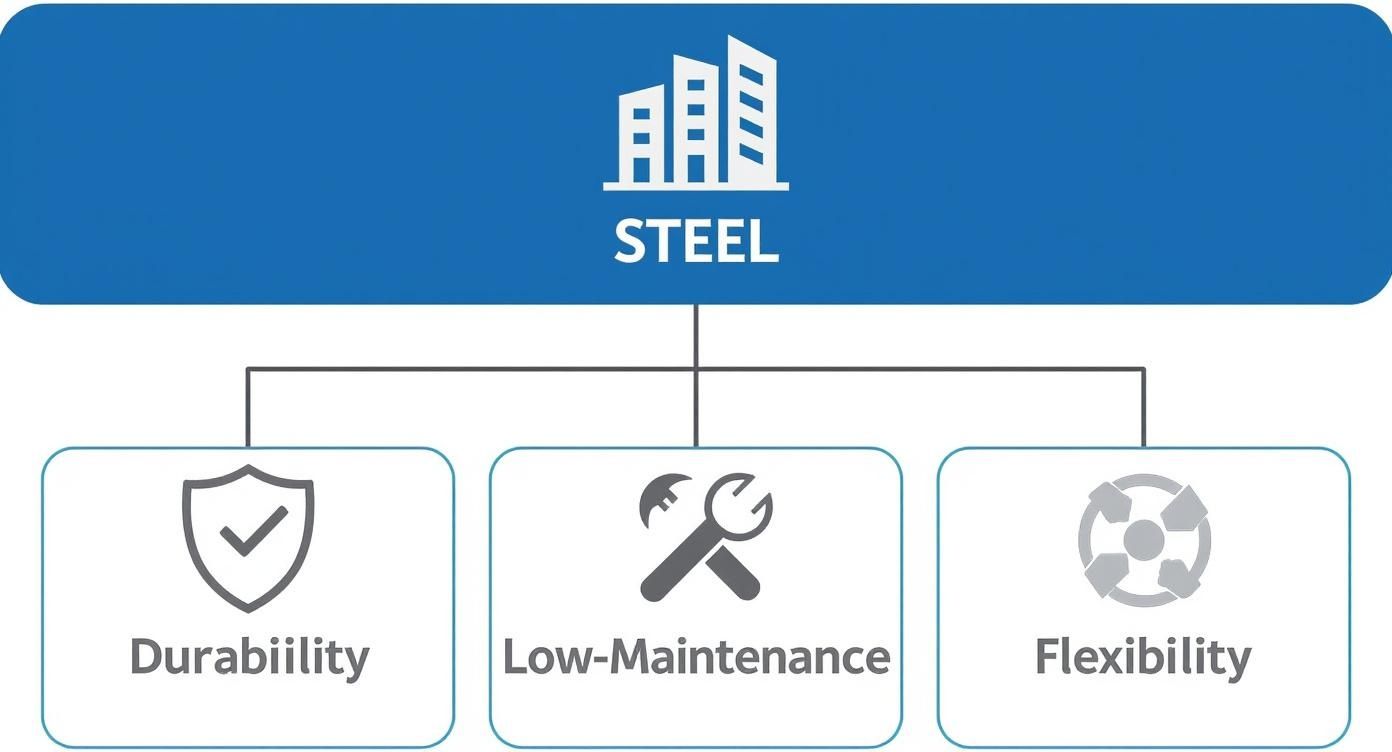
As you can see, the choice is simple. Steel delivers the strength, easy upkeep, and design freedom that modern farming demands.
To help you connect these benefits to real-world needs, the table below breaks down the most common types of metal farm buildings and what features make them work so well for specific tasks.
Matching Metal Buildings to Farm Needs
| Building Type | Primary Use | Critical Design Feature | Common Customization |
|---|---|---|---|
| Equipment Shed | Protecting tractors, combines, and planters | Clear-span interior for maximum obstruction-free space | Oversized roll-up doors, drive-through layouts, attached lean-tos |
| Livestock Barn | Housing cattle, horses, or poultry | Engineered ventilation system for air quality and moisture control | Insulation packages, easy-to-clean interior wall panels, wash bays |
| Hay & Feed Storage | Keeping bales and grain dry and safe from pests | Weather-tight roof and wall panels to seal out moisture | High eaves for vertical stacking, large doors for tractor access |
| Farm Workshop | Vehicle maintenance and equipment repair | Durable foundation and excellent lighting (natural & artificial) | Skylights, reinforced flooring, ample electrical outlets |
Each of these buildings starts with a strong steel frame, but it's the specific design choices and customizations that truly make it the right tool for the job. Let’s dive a little deeper into each one.
Equipment and Machinery Sheds
A modern farm runs on expensive, high-tech machinery. Leaving that equipment out in the elements is simply not an option. A dedicated metal equipment shed is your first line of defense against rust, sun damage, and premature wear and tear.
The single most important factor for a machinery shed is accessibility. This means planning for oversized roll-up or sliding doors that can easily accommodate your biggest pieces of equipment, like combines or air seeders. Placing doors on multiple walls can create a drive-through design, which completely eliminates the frustration of backing in massive implements and streamlines your workflow.
- Critical Feature: A clear-span interior is a must-have. It gives you wall-to-wall open space with no pesky support columns getting in the way.
- Customization Tip: Think about adding a lean-to on one side. It creates a great covered, open-air spot to park smaller UTVs or implements you need to grab quickly.
Livestock Barns and Animal Housing
When it comes to housing animals, metal agricultural buildings create a far healthier and more secure environment. Unlike wood, steel panels are non-porous, meaning they don’t harbor bacteria. This makes them incredibly easy to power wash and sanitize—a huge advantage for preventing disease outbreaks.
Proper ventilation is absolutely non-negotiable in a livestock barn. A well-designed system with ridge vents and louvers guarantees constant airflow, pulling out moisture and ammonia to keep the air quality healthy. Insulation is another game-changer, helping regulate the temperature inside—keeping animals cooler in the summer and warmer in the winter, which reduces stress and boosts productivity.
The right environment has a direct impact on animal well-being and, ultimately, your bottom line. A climate-controlled metal barn helps you maintain the perfect conditions for growth, breeding, and production.
Hay Bales and Feed Storage
Moisture is the number one enemy of stored hay and feed. It leads to mold, spoilage, and can wipe out a significant portion of your investment. A weather-tight metal building is the best protection you can get. The interlocking design of steel roof and wall panels forms a sealed barrier against rain, snow, and condensation.
For hay storage, height is just as crucial as floor space. By designing a building with high eaves, you can stack bales much higher, maximizing your storage capacity without needing a massive footprint. For feed, a solid concrete foundation with a vapor barrier is essential to stop ground moisture from wicking up and ruining your inventory.
Farm Workshops and Maintenance Bays
A dedicated workshop is the heart of a well-run farm, keeping all your equipment in prime condition. A metal building is the perfect shell for a fully equipped maintenance facility, with plenty of room for tools, workbenches, and even a vehicle lift.
Key things to plan for in a workshop include durable flooring that can handle spills and heavy loads, plenty of electrical outlets, and great lighting. You can incorporate skylights or translucent wall panels to bring in more natural light and cut down on your power bill. Good insulation not only makes the space more comfortable to work in year-round but also helps dampen the noise.
To see an even wider range of building applications, you can explore the various types of metal buildings available for different needs.
Designing Your Ideal Agricultural Building
Think of designing a new farm building like buying a new piece of equipment. You wouldn't just grab any old tractor; you'd get the one that’s perfectly suited for the job. The same logic applies here. Moving beyond a generic structure to a thoughtfully planned metal agricultural building is how you create a true long-term asset for your operation.
The whole process starts with one simple but crucial question: what job does this building need to do, not just today but five years from now? Your answer will shape every single decision, from the basic footprint to the final hardware. Planning for that future growth right now will save you a world of cost and headache down the road.
Sizing Up Your Needs The Right Way
First things first, you need to nail down the right size and layout. This is about way more than just square footage—it's about creating a smooth workflow and having the capacity you actually need. Don't just eyeball it. Get out the tape measure and walk through your daily operations.
For equipment storage, map out the space you need for your biggest machinery, like a combine with its headers still attached. Make sure there’s plenty of clearance not just to park it, but to walk around and perform maintenance. One of the most common mistakes we see is planning for a super tight fit, which just creates logistical nightmares later on.
When it comes to livestock, the math is different. Figure out the ideal space needed per animal to keep them healthy and comfortable, then multiply that by your current herd and where you see it going. For example, if you plan to grow your herd by 20% in the next three years, you absolutely want to engineer that extra space into the design from day one.
A well-planned layout just makes sense. For a livestock barn, you’re thinking about feeding routes, access for cleaning, and how you'll move animals in and out. For a workshop, it means putting your workbenches and tool storage in a logical spot near where the equipment will be parked for repairs.
This kind of foresight is what prevents bottlenecks and makes sure your building helps your business grow, instead of holding it back.
Key Customization Options for Peak Performance
Once you've got your dimensions locked in, the real fun begins with customization. These choices are what directly impact your building's functionality, energy efficiency, and overall usability.
Here are the most critical elements to get right:
- Insulation Packages: If you're housing animals or creating a workshop, good insulation is non-negotiable. It keeps the interior temperature stable, preventing heat stress in the summer and protecting your animals and equipment from freezing in the winter. It also does a fantastic job of cutting down on condensation, which is a killer when it comes to rust and moisture damage.
- Doors and Windows: The placement and type of doors are vital to your workflow. Big, oversized roll-up doors give you easy access for large machinery, while standard walk-in doors should be placed where it’s most convenient for people to get in and out. You can also use strategically placed windows or translucent wall panels to flood the inside with natural light, which cuts down on electricity bills and makes for a much better working environment.
- Ventilation Systems: In any livestock facility, proper ventilation is everything for animal health. A simple combination of ridge vents, louvers, and large openings on the end walls creates a constant flow of air that gets rid of harmful ammonia and moisture. This one feature can make a huge difference in reducing respiratory issues in your herd.
The global market for metal building framing systems—the very backbone of these structures—is projected to climb from US$ 515 million in 2025 to US$ 654 million by 2031. This boom is fueled by the demand for strong, lightweight steel frames that can be prefabricated, slashing construction time and costs.
Engineering for Future Growth
The structural integrity of your building comes down to its core components. Getting a basic grasp of the metal building frame is key to making sure your structure can handle whatever you throw at it. For instance, if you're even thinking about putting a solar array on your roof someday, the frame needs to be engineered from the start to support that extra load.
Likewise, if you think you might want to add a lean-to for extra covered storage or extend the building's length later, bring it up with your supplier during the design phase. It’s almost always cheaper to prep the frame for future expansion during the initial build than it is to try and retrofit it years down the line. To get a better handle on this, check out our detailed guide on the fundamentals of the metal building frame.
By thinking through the size, customizations, and future potential, you turn a simple purchase into a purpose-built facility. This thoughtful approach is what ensures your new metal agricultural building will be a productive and efficient hub for your farm for decades to come.
Understanding the True Cost and ROI
When you’re looking at a new piece of farm equipment, you don't just look at the sticker price. You think about its long-term value and what it’s going to do for your operation. A metal agricultural building is no different. The real cost isn't just the price of the building kit; it’s the total investment needed to get it up and running.
Figuring out that total cost is step one. But the more important step is understanding its return on investment (ROI). That’s what turns the purchase from an expense into a strategic move that pays you back for years.
Breaking Down the Full Investment
The quote you get for a steel building kit is a big part of the cost, sure, but it's only one piece of the puzzle. To really budget right, you have to account for everything it takes to get that structure from a plan on paper to a working building on your property.
Here’s a realistic look at what’s involved:
- Building Kit: This is your main expense. It covers the steel frames, wall and roof panels, and all the standard hardware.
- Site Preparation: Before anything can happen, the land has to be cleared, graded, and leveled. The cost here can swing wildly depending on what your property looks like now.
- Concrete Foundation: A solid foundation isn't optional. This includes the concrete itself, rebar for reinforcement, labor, and finishing.
- Delivery Fees: All those prefabricated parts show up on large trucks, and shipping costs are almost always a separate line item.
- Construction Labor: Whether you hire a professional crew or rent equipment to build it yourself, you’ll have costs tied to putting the structure together.
Once you add all these pieces up, you get a much clearer picture of your total upfront investment. For an even deeper dive, you can learn more about the complete cost of steel buildings in our comprehensive guide.
Calculating the Long-Term Return
Now, let's stop talking about cost and start talking about value. A metal building isn’t a passive structure; it actively generates returns by cutting your costs and making your whole farm run smoother. This is where the ROI really shines.
A metal building pays for itself over time not through what it costs, but through what it saves. It’s an asset that actively reduces operational drag, minimizes financial risk, and protects your most valuable equipment and commodities.
Think about these powerful ROI drivers:
- Lower Insurance Premiums: Steel is non-combustible and stands up incredibly well to extreme weather. Many insurance companies offer much lower premiums for steel buildings compared to wood, saving you money every single year.
- Minimal Maintenance Costs: Say goodbye to the endless cycle of painting, sealing, and treating for termites that comes with a wooden barn. A metal building just needs an occasional wash, saving you thousands in labor and materials over its long life.
- Increased Operational Efficiency: Keeping your combines, tractors, and planters out of the elements prevents rust and wear, extending their lifespan and keeping their resale value high. Less downtime for repairs means more time working the fields.
As you look at the long-term profitability, you might even think about adding solar panels. You can calculate the solar return on investment to see how turning your roof into a power source can speed up your ROI even faster. When you look at your building through the lens of ROI, it becomes obvious that this is a solid investment in the future of your farm.
Your Farm Building Construction Timeline
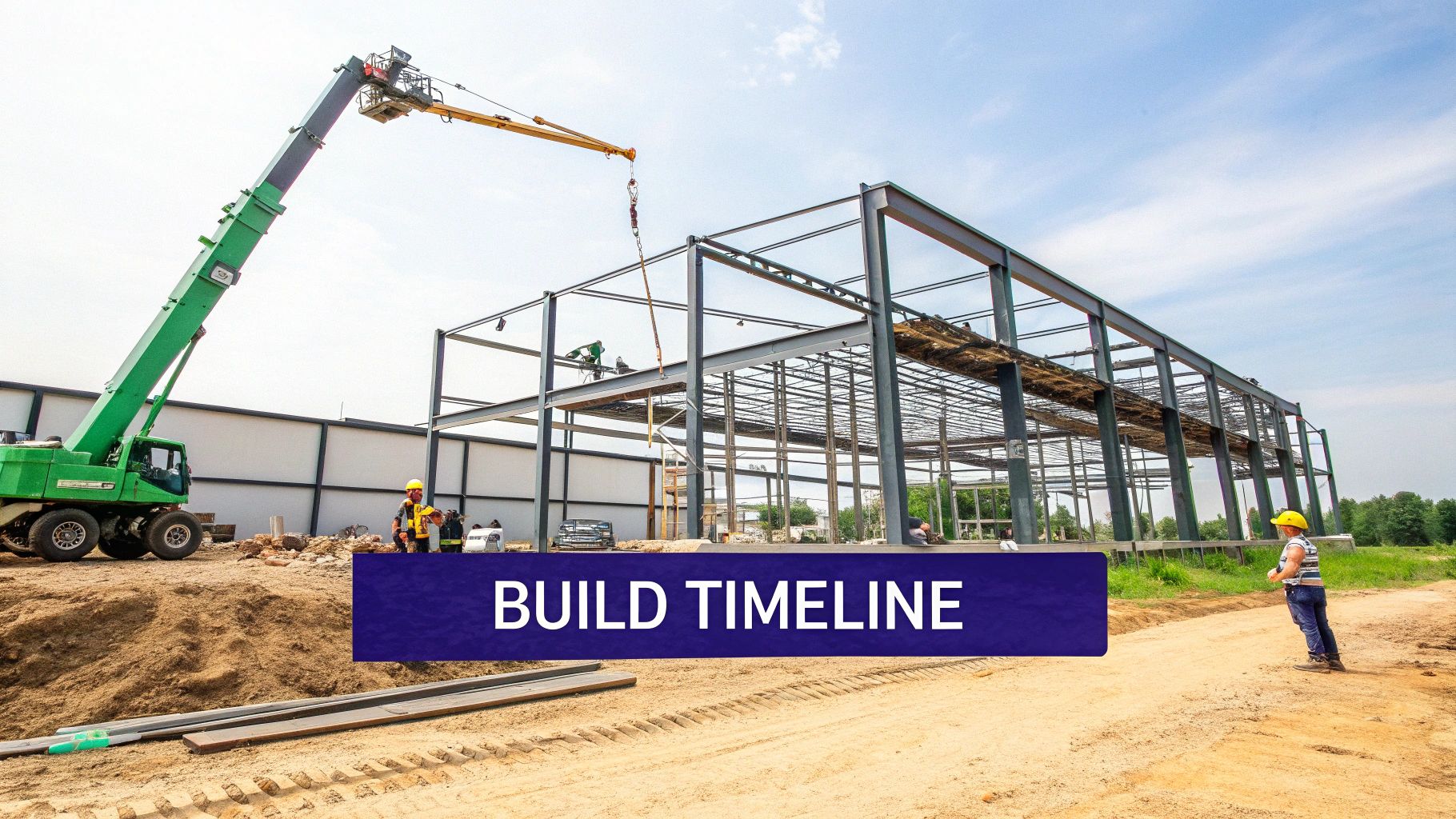
Watching your metal agricultural building go from a blueprint to a finished structure is one of the most exciting parts of the whole process. Knowing what to expect demystifies the experience, giving you a clear roadmap from the moment the delivery truck rolls up until that final bolt is tightened.
The real beauty of a prefabricated steel building kit is its efficiency. Traditional construction can drag on for what feels like an eternity, but a metal building project is a streamlined, predictable sequence of phases. Each step follows the last in a logical order, making for a fast and reliable build schedule.
The Major Construction Phases
From a patch of dirt to a fully functional building, the construction journey follows a surprisingly straightforward path. Think of it like assembling a giant, high-stakes model kit where every single piece has been precision-engineered for a perfect fit.
Here’s a step-by-step look at how it all comes together:
- Site Prep and Foundation: This is the critical groundwork. Your site needs to be cleared, leveled, and graded before a pro crew can pour the concrete foundation. That concrete needs time to cure—usually a few weeks—so it’s strong enough to support the building’s weight.
- Kit Delivery and Staging: Once the foundation is ready, your building kit arrives. The first job is to inventory every component—main frames, secondary supports, panels, and all the hardware—and lay them out for easy access during the build.
- Frame Erection: This is where you see your building truly take shape. The main steel frames, the "ribs" of the structure, are assembled on the ground, then lifted into place and bolted securely to the foundation.
- Secondary Framing: With the main columns and rafters locked in, the crew installs the secondary framing. These are the girts (for the walls) and purlins (for the roof) that connect the main frames, adding stability and creating the skeleton for the exterior panels.
- Panels and Finishing Touches: The final major step is "sheeting" the building—attaching the wall and roof panels to the secondary framing. Once it’s enclosed, the crew installs doors, windows, insulation, and any other custom features you’ve chosen.
DIY Build Or Professional Contractor
One of the biggest calls you'll have to make is whether to erect the building yourself or bring in a professional crew. A DIY approach can definitely save you money on labor, but it's not a small undertaking. It requires the right tools, heavy equipment like a lift, and a solid understanding of construction basics.
For smaller, simpler structures, a DIY build is often manageable for a skilled farmer. However, for large or complex metal agricultural buildings, the expertise of a professional installation crew ensures the job is done safely, correctly, and much more quickly.
Hiring professionals adds to the upfront cost, but it buys you peace of mind and a much quicker completion time. These crews have the specialized equipment and years of experience to put up a large building in a fraction of the time it would take a less experienced team. To help you weigh the pros and cons, our guide on metal building installation offers a detailed look at what both paths involve.
Frequently Asked Questions
When you're looking at a major investment like a new farm building, it's only natural to have a few questions. Getting the right answers is the key to moving forward with confidence. Let's tackle some of the most common things people ask about metal agricultural buildings.
How Long Do Metal Agricultural Buildings Last?
A well-built, properly maintained metal ag building will easily serve your farm for 50 years or more—and many last much, much longer than that. Their incredible longevity comes down to smart engineering: a galvanized steel frame that laughs off rust and corrosion, paired with tough paneling and advanced paint systems that are often warrantied for decades.
Think about the common threats on a farm. Unlike wood, steel is completely immune to rot, termites, and fire. That natural resilience means a longer, stronger structural life with far less need for the constant, expensive upkeep that wooden barns demand.
What Are the Design Limits for a Steel Farm Building?
Honestly, the sky is almost the limit. Modern steel buildings give you incredible design flexibility, making them perfect for just about any farm operation. They’re famous for their clear-span designs, which create massive, wide-open interiors of 200 feet or more without a single interior support column getting in your way. That’s a game-changer for maneuvering large equipment or designing flexible livestock pens.
Beyond that, everything from the building's height and overall length to the pitch of the roof is fully customizable. While every structure has its engineering limits, they usually go far beyond what most modern farms actually need. You get a truly purpose-built facility.
The real advantage of steel isn't just its strength—it's the freedom it gives you. You're not stuck trying to fit your operation into a pre-set box. You get to design a building that works exactly the way you need it to.
What Is the Typical Time from Order to Delivery?
Lead times can shift a bit depending on the manufacturer, how complex your design is, and even the time of year. As a general rule of thumb, you can expect a turnaround of about 6 to 12 weeks from the day you sign off on your final plans to the moment the building kit arrives on your property.
It's really important to factor this into your project timeline. If you're racing against a planting or harvest season, make sure you confirm the current production schedule with your supplier early on so there are no surprises.
Ready to design a building that will serve your farm for decades? The team at Icon Steel Buildings is here to help you create the perfect structure for your operational needs. Get your free quote today.