
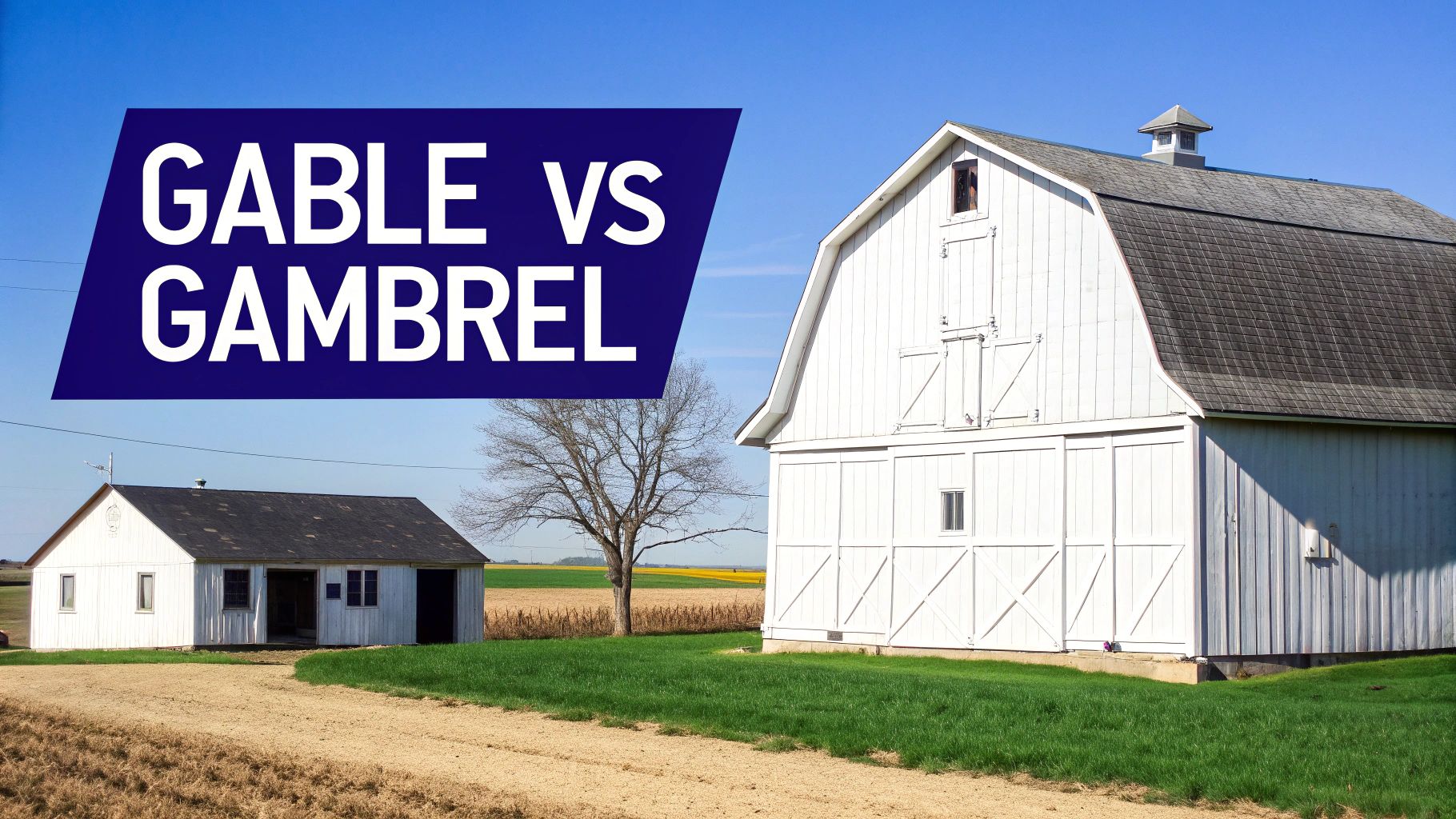
When you're choosing a roof for a new barn, you're doing more than just picking a cover—you're defining its character, its utility, and how it will stand up to the elements for decades to come. The two styles that usually come to mind are the classic Gable, known for its simple, effective design, and the iconic Gambrel, famous for creating that massive, usable loft space.
Your choice ultimately shapes everything from the barn's interior volume and airflow to its resilience against whatever Mother Nature throws at it.
Your Guide to Choosing the Right Barn Roof
Think of a barn's roof as its most important tool. It’s the single architectural feature that dictates how the building works. Do you need to cram every square inch with hay? Prioritize airflow for livestock? Or just make sure heavy snow slides right off? Each roof design answers these questions in its own way.
The decision might seem overwhelming, but it really boils down to three things: its intended function, the local climate, and the overall cost. Getting a handle on how these three factors play off each other is the first step to picking a roof that not only looks right but performs flawlessly. For anyone leaning toward modern construction, versatile and long-lasting metal agricultural buildings can be designed to fit nearly any roof style you can imagine.
Key Factors at a Glance
This diagram really helps visualize how the core considerations—function, climate, and cost—all connect to the central goal: building the perfect barn for your needs.
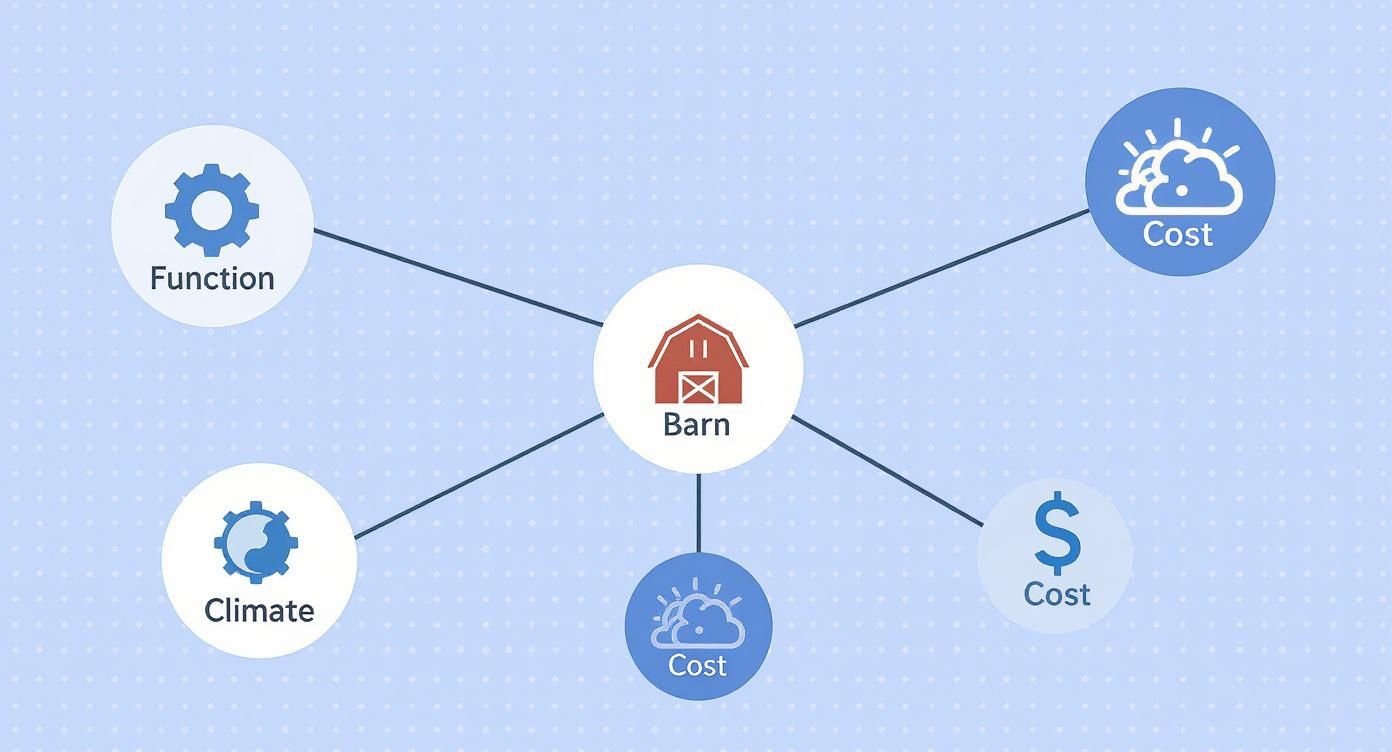
As you can see, these elements are all intertwined. A decision made based on climate, for instance, will almost certainly affect your costs and functional options. Understanding this relationship is what guides you toward the most practical design for your property.
To get the ball rolling, I've put together a quick comparison table of the most common barn roof styles. It’s a great starting point for seeing the primary features at a glance. And if you’re exploring options for a modern structure that mixes living and working spaces, specialized Barndominium construction services can offer solutions perfectly suited to these unique designs.
A barn’s silhouette against the skyline is defined by its roof. This single design choice impacts everything from interior light and air quality to its ability to withstand a generation of storms.
Quick Comparison of Common Barn Roof Styles
This table offers a high-level overview of the most popular barn roof styles, comparing their key characteristics to help you make an initial assessment.
| Roof Style | Key Feature | Best For | Typical Cost | Complexity |
|---|---|---|---|---|
| Gable | Simple, triangular shape | General-purpose use, shedding rain/snow | Low | Low |
| Gambrel | Dual-slope, iconic "barn" look | Maximizing loft and attic space | Moderate | Moderate |
| Monitor | Raised center aisle | Excellent ventilation for livestock | High | High |
| Hip | Slopes on all four sides | High-wind and hurricane-prone areas | Moderate-High | Moderate |
| Lean-To | Single-slope design | Additions, simple equipment storage | Very Low | Very Low |
Consider this your cheat sheet. As we dive into each of these styles in more detail, you’ll get a much clearer picture of the pros, cons, and trade-offs involved. That way, you can make a decision for your project that you feel confident about.
The Two Most Iconic Barn Roof Designs
When you picture a classic barn, chances are one of two distinct roof styles comes to mind. These silhouettes, the simple Gable and the iconic Gambrel, are deeply woven into the American landscape for reasons that go far beyond just looking good. They represent practical, time-tested solutions to the fundamental needs of farmers and landowners for centuries.
The first of these is the Gable roof, easily recognized by its triangular "A-frame" shape. Think of it as the original, no-fuss design. Its elegant simplicity is its greatest strength, featuring two straight panels that meet at a central ridge. This creates a clean, classic profile that effortlessly sheds water and snow.
This straightforward geometry makes the gable one of the most cost-effective and easiest roofs to construct. With fewer complex joints and less material waste, it’s a popular choice for everything from small sheds to large agricultural buildings where function and budget are top priorities.
The Classic Gable Roof
The biggest advantage of a gable roof is how well it performs in wet and snowy climates. The steep, consistent pitch ensures that rain and melting snow run off quickly, which minimizes the risk of leaks and reduces the structural load on the building. That makes it an incredibly reliable choice for regions that see a lot of precipitation.
But its simplicity comes with a trade-off. While the attic space under a gable roof is usable, the sloped sides limit the practical headroom, especially near the eaves. You get storage, but it’s often confined to the center of the loft.
Pros and Cons of Gable Roofs:
- Pro: Excellent at shedding rain and snow, reducing moisture-related issues.
- Pro: Simple construction leads to lower material and labor costs.
- Con: Can be vulnerable to damage in high-wind areas if not properly braced.
- Con: Provides less usable interior loft space compared to other designs.
This design is a true workhorse, ideal for general-purpose barns, workshops, and garages where maximizing overhead storage isn't the primary goal. You can find plenty of inspiration for integrating this timeless style by exploring various metal building design ideas that show off its versatility.
The Quintessential Gambrel Roof
Now, let's talk about the Gambrel roof—the style so closely associated with agriculture that it’s often just called a "barn roof." This design is a masterclass in spatial efficiency, engineered specifically to create the largest possible interior volume on the upper level.
Imagine taking a simple gable roof and breaking each side into two separate slopes. The upper slope is gentle, while the lower slope is nearly vertical. This clever geometry pushes the roof structure outward, transforming the attic from a cramped triangle into a spacious, room-like area with ample headroom. It’s the architectural equivalent of turning a small attic into a full-size second story.
The gambrel roof’s design was a direct response to a farmer’s greatest need: storage. By creating a cavernous loft, it allowed for the storage of vast quantities of loose hay, protecting it from the elements and keeping it accessible for livestock below.
This historical significance is rooted in pure function. As one of the most iconic barn roof styles, the gambrel has been a fixture in North America since the colonial era. In fact, the oldest known gambrel roof in America dates all the way back to 1677 on the second Harvard Hall, proving its long-standing architectural presence. You can discover more insights about the history of barn roof types on Barntraders.com.
The immense loft space it creates is perfect for hay storage, living quarters in a barndominium, or a large workshop area. While it's more complex and costly to build than a gable, the functional return on investment is undeniable for anyone who needs maximum usable space. However, like the gable, its broad sides can catch the wind, requiring robust engineering in storm-prone regions.
Designs That Improve Ventilation and Natural Light
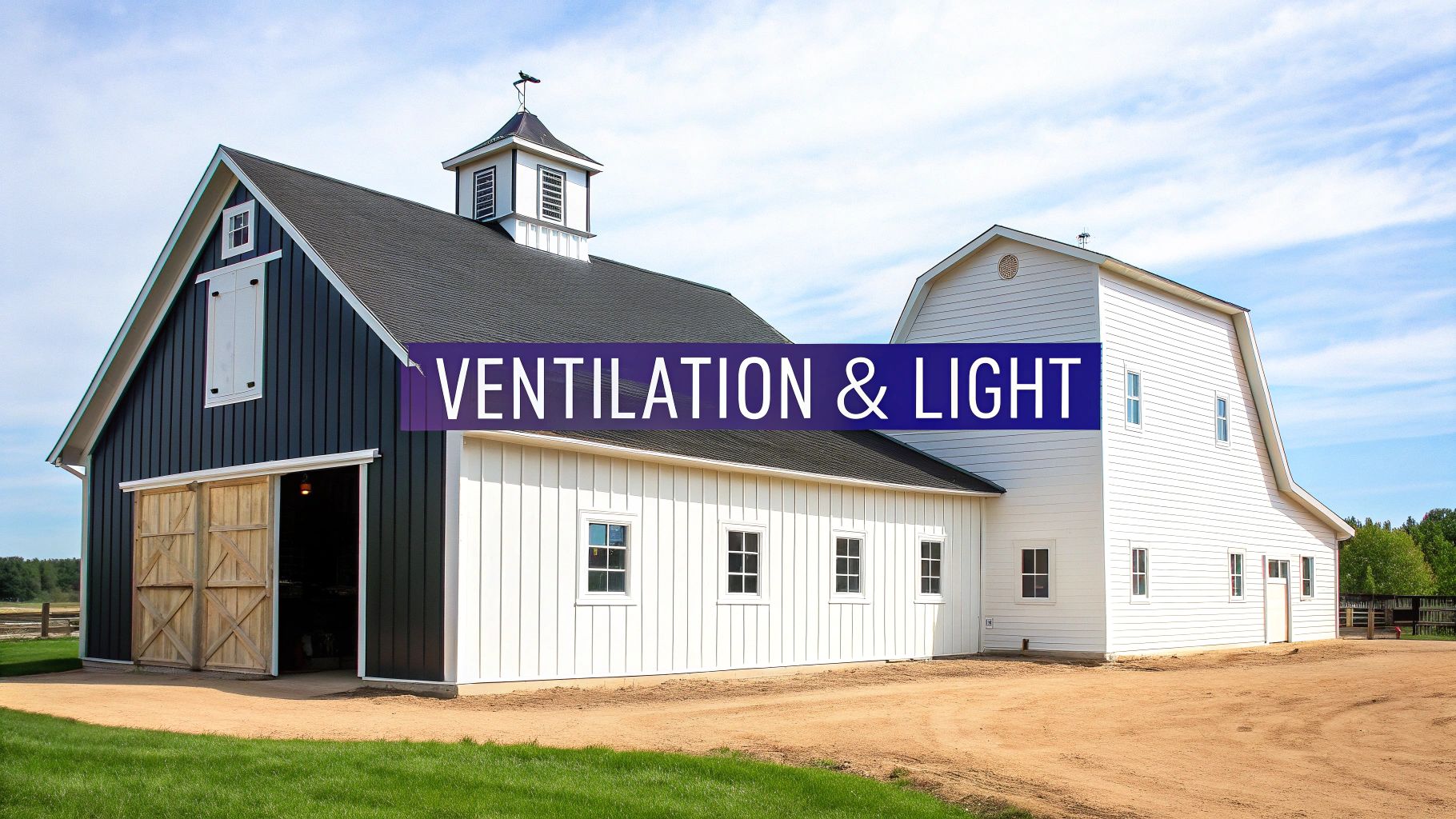
Some barn roof styles do more than just keep the rain out—they're engineered to create a healthier, more pleasant environment inside. When you're housing animals or spending long hours working in the barn, things like air quality and natural light aren't just luxuries; they're essential.
This is where clever designs like the Monitor and Clerestory roofs really shine. Think of them as giving your barn its own set of lungs and eyes. They use height and strategic openings to actively manage the interior atmosphere, a massive step up from a simple, solid roof. These styles transform a basic structure into a dynamic, comfortable space for both people and livestock.
The Monitor Roof: A Natural Chimney
You can spot a Monitor roof from a mile away. It’s that distinctive raised section running along the center ridge of what is otherwise a standard gable roof. This raised portion, the "monitor," features vertical walls on both sides, which are perfect for installing windows or vents.
This design brilliantly turns the whole building into a natural chimney. Inside a barn, especially one filled with animals, hot, humid, and stale air naturally rises. The monitor’s vents give that trapped air a perfect escape route right at the peak.
As the warm air exits, cooler, fresh air is pulled in through lower doors and windows, creating a constant, gentle circulation cycle. This "stack effect" is incredibly efficient at keeping the interior air clean and dry without needing any power.
Benefits of a Monitor Roof:
- Superior Ventilation: It's one of the best passive designs for airflow, which is critical for animal health because it reduces humidity and harmful ammonia buildup.
- Ambient Light: Windows in the monitor let natural light pour into the center of the barn, illuminating the main aisle beautifully.
- Classic Aesthetic: This style gives a building that traditional, stately look you often see in high-end equestrian facilities and classic barn designs.
The only real downside is the added complexity and cost. A monitor roof requires more materials and specialized labor than a simple gable, and you have to be extra careful to seal all the additional joints to keep it watertight.
The Clerestory Roof: Inviting the Sunlight In
A Clerestory roof (pronounced "clear-story") works on a similar principle as the monitor, but its main mission is to drench the interior with natural light. The design is asymmetrical, with one side of the roof built higher than the other. This creates a vertical wall between the two roof planes.
That entire vertical wall is then filled with a long bank of windows—the clerestory windows. The whole point is to capture as much sunlight as possible.
By strategically orienting a clerestory roof, you can capture morning or afternoon sun, drastically reducing the need for artificial lighting during the day. This not only cuts down on energy costs but also creates a more pleasant and productive environment.
This style is a phenomenal choice for any space within a barn that doubles as a workshop, studio, or even a retail storefront where bright, natural light is a huge plus. While it helps with ventilation, its true superpower is illumination. The complex engineering of these larger rooflines is often best supported by the strength and precision of steel framing. You can learn more about how these structures handle intricate designs by exploring the benefits of metal truss buildings.
Just like the monitor, a clerestory roof is more structurally complex and costs more than basic designs. The joint where the upper and lower roof sections meet has to be flawlessly constructed and waterproofed to guarantee it will hold up for the long haul.
Unique and High-Performance Roof Options
While Gable and Gambrel roofs are the undisputed classics, some projects call for something different. Certain designs offer huge advantages in performance and stability, especially when you're up against extreme weather or need a very specific interior layout.
These alternative roof styles solve real-world problems, from shrugging off hurricane-force winds to creating massive, wide-open floor space. They show how barn architecture has evolved beyond pure tradition to embrace forms that deliver superior strength and function.
The Hip Roof: A Fortress Against the Wind
When it comes to structural stability, the Hip roof is a true champion. Unlike a gable roof with its two sloping sides and two flat, vertical ends, a hip roof has four sloping sides that meet at the top. Imagine a pyramid sitting on top of your barn walls, and you've got the basic idea.
This four-sided design is naturally braced and self-supporting. There are no flat ends to catch the wind like a giant sail, so it does an incredible job of deflecting strong gusts from any direction. That makes it an extremely smart choice for barns in coastal regions, hurricane zones, or wide-open prairies known for severe storms.
Globally, barn roofing is a direct reflection of local climate. While the simple gable is the most common design, the hip roof is a close second in many historic registries, making up about 16% of barns—especially in areas where its wind resistance is a must-have feature. You can explore more about how barn architecture adapts to local conditions on HeartlandScience.org.
The Quonset Roof: Maximum Unobstructed Space
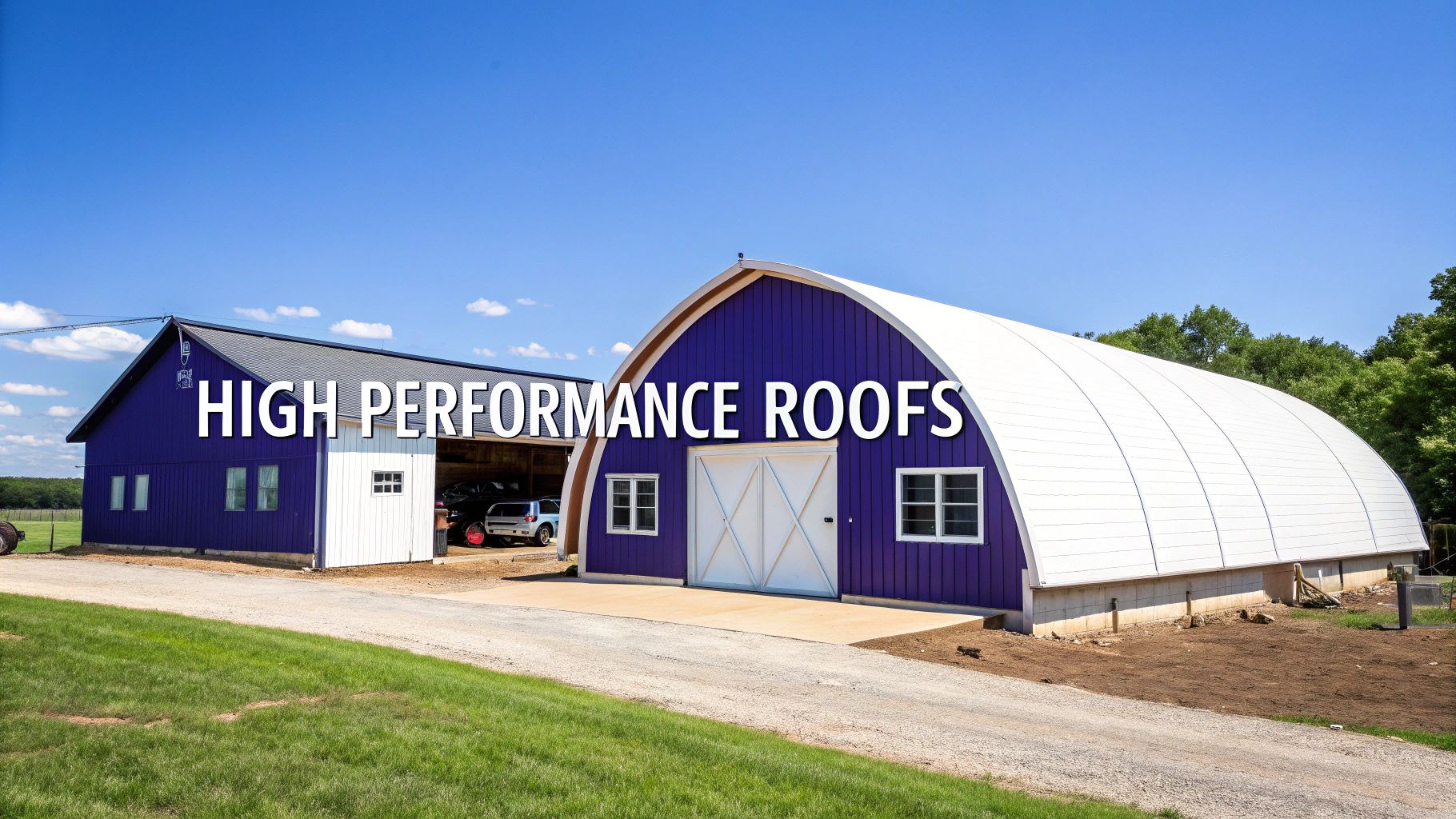
For pure, uninterrupted interior volume, nothing beats a Round or Quonset roof. This semi-cylindrical arch is instantly recognizable and a marvel of engineering efficiency. The entire structure supports itself, which means it needs zero interior columns or trusses.
This creates a massive, clear-span interior that's perfect for:
- Storing huge combines and other large farm equipment
- Bulk storage for grain or hay
- Use as an aircraft hangar or a massive workshop
The curve is also exceptionally strong and sheds snow and rain effortlessly. Made from corrugated steel, Quonset huts are durable, relatively quick to build, and surprisingly cost-effective for their size. Their strength and cavernous interior are exactly why they’re so popular for military, industrial, and agricultural buildings where usable floor space is the number one priority. In these structures, the quality of the materials is everything; that's why it's so important to understand the benefits of using US-made steel for your structure.
A Quonset roof provides the ultimate clear-span interior. Its arched design eliminates the need for internal supports, creating a cavernous, column-free space that’s impossible to achieve with most traditional framing methods.
Complementary and Asymmetrical Designs
Beyond these major styles, a few simpler designs play supporting roles or offer unique aesthetic and functional perks. You'll often see these used for additions or on buildings where managing weather from one specific direction is the main goal.
Lean-To Roofs
A Lean-To is the simplest roof there is—just a single slope attached to a taller, existing building. It's the go-to design for cost-effective additions like equipment sheds, covered animal pens, or firewood storage.
Saltbox Roofs
The Saltbox roof is an asymmetrical design with two slopes of different lengths. One side is short and steep, while the other is long and gradual, sometimes extending nearly to the ground floor. This profile was a clever solution in snowy regions, helping shed heavy snow loads while also blocking harsh winds.
Butterfly Roofs
A modern and visually dramatic option, the Butterfly roof is basically an inverted gable. The two slopes angle upward from a central valley. This design is fantastic for collecting rainwater and allows for taller walls and much larger windows, flooding the interior with natural light and creating a bold, contemporary look.
How to Make Your Final Roof Decision
Choosing from all the different roof styles for barns can feel like a high-stakes puzzle. With so many variables in play, it’s easy to get stuck. But if you break the decision down into a logical framework, you can move forward with confidence, knowing you’ve picked the perfect design for your needs. It really just comes down to a thoughtful assessment of your climate, the barn’s purpose, and your long-term budget.
This approach turns a complicated choice into a series of straightforward questions. What kind of weather will your barn have to endure? What will you be doing inside it every day? And what’s the total cost of ownership, not just the check you write today? Answering these honestly will light up the best path forward.
Prioritize Climate and Weather Resilience
Your local weather is the non-negotiable starting point. A roof that’s perfect for a dry, calm climate could be a complete disaster where heavy snow or high winds are the norm. Your design absolutely must handle the worst conditions your region throws at it.
Think about these climate-specific needs:
- Heavy Snow: Steeper pitches are your best friend here, like those on Gable and Saltbox roofs. They let gravity do the work, shedding heavy snow to prevent dangerous loads from building up and threatening the structure.
- High Winds: In hurricane country or wide-open prairies, a Hip roof is your strongest defender. Its four-sided, self-bracing design deflects wind from every direction, drastically cutting down on uplift forces.
- Heavy Rain: While most pitched roofs handle rain just fine, you have to make sure your design includes proper overhangs and a solid gutter system to channel water safely away from the foundation.
Match the Roof to Its Function
Next up, what are you actually doing in the barn? The roof’s design has a huge impact on how usable the interior space is. A roof isn't just a lid; it’s a critical part of the building’s functional machinery.
For instance, a farmer needing to pack away tons of loose hay will find the massive, open loft of a Gambrel roof absolutely indispensable. This need for cavernous storage is exactly why certain styles caught on historically. Barns have come a long way from the simple gables of early English barns to more complex forms that evolved as farming intensified.
Your barn’s primary purpose should be the architect of its roof. A design that fights against your daily workflow is a constant source of frustration, while one that enhances it is a long-term asset.
If your priority is keeping livestock healthy, the superior airflow from a Monitor roof is a game-changer. For those who need a massive, column-free space to park and maneuver large equipment, the clear-span arch of a Quonset is really the only practical choice.
Balance Budget and Long-Term Value
Finally, you have to run the numbers. And that means looking at the whole picture—not just the initial price for materials and labor, but also the long-term costs of maintenance, repairs, and energy. A cheaper roof today might end up costing you a lot more over the life of the building.
Simpler designs like a Gable or Lean-To are the most budget-friendly to build right out of the gate. More complex styles like a Monitor or Hip roof demand more materials and specialized labor, bumping up that initial investment. Remember, the metal building frame is the skeleton holding everything up, so its design and strength are vital to the whole project’s success.
Don’t forget about upkeep. A metal roof from Icon Steel might have a higher upfront cost than asphalt shingles, but its 20 to 40-year lifespan and minimal maintenance often lead to a much lower total cost of ownership. Before you sign on the dotted line, it's always smart to talk with experts and get professional roof inspection services to make sure your plans are solid. By taking this complete view, you can make a choice that’s both financially smart and perfectly functional for years to come.

Common Questions About Barn Roof Styles
https://www.youtube.com/embed/9Rs-JSnIqUc
Choosing the right roof for your barn brings up a lot of practical questions. As you move from initial ideas to final blueprints, getting clear answers to common concerns is the best way to make a confident decision. This section tackles some of the most frequent questions we hear from builders and property owners just like you.
What Is the Most Budget-Friendly Barn Roof?
For most new constructions, the classic Gable roof is the most cost-effective option out there. Its simple A-frame geometry just requires fewer materials and less complex labor compared to other, more intricate designs.
The straightforward construction process also means quicker installation times, which helps keep those labor costs down.
Another incredibly inexpensive way to expand your structure is with a Lean-To addition. By attaching a single-sloped roof to an existing wall, you can add covered space for equipment or livestock without the expense of a whole new standalone building. Both options are all about efficiency and value.
How Does a Metal Roof Impact Barn Temperature?
There's a common myth that a metal roof will automatically turn a barn into an oven during the summer. In reality, modern metal roofing is one of the most effective materials for temperature regulation, especially when it comes to keeping the inside cool.
Today's metal panels often feature highly reflective coatings, sometimes called "cool-roof" technology. These surfaces reflect a huge chunk of the sun's solar radiation instead of absorbing it as heat. When you combine this with proper attic ventilation and good insulation, a metal roof can actually keep a barn cooler than a traditional asphalt shingle roof. This helps create a more comfortable environment for animals and protects whatever you have stored inside.
The key to temperature control isn't just the roofing material itself, but a complete system. Reflective metal, adequate ventilation to exhaust hot air, and a quality insulation barrier work together to maintain a stable interior climate year-round.
Which Roof Style Provides the Most Loft Space?
When it comes to maximizing usable upper-level space, the Gambrel roof is the undisputed champion. There's no contest. Its unique dual-slope design, with a steep lower section and a gentler upper section, is specifically engineered to create a vast, room-like loft.
If you put a Gambrel roof on the exact same foundation as a Gable roof, the Gambrel carves out a significantly larger and more practical attic. The nearly vertical lower slopes push the walls of the loft outward, giving you tons of headroom across a much wider floor area. This makes it the perfect choice for anyone needing a huge hayloft, an integrated living space, or a spacious workshop on the second level.
Ready to design a barn that perfectly matches your needs? The team at Icon Steel Buildings can help you select the ideal roof style and create a durable, custom metal building that will last for decades. Explore your options and get started at the official Icon Steel Buildings website.