
When you're looking for a steel building manufacturer, you're not just buying a product—you're choosing a partner for one of the most significant investments you'll make. The best companies aren't just suppliers; they bring a mix of high-quality American steel, deep in-house engineering expertise, and real customer support to the table. This decision will shape everything from your project's final cost and timeline to how well the building stands up over the decades.
Choosing the Right Partner for Your Steel Building
Nailing down the right manufacturer is hands-down the most important decision you'll make. This isn't like picking something off a shelf. It’s more like hiring a key member of your team who will be responsible for bringing your vision to life, from the first sketch to the final bolt. This guide goes beyond simple company lists to give you a solid framework for judging manufacturers on what actually matters.
First, let's get on the same page about the foundation of modern steel construction: the pre-engineered metal building (PEMB).
Think of a PEMB like a high-end, custom car chassis. It's the precision-engineered foundation that everything else is built on. This guarantees immense strength, allows for rapid assembly, and delivers major cost savings compared to old-school construction.
Why Your Choice of Manufacturer Matters
A top-tier manufacturer delivers more than just a pile of steel beams. They provide a complete, engineered system where every single component is designed to fit and work together perfectly. This integrated approach is what ensures the building's structural integrity and makes the construction process so much smoother—a huge win for both DIY builders and professional crews. Our guide on buying a metal building provides additional context on what to expect.
The demand for these buildings is surging for a reason. The global prefabricated steel building systems market was valued at USD 2.01 billion and is projected to hit USD 2.79 billion by 2032. This isn't just a trend; it's a worldwide shift toward building smarter and more reliably. You can dig into more insights about this expanding market and its key players.
A bigger market means you have more options than ever, but it also makes doing your homework even more critical. The best companies set themselves apart in a few key areas, which we'll break down throughout this guide:
- Unwavering Quality Control: From the specific grade of steel they use to the precision of their welds, every tiny detail impacts your building's lifespan.
- Engineering and Customization: The ability to tailor a design to your exact needs—while satisfying strict local building codes—is absolutely non-negotiable.
- Transparent Pricing and Timelines: A good partner gives you clear, detailed quotes and realistic delivery schedules. No surprises.
- Robust Warranties and Support: What happens after the sale is a true test of a company's character. Strong warranties and accessible support show they stand behind their product.
By focusing on these core pillars, you can navigate the market with confidence and pick a manufacturer that will make your project a massive success.
Decoding Build Quality and Material Standards
So, what’s the real difference between an exceptional steel building and one that’s just… average? It’s not just the design. The true story is forged in the quality of the steel itself and the precision of the craftsmanship. Getting a handle on these details is the key to evaluating the top steel building manufacturers and seeing past the sales jargon to judge quality like a pro.
Think of it like choosing a rope for mountain climbing. A thin, cheap rope might be fine for a small hill, but you wouldn't trust it on a serious ascent. For that, you need something engineered for extreme strength and durability. In the same way, your building's entire structural integrity hangs on the quality of its core components, from the massive primary frames right down to the smallest fasteners.
The Foundation of Strength: Steel Gauge and Coatings
Your first clue to quality is the steel gauge, which is simply a measure of its thickness. Now, here’s a quirk of the industry: a lower gauge number actually means thicker, stronger steel. For most applications, 26-gauge steel is a solid standard. But upgrading to a heavier 24-gauge gives you superior resistance against dents, dings, and severe weather.
But raw thickness isn't the whole story. Steel needs a shield against the elements, and that's where coatings come in. The industry gold standard is Galvalume, a patented coating made of aluminum, zinc, and silicon. This stuff provides incredible corrosion resistance. A building finished with high-quality Galvalume can fight off rust and decay for decades, blowing simple galvanized steel out of the water.
When you're talking to manufacturers, don't be shy—ask about the specifics. You can learn more about why American-made steel is a critical quality factor to understand its impact on longevity and performance.
Weld Integrity and Component Precision
Beyond the raw materials, the fabrication process is where a company’s commitment to quality really shines. The welds holding the steel components together are everything. A sloppy, poor-quality weld is a weak point, plain and simple. It's a failure waiting to happen under the stress of heavy snow or high winds.
Top-tier manufacturers use advanced, automated welding to ensure every single connection is clean, consistent, and unbelievably strong. That same laser-focused precision applies to every pre-drilled hole and pre-cut component.
A superior steel building kit is like a giant, high-stakes LEGO set. Every piece should fit together perfectly without force or on-site modifications. This not only guarantees a stronger final structure but also dramatically speeds up the erection process, saving you time and money on labor.
This level of precision doesn't happen by accident. It's the result of a serious quality control process. The best companies have multi-point inspection systems to make sure every single piece that leaves their factory meets their exacting standards.
The Power of Industry Certifications
Okay, but how can you be sure a manufacturer actually delivers on its quality claims? This is where industry certifications act as an objective seal of approval. In the United States, the most respected credential comes from the American Institute of Steel Construction (AISC).
An AISC certification isn't just a piece of paper they hang on the wall. It's proof that a manufacturer's facility, people, and processes have passed a grueling audit and meet the highest standards for safety and quality.
To get that AISC stamp, a manufacturer must prove:
- Personnel qualifications and ongoing training for their welders and fabricators.
- Material traceability to confirm they're using the specified grade of steel.
- Equipment calibration and maintenance to guarantee precision.
- Documented quality control procedures that are followed every single time.
Choosing an AISC-certified manufacturer takes a massive amount of guesswork out of the equation. It's independent assurance that you're working with one of the top steel building manufacturers dedicated to producing a structure that is safe, durable, and built to last. Always ask for their proof of certification and don't hesitate to verify it. This one step is one of the smartest ways to protect your investment.
Evaluating Customization and Engineering Strength
Your project is one-of-a-kind, and a top-tier manufacturer will treat it that way. Not every building is a simple box; your operation might demand specific dimensions, a unique layout, or specialized features that a standard kit just can't deliver. This is where you see the real power of an in-house engineering team.
Think of it like buying a suit. You can grab one off the rack, and it might fit okay. Or, you can have one custom-tailored to your exact measurements for a flawless look and feel. A custom-engineered steel building is the tailored suit—designed precisely for your operational needs, your aesthetic vision, and the specific environmental demands of your location.
Beyond the Basic Building Kit
The range of customization options is huge, from simple tweaks in height or width to complex architectural designs. The best manufacturers aren't just selling you a kit; they're partnering with you to design a complete solution. This is the clearest dividing line between a basic supplier and one of the top steel building manufacturers.
What does that look like in practice? Here are a few key areas:
- Complex Rooflines: Moving past the standard gable roof to designs like gambrels, monitors, or single slopes for either architectural style or specific functions.
- Variable Column Spacing: Adjusting the interior layout to create massive, unobstructed areas (clear spans) needed for warehouses or sports arenas, or placing columns exactly where you need them for an office floor plan.
- Architectural Facades: Blending traditional materials like brick, stone, stucco, or glass with the steel frame to match existing buildings or meet local design codes.
- Specialized Features: Adding mezzanines for more office space, powerful crane systems for industrial work, or massive overhead doors for vehicle and equipment access.
This infographic gives you a snapshot of the market share held by some of the industry's leading names.
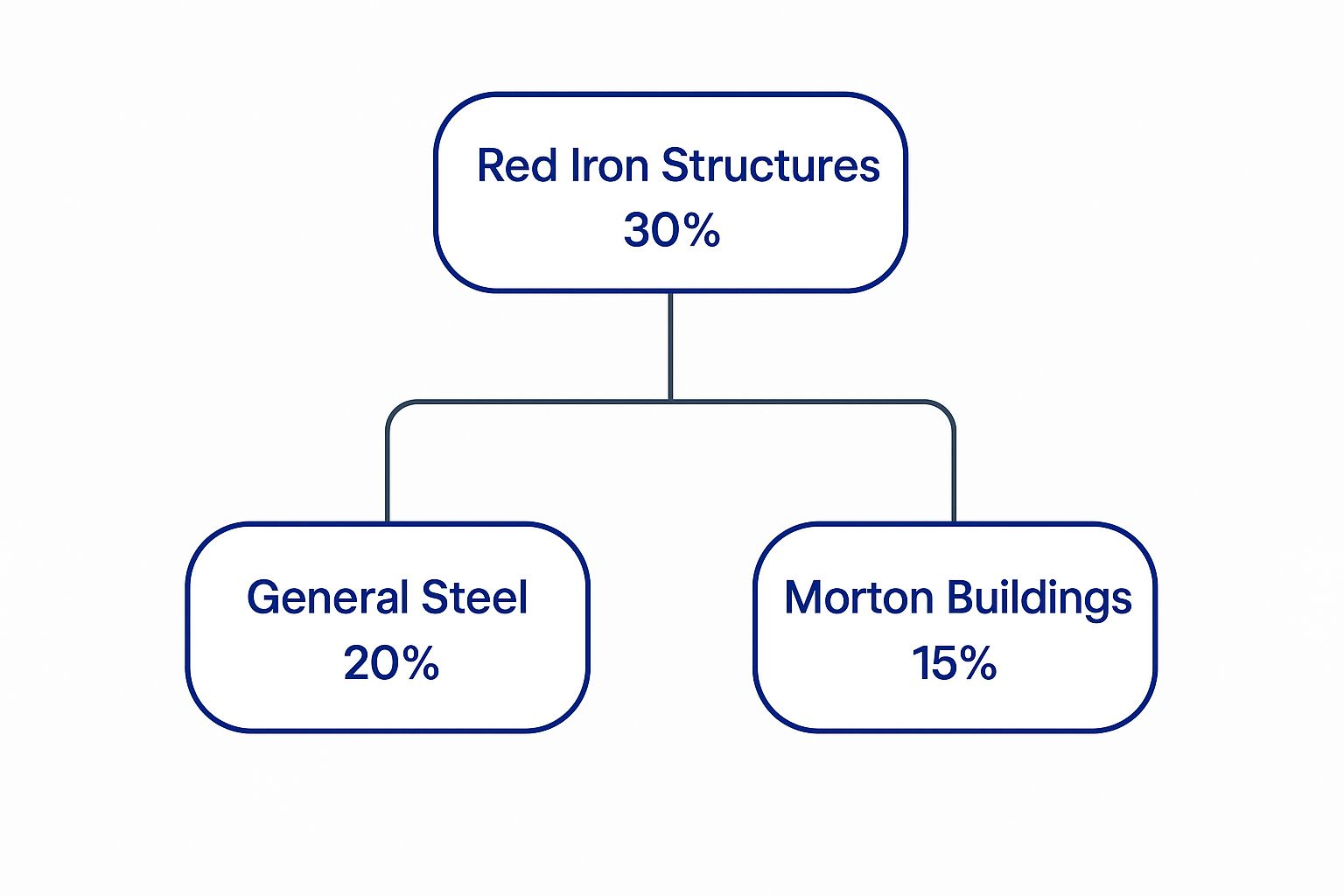
As you can see, a few key players command a significant portion of the market, which often reflects their ability to handle these complex projects. To see what's truly achievable, explore these options for custom steel buildings and start imagining the possibilities.
Before you get too far into the design, it helps to understand what features are available and how they impact your project. This table breaks down some of the most common customization choices.
Key Steel Building Customization Options
A comparison of available features and their common applications to help you define your project requirements.
| Feature | Description | Common Applications | Impact on Cost & Timeline |
|---|---|---|---|
| Clear Span Frames | Interior design with no support columns, creating a wide-open space. | Warehouses, aircraft hangars, indoor sports facilities, agricultural storage. | Increases steel cost due to larger, heavier frames but simplifies interior layout. |
| Mezzanines | An intermediate floor built between main floors, adding usable square footage. | Office space within a warehouse, storage lofts, viewing platforms in arenas. | Moderate cost increase; requires additional engineering for load support. |
| Overhead Doors | Large, roll-up or sectional doors for vehicle or equipment access. | Garages, workshops, loading docks, fire stations. | Cost varies by size, insulation, and operating mechanism. Minor timeline impact. |
| Architectural Panels | Insulated metal panels (IMPs) or decorative facades (stucco, brick). | Retail storefronts, office buildings, community centers, modern homes. | Significant impact on cost and can extend the timeline, but greatly enhances aesthetics. |
| Roof Extensions | Overhangs, canopies, or lean-tos attached to the main building. | Covered walkways, protected outdoor storage, loading bay covers. | Minor to moderate cost increase depending on the size and structural complexity. |
Understanding these options helps you communicate your needs clearly and ensures the final building is perfectly suited for its purpose.
The Critical Role of In-House Engineering
A manufacturer’s in-house engineering team is its most valuable asset, period. These are the certified professionals who turn your ideas into a buildable, structurally sound reality. Their expertise is absolutely critical for making sure your building is not only what you want but also fully compliant with tough local building codes.
An engineering team does more than just draft blueprints; they are your project's safeguard. They calculate precise load requirements to ensure your building can withstand your area's heaviest snows, strongest winds, and seismic activity, protecting your investment and its occupants.
Their work is the difference between a building that just looks good and one that is engineered to perform for decades. This team sweats the details, from the size of the anchor bolts in the foundation to the spacing of the purlins on the roof, ensuring every single component works together as one solid system. Before you sign with any manufacturer, always ask about the credentials of their engineering staff. It’s a direct reflection of the quality and reliability you can expect.
Breaking Down Project Costs and Pricing Models
Getting a clear, complete picture of your total investment is one of the most critical steps in any building project. You have to know how steel buildings are priced to avoid surprise costs down the road and compare quotes from different companies on a true apples-to-apples basis. The sticker price you see on a building kit is just one piece of a much larger puzzle.
Think of it like buying a house. The sale price is your starting point, but it doesn't include property taxes, insurance, moving costs, or future renovations. In the same way, a manufacturer's quote is for the building package itself—not the entire finished project. To budget accurately, you need to understand the full scope of what's involved.
What Is Included in a Base Quote
When you receive an initial quote from a top steel building manufacturer, it typically covers the core structural components. This is the pre-engineered "kit" that forms the skeleton and shell of your building.
A standard quote almost always includes:
- Primary Framing: The main I-beams that create the rigid "ribs" of the structure.
- Secondary Framing: The girts (for walls) and purlins (for the roof) that span between the main frames.
- Wall and Roof Paneling: Standard 26-gauge exterior sheeting, often with a Galvalume finish.
- Fasteners and Hardware: All the necessary high-strength bolts and screws for assembly.
- Engineered Drawings: The detailed blueprints required for permitting and construction.
This package gives you the essential elements to put up a weather-tight shell. But it’s what isn't included that often catches people off guard.
The initial price tag represents the cost of the manufactured components, not the total cost of ownership. A smart buyer plans for the entire project lifecycle, from groundbreaking to final inspection, to create a realistic and comprehensive budget.
Beyond the Kit: The Total Cost of Ownership
To budget effectively, you have to account for several other major expenses that fall outside the manufacturer's quote. These costs can swing wildly based on your location, project complexity, and the contractors you hire.
Key additional costs include:
- Foundation: A steel building needs a precisely engineered concrete foundation. This involves site prep, excavation, forming, and pouring the slab, which can be a substantial expense on its own.
- Delivery Fees: Shipping heavy steel components from the factory to your job site is rarely included in the base price. These freight costs typically add 5-10% to the kit price.
- Erection Labor: Unless you’re planning a DIY build for a smaller structure, you'll need to hire a professional crew to assemble the building. Labor is a major line item in any construction budget.
- Insulation: To make the building comfortable and energy-efficient, you'll need to purchase and install a quality insulation system.
- Accessories and Finishing: This catch-all category includes everything from overhead doors, windows, and gutters to interior framing, drywall, electrical, and plumbing.
Understanding these variables is crucial for smart planning. For a more detailed look, our guide covering the factors that influence commercial metal building cost provides valuable insights to help you prepare a thorough budget. By accounting for the total cost of ownership, you can confidently compare quotes, secure financing, and ensure your project stays on track financially from start to finish.
Gauging Reliability: Warranties and Customer Support
A manufacturer’s real worth isn’t just in the steel they deliver—it shows up long after the sale is complete. While top-notch engineering and build quality are the foundation, the experience you have after you’ve paid is what truly separates a simple supplier from one of the top steel building manufacturers. This is where you find out if you bought a product or invested in a partnership.
Think about it like this: you can buy the best engine in the world, but if it shows up late with a confusing manual and no one to call for help, its value drops to zero. A steel building is the exact same. A company's ability to get your building to you on time and support you through the build is just as critical as the gauge of their steel.
Production Timelines and Delivery Logistics
The gap between signing off on your design and seeing a truck pull up with your building kit can vary wildly. A few things drive this timeline: the complexity of your design, the manufacturer’s current production schedule, and even the time of year. A key sign of a reliable partner is their handle on supply chain risk management strategies, which keeps your project stable and minimizes nasty surprises.
The best companies give you realistic, honest timelines right from the start. They get it—your entire construction schedule, from pouring the foundation to booking your crew, hinges on their accuracy. The scale of these operations is mind-boggling. For instance, a major player like U.S.-based Nucor Corporation reported revenues of $44.03 billion, which gives you an idea of the massive logistical puzzle they solve daily. That level of experience usually means a schedule you can trust.
Interpreting Your Warranty Package
Warranties are the manufacturer's promise to stand by their product, but they are definitely not all created equal. You have to read the fine print to know what you’re really getting. A solid, comprehensive warranty package is a huge sign of confidence in their materials and work.
Here’s what you’ll typically find broken down in the warranty:
- Structural Warranty: This is the big one, often covering the building’s framing for 20 to 40 years—sometimes even a lifetime. It protects you from defects that could compromise the building's integrity.
- Paint and Finish Warranty: This warranty ensures your building looks good for years to come, usually covering the wall and roof panels against peeling, fading, or chalking for 30 to 40 years.
- Component Warranties: Things like doors, windows, and vents are often made by other companies and will have their own separate warranties.
A strong warranty isn't just a piece of paper; it’s an insurance policy on your investment. It tells you the manufacturer is committed to long-term performance and gives you peace of mind that you're covered if something goes wrong.
The True Value of Customer Support
When it’s all said and done, the most valuable thing a manufacturer can give you is responsive, knowledgeable customer support. When you’re standing on a job site with a question, you need an answer, and you need it now. A great partner has a support system built to make sure your project succeeds, from the first call to the final bolt.
What does that look like? First, you should get clear, detailed erection drawings that your crew can actually understand and follow. Second, many of the best companies give you a dedicated project manager. This person becomes your single point of contact for everything from logistics to technical questions.
Most importantly, they’re there for you during construction. Whether it's a question about a tricky connection or a piece that doesn't seem to fit, having an expert a phone call away can save you from expensive mistakes and painful delays. That kind of support is proof you didn’t just choose a supplier—you chose a company that’s invested in seeing your vision become a reality.
Understanding Sustainability and Industry Innovation
These days, a building’s environmental footprint is just as critical as its structural integrity. The best steel building manufacturers get this. They're actively proving that incredible strength and environmental responsibility can go hand-in-hand. When you choose a manufacturer, you're not just making a logistical decision—you're making a statement about your project's commitment to a greener future.
Steel itself is an environmental champion. It's one of the most recycled materials on the planet, with a recycling rate that consistently stays above 80%. Unlike other materials that weaken with reuse, steel can be recycled again and again without losing any of its core strength. This closed-loop lifecycle dramatically cuts down on the need for raw materials and the energy used to produce them.
On top of that, the precision of pre-engineered steel buildings is a huge win for waste reduction. Components are fabricated to exact specs in a controlled factory environment. That means the on-site construction waste is practically zero compared to the heaps of debris left behind by traditional building methods.
The Rise of Green Steel Production
The real innovation, however, is happening at the source with the development of "Green Steel." Forward-thinking manufacturers are ditching old-school, carbon-heavy blast furnaces. Instead, they're embracing newer technologies like electric arc furnaces (EAFs), which can use up to 100% recycled steel scrap to create new steel. This single change massively lowers the carbon footprint of steel production.
Choosing a manufacturer committed to Green Steel is an investment in both your project's quality and the planet's health. It aligns your building with a more sustainable supply chain, reflecting a modern approach to construction that values long-term environmental stewardship.
Global industry leaders are setting some seriously ambitious goals that are pushing everyone forward. For example, Tata Steel, a major player, has a Green Steel Plan aiming for a 40% cut in CO2 emissions by 2030. Their strategy relies heavily on advanced tech like direct reduced iron plants and electric arc furnaces. It's worth looking into how major companies are leading decarbonization efforts to see where the industry is headed.
Practical Steps Toward a Greener Building
Sustainability doesn't stop with the steel frame. The long-term efficiency of your finished building is a massive part of its environmental story. Proper insulation is one of the most powerful tools for slashing energy consumption from heating and cooling over the building's life. Our guide explores the different steel building insulation options that will help you lock in maximum energy efficiency.
For a deeper dive into measuring your project's impact, check out this practical guide to carbon accounting in construction and real estate.
By looking closely at a manufacturer's use of recycled content, their production methods, and their focus on energy-efficient designs, you ensure your project isn't just built for today—it's designed responsibly for tomorrow.
Common Questions We Hear About Choosing a Manufacturer
When you're diving into the world of steel buildings, a few questions always seem to pop up. Getting straight answers is the key to making a smart decision and getting your project started on the right foot. Let’s tackle some of the most common ones we hear from prospective buyers.
How Do I Know a Manufacturer's Certifications Are Legit?
This is a great question. Wondering if a company's claims are the real deal? You can—and should—go straight to the source. The gold standard in our industry is the American Institute of Steel Construction (AISC), and they keep an online directory of every single one of their certified members.
It’s simple. Just ask the manufacturer for their certification number and pop it into the AISC website's lookup tool. In just a few seconds, you’ll confirm they meet tough standards for quality, safety, and personnel. It’s a small step that gives you huge peace of mind about your building's structural integrity.
What's the Real Difference Between a Manufacturer and a Broker?
Understanding this distinction is absolutely critical. A manufacturer is the company that actually designs, engineers, and fabricates your building in their own shop. They have direct, hands-on control over the quality, schedule, and materials from day one.
A broker, on the other hand, is a middleman. They take your order and then shop it around to a separate manufacturing company to get it built. While a broker might sometimes offer a competitive price, going directly to the source usually gives you some major advantages:
- Better Communication: You’re talking directly to the people who are making your building. No games of telephone.
- More Control Over Customization: It’s far easier to discuss specific design tweaks and get them implemented correctly.
- Clearer Accountability: If an issue comes up, there's no pointing fingers. The buck stops with the manufacturer.
Do Steel Building Manufacturers Also Handle the Construction?
Most top-tier manufacturers focus on what they do best: designing, engineering, and fabricating the building kit itself. They don't typically handle the on-site construction or erection. Their expertise is in creating a precision-engineered system that arrives at your job site ready for a builder to assemble.
Think of the manufacturer as the team that designs and builds a high-performance engine; you still need a skilled mechanic to install it in the car.
That said, any reputable manufacturer knows that finding a good builder is a huge part of the puzzle. Many of us maintain a network of trusted, independent contractors and can give you solid recommendations for experienced erection crews in your area. Ultimately, you'll be the one to hire and manage the contractor who pours the foundation and puts the building together.
Ready to work with a manufacturer who believes in quality, transparency, and expert support every step of the way? The team at Icon Steel Buildings is here to help you design the perfect structure for your needs. Explore our custom building options and get a free quote today!