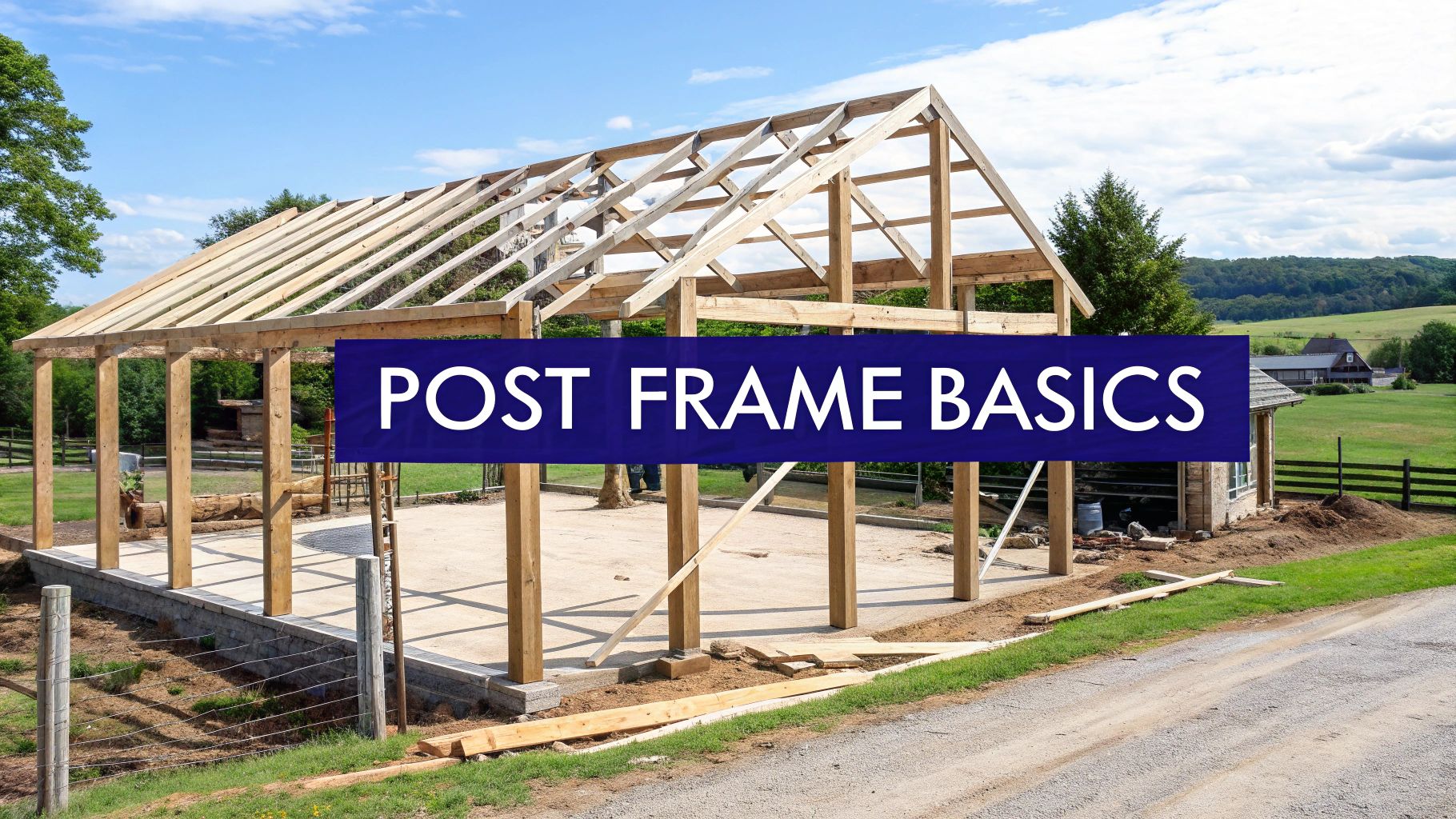
If you’ve ever wondered what a “pole barn” is, you’re already familiar with the basics of post frame construction. At its core, this is a building method where large, solid posts are anchored deep into the ground or onto a foundation, forming the entire structural backbone.
Unlike a conventional house that relies on a complex frame of smaller studs, a post frame building is all about simplicity and strength.
The Foundation Of Post Frame Buildings
Think about a traditional stick-built home. Its structure is like a detailed skeleton made of many small, interconnected bones (the 2×4 or 2×6 studs) that all rest on a continuous concrete foundation.
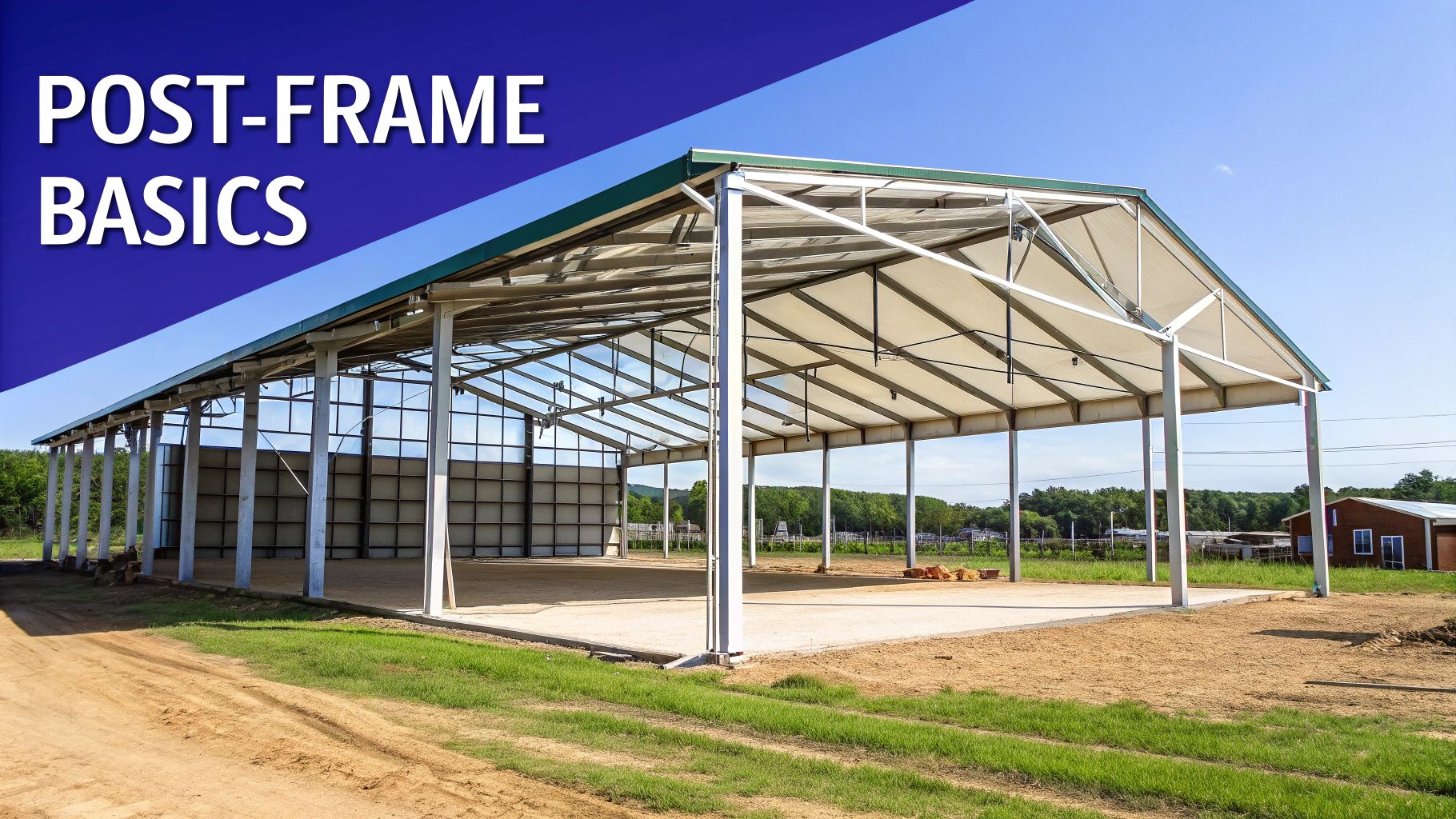
Now, picture a post frame building. Its skeleton is much simpler but far more powerful. Instead of dozens of small bones, it stands on a few massive legs—the posts—that are anchored firmly into the ground. Everything else is built around this core support system.
This is the key difference that defines post frame construction. The large posts are spaced far apart (often 8 feet or more) and are engineered to carry the entire weight of the roof and walls. They transfer all that load directly into the ground or onto concrete piers, which is an incredibly efficient way to build.
A Diaphragm System For Strength
So, if there aren't many interior walls or studs, what keeps the building from swaying? The secret is a clever engineering concept called a "diaphragm" system.
The exterior skin of the building, usually made of tough steel panels, is fastened directly to the posts and the roof trusses. This simple step connects every major component, turning the entire shell into a single, rigid box. This unified structure is exceptionally good at resisting lateral forces like heavy winds or even seismic tremors.
This integrated approach delivers some serious advantages:
- Massive Clear Span Interiors: Because the posts do all the heavy lifting, you don't need interior load-bearing walls. This leaves you with wide-open, unobstructed spaces perfect for workshops, garages, agricultural storage, or even airy open-concept homes.
- Foundation Simplicity: In many cases, you can skip the expensive and time-consuming process of pouring a continuous concrete foundation. This saves a huge amount on materials and labor.
- Material Efficiency: The whole design is streamlined. It uses fewer, but bigger and stronger, structural members, which translates directly into cost savings.
Post Frame Vs Traditional Stick-Built At A Glance
To really see the difference, it helps to put these two building methods side-by-side. Each has its place, but their core philosophies are worlds apart.
| Feature | Post Frame Construction | Traditional Stick-Built |
|---|---|---|
| Primary Support | Large, widely spaced vertical posts | Smaller, closely spaced studs (16-24 inches on center) |
| Foundation | Posts anchored in the ground or on piers; continuous slab optional | Requires a continuous concrete foundation or crawlspace |
| Load Transfer | Directly from posts into the ground | Distributed across the foundation wall |
| Interior Space | Large, open clear spans with no need for interior support walls | Interior load-bearing walls are often necessary |
| Construction Speed | Faster due to fewer components and simpler foundation | Slower, more labor-intensive framing process |
| Material Use | Fewer, larger structural members | Many smaller framing components (studs, joists, etc.) |
While this method got its start in agriculture, its efficiency and flexibility have made it a popular choice for all sorts of buildings. For a deeper dive into how different building methods stack up, exploring the key differences between a metal building vs stick-built construction can offer even more perspective on its unique benefits.
Understanding The Key Components And Materials
To really get what post frame construction is all about, you have to look under the hood at its core parts. Think of it as a simple "parts list" for a surprisingly tough and efficient building. Each piece has a specific job, from the posts that anchor it to the ground to the metal siding that gives it a protective skin.
Unlike a traditional stick-built structure with its countless smaller framing pieces, a post frame building is built with fewer, but much beefier, components. It’s this minimalist approach that makes the whole system work so well. Let’s break down the key players.
The Backbone: Laminated Columns And Posts
The whole building starts with its foundational supports, which are usually either solid sawn posts or—more often these days—laminated columns. These aren't just big pieces of wood; they're seriously engineered structural elements.
Laminated columns are made by fusing together multiple layers of high-grade lumber. The result is a post that is way stronger and more resistant to twisting or warping than a single solid timber of the same size. These columns are the legs of the building, carrying all the weight from the roof and walls straight down into the ground or a concrete foundation. Their sheer strength and wide spacing are what make those signature wide-open interiors possible.
The Skeleton: Trusses, Girts, And Purlins
Once the posts are in the ground, the rest of the building's skeleton can go up. This is the framework that gives the structure its shape and strength.
- Engineered Roof Trusses: These are the big triangular frames that stretch across the building's width, creating the roofline. They are engineered to handle specific snow and wind loads in your area, and they do a fantastic job of spreading the roof's weight out to the posts. Their smart design allows them to span huge distances without needing any interior support walls.
- Wall Girts: Think of these as the building's ribs. They are horizontal boards that run between the main posts, giving the walls lateral support and providing a solid place to attach the exterior siding.
- Roof Purlins: Just like girts on the walls, purlins are horizontal pieces that run across the top of the roof trusses. They create the framework for attaching the roofing panels and lock the entire roof system together, making it incredibly rigid.
Key Insight: The way the posts, trusses, girts, and purlins all connect creates an incredibly strong, interlocking frame. The system is designed to act like a single unit, distributing loads across the entire structure instead of letting them build up in one spot.
The Protective Skin: Sheathing And Roofing
The last major piece of the puzzle is the exterior shell that wraps the building and shields it from the weather. For most post frame buildings, that means tough, low-maintenance metal panels.
Modern steel siding and roofing are a world away from the old tin barns you might picture. Today's panels come in different thicknesses, with 26-gauge or 29-gauge being the most common. They’re finished with high-tech paint systems that are designed to resist fading, chipping, and rust for decades. The quality of the metal gauge and the paint you choose will have a big impact on your building's lifespan and how it looks over the years.
To get a better sense of how all these parts work together, you can learn more about the different types of metal building frames and see how they create a truly durable structure.
Ultimately, the careful choice of these materials—from the treated lumber in the columns to the thickness of the steel sheathing—is what dictates how the building performs. Quality components ensure your structure can handle rough weather, needs very little upkeep, and will give you decades of solid service.
The Building Process From Groundbreaking To Completion
Knowing the parts of a post frame building is one thing, but watching them come together is where you really see the efficiency shine. The entire construction sequence is remarkably streamlined, turning an empty plot of land into a solid, enclosed structure faster than you might think. It’s a journey that starts with careful planning and ends with the finishing touches that make the building yours.
Before a single shovel hits the dirt, a solid plan is essential. This stage is all about mapping out every detail with detailed construction drawings that will guide the entire project. Getting this part right ensures the build goes smoothly from day one.
Preparing The Site And Foundation
The first real work begins with site prep. The crew clears and levels the land, creating a stable, flat base for the structure. With the ground ready, the foundation process starts—and this is one of the key areas where post frame construction really stands apart from traditional building.
Instead of pouring a continuous concrete footing around the entire perimeter, the crew digs individual holes for each of the main support posts. These holes are positioned with precision, directly following the building plans. A concrete pier or footing is then poured at the bottom of each hole, creating a solid anchor that transfers the building’s weight deep into the ground.
Of course, if you're planning on a full concrete floor, a slab-on-grade foundation is a popular way to go. This method combines the structural support and the finished floor all in one pour. We cover similar foundation options in our guide on steel building foundation requirements, and many of those principles apply here, too.
Erecting The Structural Skeleton
This is where the magic happens and the building starts to take shape—fast. Once the footings have cured, the large laminated posts are lifted into place, anchored, and braced to ensure they’re perfectly plumb. All of a sudden, the 2D footprint on the ground becomes a 3D reality.
Next up are the engineered roof trusses. They’re hoisted up and secured to the tops of the posts, instantly defining the roofline and creating that signature wide-open interior space post frame is famous for. At this point, the structure looks like a massive skeleton reaching for the sky.
To tie it all together and complete the frame, crews install the horizontal framing members:
- Girts run horizontally between the wall posts.
- Purlins are laid across the top of the roof trusses.
This secondary framing makes the structure incredibly rigid and provides the attachment points for the exterior walls and roof.
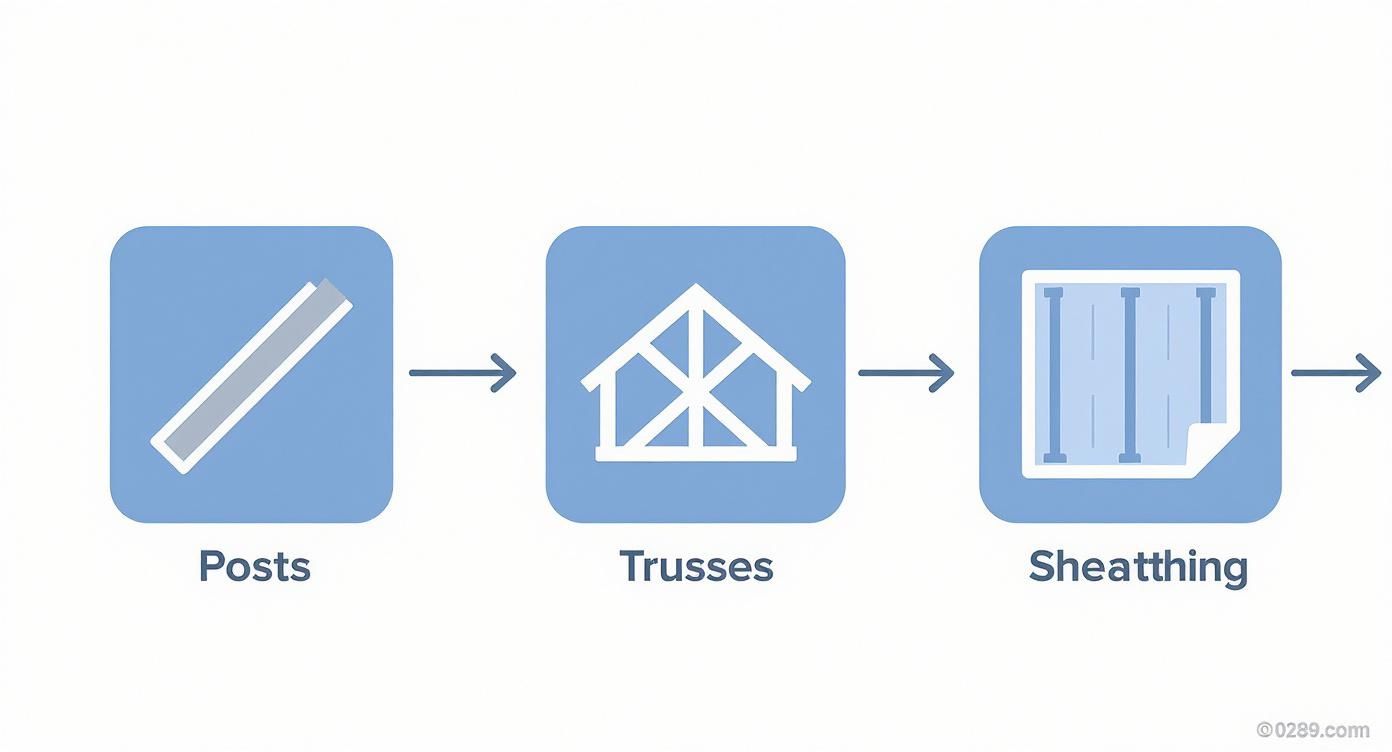
This simple flow—posts, trusses, then sheathing—is the core of what makes the post frame assembly process so methodical and efficient.
Enclosing The Building And Finishing Touches
With the complete skeleton standing, it’s time to enclose it. Crews systematically fasten large steel panels to the wall girts and roof purlins. This part of the process moves quickly, and in what feels like no time at all, the building is fully protected from the elements.
This rapid enclosure is a huge part of the appeal of post frame construction and why demand remains strong across agricultural, commercial, and even residential markets.
Final Stage Transformation: The last steps are what transform the structural shell into a personalized, functional space. This is when openings are cut for windows and doors, trim is added for a clean and finished look, and any interior work gets underway.
Whether you’re adding insulation and electrical wiring or framing out separate rooms, the interior can be completely customized for any purpose. From a simple workshop with a gravel floor to a fully finished "barndominium" with polished concrete and drywall, these finishing touches complete the building’s journey from a project to a valuable asset.
Why Builders Choose Post Frame Construction
Knowing the parts and the process is one thing, but the real story is why so many builders and property owners are turning to post frame construction for everything from workshops to full-blown homes. The reasons are practical, measurable, and hit on the biggest challenges in modern construction: cost, speed, and flexibility.
These aren't just minor perks. They represent a fundamental shift in how efficiently you can design, build, and even operate a structure over its entire lifespan. It's a system that delivers serious value from day one.
Significant Cost Effectiveness
Let's start with the bottom line—it’s one of the most compelling reasons people go with post frame. The savings kick in right away with the foundation. Because you don't need a continuous concrete perimeter foundation, you immediately slash huge concrete and labor costs. The entire structure is supported by strategically placed piers, which is a far more economical way to get started.
That efficiency carries right through to the framing materials. Post frame buildings use fewer, but larger, structural members instead of the dense grid of studs you see in a typical stick-built wall. That means less lumber overall, which cuts down material expenses. When you pair a simpler foundation with a smarter frame, you get a building that’s often significantly more affordable to put up, all without giving up an ounce of strength.
Unmatched Speed of Construction
In construction, time is always money, and this is where post frame really shines. The whole process, from setting the posts in the ground to hanging the last wall panel, is incredibly fast. With fewer components to manage and a simpler system to assemble, crews can often get the entire shell of a building up in a fraction of the time it takes with conventional methods.
This speedy timeline gives you a few key advantages:
- Reduced Labor Costs: Fewer days on the job site mean a smaller final labor bill. Simple as that.
- Faster Occupancy: You can get the building enclosed and protected from the weather in record time, so interior work can start much sooner. That means you can start using your new garage, workshop, or barn way ahead of schedule.
- Less Weather Disruption: A shorter construction window naturally lowers the risk of getting sidelined by bad weather and costly delays.
Superior Energy Efficiency
Here’s a benefit that often flies under the radar but has a huge impact: built-in energy efficiency. In traditional stick-built walls, you have studs every 16 or 24 inches. Each one of those studs is a "thermal bridge"—a spot where heat can easily pass through, breaking up your insulation.
Post frame walls are different. The posts are spaced 8 feet or even further apart, creating huge, uninterrupted cavities. This design allows you to roll out a continuous blanket of insulation, minimizing those thermal bridges and dramatically boosting the building's ability to hold heat in the winter and stay cool in the summer.
By creating a more effective thermal envelope, post frame buildings can lead to substantially lower heating and cooling costs over the life of the structure. The wider spacing between structural elements is the key to achieving this superior insulating performance.
Remarkable Design Flexibility
The clear-span design is maybe the most game-changing feature of post frame construction. The massive posts and engineered roof trusses are doing all the heavy lifting, which means you don’t need any interior load-bearing walls. None. This opens up a world of possibilities for how you lay out the inside.
You get a completely open, column-free space that you can configure for literally any purpose. Need a massive workshop for oversized equipment? An open-concept living area for a barndominium? A wide-open retail floor? Post frame gives you the ultimate blank canvas, a kind of structural freedom that’s incredibly difficult and expensive to pull off with other methods.
Here's a quick look at why post frame construction is such a popular choice.
Summary Of Post Frame Construction Advantages
| Benefit | Description | Typical Impact |
|---|---|---|
| Cost Savings | Simpler foundation requirements and more efficient use of lumber reduce overall material and labor expenses. | Lower upfront investment and a more predictable budget. |
| Construction Speed | The streamlined process with fewer components allows for rapid assembly of the building's shell. | Faster move-in dates, reduced labor costs, and less exposure to weather delays. |
| Energy Efficiency | Wide post spacing creates large wall cavities for continuous insulation, minimizing thermal bridging. | Lower long-term heating and cooling bills and increased interior comfort. |
| Design Flexibility | The clear-span truss system eliminates the need for interior support walls, creating wide-open interior spaces. | Complete freedom to customize layouts for any application, from workshops to open-concept homes. |
These advantages make it clear why the method continues to gain traction across so many different types of projects.
Economically, the appeal of post frame methods is right in line with market trends. The related timber frame market is projected to grow with a compound annual growth rate of around 7.1%. This is driven by new technologies in treated wood that make it more durable and fire-resistant while keeping costs low and design options wide open. You can find more on timber frame construction market trends on verifiedmarketresearch.com. This signals a growing confidence in modern wood-based building systems. For more on how wood stacks up against other materials, see our comparison of a steel building vs a wood building.
Popular Uses For Post Frame Buildings Today
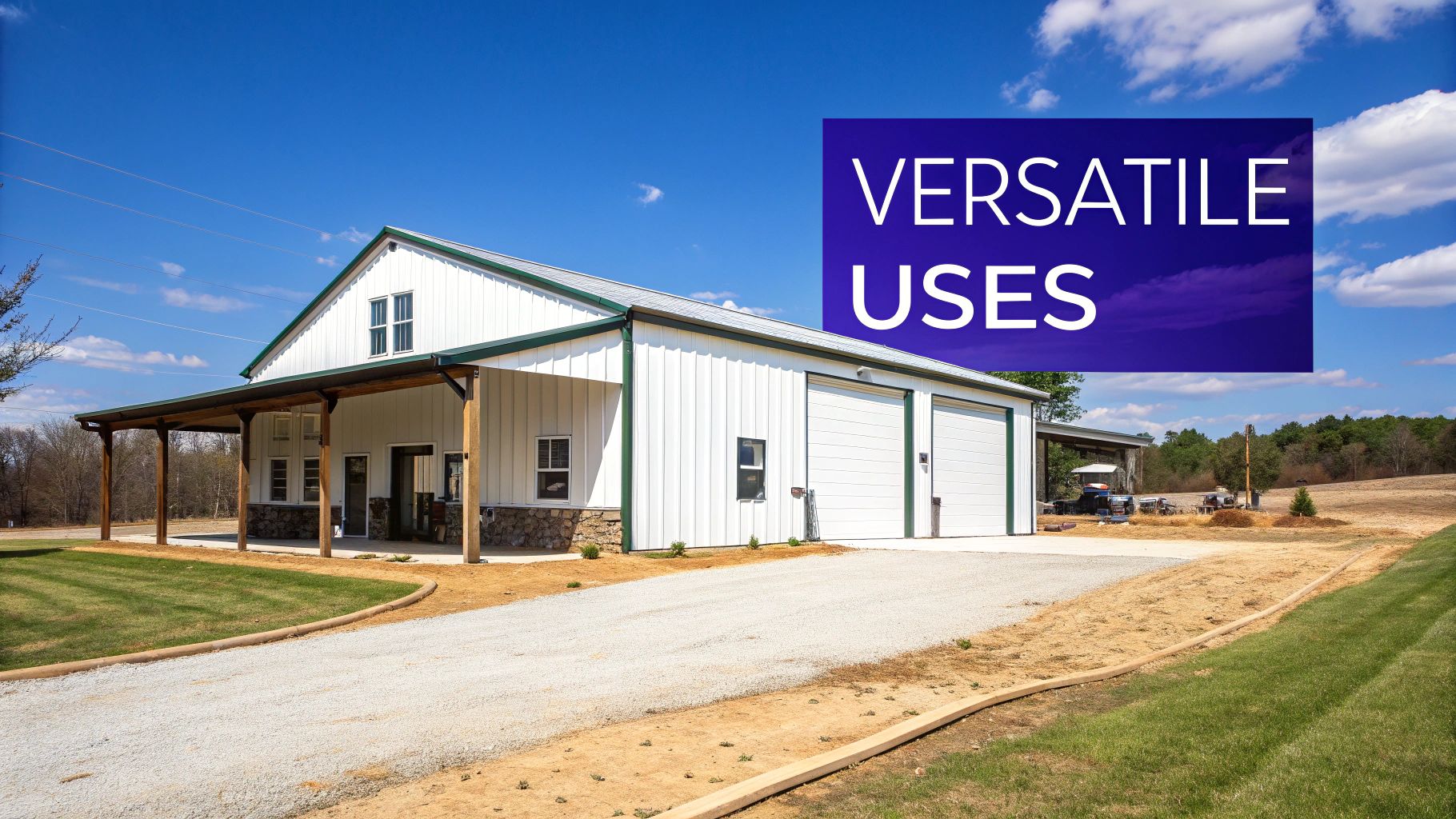
When you hear "pole barn," you probably picture a classic farm scene. But the truth is, modern post frame construction has broken out of the pasture and is showing up everywhere. Its core strengths—being cost-effective, quick to build, and offering massive open interiors—have made it the perfect solution for a surprising range of projects.
These days, you're just as likely to see a post frame building as a trendy retail store or a custom home as you are an equipment shed. That's the real magic of this method. It adapts effortlessly to residential, commercial, and, of course, agricultural needs. Let’s look at where these incredibly engineered structures are making their mark.
Still King on the Farm
Post frame construction got its start in agriculture, and it still reigns supreme there. For modern farming, which requires huge, unobstructed spaces, nothing else really compares.
These buildings are perfect for:
- Equipment Storage: Those clear-span interiors are a game-changer, easily fitting massive machinery like combines, tractors, and planters. It's the best way to protect those high-dollar assets from the weather.
- Livestock Shelters: From simple cattle barns to complex equestrian facilities, the design provides fantastic ventilation and totally customizable layouts. For anyone thinking about horses, knowing how to properly build a horse barn shows just how tailored these structures can be for animal safety and comfort.
- Hay and Feed Storage: A weather-tight post frame building keeps valuable feed and hay protected from moisture and pests, which is crucial for preserving its quality and preventing loss.
Making Inroads in Commercial and Industrial Spaces
Business owners are catching on. Why? Because post frame construction makes good financial sense. The speedy build time means your business is up and running faster, generating a quicker return on your investment. Plus, the lower upfront cost is a huge help for any project budget.
In the commercial world, you’ll see them used as:
- Warehouses and Storage Units: The column-free design is a dream for maximizing storage space and letting forklifts zip around without obstacles.
- Workshops and Manufacturing Facilities: The robust structure can be engineered to handle heavy equipment and the daily grind of industrial operations with ease.
- Retail Storefronts: Don't let the "barn" name fool you. With limitless options for exterior finishes, a post frame building can become a stylish and inviting retail shop for a fraction of what traditional construction would cost.
The New Frontier: Post Frame Homes
This is where things get really exciting. Post frame construction is booming in the residential market, and for good reason. The same flexibility that works for a warehouse creates incredible opportunities for home design, leading to the wildly popular "barndominium" trend.
A barndominium perfectly blends the rustic charm of a barn with all the modern comforts you'd want in a custom home. The wide-open floor plan, a natural feature of post frame, allows for breathtaking great rooms, soaring ceilings, and a seamless flow between living areas and hobby space.
It’s not just for primary homes, either. This method is a top choice for building spacious detached garages, hobby shops, and even accessory dwelling units (ADUs). For homeowners looking to add functional space and value to their property, the combination of cost savings and design freedom makes it an incredibly appealing choice.
Key Design Choices And Cost Factors To Consider
This is where the fun begins. Planning your post frame building is the moment your vision starts taking shape on paper. But every decision you make from here on out—from the ground up—directly impacts how your building works and what it costs. Getting these choices right is key to building a structure that fits your needs and your budget.
First things first: the building's footprint. The overall size—length, width, and height—is easily the single biggest driver of your final cost. It's simple math: a larger structure requires more materials and more labor. But don't just think in square footage. Think about how you'll actually use the space. Planning your dimensions to maximize function without adding unnecessary size is the smartest first step you can take.
Core Design And Material Selections
With a general size mapped out, it's time to dig into the specific materials and features that give your building its character and performance. This is your chance to strike the perfect balance between looks, long-term durability, and what you're willing to spend.
Your exterior finishes are a huge part of this. Steel panels are the go-to for siding and roofing for a reason—they’re tough, last forever, and require almost no maintenance. Of course, you have other options, too. When you're weighing your choices for the roof, it's a good idea to explore the benefits and drawbacks of metal roofing to really get a handle on the long-term value.
Other critical design elements include:
- Doors and Windows: How many do you need? What size and style? Every overhead door, walk-in door, and window affects both the final price and day-to-day usability.
- Insulation: The R-value you choose will have a direct impact on your building's long-term energy bills and overall comfort. Don't skimp here.
- Aesthetic Add-ons: This is the stuff that adds personality. Features like wainscoting, cupolas, porches, and overhangs give your building serious visual appeal, but they will add to the project's bottom line.
Budgeting Tip: Nail down your needs before you start adding your wants. Lock in your budget for the essentials—like the right size and good insulation—first. You can always add the aesthetic touches later as your finances allow.
Breaking Down The Primary Cost Drivers
Getting a firm grip on what drives the final price tag is the best way to build a realistic budget. Beyond the obvious factor of size, a few key variables will shape your total investment. The complexity of your design is a big one. A simple, clean rectangular building will always cost less than one with multiple offsets or an intricate roofline.
Material quality also plays a massive role. Opting for thicker gauge steel, premium windows, or upgraded insulation will raise your upfront costs, but you're often buying better long-term performance and durability. Finally, your geographic location touches everything from local labor rates to material delivery fees and building codes, which might demand specific structural upgrades. By thinking through these elements carefully, you can create a detailed plan that aligns perfectly with both your vision and your wallet.
Still Have Questions? Let's Talk Post Frame.
Even after you've seen how post frame construction works and why it's so popular, a few practical questions usually pop up. It's a versatile building method, sure, but it's totally natural to wonder about the long-term performance, the money side of things, and if it's really the right fit for you.
Let's clear the air on some of the most common things people ask.
Practical Concerns and Straight Answers
"How long will this thing actually last?"
This is probably the #1 question, and it's a good one. Can a building with posts in the ground really go the distance? The answer is a definite yes. We're not talking about untreated fence posts here. Modern post frame buildings use pressure-treated, laminated columns that are specifically engineered to fight off rot and insects for decades.
When they're installed correctly, these structures are designed to last 50 years or more, putting them right on par with the lifespan of many traditionally built homes and commercial buildings.
"Can I get a loan for a 'pole barn'?"
Another big one is financing. That old term "pole barn" can sometimes make people think lenders will run the other way, but that's not the case anymore. Lenders treat modern post frame homes and commercial buildings just like any other construction project.
As long as your building is a permanent structure on a proper foundation and meets all your local building codes, getting a construction loan or a mortgage is a standard process.
"What about handling tough weather?"
Post frame buildings are incredibly tough and adaptable.
- Heavy Snow? The engineered roof trusses are designed from the ground up to handle serious snow loads. It's why they're such a common sight in northern climates.
- High Winds? The way the steel sheathing connects to the entire frame creates a super-rigid structure. This "diaphragm action" makes it exceptionally resistant to the lateral forces of strong winds.
- Extreme Heat or Cold? The wide spacing between posts creates deep wall cavities, which is perfect for packing in a ton of insulation. This makes them incredibly energy-efficient, keeping you comfortable while lowering your utility bills.
The main thing to remember is that modern post frame isn't just a simple building technique—it's a highly engineered system. It's not a one-size-fits-all kit, but a customizable method that can be adapted to meet strict building codes and harsh weather anywhere in the country.
So, is a post frame building a good investment? When you add up the lower upfront costs, quicker build times, long-term energy savings, and serious durability, the answer is a resounding yes. It’s a smart way to build that delivers lasting value and flexibility, whether you need it for a farm, a business, or your family's home.
Ready to turn your vision into a durable, cost-effective reality? At Icon Steel Buildings, we specialize in designing and delivering high-quality post frame structures built to last. Explore your options and get a custom quote today at https://iconsteelbuildings.com.