When you hear "metal building," you might picture a simple, utilitarian warehouse. But the reality is far more exciting. Modern engineering has transformed steel structures into versatile, customizable, and surprisingly beautiful solutions for nearly any application. From sprawling agricultural complexes to sleek commercial storefronts and ultra-secure data centers, the possibilities are vast and varied.
This guide explores 12 innovative metal buildings ideas that showcase the true potential of steel. We'll dive into specific designs, practical applications, and actionable tips to help you envision and plan your own project. Instead of generic concepts, you will find concrete examples that demonstrate how to maximize space, efficiency, and durability.
Whether you're a business owner planning an expansion, a farmer needing reliable storage, or an entrepreneur launching a new venture, these concepts provide the inspiration you need. Forget the outdated notion of a simple box. This list will help you understand how to build bigger, better, and smarter with steel, unlocking creative designs that meet precise functional demands. We'll cover everything from massive clear-span sports facilities to energy-efficient green buildings and disaster-resistant structures, offering a comprehensive look at what's possible.
1. Clear Span Design
A clear span design is a foundational concept in metal building construction, offering an interior completely free of support columns. This uninterrupted space is achieved by a structural system where the roof is supported by massive frames that span the entire width of the building, transferring all loads directly to the foundation. This design is one of the most versatile metal buildings ideas for applications requiring maximum usable floor space.
Why Choose a Clear Span Design?
This approach is ideal for operations that need large, open areas for machinery, inventory, or large-scale activities. Think of aircraft hangars, indoor sports arenas, or agricultural storage facilities where interior columns would obstruct movement and limit functionality. For commercial use, it allows for complete flexibility in laying out floor plans, from manufacturing lines to retail showrooms.
Implementation Tips
- Load Calculation: Accurately calculate regional snow and wind load requirements. A wider span requires a stronger frame to handle environmental stress.
- Future-Proofing: Consider potential future uses. A clear span design makes it easier to reconfigure the interior as your needs change.
- Ventilation: Plan for adequate ventilation systems. Large, open interiors can have challenges with air circulation and temperature regulation if not addressed during the design phase.
The integrity of this design hinges on the quality and engineering of its structural framework. For a deeper understanding of the components involved, you can learn more about the different types of metal building frames.
2. Agricultural Metal Buildings
Agricultural metal buildings are structures engineered specifically for the demands of modern farming. They provide durable, low-maintenance solutions for everything from equipment storage and livestock housing to crop protection. Designed to withstand harsh weather and the wear and tear of daily farm operations, these buildings are a cornerstone of efficient agricultural infrastructure. This application is one of the most practical metal buildings ideas for the farming sector.
Why Choose an Agricultural Metal Building?
These structures are ideal for protecting valuable assets like combines, tractors, and harvested crops from the elements. For livestock, metal barns offer a safe, clean, and well-ventilated environment that can be easily sanitized. Their adaptability makes them suitable for diverse needs, including dairy operations, hay storage, and equipment maintenance shops. The integration of technology, like agriculture GPS tracking solutions, further enhances operational efficiency within these modern farm buildings.
Implementation Tips
- Ventilation is Key: Install ridge vents and sidewall louvers to ensure proper airflow, which is critical for livestock health and preventing crop spoilage.
- Control Condensation: Use high-quality vapor barriers in the roof and walls to manage moisture and protect stored goods and equipment from rust.
- Plan for Growth: Design the building with future expansion in mind. Position doors and frame end walls to simplify adding new sections as your operation grows.
The versatility of these structures makes them a valuable investment for any agricultural enterprise. To explore the options available, you can learn more about how steel building kits are used for agricultural purposes.
3. Industrial Warehouse with Mezzanine Levels
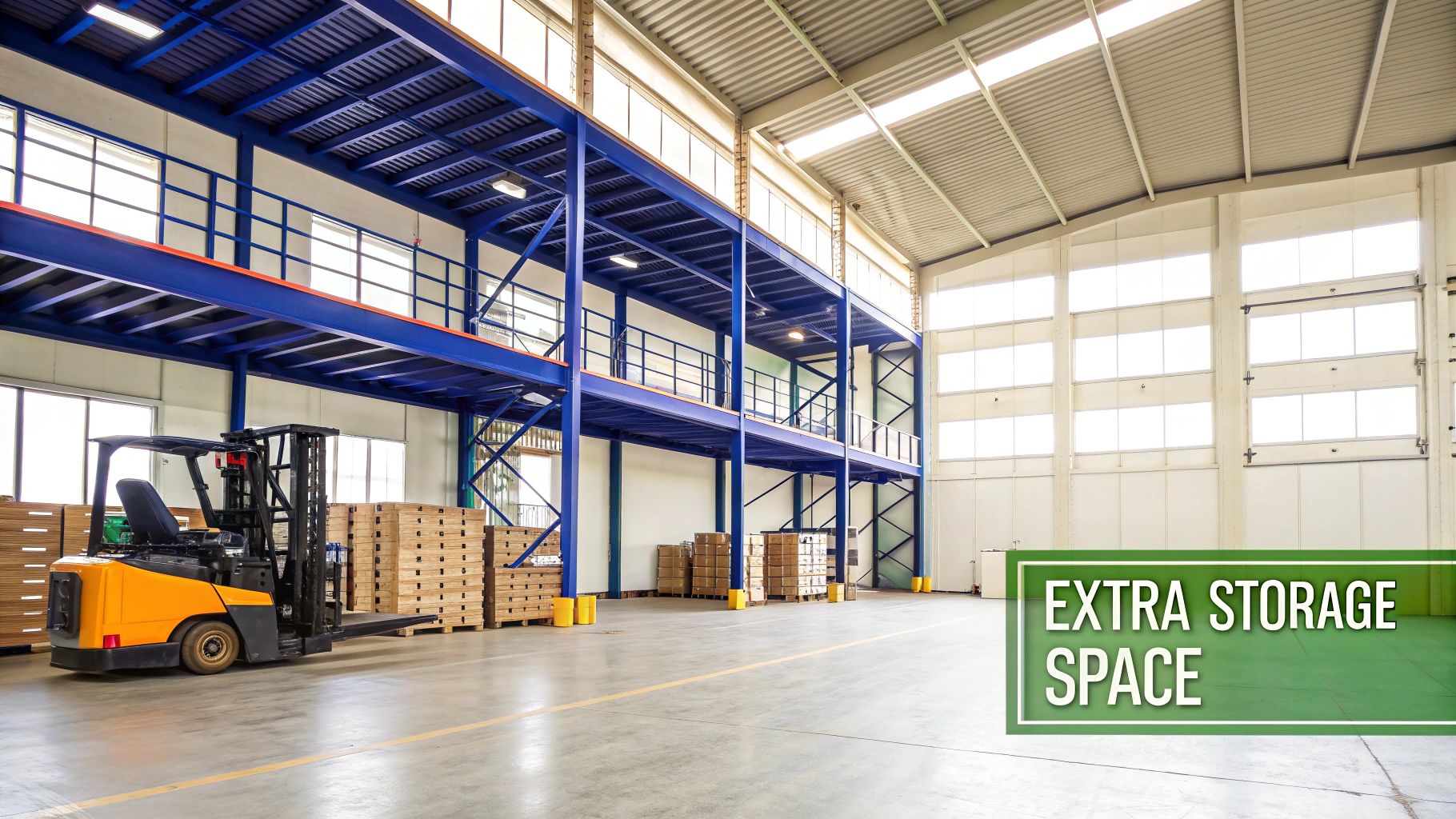
An industrial warehouse with mezzanine levels is one of the most efficient metal buildings ideas for maximizing vertical space. This design involves installing intermediate floor platforms within a building's high ceilings, effectively creating a second or third story for storage or operations without expanding the physical footprint. These semi-permanent structures leverage the vertical volume that often goes unused in tall warehouse buildings.
Why Choose a Warehouse with Mezzanine Levels?
This configuration is a game-changer for businesses that need more room but are constrained by land availability or cost. It is perfect for e-commerce fulfillment centers that require dense storage solutions, manufacturing facilities needing overhead office space, or automotive parts depots organizing vast inventories. By building up instead of out, you can dramatically increase your usable square footage at a fraction of the cost of new construction.
Implementation Tips
- Load Distribution: Work closely with a structural engineer to ensure the mezzanine’s weight and its intended load are safely supported by the building frame and foundation.
- Accessibility: Plan for efficient access with stairs, lifts, or conveyors. Ensure that pathways comply with OSHA safety standards for workers.
- Forklift Clearance: Design the layout with adequate vertical and horizontal clearance for forklifts and other machinery to operate safely underneath the mezzanine.
The strategic addition of mezzanines transforms a standard structure into a high-density operational hub. To explore purpose-built structures designed for this kind of vertical expansion, you can find more information about warehouse steel buildings.
4. Retail and Commercial Storefronts
Transforming a basic steel structure into an attractive commercial storefront is one of the most practical metal buildings ideas for business owners. This approach combines the cost-effectiveness and durability of steel with sophisticated facade systems, large glass windows, and professional interior finishes. The result is a modern, inviting space that can be customized for retail stores, office buildings, or even quick-service restaurants, challenging the traditional image of metal buildings.
Why Choose a Commercial Storefront Design?
This application is perfect for businesses seeking a quick-to-construct yet highly customizable building. The steel frame provides a robust skeleton that can be clad in various materials like brick veneer, stucco, or architectural metal panels to achieve any desired aesthetic. It allows for wide-open interior layouts that can be easily configured for retail displays, office cubicles, or dealership showrooms, offering a blend of functionality and curb appeal.
Implementation Tips
- Insulation: Invest in high-quality insulation (R-20 to R-30) and thermal breaks to ensure energy efficiency and customer comfort.
- Interior Finishing: Utilize metal framing that can be easily concealed with standard drywall for a polished, conventional interior look.
- Facade Materials: Select attractive cladding materials that align with your brand identity, such as stone veneer or sleek metal panels, to create an inviting exterior.
- HVAC Planning: Design zoned HVAC systems to maintain consistent climate control across different areas, like separating a showroom from office space.
Careful upfront planning is essential for a successful commercial build. To visualize how your space can be configured, you can explore various metal building floor plans.
5. Aircraft Hangars
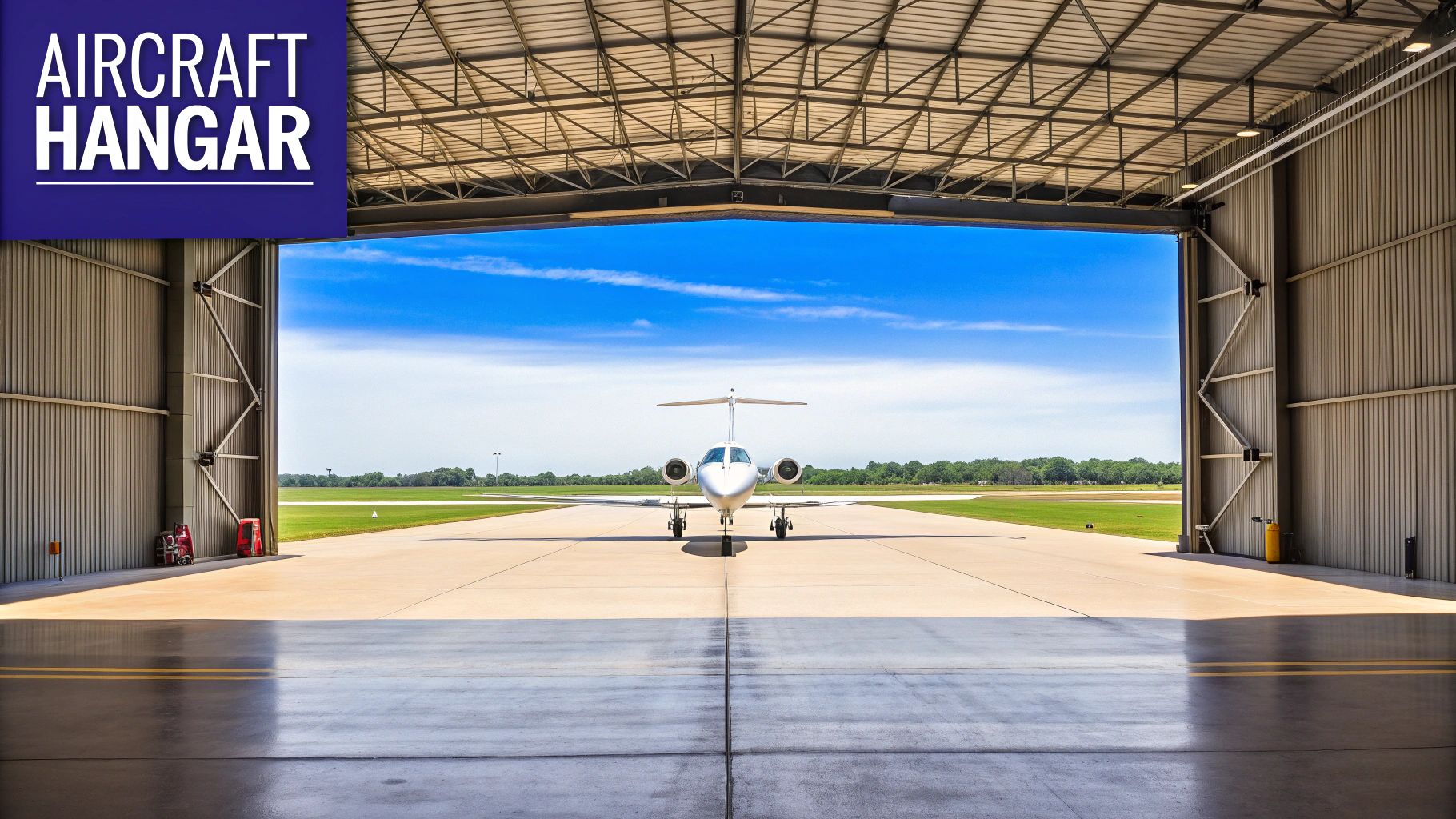
Aircraft hangars represent one of the most specialized and demanding applications for metal buildings, requiring extra-large clear spans, high eave heights, and robust structural systems to protect high-value assets. These structures are engineered to accommodate massive hangar doors and withstand significant wind loads, making them ideal for storing and maintaining everything from small private planes to large commercial jets.
Why Choose a Metal Aircraft Hangar?
Steel is the superior choice for aviation facilities due to its strength-to-weight ratio, which is crucial for achieving the enormous clear spans needed for aircraft wingspans. This design provides unobstructed interior space for maneuvering aircraft and equipment. Metal buildings are also durable and low-maintenance, offering long-term protection against the elements at military air bases, private aviation facilities, and commercial airports.
Implementation Tips
- Door System Integration: Plan for sophisticated door systems (like bi-fold or hydraulic doors) from the beginning, as they are integral to the building's structural design.
- Specialized Engineering: Engage aerospace or structural engineers experienced with aviation-specific requirements, including floor loads and fire suppression systems.
- Climate Control: Consider installing insulation and climate control systems to protect sensitive avionics and components from temperature fluctuations and humidity.
These complex structures are often streamlined through the use of pre-engineered systems. To explore how these systems can be adapted for large-scale projects, you can find more information about prefabricated metal building kits.
6. Sports and Recreation Facilities
Metal buildings are exceptionally well-suited for sports and recreation facilities, offering expansive, column-free interiors perfect for uninterrupted athletic activities. These structures are engineered to accommodate everything from indoor soccer fields and ice hockey arenas to gymnasiums and equestrian centers. The strength of steel framing allows for the vast clear spans necessary for playing surfaces, spectator seating, and ancillary spaces, making them a top choice for community and commercial sports complexes.
Why Choose a Metal Building for Sports?
The primary advantage is the creation of large, open spaces that are essential for most sports. Unlike traditional construction, steel buildings can achieve wide spans without interior supports, ensuring sightlines are clear and play is unobstructed. This design flexibility also supports specialized requirements like high ceilings for basketball or tennis, and the structural capacity to handle lighting rigs, scoreboards, and spectator bleachers. They offer one of the most cost-effective metal buildings ideas for large-scale recreational projects.
Implementation Tips
- Acoustic Control: Install acoustic panels on walls and ceilings to dampen noise and reduce echo, a common issue in large, open facilities.
- Climate Management: Design a robust HVAC system capable of managing the high heat and humidity generated by intense physical activity.
- Specialized Flooring: Incorporate appropriate sports flooring, such as sprung hardwood for basketball courts or synthetic turf for indoor soccer, ensuring the foundation is engineered to support it.
- Moisture Control: For facilities like ice arenas or indoor pools, integrate a powerful dehumidification system to prevent condensation and protect the building's structural integrity.
7. Energy-Efficient Green Metal Buildings
An energy-efficient green metal building integrates sustainable technologies and materials to dramatically reduce its environmental footprint and long-term operational costs. This modern approach to construction goes beyond basic steel framing, incorporating systems like solar panels, advanced insulation, and smart controls. These features make it one of the most forward-thinking metal buildings ideas for environmentally conscious owners.
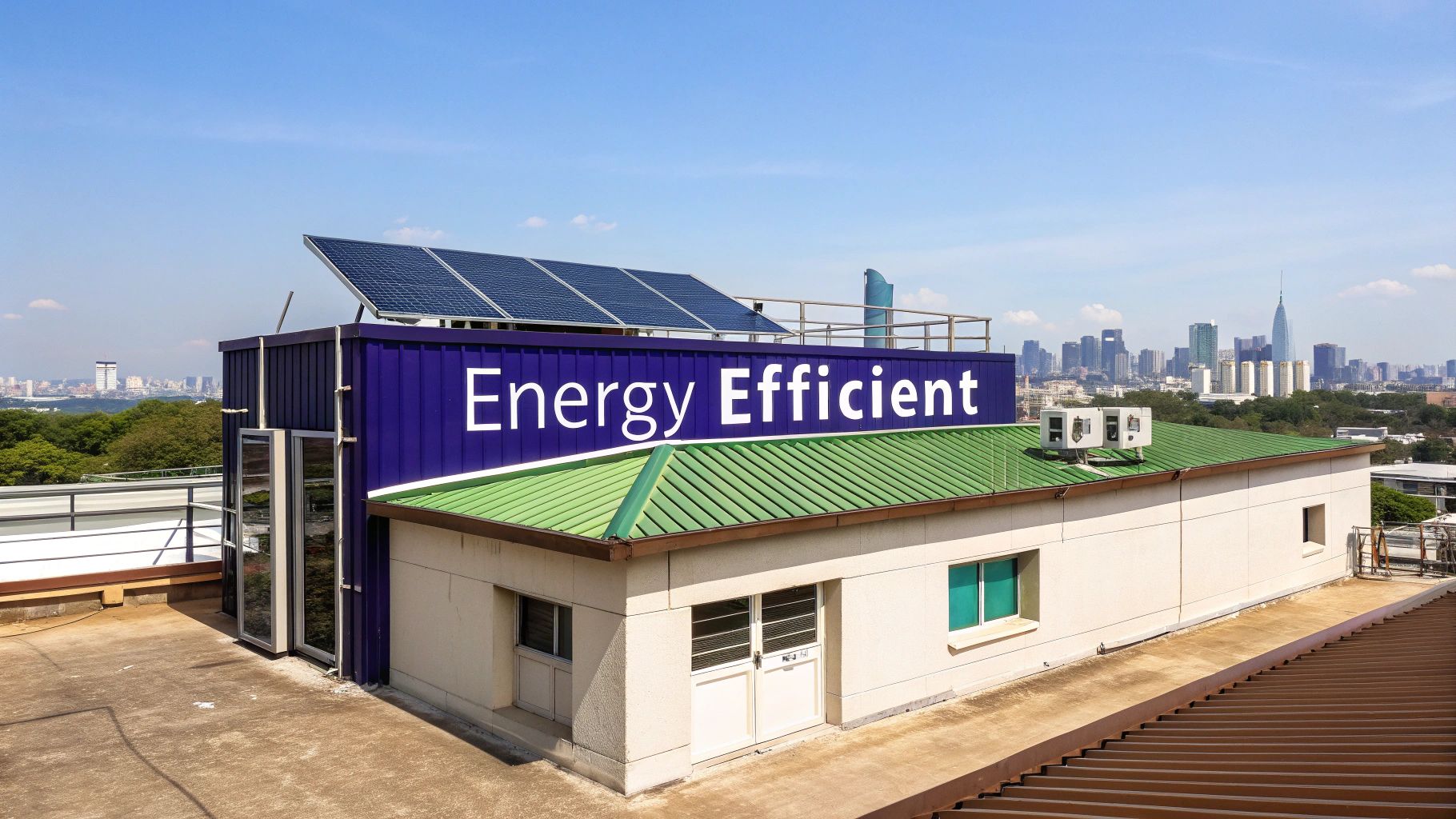
Why Choose an Energy-Efficient Design?
This design is ideal for businesses and organizations aiming for net-zero energy goals or seeking significant savings on utility bills. It's perfectly suited for corporate headquarters, educational institutions, and large-scale commercial facilities like Costco warehouses, where solar-paneled roofs can generate substantial power. The high thermal performance also makes these buildings more comfortable and productive for occupants.
Implementation Tips
- Calculate ROI: Before committing to technologies like solar panels, calculate your potential return on investment based on local energy rates and available tax incentives.
- Roof Orientation: Position the building and design the roof to maximize solar exposure for photovoltaic panels, a key principle of passive solar design.
- Invest in Insulation: Use high-R-value insulation systems, like insulated metal panels (IMPs), to create a tight thermal envelope that minimizes heat loss and gain.
- Smart Controls: Integrate smart building controls for HVAC and lighting systems to automate energy use and optimize efficiency based on occupancy and time of day.
8. Data Centers and Server Facilities
A highly specialized application for steel construction, data centers are mission-critical facilities designed to house servers and networking equipment. Metal buildings provide the structural integrity and customization needed for these high-tech environments, accommodating precise climate control, redundant power systems, and robust security measures. This is one of the most demanding metal buildings ideas, requiring meticulous planning and engineering.
Why Choose a Metal Building for a Data Center?
Steel structures offer the scalability and controlled environment essential for protecting sensitive IT infrastructure. Their durability protects against environmental threats, while the clear span design possibilities allow for unobstructed floor space needed for server racks and cooling systems. Companies like Digital Realty and Equinix leverage metal buildings for their rapid deployment and cost-effective construction.
Implementation Tips
- Redundancy Planning: Design for N+1 or greater redundancy in power and cooling to ensure uptime during equipment failure or maintenance.
- Aisle Containment: Implement a hot/cold aisle containment strategy to manage airflow efficiently, reducing energy consumption and preventing equipment overheating.
- Future-Proofing: Plan for future capacity expansion from the outset. Design the layout and structural frame to accommodate additional servers and power distribution units.
The security and operational continuity of a data center depend entirely on its physical infrastructure, making a well-engineered metal building a strategic choice.
9. Manufacturing and Production Facilities
Engineered for industrial applications, metal buildings serve as ideal manufacturing and production facilities. These structures are designed to support heavy equipment, accommodate complex assembly lines, and facilitate the high-volume movement of materials and personnel. Their inherent durability and design flexibility make them one of the most practical metal buildings ideas for industrial operations ranging from automotive plants to food processing centers.
Why Choose a Metal Building for Manufacturing?
Metal structures are uniquely suited for the demands of industrial environments. Their clear span capabilities allow for unobstructed floor space, crucial for laying out production lines and maneuvering large machinery. The robust steel framework can be easily designed to support overhead crane systems, industrial-grade ventilation, and heavy-duty electrical infrastructure, making them a cost-effective and highly functional solution for modern manufacturing.
Implementation Tips
- Crane Systems: If your process requires overhead cranes, integrate the necessary support beams and runway systems into the initial building design to ensure structural integrity.
- Material Flow: Map out the entire production process from raw material intake to finished product output. Design door placements, bay spacing, and interior layout to optimize workflow.
- Utility Planning: Plan for heavy-duty electrical distribution, compressed air lines, and specialized plumbing. A concrete slab foundation should be engineered to handle equipment loads and potential vibrations.
10. Modular and Expandable Metal Buildings
A modular and expandable design is one of the most forward-thinking metal buildings ideas, allowing for future growth without costly demolition and reconstruction. These systems are engineered with components that facilitate easy expansion. The endwalls are often designed to be non-load-bearing, so they can be removed and relocated to extend the building’s length as operational needs evolve.
Why Choose a Modular and Expandable Design?
This approach is perfect for businesses and operations with a clear growth trajectory. Scaling e-commerce warehouses, growing manufacturing plants, or agricultural operations that anticipate increasing storage capacity can benefit immensely. It allows an organization to invest in the space they need now while having a cost-effective plan for the future, protecting the initial investment.
Implementation Tips
- Site Planning: Position the building on your property to allow for unobstructed expansion. Ensure the layout accounts for future traffic flow, parking, and utility access.
- Foundation Design: Plan the foundation to accommodate future additions. This may involve engineering the initial slab to support a larger structure later.
- Document Everything: Keep detailed records of the original engineering plans, color codes, and component suppliers to ensure a seamless match during expansion.
11. Cold Storage and Freezer Facilities
Among the most specialized metal buildings ideas are cold storage and freezer facilities, engineered to maintain precise, low-temperature environments. These structures use insulated metal panels (IMPs) and advanced vapor barriers to create a tightly sealed thermal envelope. This design is crucial for preserving perishable goods like food, pharmaceuticals, and other temperature-sensitive materials, preventing spoilage and ensuring regulatory compliance.
Why Choose a Cold Storage Facility Design?
This application is essential for industries where product integrity depends on a controlled climate. Frozen food distribution centers, pharmaceutical warehouses, and meat processing plants rely on these facilities to maintain their cold chain. The steel framework provides the structural strength to support heavy refrigeration equipment and high-density racking systems, while the insulated panels offer superior thermal performance and energy efficiency.
Implementation Tips
- Insulation Quality: Invest in high-R-value insulation like polyurethane or expanded polystyrene (EPS) panels to minimize thermal bridging and reduce energy consumption.
- Redundant Systems: Design the facility with redundant refrigeration systems to protect valuable inventory in case of primary system failure.
- Climate-Controlled Docks: Install insulated overhead doors and dock seals to maintain temperature consistency during loading and unloading.
- Monitoring and Alarms: Implement a robust temperature monitoring system with alarms to provide real-time alerts for any temperature deviations.
12. Natural Disaster-Resistant Metal Buildings
Among the most resilient metal buildings ideas is the concept of a structure engineered specifically to withstand extreme weather and seismic events. These buildings go beyond standard codes, incorporating reinforced frames, advanced connection techniques, and materials rated for severe environmental conditions like hurricanes, tornadoes, and earthquakes. Their primary function is to protect occupants and assets when they are most vulnerable.
Why Choose a Disaster-Resistant Design?
This approach is critical for facilities that must remain operational during and after a natural disaster. Think of emergency management centers, hospitals, and critical infrastructure facilities where failure is not an option. For businesses in coastal or tornado-prone regions, such as manufacturing plants or warehouses, a disaster-resistant design minimizes downtime and protects valuable inventory and equipment from catastrophic loss.
Implementation Tips
- Continuous Connections: Ensure a continuous load path from the roof to the foundation to resist uplift and lateral forces from high winds.
- High-Wind Rated Roofing: Install a metal roof system tested and rated to withstand the specific wind speeds anticipated for your region.
- Impact Resistance: Use impact-resistant exterior wall panels and glazing to protect against flying debris during a severe storm.
- System Integration: Anchor all heavy equipment securely to the structure and plan for integrated backup power and water systems to maintain functionality.
12 Metal Building Ideas Comparison
| Type | Implementation Complexity 🔄 | Resource Requirements ⚡ | Expected Outcomes 📊 | Ideal Use Cases 💡 | Key Advantages ⭐ |
|---|---|---|---|---|---|
| Clear Span Design | High 🔄🔄🔄 — complex long-span engineering | High ⚡⚡⚡ — stronger frames, materials, connections | Very high usable open space; flexible layouts 📊⭐⭐⭐ | Warehouses, aircraft hangars, convention centers | Unobstructed floor; flexible layouts; excellent sightlines |
| Agricultural Metal Buildings | Medium 🔄🔄 — ventilation & drainage considerations | Medium ⚡⚡ — coatings, vents, simple HVAC | Protects assets; low maintenance vs wood 📊⭐⭐ | Grain storage, dairy barns, equipment sheds, livestock housing | Durable; cost-effective; customizable for farm needs |
| Industrial Warehouse with Mezzanine Levels | High 🔄🔄🔄 — complex load and code issues | High ⚡⚡⚡ — mezzanine structures, access systems | Dramatically increased usable area without expanding footprint 📊⭐⭐⭐ | Distribution centers, e-commerce fulfillment, parts storage | Adds floor area quickly; optimizes land use; modular install |
| Retail and Commercial Storefronts | Medium 🔄🔄 — aesthetic and thermal design | Medium ⚡⚡ — glazing, facade, HVAC | Attractive, energy-efficient commercial spaces 📊⭐⭐ | Strip malls, showrooms, small offices, restaurants | Fast construction; modern appearance; lower maintenance |
| Aircraft Hangars | Very high 🔄🔄🔄 — specialized structural and door systems | Very high ⚡⚡⚡ — reinforced floors, doors, systems | Accommodates large aircraft; high protection and durability 📊⭐⭐⭐ | Airports, military bases, private aviation facilities | Extremely large spans; custom doors; heavy-duty durability |
| Sports and Recreation Facilities | High 🔄🔄🔄 — acoustics, HVAC, spectator structures | High ⚡⚡⚡ — sound treatment, HVAC, seating systems | Weather-protected, multi-use athletic spaces 📊⭐⭐ | Indoor arenas, ice rinks, gymnasiums, equestrian centers | Quick build; multi-use flexibility; cost advantage over masonry |
| Energy-Efficient Green Metal Buildings | High 🔄🔄🔄 — system integration (solar, ERV, controls) | High ⚡⚡⚡ — solar, high R-values, smart systems | Lower operating costs; sustainability and incentive potential 📊⭐⭐⭐ | Corporate HQ, warehouses with solar, municipal buildings | Reduced energy use; tax incentives; LEED/Net-Zero potential |
| Data Centers and Server Facilities | Very high 🔄🔄🔄 — precision engineering for uptime | Very high ⚡⚡⚡ — power, cooling, redundancy systems | High availability and scalable compute capacity 📊⭐⭐⭐ | Hyperscale facilities, colo, enterprise IT centers | Fast deployment; scalable; efficient use of space for IT loads |
| Manufacturing and Production Facilities | High 🔄🔄🔄 — supports heavy equipment and utilities | High ⚡⚡⚡ — reinforced floors, cranes, ventilation | Robust production environment; supports heavy loads 📊⭐⭐⭐ | Automotive plants, electronics assembly, food processing | Customizable layouts; supports heavy machinery; quick construction |
| Modular and Expandable Metal Buildings | Medium 🔄🔄 — upfront planning for future phases | Medium ⚡⚡ — standardized modules, phased utilities | Scalable growth with lower initial capex 📊⭐⭐ | Growing manufacturers, scaling warehouses, self-storage | Phased expansion; lower initial cost; quick future add-ons |
| Cold Storage and Freezer Facilities | Very high 🔄🔄🔄 — tight thermal, vapor, and code control | Very high ⚡⚡⚡ — thick insulation, refrigeration, backups | Precise temperature control; reduced spoilage 📊⭐⭐⭐ | Frozen food distribution, pharma storage, vaccine facilities | High thermal reliability; zoned control; energy-recovery options |
| Natural Disaster-Resistant Metal Buildings | Very high 🔄🔄🔄 — specialized seismic/hurricane design | High ⚡⚡⚡ — reinforced foundations, impact materials | Enhanced asset and occupant protection in extreme events 📊⭐⭐⭐ | Hospitals, emergency centers, coastal warehouses, critical infra | Resilient design; potential insurance benefits; extended lifespan |
From Blueprint to Reality: Building Your Vision with Steel
The journey through these diverse metal buildings ideas reveals a powerful truth: steel is no longer just a material for basic sheds or utilitarian garages. It's a dynamic, adaptable, and innovative building block for modern construction. We've explored how its inherent strengths can be harnessed to create everything from expansive, clear-span agricultural barns and multi-level industrial warehouses to sophisticated, climate-controlled data centers and resilient, disaster-proof community shelters. The common thread is versatility. The same core principles of steel construction can be tailored to meet the precise demands of a commercial storefront, an aircraft hangar, or an energy-efficient green building.
The true potential of these concepts is unlocked when creative vision meets strategic planning. By understanding the unique benefits of steel, you can design structures that are not only cost-effective and quick to erect but also exceptionally durable and low-maintenance. This translates into a smarter long-term investment, whether you're a business owner optimizing for operational efficiency or a homeowner creating a custom workshop.
Key Takeaways for Your Next Project
As you move from inspiration to implementation, remember these crucial points:
- Function Dictates Form: The most successful metal building projects begin with a clear understanding of the end-use. The requirements for a cold storage facility are vastly different from those of a retail space, and your design choices, from insulation to door placement, must reflect this.
- Embrace Customization: Pre-engineered does not mean one-size-fits-all. The beauty of modern steel buildings lies in their adaptability. You can specify exact dimensions, add mezzanine levels for extra space, incorporate extensive window systems for natural light, and choose from a wide array of colors and finishes to match your brand or aesthetic.
- Plan for the Future: One of steel's greatest advantages is its capacity for easy expansion. Designing a modular structure from the outset allows your building to grow alongside your business or evolving needs, saving significant time and expense down the road.
Ultimately, the most innovative metal buildings ideas are born from a partnership between your vision and a team of experts who can translate that vision into engineered reality. The strength, sustainability, and flexibility of steel provide a superior foundation, empowering you to build a structure that is not just functional today, but also resilient and valuable for decades to come.
Ready to bring your own metal building idea to life? The team at Icon Steel Buildings specializes in providing high-quality, American-made steel structures designed to your exact specifications. Visit Icon Steel Buildings to explore our options and request a customized quote for your project.