When you ask, "how much is a metal building," the straight answer is that a fully constructed project typically runs somewhere between $15 to $45 per square foot. Of course, that final price tag depends heavily on whether you're just buying the pre-fabricated kit or going for a complete "turnkey" installation that includes everything from the foundation to the final bolt.
Your Quick Guide to Metal Building Costs
Diving into the numbers requires understanding the two main ways to price a project: the building kit cost and the final erected cost. Think of the kit as a complete, ready-to-build package. It comes with all the steel framing, wall panels, roofing, and hardware you'll need. This is definitely the most budget-friendly path if you have the know-how and equipment to handle the construction yourself.
But for most people, a turnkey solution is the way to go. This all-in price covers more than just the building materials; it handles all the essential services needed to transform an empty plot of land into a finished, functional structure.
A turnkey price almost always includes:
- The Metal Building Kit: The core steel structure and all its components.
- Foundation Work: Pouring the concrete slab that your building will stand on.
- Labor and Erection: The cost for the crew that actually puts the building together.
- Delivery Fees: Getting all those heavy materials from our factory to your job site.
- Permits and Inspections: Navigating the local municipal fees and approvals required for any new construction.
Estimated Cost By Common Building Sizes
To help you get a clearer picture of what to expect, let's look at some popular building sizes and their typical price ranges. This table makes it easy to see the difference between buying just the kit versus paying for a complete, ready-to-use building.
Estimated Metal Building Cost by Size (Kit vs. Turnkey)
| Building Size (Width x Length) | Estimated Kit Cost Range | Estimated Turnkey Cost Range (All-Inclusive) |
|---|---|---|
| 30' x 40' (1,200 sq ft) | $13,000 – $22,000 | $18,000 – $54,000 |
| 40' x 60' (2,400 sq ft) | $22,000 – $36,000 | $36,000 – $108,000 |
| 60' x 100' (6,000 sq ft) | $45,000 – $75,000 | $90,000 – $270,000 |
| 100' x 200' (20,000 sq ft) | $140,000 – $220,000 | $300,000 – $900,000 |
These numbers are a fantastic starting point for budgeting your project. For a deeper dive, you can explore our complete guide to metal building kit prices and see exactly how different customizations can impact the bottom line.
There's a good reason so many people are turning to steel. The global market for pre-engineered buildings is set to grow from $18.79 billion in 2024 to $20.21 billion in 2025, a trend fueled by the demand for faster construction and real long-term cost savings. This industry growth just goes to show why so many are choosing metal for its unbeatable efficiency and durability.
Breaking Down Your Total Building Cost
So, how much is a metal building really going to cost? To get an honest answer, you have to look past a single price tag and see the whole picture. It's a lot like buying a new grill for your backyard—you have the grill itself, but you also need to factor in the cost of the concrete patio it sits on and the labor to assemble it all.
Your steel building project is no different. It’s made up of three main cost categories, and understanding how they all fit together is the key to setting a realistic budget and avoiding any nasty surprises. Let’s break down exactly where your money goes.
The Metal Building Kit
This is the heart of your project. The building kit itself typically makes up about 40% to 50% of your total investment. Think of it as the "flat-pack" part of the build—it’s the pre-engineered package with all the core structural materials that get delivered right to your property.
Here’s what’s inside your kit:
- Primary Framing: These are the heavy-duty steel I-beams that create the building’s main skeleton, giving it shape and incredible strength.
- Secondary Framing: This includes smaller steel parts like girts and purlins that run between the main frames to support the wall and roof panels.
- Wall and Roof Panels: This is the "skin" of your building. Your choice of thickness, color, and style will affect the final price.
- Fasteners and Hardware: Every single nut, bolt, screw, and piece of trim you need for assembly is included.
It's also worth noting that when you're comparing metal roof options to traditional materials, the long-term savings become really clear. The market reflects this shift; the global metal building framing sector alone was valued around $515 million in 2025 and is on track to hit $654 million by 2031. This isn't just a trend—it's a fundamental change in construction.
The Foundation Cost
A building is only as solid as the ground it stands on. Your concrete foundation is the literal base for the entire structure, and its cost can swing quite a bit depending on your location, soil type, and the building's purpose. It’s an absolutely critical expense that protects your investment for the long haul.
A simple 4-inch monolithic slab for a small garage on solid, level ground will be much more affordable than a complex pier-and-beam foundation needed for a huge industrial building on tricky soil.
Key Takeaway: Never, ever cut corners on your foundation. Skimping here is a recipe for serious structural problems down the road. You should always get a quote from a local concrete contractor who can assess your specific site and local code requirements.
Getting the foundation right is non-negotiable for structural integrity. That’s why we put together a detailed guide covering the essential steel building foundation requirements.
Construction and Labor Costs
The final piece of the cost puzzle is the hands-on work needed to bring your building to life. This bucket includes everything from clearing the land to tightening the last bolt. Even if you're a hardcore DIYer planning to erect the kit yourself, you'll almost certainly need to hire pros for the excavation and concrete work.
Here’s what usually falls under labor and construction costs:
- Site Preparation: Clearing, grading, and leveling the land for your foundation.
- Foundation Pouring: The labor and materials for forming and pouring the concrete slab.
- Building Erection: The crew that actually assembles your steel kit.
- Equipment Rental: Costs for any lifts, cranes, or other machinery needed for the job.
These expenses are heavily influenced by your location, how complex the build is, and the local labor market. Labor often makes up a big chunk of the total budget, so getting detailed quotes from contractors is a must.
Key Factors That Drive Your Building Price
Ever wonder why two metal buildings of the exact same size can have wildly different price tags? The answer is always in the details. It’s like comparing a base model car to a fully loaded one—they share the same frame, but hundreds of individual choices determine the final cost.
When you're trying to figure out "how much is a metal building," the initial square footage is just a starting point. A whole host of factors, from the complexity of your design to the specific materials you choose, will shape your total project cost. Understanding these variables puts you in the driver's seat, allowing you to invest in what truly matters without overspending on features you don't need.
Building Size and Design Complexity
The most obvious cost driver is, of course, size. It’s simple math: a larger building needs more steel, more panels, and more labor. A 60×100 warehouse is naturally going to cost more than a 30×40 workshop. But complexity plays just as big of a role.
A straightforward, rectangular building with a standard gable roof is always the most cost-effective design. As soon as you start introducing more complex features, the price starts to climb.
- Custom Roof Pitches: Steeper or asymmetrical rooflines demand more engineering and materials.
- Multiple Bays or Levels: Adding interior sections, second floors, or mezzanines boosts the structural complexity and the budget.
- Irregular Shapes: Once you move beyond a basic rectangle to an L-shaped or T-shaped footprint, you’re adding to the design and fabrication costs.
Each of these tweaks requires more detailed engineering, more precise manufacturing, and often more specialized labor to erect, all of which get factored into the final price.
Material Choices and Steel Gauge
The quality and thickness of your steel are major players in both your building's price and its long-term performance. We measure steel thickness in gauge, and here's the key takeaway: a lower gauge number means thicker, stronger, and more expensive steel. A 24-gauge panel, for example, is thicker and far more durable than a 26-gauge panel.
Your material choices go beyond just the frame, too. Quality construction materials are in high demand globally. In 2021, the metal building materials market was valued at around $177.55 billion and is expected to hit $225.23 billion by 2025. You can see how these industry trends impact project costs by checking out the growth of the metal building materials market.
Expert Tip: Think of thicker gauge steel as an investment, not just an expense. Spending more upfront for a lower-gauge frame gives you superior resistance to impacts, harsh weather, and general wear and tear, potentially saving you thousands in repairs down the road.
You can dive deeper into the specifics of your building's skeleton by exploring our guide on the different types of metal building frame systems available.
Customizations and Accessories
This is where you get to make the building truly yours, but it's also where costs can add up fast. Every door, window, and finish you add will influence the final number. Just like adding options to that new car, each one serves a purpose but comes with a price.
Some of the most common customizations that affect the bottom line include:
- Doors: Roll-up doors, overhead doors, and walk-in doors all have different costs based on their size, insulation, and how they operate.
- Windows and Skylights: Bringing in natural light is fantastic for usability and energy savings, but every opening requires extra framing and installation.
- Insulation: This is a crucial add-on for any climate-controlled space. Insulation packages vary in price depending on their R-value (a measure of thermal resistance).
- Gutters and Downspouts: These are essential for managing water, protecting your foundation, and preventing erosion around the building.
- Wainscoting and Special Finishes: Adding aesthetic touches like a brick facade or colored paneling can really enhance the look, but it also increases the budget.
Geographic Location and Local Codes
Finally, there’s a factor people often overlook: where your building will stand. Your geographic location has a massive influence on your total cost for a few key reasons.
First, local building codes dictate specific design requirements. A building in Florida must meet tough wind load ratings to handle hurricanes, while one in Colorado needs a high snow load rating to manage heavy snowfall. These rules often mean using thicker steel or more reinforcement, which directly increases the price of your kit.
Second, labor rates can vary dramatically from one region to another. The cost of hiring a concrete crew or an erection team in a major city will almost certainly be higher than in a rural area.
And last, delivery fees are calculated based on the distance from our manufacturing plant to your job site. The farther away you are, the more it will cost to ship your building kit. These location-based factors are non-negotiable and have to be built into your budget from day one.
Real-World Pricing for Popular Building Projects
Square-foot estimates are a decent starting point, but they don't tell the whole story. To really wrap your head around what a metal building costs, it's best to walk through a few real-world examples. Seeing how different choices add up to a final price tag makes the whole budgeting process feel much more concrete.
Let’s break down three of the most popular projects we see: a homeowner’s workshop, a small business warehouse, and a classic agricultural barn. Each one has its own set of needs that directly impacts the bottom line.
Scenario 1: A Homeowner’s Dream Workshop
Picture Sarah, a homeowner who needs a dedicated spot for her woodworking hobby and to store her classic car. She settles on a 30×50 (1,500 sq. ft.) metal building—big enough for her tools and a vehicle lift, but still a comfortable fit for her property.
Sarah's project isn't just about four walls and a roof; she needs a functional, all-season workspace. That means a few key features that will shape the final cost.
- Insulation: To keep the workshop comfortable in both summer heat and winter cold, she goes with a 2-inch fiberglass insulation package.
- Doors: She needs a large 12×12 roll-up door to get her car in and out, plus a standard 3×7 walk-in door for everyday access.
- Foundation: A standard 4-inch reinforced concrete slab is the perfect base for her workshop floor.
Here’s a rough idea of what Sarah’s budget looks like:
- Metal Building Kit: $18,000 – $25,000
- Foundation: $9,000 – $12,000
- Construction Labor: $7,000 – $10,000
- Total Estimated Project Cost: $34,000 – $47,000
This workshop is a perfect example of a common residential project. If you're thinking about a similar but slightly different size, our detailed guide on 30 x 40 metal building kits offers more specific pricing insights.
Scenario 2: The Small Business Warehouse
Next up, let’s look at a growing e-commerce business that needs a 60×100 (6,000 sq. ft.) warehouse for inventory storage and shipping. As a commercial project, it comes with a whole different set of demands driven by workflow and efficiency.
This business needs more than just an empty shell. Its daily operations require specific features that, while adding to the initial investment, will pay for themselves in productivity.
- Loading Docks: Two 10×10 overhead doors at a raised dock height are a must-have for handling truck deliveries.
- Office Space: A small, framed-out 500 sq. ft. interior office with basic electrical and HVAC is needed for the administrative side of things.
- Foundation: This is a bigger, heavier building, so it needs a thicker 6-inch concrete slab engineered to handle heavy pallets and forklift traffic.
Key Insight: Commercial projects almost always have higher foundation and accessory costs. That’s because they have to be tougher and meet stricter commercial building codes compared to residential structures.
The budget for this warehouse is a big step up:
- Metal Building Kit: $55,000 – $80,000
- Foundation: $42,000 – $54,000
- Construction Labor: $30,000 – $45,000
- Interior Office Finish-Out: $15,000 – $25,000
- Total Estimated Project Cost: $142,000 – $204,000
Scenario 3: The Functional Agricultural Barn
Finally, let's price out a 50×80 (4,000 sq. ft.) agricultural barn. A farmer needs it to shield expensive tractors and hay from the weather, so the main goals are pure utility and long-term durability, not climate control.
The design prioritizes wide-open space and easy access over finished interiors. The farmer wants something simple, incredibly strong, and low-maintenance.
- Open Bays: Instead of being fully enclosed, one side has three large, open-wall bays so equipment can be moved in and out quickly.
- Roof-Only Insulation: A simple vapor barrier under the roof is all that’s needed to stop condensation from dripping on the machinery.
- Minimal Doors: One large 14×14 roll-up door on the enclosed endwall is plenty.
Focusing on this open-concept design helps keep the price tag down:
- Metal Building Kit: $35,000 – $50,000
- Foundation: $24,000 – $32,000
- Construction Labor: $16,000 – $24,000
- Total Estimated Project Cost: $75,000 – $106,000
These three stories all highlight one crucial point: the question "how much is a metal building?" has a lot of different answers. Your final cost is always a direct reflection of your building's size, its purpose, and the specific features you decide you need.
Creating Your Own Accurate Project Budget
Moving from a ballpark estimate to a real-world project budget is a huge step, but it’s where you truly take control of your investment. Building an accurate budget isn't about guesswork. It's a straightforward process of nailing down your needs, researching local costs, and planning for the unexpected. This approach turns a fuzzy idea of "how much is a metal building" into a solid financial plan.
The first step is to get specific. A simple list of your building's exact specifications is the bedrock of your budget. You need to think beyond just length and width and detail every single component that will impact the final cost.
- Define the Layout: Lock in the building's dimensions, including height and roof pitch.
- List All Openings: Decide on the exact number, size, and type of doors (roll-up, overhead, walk-in) and windows.
- Specify Finishes: Choose your insulation R-value, panel colors, and any aesthetic touches like wainscoting.
Researching Critical Local Costs
With your specs in hand, it's time to dig into the costs that are unique to your location. National averages are a good starting point, but local prices for labor and materials can dramatically swing your total budget. Start by calling local contractors to get pricing for concrete work—this is always a major expense.
Next, get in touch with your local building department to understand permit fees and any special requirements they might have. Labor rates also vary wildly by region, so getting quotes from at least three different erection crews is a must. This local homework is the key to creating a budget that reflects reality, not just a guess. For a full rundown of the entire process, check out our guide on buying a metal building.
Plan for the Unexpected with a Contingency Fund
Let's be honest: no construction project goes exactly as planned. Whether it's hitting a surprise patch of rock during excavation or a last-minute design tweak, unexpected costs are practically a guarantee. This is where a contingency fund becomes your best friend.
Pro Tip: A contingency fund of 10-15% of your total estimated project cost is the industry standard. This isn't "extra" money; it's a planned buffer that keeps minor hiccups from derailing your entire project.
This chart shows how a building's intended use directly ties into its project value and, by extension, the complexity of its budget.
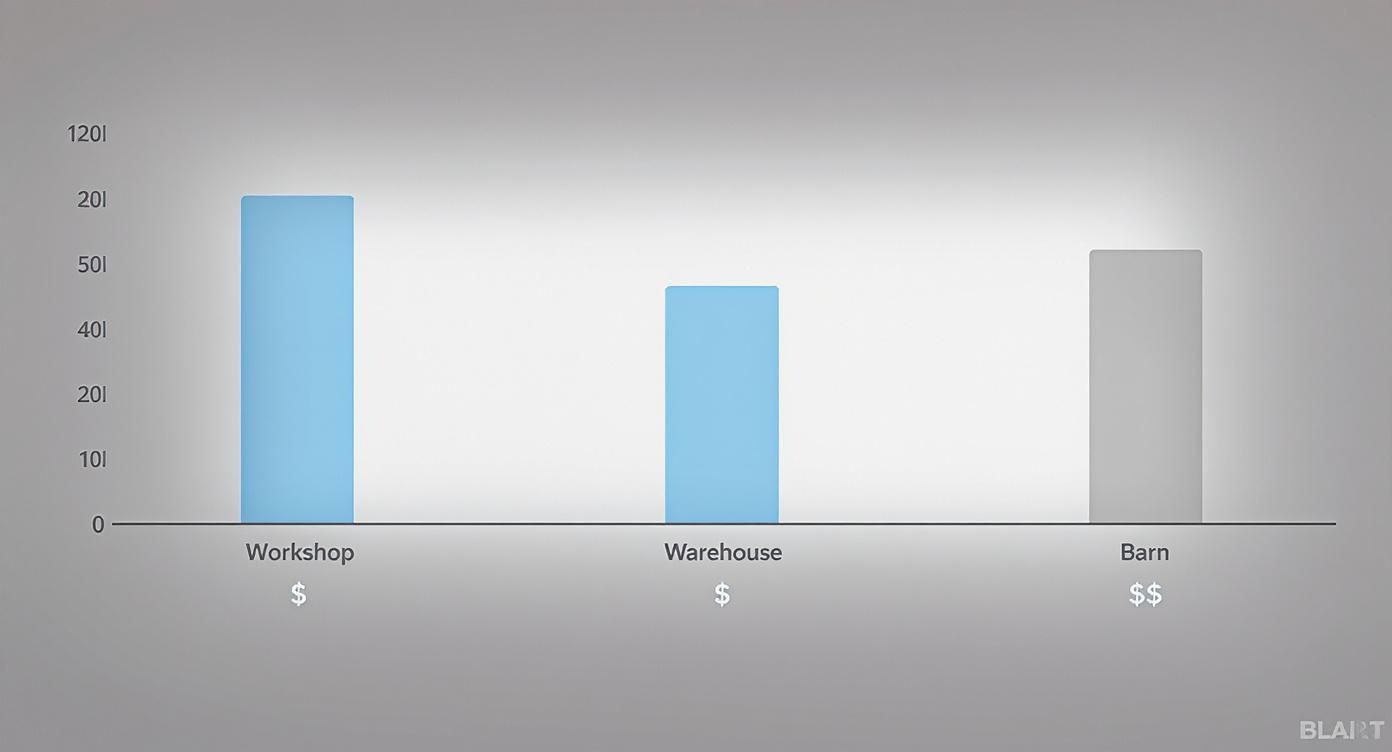
As you can see, more complex structures like warehouses often demand larger budgets to account for specialized features. This just reinforces the need for a solid contingency fund, especially as the project scope grows. When you start factoring in the interior details for commercial spaces, it helps to understand typical tenant improvement costs per square foot to budget for those finish-outs accurately. Building this fund into your budget from day one is the smartest financial move you can make—it gives you peace of mind and the flexibility to handle whatever comes your way.
Frequently Asked Questions About Metal Building Costs
Even when you have a solid plan sketched out, a few questions always seem to surface right when you're trying to nail down the final cost of a metal building. Getting straight answers to these common sticking points is the key to finalizing your budget with confidence.
Let's dive into some of the most frequent questions we hear from people just like you.
Is It Cheaper to Build With Wood or Metal?
This is the big one. If you only look at the price tag on a pile of lumber versus a steel building kit, wood can sometimes look a little cheaper on paper. But that's a classic case of missing the forest for the trees.
The real savings with steel come from the massive reduction in labor costs. Because our buildings are pre-engineered, they go up incredibly fast, saving you a fortune on crew hours. Then there are the long-term savings. A steel building laughs at things that give wood-frame owners nightmares: rot, termites, warping, and even fire. That means you're not spending money year after year on repairs, pest control, and repainting.
The Bottom Line: Wood might have a lower initial material cost in some scenarios, but a metal building is almost always the more economical choice when you factor in lightning-fast assembly, lower insurance premiums, and decades of virtually zero maintenance.
How Long Does It Take to Construct a Metal Building?
Speed is one of steel's superpowers. A pre-engineered metal building shell can be standing and complete 30% to 50% faster than a traditional wood or concrete structure. It’s all possible because every single component is manufactured with precision in a factory and shows up at your site ready to be bolted together.
How fast are we talking? A simple two-car garage could be up in just a few days. A much larger or more complex warehouse might take several weeks. Either way, that speed translates directly into money saved on labor and equipment rentals.
What Are My Financing Options?
Financing a steel building is a common and surprisingly simple process. You don't have to have all the cash upfront. Most of our customers use standard financing to make their project affordable and manageable.
Here are the most common routes people take:
- Bank Loans: A traditional construction loan from your local bank or credit union is a very popular choice.
- Builder Financing: We partner with specialized lenders who know the steel building industry inside and out, often providing tailored financing packages.
- Home Equity Loans: If you have equity built up in your home, a home equity line of credit (HELOC) can be a flexible and powerful way to fund your new building.
Ready to stop guessing and get real numbers for your project? The team at Icon Steel Buildings is on standby to put together a detailed, no-obligation quote based on your exact needs. Get your free quote today and let's get building.