
A well-organized workshop is more than just a tidy space; it’s the engine of productivity, safety, and creativity. For owners of versatile metal buildings, the potential to create a hyper-efficient setup is immense. Traditional workshops often struggle with fixed layouts, intrusive support columns, and limited vertical space. However, the clear-span design inherent in steel structures from providers like Icon Steel Buildings removes these barriers, opening up a world of possibilities for superior workflow and storage.
This guide moves beyond generic tips like “buy a toolbox.” Instead, we will provide a comprehensive roundup of actionable workshop organization ideas designed to leverage the unique advantages of a steel structure. We’ll explore everything from strategic layout planning and zone-based workflow mapping to innovative vertical storage systems and mobile workstations that maximize your floor space. You will discover practical methods for implementing advanced tool storage, effective labeling, and robust safety protocols.
Our goal is to help you transform your raw, open space into a meticulously organized, high-performance command center for any project, whether it’s for a home hobby, a commercial enterprise, or agricultural maintenance. Each idea is presented with specific implementation details and practical examples to ensure you can apply these concepts directly. Let’s unlock the true potential of your workshop and build a foundation for more efficient, enjoyable work, one strategic idea at a time.
1. Master Your Space with Zone-Based Workflow Planning
An efficient workshop isn’t just about having the right tools; it’s about arranging them to support a logical, seamless workflow. Instead of placing equipment wherever it fits, the zone-based method involves strategically dividing your space into distinct functional areas. This is one of the most impactful workshop organization ideas because it minimizes unnecessary movement, reduces project setup time, and keeps task-specific messes contained.
How Zone-Based Planning Works
The core idea is to map out your primary work processes from start to finish. Think of it as creating a production line. A project should flow logically from one zone to the next with minimal backtracking. For example, raw materials enter at one end, move through fabrication, then assembly, and finally to a finishing station near an exit.
In a steel building, the open, clear-span interior is a blank canvas perfect for this approach. Without interior columns to work around, you have complete freedom to define and adjust zones as your needs evolve.
Defining Your Key Workshop Zones
While every workshop is unique, most benefit from these core zones:
- Raw Material Storage: This area, often near a large garage door, is for storing uncut lumber, sheet metal, and other stock.
- Fabrication Zone: This is the “dirty” area for cutting, welding, and grinding. Position it where dust and debris are easily managed.
- Assembly Zone: A large, open area with a sturdy workbench for putting projects together. This should be centrally located and well-lit.
- Finishing Zone: A dedicated, well-ventilated space for painting, staining, or sanding to prevent dust from contaminating fresh finishes.
- Clean Zone: Reserved for sensitive tasks like electronics, planning, or detailed component assembly. This area should be kept free of dust and heavy-duty tool clutter.
By dedicating space for each step, you create a more intuitive and productive environment, turning random activity into a streamlined process.
2. Design Thinking Workshop Framework
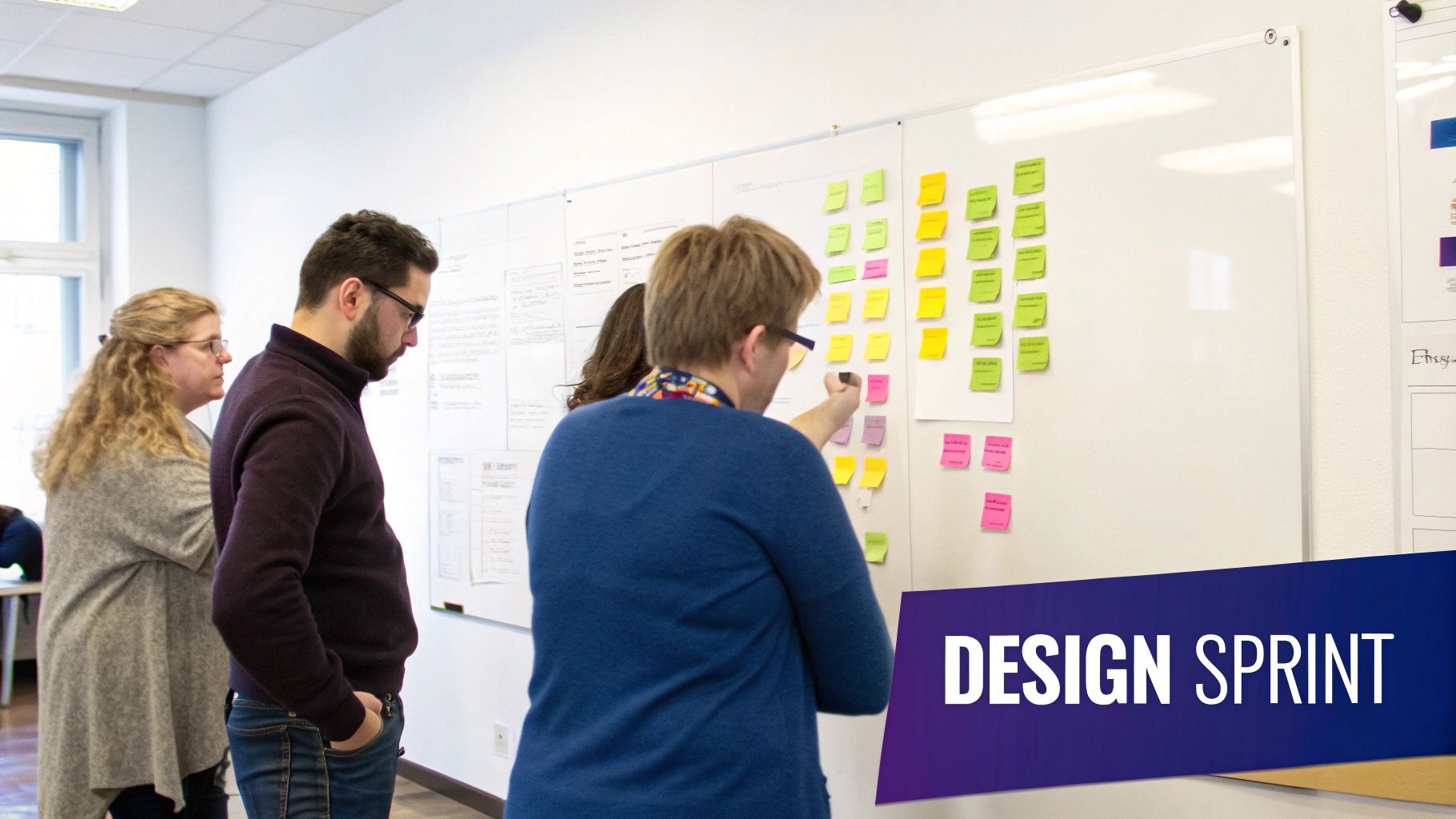
Applying a design thinking framework is a surprisingly effective and human-centered approach to workshop organization. Instead of just organizing tools, this method focuses on organizing your space around how you work by using empathy, ideation, and prototyping to solve your specific workflow problems. This is one of the more innovative workshop organization ideas as it transforms your setup from a static storage area into a dynamic environment designed to meet your creative and practical needs.
How the Design Thinking Framework Works
Popularized by Stanford University’s d.school and the design firm IDEO, this framework puts the user (you) at the center. It encourages you to observe your own habits, identify friction points in your process, brainstorm creative solutions, and then test them with low-cost mockups. For example, you might realize you constantly walk back and forth for a specific tool, leading you to prototype a mobile tool cart and test its effectiveness before committing to a permanent solution.
The clear-span interior of a steel building provides an ideal environment for this iterative process. You can easily reconfigure layouts, move mobile workstations, and test different zone arrangements without structural limitations, allowing your workshop to evolve with your projects.
Implementing Design Thinking in Your Workshop
This method is less about rigid rules and more about a mindset. Here’s how to apply it:
- Empathize & Define: Map out your typical project workflow from start to finish. Use sticky notes to identify every step and pain point, such as “searching for fasteners” or “lack of assembly space.”
- Ideate: Brainstorm wild and practical solutions for each pain point. Could a wall-mounted French cleat system solve the fastener issue? Could a fold-down workbench create more assembly area?
- Prototype: Create simple, low-fidelity mockups. Use cardboard to represent a new cabinet or painter’s tape on the floor to outline a mobile tool station. Test these prototypes in your actual workflow.
- Test & Iterate: Did the prototype solve the problem? Refine it based on what you learned. This cycle of testing and improving ensures your final organization system is perfectly tailored to your needs.
By using this framework, you create a workshop that is not just organized but is intentionally designed for maximum efficiency and ease of use.
3. The Lean Workshop Model
Beyond physical layout, world-class efficiency comes from your operational philosophy. The lean model, adapted from the Toyota Production System and Lean Manufacturing, is a powerful framework for eliminating waste and maximizing value. Applying this to your space is one of the most transformative workshop organization ideas because it shifts the focus from just storing tools to optimizing every single process.
How The Lean Model Works
The core principle of a lean workshop is to remove anything that doesn’t add direct value to the final product. This includes wasted motion, excess inventory, unnecessary process steps, and time spent searching for tools. It’s a minimalist approach that relentlessly pursues efficiency, ensuring every element in your workshop has a clear, value-adding purpose.
A steel building’s unobstructed, versatile space is ideal for implementing lean principles. The ability to mount systems directly to steel framing and the lack of interior obstacles allow for a hyper-organized layout where everything can be seen, accessed, and returned with minimal effort, perfectly aligning with lean’s “a place for everything, and everything in its place” mantra.
Implementing Lean Principles in Your Workshop
Adopting a lean mindset involves continuous improvement. Here are some key principles to start with:
- 5S System: This is the foundation of a lean workshop. It stands for Sort, Set in Order, Shine, Standardize, and Sustain. Systematically remove unnecessary items, organize what’s left, clean the space, create standard procedures, and commit to maintaining the system.
- Shadow Boards: Create visual homes for your tools by outlining them on a wall or board. This makes it instantly obvious what’s in use or missing, eliminating search time.
- Kanban for Consumables: Use a simple visual system, like a two-bin system, for managing screws, sandpaper, and other consumables. When the first bin is empty, it’s the signal to reorder while you use the second bin.
- Point-of-Use Storage: Store frequently used tools and supplies directly where the work happens. For example, keep all your welding clamps, rods, and safety gear on a mobile cart right next to the welding station.
By applying these lean strategies, you reduce clutter, streamline workflows, and create a workshop that is not just organized but also intelligently designed for peak productivity.
4. Revolutionize Storage with a French Cleat System
A French cleat system is one of the most versatile and adaptable workshop organization ideas available, offering unparalleled flexibility for tool and supply storage. This ingenious system consists of two main parts: a series of interlocking 45-degree angled cleats mounted horizontally on the wall, and corresponding cleats attached to tool holders, cabinets, and shelves. This simple yet robust design allows you to hang, rearrange, and customize your storage layout in seconds without drilling new holes.
How a French Cleat System Works
The concept is brilliantly simple. The weight of the item on its holder pulls the two angled cleats together, creating a strong, gravity-assisted lock that is surprisingly secure. To move an item, you just lift it up and off the wall cleat and place it on another. This makes it an ideal solution for a workshop where project needs and tool collections are constantly changing.
In a steel building, where wall studs might be spaced differently than in traditional construction, a French cleat system is particularly effective. You can securely fasten the wall cleats to the steel girts, creating a continuous and strong mounting surface across the entire wall. This maximizes vertical space that might otherwise be underutilized.
Implementing Your French Cleat System
Creating your own system is a straightforward woodworking project, but the organizational payoff is immense.
- Wall Cleats: Start by attaching long strips of plywood or solid wood, cut at a 45-degree angle, horizontally along your workshop walls. Ensure they are level and securely fastened.
- Tool Holders: Create custom holders for every tool in your collection. A small block with a corresponding 45-degree cleat can hold a hammer, while a custom-built shelf can house your drills and chargers.
- Cabinets & Bins: You can even mount small cabinets and parts bins to cleats, keeping fasteners and small components off your workbench but still within easy reach.
- Layout Planning: The beauty of this system is its modularity. You can group tools by function (e.g., all measuring tools together) or by project workflow. As your needs change, the layout can change with them. To see how this can be integrated into your initial setup, you can explore metal building floor plans to visualize a fully optimized space.
By investing the time to build a French cleat wall, you transform a static wall into a dynamic and completely customizable storage hub.
5. Build Smart with Mobile Workstations and Tool Carts
Static workbenches can limit your flexibility, forcing you to carry heavy materials and tools across the workshop floor. Mobile workstations and tool carts are transformative workshop organization ideas that bring your tools and work surfaces directly to the project. This “go-to-the-work” approach enhances efficiency, saves physical effort, and allows you to reconfigure your space on the fly for large or unusually shaped projects.
How Mobile Workstations Work
The principle is simple: put your most-used tools and surfaces on wheels. Instead of a single, fixed assembly table, you might have several smaller, mobile benches that can be used individually for small tasks or locked together to create a massive, customized worktop. This adaptability is especially valuable in a metal building’s clear-span interior, where you have the freedom to redefine your layout for any job without permanent fixtures getting in the way.
A mobile setup dramatically reduces the time spent walking back and forth, keeping everything you need for a specific task- like assembly, sanding, or electronics- within arm’s reach.
Defining Your Key Mobile Units
Creating a fleet of mobile stations allows you to build a workshop that adapts to you, not the other way around. Consider these essential mobile units:
- Mobile Workbench: A heavy-duty, rolling table that serves as your primary project surface. Equip it with a vise, bench-dog holes, and locking casters for stability.
- Dedicated Tool Carts: Create carts for specific processes. A “sanding cart” might hold various sanders, sandpaper, and dust extraction hoses, while a “welding cart” would carry the welder, helmet, clamps, and consumables.
- Assembly and Outfeed Tables: These rolling tables can be adjusted to the height of your table saw or other stationary tools to safely support large materials. They can also be wheeled to the center of the floor for assembly tasks.
- Clamp and Hardware Carts: A mobile rack dedicated to holding all your clamps and a cart with organized bins for fasteners makes finding the right hardware quick and easy.
By mobilizing your workspace, you create a dynamic environment that boosts productivity and can be instantly customized for any project, big or small.
6. Experiential Learning Workshop Design
While physical layout is crucial, organizing the purpose of your workshop space can transform its value. The experiential learning approach, based on David Kolb’s learning cycle, structures your workshop not just for building things, but for building skills. This is one of the more advanced workshop organization ideas because it moves beyond tool storage and focuses on creating an environment for active, hands-on learning, reflection, and practical application.

How Experiential Learning Works
This model organizes your activities into a four-stage cycle: concrete experience (doing), reflective observation (reviewing), abstract conceptualization (learning), and active experimentation (trying). Rather than just following instructions, users actively engage in a task, think critically about the outcome, understand the underlying principles, and then apply that knowledge to a new challenge. This method is highly effective for training, team-building, or personal skill development.
A clear-span steel building provides the ideal open-concept space needed for this dynamic approach, allowing you to set up distinct stations for each phase of the learning cycle without restrictive columns. If you are planning a space dedicated to this, you might explore different layouts; learn more about designing a versatile shop with our 60×40 plans to see what’s possible.
Designing Your Experiential Workshop
To implement this, dedicate specific areas or resources to support the learning cycle. The goal is to create a safe space for experimentation and even failure.
- Concrete Experience Zone: This is your primary hands-on area, like a medical simulation lab or a flight simulator. It needs the core tools and space for users to perform the main activity.
- Reflection & Debriefing Area: A quieter, comfortable space with whiteboards or tables where participants can discuss their experience. Questions guide reflection on what worked and what didn’t.
- Conceptualization Corner: A small area with reference materials, diagrams, or a computer for research. This is where participants connect their experience to established theories or principles.
- Experimentation & Application Station: A versatile space where learners can apply their new understanding to a modified or new problem, reinforcing the lesson.
By structuring your workshop this way, you create a powerful environment that fosters deep understanding and practical mastery, making it more than just a place to work.
7. Embrace Mobility with Rolling Workstations and Carts
A static workshop layout can be restrictive, forcing you to carry heavy materials and tools across the floor. Embracing mobility through rolling workstations, tool carts, and storage units is one of the most transformative workshop organization ideas for creating a flexible and dynamic space. This approach allows you to reconfigure your layout on the fly, bring tools directly to your project, and maximize every square foot of your shop.
How a Mobile-First Approach Works
The core concept is to put everything possible on high-quality casters: your primary workbench, tool chests, miter saw stand, and even project assembly tables. Instead of being locked into a fixed arrangement, your workshop becomes a modular system that adapts to the task at hand. Need a large, open area for assembling a big project? Simply roll your workstations against the walls. Working on a vehicle? Wheel your tools and parts carts right next to it.
In a steel building with a smooth, level concrete floor, this strategy is especially effective. The unobstructed, clear-span interior allows for effortless movement, turning your entire floor into a versatile work surface.
Key Mobile Units for Your Workshop
While you can add wheels to almost anything, certain mobile pieces offer the biggest organizational benefits:
- Mobile Workbench: Your central work surface becomes a movable command center. Look for a heavy-duty model with locking casters to ensure stability when you need it.
- Dedicated Tool Carts: Create task-specific carts for jobs like welding, woodworking, or automotive repair. Stock each with the necessary tools so you can grab one cart and have everything you need.
- Project Carts: Use simple, multi-level rolling carts to hold parts, hardware, and components for a specific project. This keeps everything organized and prevents your main workbench from getting cluttered.
- Rolling Material Racks: For storing lumber, metal stock, or sheet goods, a mobile rack lets you bring your materials to the fabrication zone instead of the other way around.
By making your key assets mobile, you create an agile environment that can be optimized in minutes, dramatically improving workflow and efficiency for any project you tackle.
8. Embrace Ultimate Flexibility with Mobile Workstations
Static workbenches are the heart of many workshops, but their fixed nature can create logistical bottlenecks. A powerful solution is to adopt mobile workstations, a key strategy among modern workshop organization ideas. By putting your work surfaces and key tools on wheels, you transform a rigid layout into a dynamic, adaptable space that can be reconfigured in minutes to suit any project.
How Mobile Workstations Work
The principle is simple: mount your essential equipment, such as miter saws, drill presses, planers, and general assembly tables, onto heavy-duty rolling bases or carts. This allows you to bring the tool to the material, rather than lugging heavy lumber or steel across the shop. It also lets you temporarily expand your workspace into an open area for large assemblies, then tuck everything away to reclaim floor space.
In a steel building with its clear-span interior, this approach is especially effective. Without columns to navigate, you can roll a miter saw station to the center of the floor for cutting long boards or move an assembly table directly under an overhead hoist for heavy lifting, maximizing every square foot of your unobstructed space.
Key Mobile Workstation Setups
Consider making these core workshop elements mobile to dramatically improve your workflow:
- Mobile Miter Saw Station: A rolling cart, often with built-in wings for material support and storage for blades and accessories below.
- Outfeed Table on Casters: A movable table that can be positioned behind a table saw or planer to support long materials, then rolled away when not in use.
- Modular Assembly Benches: Instead of one massive workbench, use two or three smaller mobile tables that can be used separately or locked together to form a larger surface.
- Tool-Specific Carts: A dedicated rolling cart for grinders, sanders, or welding equipment keeps all related accessories in one place and can be moved directly to the work area.
By making your major workstations mobile, you give yourself the freedom to adapt your shop layout on the fly, ensuring your space is always optimized for the task at hand.
9. Micro-Workshop Series Organization
This approach to organization shifts focus from physical tools to the workflow of learning and skill development within your workshop space. Micro-workshop series organization involves structuring your projects or training sessions into short, focused modules. Instead of tackling a massive project in one go, you break it down into a series of manageable, bite-sized tasks, each with a clear objective. This is one of the most effective workshop organization ideas for skill-building because it respects attention spans, improves knowledge retention, and makes complex processes feel less intimidating.

How Micro-Workshop Planning Works
The core principle is to map out a skill or project as a curriculum. Each step becomes a mini-workshop with its own dedicated time, tool list, and goal. This method turns a potentially chaotic multi-day project into a structured, step-by-step process. For instance, building a cabinet becomes a series: Session 1 is material selection and breakdown; Session 2 is joinery cutting; Session 3 is assembly, and so on.
This systematic approach is perfectly suited for the planned environment of a workshop. The open layout of structures built from prefabricated metal building kits allows you to dedicate a corner or a mobile bench as the “classroom” for each focused session, keeping your primary work zones free.
Defining Your Micro-Workshop Structure
While adaptable to any project, this method thrives on a clear, progressive structure. Consider implementing these elements:
- Curriculum Map: Create a visual flowchart showing how each mini-session connects to the next, outlining the entire project from start to finish.
- Session Prep Kits: For each session, gather all necessary tools, materials, and safety gear into a dedicated bin or cart. This minimizes setup time and keeps you focused on the task.
- Focused Time Blocks: Allocate specific, uninterrupted time slots for each session (e.g., 90 minutes). This mental organization prevents burnout and maintains high-quality work.
- Documentation Station: Designate a clean area with a notebook or tablet to log progress, note challenges, and plan the next session’s adjustments.
- Skill Progression: Organize the series so that foundational skills are practiced in early sessions, building up to more complex tasks later in the project.
By organizing your time and tasks this way, you create a powerful learning environment that boosts both confidence and competence, transforming your workshop into a true hub of innovation.
10. Digitize Your Inventory and Small Parts Management
Losing track of small but critical parts like screws, fasteners, and specialty hardware can bring a project to a grinding halt. A digital inventory system is one of the most transformative workshop organization ideas for tackling this common frustration. Instead of rummaging through disorganized bins, you create a searchable, real-time database of your stock, saving time and preventing unnecessary trips to the hardware store.
How Digital Inventory Systems Work
The core principle is to assign a unique identifier, often a QR code or barcode, to every container of small parts. You then use a simple app on your smartphone or a dedicated scanner to log items as they are used or replenished. This creates a digital record of what you have, where it is, and when you need to reorder, turning chaotic bins into a smart, manageable system.
This approach is highly effective in a steel building workshop, where dedicated storage walls can be outfitted with uniform, labeled bins. The clean, organized backdrop makes implementing and maintaining a scannable system straightforward and visually coherent.
Key Steps for Implementation
Digitizing your inventory doesn’t have to be complicated. Start small and focus on your most frequently used items first.
- Choose Your System: Select an inventory management app. Many simple, free options are available for small-scale use, or you can use a basic spreadsheet.
- Organize Physically: Group similar items together in clear, modular storage containers or bin systems. This is the foundation of your digital setup.
- Label Everything: Generate and affix a unique QR code or simple label to each bin. The label should correspond to an entry in your digital system.
- Scan and Track: Develop the habit of scanning items as you use them. This discipline is key to maintaining an accurate inventory count.
- Set Reorder Points: Configure your system to alert you when stock for a particular item falls below a certain threshold, automating your shopping list.
For those looking to truly revolutionize their workshop, understanding the role of IoT in enhancing electrical component efficiency can provide innovative solutions for inventory management and process optimization, making your digitized workshop even smarter. By digitizing your small parts, you convert clutter into a reliable resource, ensuring you always have what you need right when you need it. Discover more innovative ways to set up your space by exploring various metal building design ideas.
Top 10 Workshop Organization Comparison
| Title | Implementation Complexity 🔄 | Resource Requirements ⚡ | Expected Outcomes 📊 | Ideal Use Cases 💡 | Key Advantages ⭐ |
|---|---|---|---|---|---|
| Agile Workshop Planning | High — iterative coordination and experienced facilitators | Moderate — cross-functional team time, digital boards, frequent meetings | Incremental improvements; responsive agendas and higher participant satisfaction | Complex events needing iteration (tech conferences, corporate training) | ⭐ Flexible and adaptive planning cycles |
| Design Thinking Workshop Framework | High — time-intensive, requires skilled facilitation | High — prototyping materials, dedicated spaces, diverse participants | User-centered, highly innovative and validated solutions | Product/service innovation, strategic planning, service design | ⭐ Drives creative, user-validated outcomes |
| The Lean Workshop Model | Medium — requires careful upfront analysis and discipline | Low–Moderate — minimal materials, analysis time, time-boxing | Efficient delivery with high ROI and reduced participant fatigue | Fast-track bootcamps, resource-constrained trainings, manufacturing training | ⭐ Cost-effective and highly efficient |
| Blended Learning Workshop Format | High — dual facilitation and modality coordination | High — LMS, conferencing tools, content production, analytics | Extended learning timeframe with improved retention and accessibility | Large-scale training, certifications, hybrid corporate programs | ⭐ Combines accessibility with reinforced learning |
| The Liberating Structures Approach | High — steep facilitator learning curve for many microstructures | Moderate — facilitator training, simple visual materials | Dramatically increased participation, faster collaborative problem-solving | Inclusive meetings, cross-functional workshops, strategic planning | ⭐ Equitable participation and distributed leadership |
| Experiential Learning Workshop Design | Medium–High — simulation setup and thorough prep | Moderate–High — space, materials, facilitators, simulation tools | Deep skill acquisition, high retention, strong transfer to work | Skill-based training (simulations), leadership development, labs | ⭐ High retention and practical skill transfer |
| Virtual-First Workshop Organization | High — needs redesign for remote-first delivery and time-zone support | Moderate–High — robust platforms, AV, moderation and support staff | Wide reach, measurable engagement, scalable delivery | Global audiences, distributed teams, virtual conferences | ⭐ Global reach with rich analytics and flexibility |
| Cohort-Based Workshop Model | Medium — scheduling and sustained cohort management | Moderate — community platforms, ongoing facilitation, alumni support | Strong peer networks, high completion and accountability | Intensive skill tracks, leadership programs, career transitions | ⭐ Strong peer support and long-term networks |
| Micro-Workshop Series Organization | Low–Medium — many short events but simpler per session | Low — short-session prep, modular content, scheduling | Improved retention via spaced learning; flexible participation | Busy professionals, CPD, bite-sized skill building | ⭐ High accessibility and easy scalability |
| Unconference and BarCamp Workshop Format | Medium — self-organizing logistics and dynamic scheduling | Low–Moderate — venue, schedule board, minimal pre-made content | Highly relevant, participant-driven outcomes; variable quality | Community-driven events, emergent-topic sharing, tech communities | ⭐ Organic engagement and highly relevant sessions |
Building Your Foundation for Lasting Organization
Transforming a cluttered workshop into a bastion of efficiency is not a one-time event; it is a continuous process built on a solid foundation of strategic planning and smart systems. Throughout this guide, we have explored a comprehensive suite of workshop organization ideas, moving far beyond simple tidiness to embrace a holistic philosophy of workflow optimization. The journey from chaos to clarity begins with understanding that every tool, every workstation, and every square foot of your space holds potential.
We began by establishing the critical importance of layout and zoning, creating dedicated areas for fabrication, assembly, finishing, and storage to minimize wasted movement and cross-contamination. This foundational step ensures that your workflow is intuitive and logical. From there, we elevated our perspective, quite literally, by focusing on vertical and overhead storage. Harnessing the high ceilings inherent in metal buildings with solutions like custom shelving, French cleats, and ceiling-mounted racks unlocks a vast amount of previously untapped storage real estate, keeping your floor clear and your projects moving.
Key Takeaways for a Systematically Organized Workshop
The core principle connecting all these concepts is intentionality. A truly organized workshop doesn’t happen by accident. It is the result of deliberate choices aimed at creating a system that works for you, not against you.
Here are the most critical takeaways to implement immediately:
- Systemize, Don’t Just Tidy: True organization lies in creating repeatable systems. This includes everything from a robust labeling strategy using color-coding and QR codes to establishing a “home” for every single tool. Tidying is temporary; systems are sustainable.
- Embrace Mobility and Flexibility: Static workstations can stifle productivity. By placing heavy equipment, workbenches, and tool cabinets on high-quality casters, you create an agile environment that can be reconfigured in minutes to accommodate projects of any size or complexity.
- Prioritize Light and Air Quality: A well-organized space is also a safe and healthy one. Investing in layered lighting solutions, from ambient overhead fixtures to focused task lighting, reduces eye strain and improves accuracy. Similarly, a robust dust collection and ventilation system is not a luxury but a necessity for protecting your health and your equipment.
- Leverage Your Building’s Strengths: A steel building provides the perfect canvas. Its clear-span interior offers unmatched layout flexibility, while its sturdy steel framing is ideal for supporting heavy-duty wall-mounted storage systems and overhead solutions without compromise.
Your Action Plan for Lasting Change
Reading about these workshop organization ideas is the first step, but implementation is what yields results. Don’t feel overwhelmed by the need to do everything at once. Instead, adopt an incremental approach to build momentum and create lasting habits.
Start by choosing one area of your workshop that causes the most friction. Is it your cluttered workbench? Your disorganized collection of fasteners? Or perhaps poor lighting over your main assembly area? Dedicate your next available weekend to tackling just that one problem using the strategies we’ve discussed. Once you experience the immediate benefit of that single improvement, you will be motivated to move on to the next.
Ultimately, mastering workshop organization is about more than just finding your tools faster. It is about creating an environment that fosters creativity, enhances safety, and maximizes productivity. It’s about respecting your craft and building a space that empowers you to do your best work, every single time. By applying these principles, you are not just organizing a building; you are engineering your own success.
Ready to build the ultimate workshop from the ground up? The journey to perfect organization starts with the right structure, and Icon Steel Buildings provides the ideal clear-span, fully customizable metal buildings that serve as the perfect blank canvas for these ideas. Explore your options and get a quote today at Icon Steel Buildings to lay the foundation for your dream workspace.