Let's get right to it. When you're looking at a basic, high-quality steel building kit, a good rule of thumb is to budget somewhere between $15 to $30 per square foot. Think of this as your starting line—it’s the core cost for the structure itself before we factor in all the other pieces that make up your project.
Unpacking Your Steel Building Investment
That initial cost-per-square-foot figure gives you a solid ballpark, but it's just one part of the bigger picture. Asking "how much is a steel building?" is a lot like asking how much a truck costs. Are we talking about a standard work truck, or a fully-loaded, top-of-the-line model with all the bells and whistles? The final price tag is all in the details.
Your final project cost is shaped by dozens of variables that go way beyond the basic kit. This guide is here to walk you through every single factor that influences your all-in price, moving from the simple kit cost to the more complex expenses that bring your vision to life.
What Determines the Final Price
To build an accurate budget, you need to see the whole field. Let's break down the key areas that will shape your final costs and give you a clear financial picture:
- The Building Kit Itself: This covers the big stuff—size, the gauge (thickness) of the steel, roof pitch, and any special protective coatings.
- Site and Foundation Work: Don't forget the groundwork. This includes clearing and prepping the land, pouring the concrete slab, and getting utilities hooked up. These are significant costs.
- Delivery and Installation: You'll have shipping fees to consider, plus the big choice between a DIY build or bringing in a professional crew to handle the heavy lifting.
- Custom Features: This is where you make it your own. Think doors, windows, insulation, and any interior finishing touches.
Getting a handle on these components is the first step to creating a budget that doesn't have any nasty surprises. The pre-engineered steel building market is a huge industry, valued at $4 billion in North America alone and projected to hit $7.5 billion by 2035. That growth speaks volumes about its popularity and why smart cost planning is so critical.
To give you a quick idea of those baseline kit costs, the table below breaks down the estimated price for just the building package across a few common sizes. Use this as your starting point, and we'll build on it from here. For a deeper dive into these numbers, check out our complete guide on how much metal buildings are.
Estimated Cost Per Square Foot for Basic Steel Building Kits
This table gives you a snapshot of what to expect for just the building kit itself. Remember, these are baseline numbers before you add customizations, delivery, foundation, and installation.
| Building Size (Square Feet) | Average Cost Per Sq. Ft. | Estimated Total Kit Cost |
|---|---|---|
| 1,200 sq. ft. (30×40) | $20 – $30 | $24,000 – $36,000 |
| 2,400 sq. ft. (40×60) | $18 – $28 | $43,200 – $67,200 |
| 5,000 sq. ft. (50×100) | $16 – $25 | $80,000 – $125,000 |
| 10,000 sq. ft. (100×100) | $15 – $22 | $150,000 – $220,000 |
As you can see, the price per square foot generally goes down as the building gets bigger. This is a great starting point for your budget, but keep in mind that the real cost comes from putting all the pieces together.
Deconstructing the Core Price Drivers
So, why can’t you find a single, flat-rate answer to "how much is a steel building?" It's because every project is a unique creation, not an off-the-shelf product. The final price tag on your building kit is directly controlled by a handful of core variables, each one contributing to the overall strength, size, and longevity of your structure.
Think of it like spec'ing out a new truck. The base model has a set price, but the cost climbs as you add a more powerful engine, a heavy-duty towing package, or an upgraded interior. The same principle applies here. Every design choice you make, from the dimensions to the materials, directly translates into the final quote.
This section will unpack those key variables. We’ll explore exactly how your decisions about size, steel thickness, and even protective coatings impact your budget, giving you a clear understanding of what you’re paying for.
Building Dimensions: The Foundation of Your Quote
The most straightforward price driver is the sheer size of the building. Your width, length, and eave height are the three primary measurements that create the total volume of steel required for your project.
- Width and Length: These dimensions determine the building's overall footprint and, consequently, the amount of steel needed for the primary framing, roofing, and wall panels. A 40×60 building will naturally require less raw material than a 60×100 building.
- Eave Height: This is the vertical distance from the finished floor to the top of the wall where it meets the roof. Taller buildings need longer wall columns and panels, and they must be engineered to handle greater wind loads—all of which increases the steel requirement and the cost.
It’s not just about more material; it’s also about structural engineering. A wider or taller building requires a more robust frame to maintain its integrity, which means using larger, heavier steel members.
Steel Gauge and Coatings: Performance You Pay For
Beyond size, the quality and type of steel are major factors. Just like that truck analogy, you can choose a standard frame or opt for a heavier-duty one designed for tougher conditions. In the world of steel buildings, this comes down to steel gauge and protective coatings.
Steel gauge refers to the thickness of the steel, and it's a bit counterintuitive: a lower gauge number means thicker, stronger, and heavier steel. For instance, 12-gauge steel is thicker and more robust than 14-gauge steel. Opting for a lower gauge increases the material cost but provides superior strength, which is often necessary to meet local building codes for high snow or wind loads.
Similarly, the protective coating on the steel panels makes a significant difference. Most standard buildings use a Galvalume finish, but you can upgrade to options like Galvalume Plus. This premium coating offers enhanced corrosion resistance and a brighter, more uniform appearance, adding a layer of long-term value for a higher upfront cost.
The flowchart below shows how these kit-related costs fit into the overall project budget.
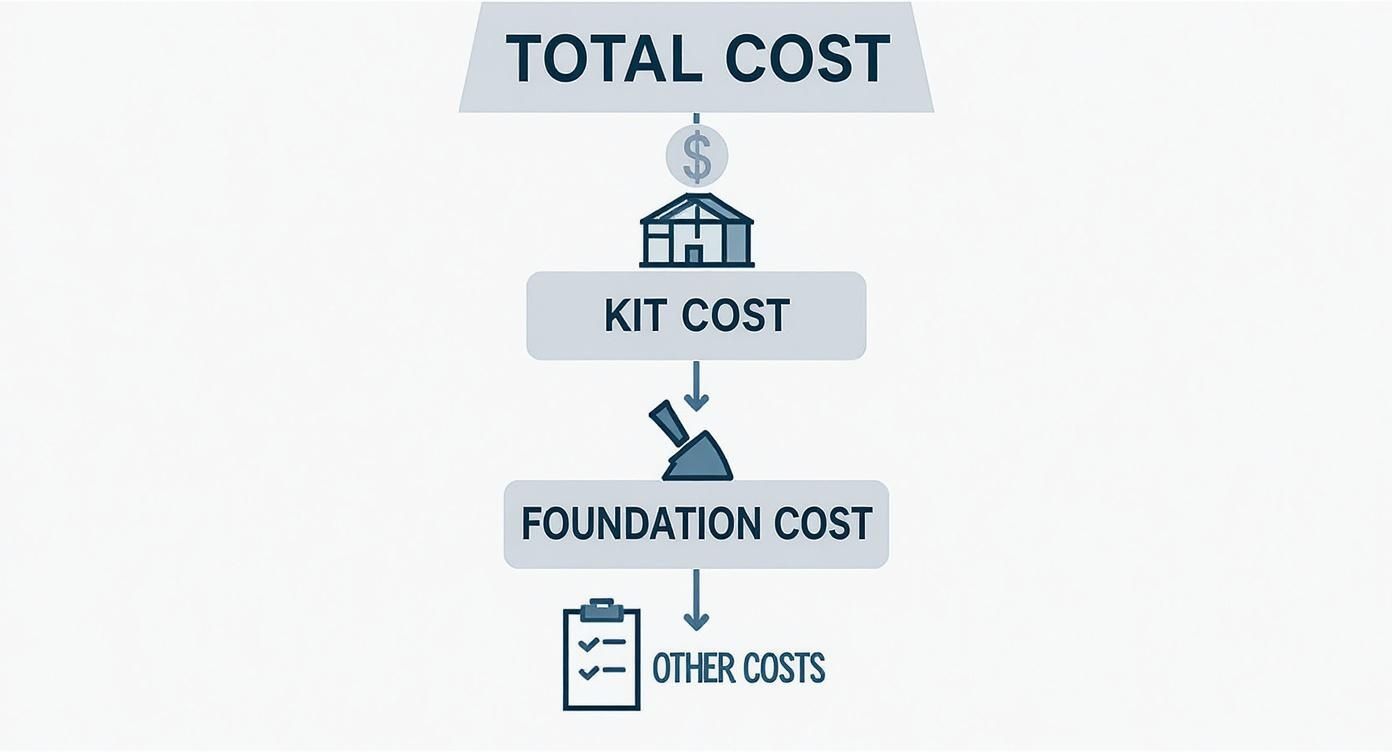
As you can see, while the building kit is a major expense, it’s only one piece of the puzzle alongside the foundation and other project costs.
Roof Pitch and Design Complexity
The design of your building, particularly the roof, also plays a role in the price. The roof pitch is the angle or slope of your roof, expressed as a ratio (e.g., 2:12, 4:12).
A steeper roof pitch, like a 4:12, requires more material for the roofing panels and often needs more complex truss and rafter designs compared to a flatter 1:12 pitch. This additional material and engineering work contribute to a higher kit price. However, a steeper pitch is much better for shedding heavy snow and rain, making it a necessary investment in certain climates.
Your building’s price is also tied to global economic factors. The cost of steel buildings is influenced by global steel prices, regional demand, and construction trends. The global steel market was valued at approximately USD 1.47 trillion, with projections suggesting it will reach USD 1.92 trillion by 2030. These market shifts directly impact material costs.
Ultimately, understanding these drivers empowers you to make informed decisions. By balancing your needs for size, strength, and design complexity, you can tailor a building that fits both your purpose and your budget. For a detailed breakdown of how these factors come together in a final price, you can explore our in-depth look at the metal building cost structure. This will help you see how your specific choices shape the bottom line.
Looking Beyond the Kit's Price Tag
It’s easy to get fixated on the initial quote for a steel building kit, but that number is just the first chapter of your project's financial story. One of the most common mistakes we see is underestimating the costs that turn a pile of steel beams and panels into a fully functional building.
Think of it like this: the kit price is the engine, but you still need the chassis, wheels, and everything else to actually build a car. These additional costs aren't "hidden"—they're just essential parts of any construction job. We'll walk through them so you can build a complete, realistic budget from day one.
A smart investment means looking at the big picture. It’s not just about the upfront cost, but about reducing total cost of ownership over the entire life of your building.
The Unavoidable Cost of a Solid Foundation
Before a single steel beam goes up, you need a solid base to put it on. The concrete foundation is one of the biggest expenses outside of the kit itself, and it's absolutely non-negotiable for your building's stability and longevity.
The cost can swing wildly depending on a few key things. Naturally, a bigger, heavier building needs a thicker, beefier foundation with deeper footings, which means more materials and more labor. The ground itself is another huge factor—poor soil conditions might require extra engineering and reinforcement, bumping up the price.
A standard 4-inch reinforced concrete slab typically runs between $6 to $12 per square foot. For a 40×60 building (2,400 sq. ft.), that foundation alone could add $14,400 to $28,800 to your budget.
Getting Your Site Prepped and Your Kit Home
Your land needs to be ready before any concrete gets poured. Site preparation involves clearing trees and rocks, leveling the ground, and making sure water will drain away from your new building. A flat, clear lot will cost far less to prep than a sloped, wooded one.
And don't forget about delivery. A steel building kit is big, heavy, and needs specialized freight to get to you. The distance from our plant to your job site dictates the shipping cost, which can be anywhere from a few hundred to several thousand dollars. Always ask if delivery is baked into your quote or if it’s a separate line item.
The Big Question: Installation Labor
Once the kit is on-site, it’s time for assembly. This is where you have a major decision that will dramatically affect your budget: do you build it yourself or hire a pro?
- DIY Installation: Going the DIY route can save you a bundle on labor. But it's a serious job that requires the right tools, heavy equipment like a lift, and some real know-how. A mistake here can be expensive and even dangerous.
- Hiring a Professional Crew: A professional erection crew brings experience and efficiency to the table. They’ll get your building up correctly and safely. You can expect labor costs to run from $5 to $10 per square foot, depending on how complex the build is and where you're located.
The "Soft Costs": Permits and Plans
Finally, you have the administrative expenses, often called "soft costs." Before you can break ground, you'll need building permits from your local city or county, and these fees vary all over the map.
You'll also need stamped engineering drawings for your permit application. These are plans certified by a licensed engineer, confirming your building is designed to handle local wind, snow, and seismic loads. They’re your ticket to a project that’s both legal and safe. For more detail on what your purchase includes, our guide to steel building kit prices can offer some extra clarity.
How Custom Features Impact Your Budget
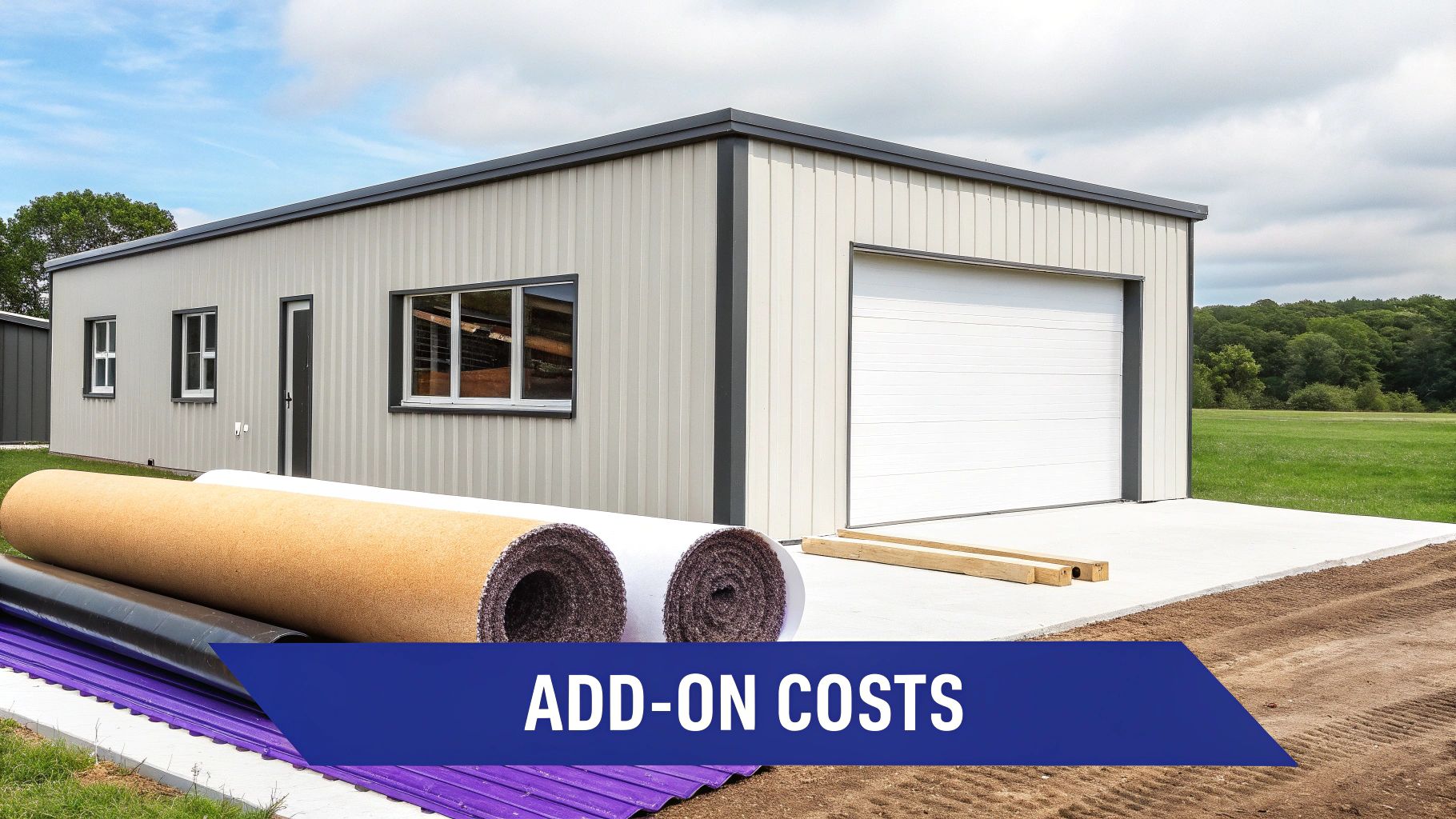
A basic steel building kit gives you the shell, but the real magic happens when you start turning that empty space into something truly yours. Custom features are what transform a simple structure into your dream workshop, a bustling commercial space, or a hard-working agricultural hub.
Of course, every addition—from a simple man door to a high-performance roofing system—will influence your budget. This is where you have the most control over the final price tag and where your project’s unique personality really takes shape.
Openings: Doors and Windows
The most common customizations are the access points. Doors and windows are what let people, light, and vehicles in and out of your building, and each type comes with a different price point.
- Walk-in Doors: A standard 3×7 foot man door is a must-have for easy personnel access. You can expect this to add $400 to $800 per door.
- Roll-up Doors: Absolutely essential for garages, warehouses, and shops. A smaller 10×10 foot door might add $1,000 to $2,500, but a heavy-duty commercial door can easily top $5,000.
- Windows: Bringing in natural light with windows typically runs from $300 to $1,000 per unit, depending on the size, style, and energy rating.
- Skylights: These are fantastic for brightening large interiors and can cut down on electricity bills. Plan on $500 to $1,500 per installed unit.
Keep in mind, adding these features isn't just about the cost of the door or window itself. It also requires engineering framed openings into the structure, which adds a bit to the overall complexity and price.
Insulation and Climate Control
Insulation is probably the single most important functional upgrade you can make. An uninsulated building is just a shell, but adding insulation turns it into a comfortable and energy-efficient space year-round. It's a key decision that impacts both your initial investment and your long-term operating costs.
The R-value of insulation measures its ability to resist heat flow—the higher the R-value, the better it works. For a steel building, an R-value between R-13 and R-30 is typical, depending on your local climate and how you plan to use the space.
Fiberglass batting is a popular, cost-effective choice. On the other hand, spray foam insulation offers superior air sealing and higher R-values, but it comes at a premium. Upgrading to high-performance spray foam can add several dollars per square foot to your project, but the payoff is huge—it can slash your heating and cooling bills by 30% or more.
Below is a quick look at how various upgrades can affect your project's bottom line.
Price Impact of Common Steel Building Customizations
| Customization Feature | Typical Cost Range (Added to Base Price) | Key Considerations |
|---|---|---|
| Standard Roll-Up Door | $1,000 – $2,500 | Size and insulation level are the main price drivers. |
| High-Performance Insulation | $2.00 – $5.00 per sq. ft. | Higher R-value means better long-term energy savings. |
| Wainscoting/Partial Siding | $500 – $2,000+ | Mostly an aesthetic choice, but adds a layer of protection. |
| Gutters & Downspouts | $8 – $15 per linear foot | Protects your foundation from water damage. |
| Upgraded Roof (e.g., Standing Seam) | $4 – $7 per sq. ft. additional | Offers superior longevity and weather resistance. |
These additions allow you to tailor the building's performance and appearance to perfectly match your needs. When thinking about upgrades, it's also worth looking into the cost of a standing seam metal roof for its long-term benefits.
To see the full range of possibilities for both functional and aesthetic additions, check out our gallery of custom steel buildings.
Real-World Pricing for Common Building Projects
Theory is great, but let's talk about what these numbers actually look like on the ground. To give you a better feel for "how much is a steel building?" in a practical sense, we've put together some all-in cost estimates for a few of our most popular projects.
These figures aren't just for the building kit. They represent a more complete picture, including a standard concrete foundation, delivery to your site, and professional installation. Think of them as a solid starting point for your budget—just keep in mind that your final cost will shift based on your location, local labor rates, and any bells and whistles you add.
Residential Two-Car Garage
A durable, secure two-car garage is a top pick for homeowners. It’s the perfect solution for keeping vehicles out of the weather and carving out extra space for tools and storage, all without a massive price tag.
- Typical Size: 24×30 feet (720 sq. ft.)
- Assumed Features: A standard 4-inch concrete slab, one walk-in door, and two 9×8 foot roll-up garage doors.
- Estimated All-In Cost: $20,000 – $35,000
This price range gets you a fully built, ready-to-use garage. It's a fantastic example of a straightforward project that adds immediate value and function to your property.
Spacious Hobbyist Workshop
For the serious woodworker, mechanic, or creative mind, a dedicated workshop is a game-changer. This size gives you enough elbow room to create different zones for your projects, move around large equipment, and store all your materials.
- Typical Size: 30×40 feet (1,200 sq. ft.)
- Assumed Features: 4-inch foundation, a basic insulation package (R-13), one walk-in door, and one 10×10 foot roll-up door.
- Estimated All-In Cost: $38,000 – $60,000
Adding insulation is a key move here, as it makes the space comfortable enough to work in year-round—a must for anyone planning to spend serious time in their shop.
Mid-Sized Agricultural Barn
Farmers and ranchers need buildings that are tough, no-nonsense, and ready for anything. A mid-sized steel barn is ideal for protecting expensive tractors, hay bales, and other essential equipment from the elements.
One of the biggest wins for steel in agriculture is its clear-span design. With no interior columns getting in the way, you get maximum usable floor space—a total necessity when you’re maneuvering a combine or other large machinery.
Here’s what a typical budget looks like:
- Typical Size: 40×60 feet (2,400 sq. ft.)
- Assumed Features: A thicker 6-inch concrete slab to handle heavy equipment, two large 14×14 foot roll-up doors, and one walk-in door.
- Estimated All-In Cost: $65,000 – $95,000
Small Commercial Warehouse
For businesses that need storage, light manufacturing space, or a local distribution hub, a small commercial steel building is a smart, scalable investment. One of the biggest advantages is how fast they go up. Because the components are prefabricated off-site, project timelines are often slashed, with some studies showing a reduction in construction time by up to 50% compared to traditional builds. You can discover more insights about prefabricated building trends and market growth.
- Typical Size: 50×100 feet (5,000 sq. ft.)
- Assumed Features: 6-inch reinforced foundation, two loading dock roll-up doors, two walk-in doors, and a basic insulation package.
- Estimated All-In Cost: $115,000 – $170,000
Getting a Truly Accurate Quote for Your Project
Online cost calculators and those general price ranges you see are great for getting a ballpark idea. They help with the initial brainstorming, but they can only take you so far.
To figure out how much a steel building will really cost for your specific project, you have to move past estimates and get a detailed, custom quote. This is the only way to nail down an accurate budget and avoid any nasty surprises later on.
Think of it like getting a custom suit versus buying one off the rack. The off-the-rack price gives you a starting point, but the final cost is all about the fabric you choose, the specific alterations, and any unique details you add. A custom quote for your steel building is exactly the same—it accounts for every single factor that makes your project yours.
Getting this quote is a straightforward process, but a little prep work goes a long way. When you have the right info ready, it turns into a productive conversation instead of a frustrating game of twenty questions.
Information to Prepare Before You Call
To get the sharpest quote possible, you’ll want to have a clear picture of what you need. Before you reach out to a supplier like Icon Steel Buildings, it pays to gather a few key details. Doing this prep work puts you in the driver's seat and makes sure the quote you get actually matches your vision. Our guide on the essentials of buying a metal building can walk you through this in more detail.
- Building Dimensions: Have your ideal width, length, and eave height ready. These are the core numbers that tell us how much steel your building will require.
- Project Location: Your zip code is non-negotiable. It allows us to calculate shipping costs precisely and, just as importantly, determine the local building codes for wind, snow, and seismic loads your structure has to meet.
- Must-Have Features: Make a simple list of all your required add-ons. How many walk-in doors do you need? What size and style of roll-up garage doors? Are you planning on windows, skylights, or insulation?
Having this information on hand completely changes the quoting process. It shifts the conversation from "what if" to "here's what we can do," allowing our experts to give you a precise, reliable number you can confidently take to the bank.
This simple preparation is your best defense against budget overruns. It ensures that every single component, from the main frame right down to the last screw for your window trim, is factored into your final price.
Frequently Asked Questions About Steel Building Costs
Even with a detailed guide, a few specific questions always come up when you start putting a budget together. We hear them all the time, so we've gathered the most common ones here to give you clear, straightforward answers.
Are Steel Buildings Cheaper Than Traditional Wood Construction?
Yes, in nearly every case, a steel building is going to save you money compared to a traditional wood-frame structure. The bigger the building, the bigger the savings. The cost advantage really comes down to two things: materials and labor.
Steel parts are all prefabricated in a factory with incredible precision. This means there’s almost no wasted material on your job site. More importantly, the bolt-together design makes assembly shockingly fast, often slashing labor costs by 30% or more. While wood might seem cheaper for a tiny shed, once you factor in the total project cost, steel almost always comes out on top.
Do Steel Prices Change Often?
They sure can. Steel is a global commodity, and just like oil or lumber, its price fluctuates based on supply and demand, trade policies, and other economic factors. This can definitely impact the final price of a building kit.
So, how do you protect yourself from a sudden price jump? Most reputable suppliers will lock in your quoted price for a set period once you put down a deposit. This is a huge benefit, as it shields your budget from any market volatility that happens between signing the contract and getting your materials.
Always make it a point to ask about the price-lock policy. It gives you certainty and peace of mind while you're sorting out the rest of your project details.
How Does My Location Affect the Price?
Your job site's location plays a massive role in the final cost, mainly for two reasons: shipping fees and local building codes.
- Shipping Costs: This one's pretty simple—the farther you are from the manufacturing plant, the more it will cost to truck the materials to you. This can range from a few hundred bucks to several thousand.
- Local Building Codes: This is the big one. Every county has its own rules for things like wind, snow, and seismic activity. A building on the Florida coast needs a much heavier, stronger frame to handle hurricanes than one in a calm, inland climate. Meeting those tougher codes means more steel, which adds to the material cost.
This is exactly why giving us your zip code is one of the very first things we ask for. It’s impossible to give you an accurate answer to "how much is a steel building?" without it.
Can I Save Money by Installing the Building Myself?
Absolutely. Going the DIY route can save you a bundle on labor, which is often a major chunk of the total erection cost. But it’s a decision you need to make with your eyes wide open.
A DIY installation isn't a weekend project with a hammer and a drill. You'll need the right tools, access to heavy equipment like a scissor lift, and a solid grasp of how these structures go together. A mistake could be dangerous or lead to expensive fixes down the road. If you’ve got the skills and the gear, the savings are real. If not, hiring a professional crew is money well spent to get the job done right, fast, and safely.
Ready to stop guessing and get a firm price for your project? The team at Icon Steel Buildings is here to put together a detailed, no-obligation quote based on exactly what you need. Get your free custom quote today and start planning with confidence.