
When you start pricing out a metal building, you’ll quickly see two numbers thrown around. For a basic building kit, you’re looking at a range of $15 to $20 per square foot. If you want the whole project handled for you—a fully installed, turnkey building—that figure jumps to between $24 and $43 per square foot. These numbers are a great starting point, but they don't tell the whole story.
Decoding the Price of a Metal Building
Figuring out the true cost of a metal building is a bit like planning a road trip. The destination is your finished building, but the total cost really depends on whether you're taking the DIY route or booking an all-inclusive guided tour. In the building world, we call these the "kit price" and the "turnkey price."
Kit Price vs Turnkey Price
The kit price is exactly what it sounds like: the upfront cost for the core building package. Think of it as buying a high-end model airplane kit. It gives you all the essential pieces to assemble the main structure.
This typically includes:
- The primary steel frame (your main columns and rafters)
- Secondary framing (the girts and purlins that support the panels)
- Exterior wall and roof paneling
- All the fasteners, bolts, and hardware needed to put it together
What it doesn't include is the concrete foundation, delivery to your site, or the labor to actually erect the building. This route is perfect for seasoned builders or anyone comfortable managing the construction process themselves to keep labor costs down.
The turnkey price, on the other hand, covers everything from the dirt work to the final bolt. It’s the all-in cost for a building that’s ready for you to move into. This price wraps the kit, foundation, professional installation, and sometimes even interior finishing into one package. While the number looks bigger upfront, it offers a hands-off experience with very predictable expenses. For a deeper dive, check out our complete guide on how much metal buildings are.
A common mistake is budgeting only for the kit and getting blindsided by "soft costs." Things like site prep, permits, and foundation work can easily add another 40-60% to your total project cost.
To put this in perspective, 2025 supplier quotes show that a 30×40-foot metal building kit is running about $24,000. Larger structures, like a 40×60 or a 50×100, come in closer to $43,200 and $75,000 respectively. And remember, those numbers are just for the material package.
Average Metal Building Cost by Size (Kit vs Turnkey)
To give you a clearer picture of how these costs scale, the table below breaks down the estimated price ranges for some popular building sizes. It’s a great way to see the difference between buying the kit and investing in a complete, ready-to-use structure.
| Building Size (ft) | Estimated Kit Cost Range | Estimated Turnkey Cost Range |
|---|---|---|
| 30×40 | $18,000 – $24,000 | $28,800 – $51,600 |
| 40×60 | $36,000 – $48,000 | $57,600 – $103,200 |
| 50×100 | $75,000 – $100,000 | $120,000 – $215,000 |
| 60×120 | $108,000 – $144,000 | $172,800 – $309,600 |
As you can see, the turnkey cost reflects the reality of a finished project. It accounts for all the necessary steps that turn a pile of steel into a functional building, giving you a much more realistic baseline for your total budget.
Deconstructing Your Project's Core Expenses
Figuring out the total metal building cost is a lot like buying a new car. The sticker price is your starting point, but it's never the full story. To get the real financial picture, you have to look at all the individual pieces that come together to turn a pile of steel into your finished building.
Broadly speaking, these costs fall into two buckets: the price of the building kit itself and all the "turnkey" costs needed to get it project-ready. This simple hierarchy is crucial for accurate budgeting.
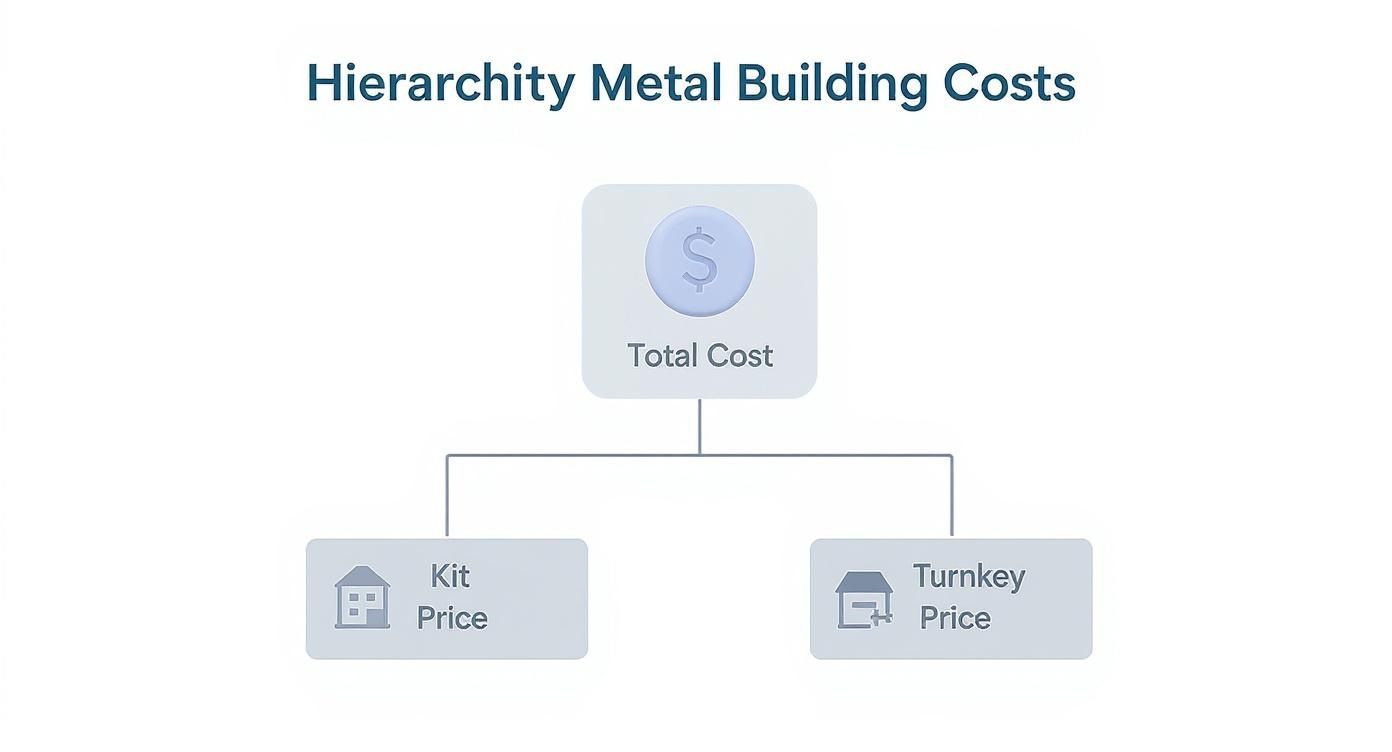
As you can see, your total investment is a sum of these two distinct parts. It’s a common mistake to only budget for the materials, so let's break down what's really involved.
The Steel Building Kit
First up is the prefabricated metal building kit. This is the heart of your project—the skeleton and skin of the structure. But not all kits are created equal, and the price tag can swing quite a bit depending on a few key variables.
Design complexity is a major one. A simple, rectangular garage will naturally be more budget-friendly than a custom workshop with a complex roofline, multiple levels, or lots of framed openings for doors and windows.
The steel gauge (its thickness) is another huge cost driver. Think of it like upgrading armor; more protection means more material and a higher price.
- 26-gauge steel: This is the workhorse of the industry. It hits the sweet spot between strength and cost-effectiveness for most applications.
- 24-gauge steel: A step up in thickness, this gauge offers better durability and impact resistance, but you'll pay a bit more for the added toughness.
- 22-gauge steel: This is the heavyweight champion. It's the thickest and most expensive option, usually reserved for buildings in areas with extreme weather or for facilities that need maximum security.
The Concrete Foundation
A building is only as solid as the ground it stands on. Your concrete foundation is a non-negotiable expense and a major line item in your budget, typically running between $5 to $12 per square foot.
What makes that price vary so much? It all comes down to the type and complexity of the slab. A straightforward 4-inch floating slab for a small shed in a mild climate is one thing. But a massive industrial building in a region with deep frost lines might demand a 6-inch reinforced foundation with deep footers and extensive groundwork, pushing the cost to the higher end of that range.
A foundation isn't just about pouring concrete. The price tag includes labor, rebar for reinforcement, and sometimes moisture barriers. Cutting corners here is a recipe for disaster, potentially leading to catastrophic structural failure years down the road.
Getting this part right is absolutely critical. For a deeper dive into what your project will require, check out our guide on steel building foundation requirements to make sure you're budgeting correctly for this vital step.
Site Preparation and Delivery
Long before the first drop of concrete is poured, your land needs to be ready. This "site prep" phase involves several essential tasks that add to the bottom line.
- Land Clearing: Got trees, boulders, or old debris? It all has to go.
- Grading and Leveling: Your foundation needs a perfectly flat, stable pad to sit on. This step makes that happen.
- Utility Access: You’ll need to run lines for water, sewer, and electricity to the building site.
Site prep costs are all over the map. They can be a few thousand dollars for a clear, level lot or jump into the tens of thousands for a sloped, wooded, or rocky piece of land. It’s a classic case of "pay me now or pay me later"—skimping here will almost certainly lead to drainage headaches and foundation problems.
Finally, you need to get the kit to your property. Delivery fees can add anywhere from $500 to $2,500 or more to your bill, depending on how far you are from the manufacturing plant and the size of the truck needed. Always ask if delivery is included in your quote to avoid any unpleasant surprises on delivery day.
How Market Forces Shape Your Final Price Tag
Your metal building project doesn't live in a vacuum. Its final cost is directly connected to a whole network of economic forces, both global and local. Think of your steel kit's price like a stock on the market—it doesn't have a fixed value. Instead, it moves up and down based on supply, demand, and what's happening around the world.
This is exactly why a quote you get in January might look quite different from one you get in July. Understanding these outside factors is crucial for smart budgeting. When you see how the big picture affects your project, you can anticipate price shifts and time your purchase more effectively. It’s the difference between reacting to a surprise price hike and proactively planning for it.
The Global Steel Market's Impact
Steel is the main ingredient in your building, and its price is constantly changing on the global stage. That volatility has a direct impact on the metal building cost of your kit. A trade dispute overseas, a new mining regulation, or a big shift in international demand can cause steel prices to spike or drop, sometimes with very little warning.
These changes are often driven by economic policies. For example, in the United States, steel tariffs were raised from 25% to 50% on June 4, 2025, which was a massive jump in import costs. This tariff hike led to immediate price increases of around 10-12% before summer 2025, with the national average for structural steel hitting $2,653 per ton by July 2025.
Just like gas prices go up and down with global oil production, the cost of your building kit reflects the current health of the international steel market. Because of this, it's always a smart move to lock in your price with a deposit once you're ready to buy. This protects your budget from any unexpected market swings.
How Local Conditions Alter Your Budget
While steel prices are set globally, many of your biggest expenses are determined right in your own backyard. These local and regional factors can easily add thousands to your total cost, turning what seems like a standard project into a much larger investment.
Here are the main local variables you need to factor in:
- Regional Labor Rates: The cost of hiring a construction crew varies wildly from one state to another, and even between cities and rural areas. A crew in a major metropolitan area will almost always charge more than one in a small town simply due to higher costs of living and greater demand.
- Local Building Codes: Your local municipality has specific rules your building has to follow. These codes dictate everything from foundation depth to structural strength and fire resistance. Meeting stricter codes often means using more materials or specialized engineering, which adds to the expense.
- Climate-Specific Requirements: Your local weather is one of the biggest hidden cost drivers. A building in a hurricane-prone coastal area needs a much higher wind load rating than one built inland, which means a stronger—and more expensive—frame.
For instance, a building going up in the snowy mountains of Colorado will need a high snow load rating. This requires beefier roof purlins and maybe even a steeper roof pitch to handle the weight of heavy snow. That directly increases material and engineering costs compared to the exact same building in a mild climate like Arizona.
These local requirements aren't optional, and they have a real impact on your final bill. They explain why two identical buildings can have totally different price tags just because one is on the coast and the other is in the Midwest. As you explore your options, our detailed breakdown of steel building kit prices can help you see how these variables play out. The only way to get a truly accurate budget is to get a clear, itemized estimate that accounts for your specific location.
Estimating Costs for Different Building Applications
When it comes to the cost of a metal building, there’s no magic number. The price changes—sometimes dramatically—based on what you plan to do with the space. A simple storage shed just doesn't have the same requirements, or price tag, as a commercial storefront built to bring in customers.
In fact, the building's purpose is the single biggest factor driving the design complexity, materials needed, and ultimately, your final metal building cost.
Think about it like this: putting together a basic two-car garage is a lot like snapping together a simple Lego kit. On the other hand, building a climate-controlled agricultural barn is more like tackling an advanced Technic set, complete with specialized parts and integrated systems. Every extra feature, from heavy-duty framing to insulation, adds another layer to the cost.
This is exactly why getting a handle on the cost per square foot for your specific use is so important for budgeting. It takes you from a wild guess to a solid financial plan.
From Simple Storage to Complex Commercial Use
Let's walk through how costs change from one building type to another. A basic agricultural building for hay storage, for example, is all about open space and keeping the weather out. It requires very little insulation, simple roll-up doors, and a standard concrete slab. This keeps its turnkey cost on the lower end, usually somewhere around $24 to $30 per square foot.
Now, picture a commercial workshop or an auto body shop. This is a whole different ballgame. You'll need thicker insulation to keep the workspace comfortable, a reinforced concrete slab to handle heavy machinery and vehicle lifts, and multiple framed openings for bay doors and windows. These essential upgrades can easily push the price up to $30 to $45 per square foot.
Industrial facilities take complexity and cost to another level entirely. These buildings demand heavy-duty steel framing, specific load ratings for overhead cranes, advanced ventilation, and often specialized fire suppression systems. This is especially true for unique structures like specialized electrical buildings, which have very specific design and material needs.
A key takeaway here is that "cost per square foot" is a moving target. As a building's purpose gets more specialized and people-focused—requiring things like climate control, plumbing, and specific finishes—the price per square foot will always climb.
Estimated Cost Per Square Foot by Building Use
To make these differences crystal clear, we've put together a table showing typical turnkey costs for some of the most common metal building uses. It’s a great way to see how size and features directly impact the price per square foot.
| Building Type | Typical Size Range (sq ft) | Estimated Cost Per Sq Ft (Turnkey) |
|---|---|---|
| Residential Garage/Storage | 500 – 1,500 | $25 – $35 |
| Agricultural Barn (Hay/Livestock) | 2,000 – 8,000 | $24 – $30 |
| Commercial Workshop/Retail | 1,500 – 10,000 | $30 – $45 |
| Large Industrial Warehouse | 10,000 – 50,000+ | $35 – $50+ |
As you can see, the bigger the building, the more variables you have to consider. A massive warehouse might seem like it has a lower cost per square foot for the basic shell, but the total project cost adds up fast with extensive foundation work, complex electrical systems, and loading dock configurations.
If you’re planning a larger project, it’s worth learning more about the specific factors that go into pricing warehouse steel buildings.
Ultimately, figuring out your building's primary job is the first and most important step in estimating your total investment. That clarity lets you budget for the right features from day one, ensuring your building is perfect for its purpose without any expensive surprises down the road.
Looking Beyond the Sticker Price: Hidden Costs and Custom Upgrades
That initial price for a metal building kit? It's a great starting point, but it's really just the beginning of the story. The true metal building cost only starts to become clear once you factor in all the upgrades that turn a basic steel shell into a usable, functional space. Then, you have to account for the so-called "hidden" fees that are just a normal part of any construction job.
Thinking the kit price is the final price is like booking a flight for your vacation and forgetting you still need to pay for the hotel, food, and everything you want to do once you get there. If you get ahead of these extra costs, you can build a realistic budget that prevents sticker shock down the road and keeps your project humming along without financial stress.
Essential Upgrades for Functionality
To get your building from a simple frame and panels to something comfortable and efficient, you’ll need to invest in a few key additions. These upgrades are a significant part of the budget, but they pay you back for years by cutting down energy bills and making the building a better place to be.
-
Insulation: This is probably the single most important upgrade you can make. Good insulation can slash your heating and cooling expenses by up to 50%. You've got a few options here. Fiberglass batts are easy on the wallet, while spray foam gives you top-tier thermal performance and seals up air leaks, though it does cost more upfront.
-
Ventilation Systems: A steel building has to breathe. Without proper airflow, you'll get condensation buildup, which is a fast track to moisture damage and rust. Your choices can be as simple as ridge vents and louvers or as involved as powered fan systems, all depending on what you plan to do inside the building.
-
Doors and Windows: Your kit might come with a standard roll-up door, but that’s rarely enough. Insulated garage doors, walk-in doors for people, and windows all add to the cost. Remember, every opening you add requires extra framing and structural support, which means more materials and more labor.
Custom Touches for Aesthetics and Curb Appeal
Of course, you want your building to look good. Custom upgrades are what take it from a generic box to a structure with real curb appeal that complements your property. These features are about more than just utility—they add serious value.
For anyone wanting to build something that truly stands out, it's worth checking out the full range of possibilities for custom steel buildings to see what can be done. Some of the most popular aesthetic choices include:
- Wainscoting: This is a classic look where you use a different color or textured panel on the lower section of the walls.
- Custom Trim: This gives your building a clean, finished look by adding trim to the corners, roofline, and around any openings.
- Overhangs and Gables: These are architectural details that not only add character but also give you a bit of extra protection from the weather.
Just keep in mind that every single customization adds to the engineering and material costs of your project. These features are fantastic for making your building one-of-a-kind, but they need to be part of the budget from day one.
The Administrative Costs Everyone Forgets
Some of the most common budget-busters have nothing to do with steel, concrete, or labor. These "soft costs" are non-negotiable, and they can add a surprising amount to your total bill if you aren't ready for them.
- Building Permits: You can't break ground without getting the green light from your local municipality. Permit fees can be anywhere from a few hundred dollars to several thousand, all depending on where you are and how big your project is.
- Engineering Fees: An engineer has to sign off on your building plans. This stamp of approval verifies that your design can handle local wind, snow, and seismic forces. It’s a crucial step to ensure the structure is safe and up to code.
Trying to skip these steps is not an option—they're legal requirements designed to keep you and your property safe. By planning for these essential upgrades and hidden fees from the start, you'll have a much clearer picture of your total metal building cost, setting yourself up for a project that's smooth and successful from start to finish.
Actionable Strategies for a Smarter Building Budget
Knowing what drives your **metal building cost** is one thing, but turning that knowledge into actual savings is where the real work begins. With a few smart moves early in the planning stage, you can seriously trim your total investment without ever cutting corners on quality or structural integrity.
Think of it as spending smarter, not cheaper. By optimizing your design, being strategic about when you buy, and knowing where to put in a little sweat equity, you can make your project a whole lot more affordable. These aren't just ideas—they're field-tested strategies that deliver real savings.
Design and Dimensions Matter
One of the quickest ways to keep costs in check is to stick with standard building dimensions. Manufacturers churn out components for common sizes like 30×40, 40×60, and 50×100 in huge volumes, which means a lower price for you.
Opting for these standard sizes often eliminates the need for expensive custom engineering. Any time you stray from the norm, you're looking at new blueprints and fresh load calculations, which adds both time and money to your project.
On top of that, a simple rectangular footprint is always the most budget-friendly option. Complicated rooflines, extra wings, or odd shapes demand more steel, more complex framing, and more labor to put it all together. All of that drives up the final bill.
Strategic Planning and Purchasing
Timing can make all the difference. The construction industry has its busy seasons and its slow seasons. If you can purchase your building kit during the late fall or winter, when demand is generally lower, you can often find better deals as manufacturers look to keep their production lines moving.
Another non-negotiable strategy? Get multiple, detailed quotes.
Never just take the first offer that comes your way. A good quote breaks everything down line by line—the kit itself, delivery, accessories, and all taxes. This transparency is key to comparing apples to apples and spotting any hidden fees.
When you compare detailed bids, you can negotiate from a place of strength, ensuring you're getting the best possible value for your investment.
Smart DIY and Finishing Choices
While putting up the main steel frame is a job for the pros, there are plenty of finishing tasks where you can save a ton of money with some DIY effort.
- Interior Finishing: Things like framing interior walls, hanging drywall, painting, and laying flooring are well within reach for a handy owner. Labor for these jobs adds up fast, so doing it yourself puts that money right back in your pocket.
- Landscaping: Basic site cleanup and landscaping after the crew leaves is another area where your own work can cut costs.
- Component Sourcing: While the core structure should come from a single supplier, you might find great local deals on items like windows, walk-in doors, or certain types of insulation.
For critical parts of the build, like the roof, it's crucial to analyze costs carefully. To get a clearer picture of what to expect, a reliable roof cost calculator can be an invaluable tool. By focusing your budget on the essential structure and saving on the finishes, you strike a smart, affordable balance.
Answering Your Top Questions on Metal Building Costs
Even with a detailed cost breakdown, you probably still have a few questions. That's completely normal. This is where we tackle the most common things people ask, giving you direct answers to help you budget with confidence.
Is It Cheaper to Build with Metal or Wood?
This is the big one, and the answer might surprise you. While the upfront material costs for metal and wood can be pretty close, metal buildings almost always come out ahead on the total project price. The biggest savings are in the labor—prefabricated steel components can cut construction time by 30-50%. Less time on site means a smaller labor bill.
But the real advantage shows up over the long haul. Metal pulls even further ahead with lower maintenance costs, better durability against pests and rot, and even potentially lower insurance premiums because it's fire-resistant.
What Is the Average Cost of a Concrete Foundation?
A concrete foundation is a major part of your budget, typically running between $5 and $12 per square foot. The final price tag depends on a few things: the thickness of the slab, local labor rates, and what kind of reinforcement is needed for your climate and soil.
For a popular 30×40 (1,200 sq ft) building, you can expect the foundation alone to cost anywhere from $6,000 to $14,400. A simple 4-inch slab for a garage will be on the lower end, while a beefier 6-inch reinforced slab for heavy equipment will push you toward the higher end.
Does a Kit Price Include Delivery and Installation?
Usually, no. This is a critical detail to watch out for. That advertised "kit price" almost always covers just the steel frame, wall panels, roof sheeting, and the fasteners to put it all together. Delivery is a separate charge based on how far you are from the manufacturing plant.
Installation, often called "erection" in the industry, is another distinct cost. To really compare offers and understand your total investment, always ask for a quote that breaks everything down line by line:
- The building kit itself
- Delivery fees
- Installation or erection labor
Getting that level of transparency is the only way to build a realistic and comprehensive budget for your project.
Ready to get a clear, detailed quote for your project? The team at Icon Steel Buildings is here to provide a transparent price breakdown for your ideal structure. Get your free, no-obligation estimate today at https://iconsteelbuildings.com.