
So, you’re thinking about turning that open-air carport into a full-fledged garage. It's a fantastic upgrade that adds security, storage, and serious value to your home. But the big question is always the same: what's it going to cost?
On average, you can expect the cost to convert a carport to a garage to land somewhere between $15,000 and $30,000. Most homeowners find their project settles in around the $25,000 mark. This investment takes your basic structure and transforms it into a secure, functional, and weather-proof part of your home.
Your Carport to Garage Conversion Cost at a Glance
Jumping into a project like this is a big deal, and getting a grip on the finances is step one. While that national average is a decent starting point, your final bill is really shaped by the decisions you make along the way—things like the size, materials you choose, and even the labor rates in your area will all play a part.
To give you a better feel for where your project might fit, let's break down some common scenarios.
Typical Cost Scenarios
Based on recent projects, a simple single-car conversion usually runs between $9,000 to $11,000. If you're enclosing a more standard two-car carport, you're likely looking at a range of $18,000 to $22,000.
Of course, these are just averages. We've seen basic, no-frills conversions done for as little as $6,000, and we've also seen high-end projects with premium finishes and custom features climb past $65,000.
Think of these numbers as your financial starting line. They help set realistic expectations before we dive into the nitty-gritty of where every dollar goes. If you want to get a broader view of the entire process, this comprehensive guide to adding a garage is a great resource for planning and permitting, which are just as important here.
Key Takeaway: The average cost is just a guide. Your final price tag will come down to your specific choices in materials, features, and how big you decide to go.
To help you visualize these numbers, here's a quick breakdown of what you can expect at different budget levels.
Typical Cost Range for Carport to Garage Conversion
This table gives you a snapshot of estimated costs, breaking them down by the size and quality of the conversion. It’s a handy tool for figuring out where your project might land.
| Project Scope | Single-Car Garage (Est. Cost) | Double-Car Garage (Est. Cost) |
|---|---|---|
| Low-End (Basic) | $9,000 – $12,000 | $15,000 – $20,000 |
| Average (Mid-Range) | $12,000 – $20,000 | $20,000 – $30,000 |
| High-End (Premium) | $20,000+ | $30,000+ |
As you weigh your options, it’s also smart to see how these costs stack up against other building methods. For instance, a prefabricated steel building can sometimes offer a more budget-friendly path. You can get a full rundown by checking out our guide on how much metal buildings cost.
Breaking Down Where Your Money Actually Goes
Figuring out the final price for a carport conversion is a bit like looking at a restaurant bill. The total is made up of a bunch of individual items, and understanding what each one costs helps you see the full picture. When you know where the money is going, you can decide what’s a non-negotiable and where you might be able to save a few bucks.
This infographic gives you a quick snapshot of the typical cost spectrum, from a basic conversion to a full-blown custom job.
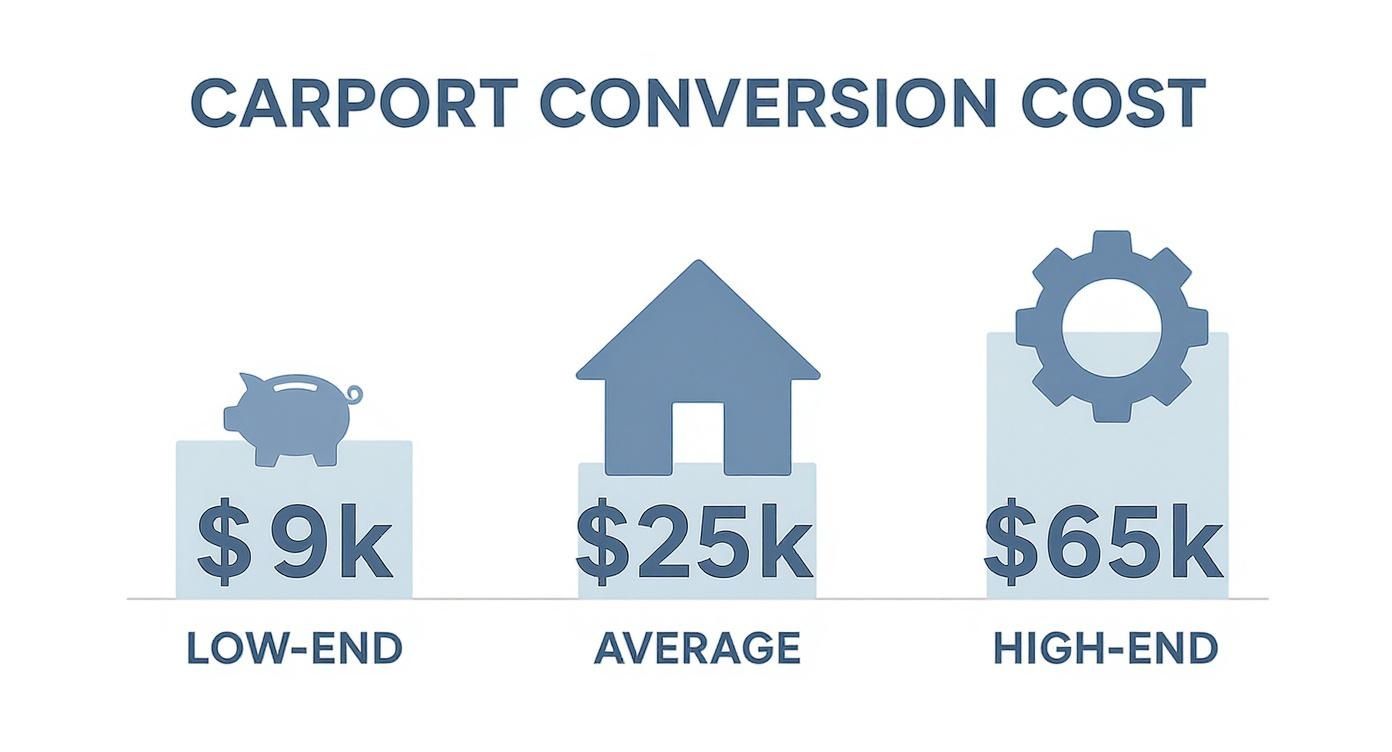
As you can see, the range is huge. That difference comes down to the scope of your project and the materials you choose. Let's dig into the line items that add up to these totals.
The Groundwork: Foundation and Slab
Everything starts from the ground up, and the foundation is the first—and most critical—expense you’ll face. The thin concrete slab under most carports just isn't built to hold the weight of walls, a roof, and a heavy garage door. Before anything else, a building inspector has to give your existing slab the green light.
If it doesn’t pass muster, you're looking at pouring a new, reinforced slab or tearing out the old one completely. This step alone can add $2,000 to $7,000 to your budget, covering excavation, rebar, and the concrete itself. This isn't an area to cut corners; a solid foundation is essential for a safe, long-lasting garage. To get a better sense of what's involved, you can learn more about proper steel building foundation requirements.
Building the Bones: Framing and Structure
With a solid base in place, it's time to frame the walls. This is where your carport really starts looking like a garage. The cost here depends on the garage's size and whether you use wood or steel for the framing.
- Single-Car Garage: Framing will likely run between $1,500 and $4,000.
- Double-Car Garage: You can expect to pay somewhere in the $3,000 to $8,000 range.
This price covers the lumber or steel studs, sheathing, and the labor to put it all together. A key part of this stage is framing the opening for the garage door, which needs a seriously heavy-duty header to carry the roof's load across that wide span.
The Outer Shell: Roofing and Siding
To make sure your new garage doesn't stick out like a sore thumb, you'll want to match its roofing and siding to your home. This is a huge factor for curb appeal and resale value. The price tag for this step varies wildly depending on what your house is made of.
Matching standard asphalt shingles could cost $800 to $2,000. If you have a metal roof or high-end tile, that number will climb. The same goes for siding—vinyl is pretty affordable at $500 to $2,500, but matching brick or stucco could easily push the cost to $4,000 or more.
Choosing Your Entryway: The Garage Door
The garage door is a massive part of your garage's function and look. A simple, non-insulated, manual door might only cost $600 to $1,500 installed. But let's be honest, most people want a bit more than the bare minimum.
An insulated, automatic garage door is more than just a convenience. It helps keep the garage temperature stable, turning it into a much more usable space for a workshop, gym, or storage.
Upgrading to a quality insulated, automatic double door with windows can push the cost to $2,500 to $5,000. If you're looking at custom materials, smart-home features, or unique designs, the price will go up from there.
Powering Your Space: Electrical Work
A garage isn't much use without electricity. At the very least, building codes demand a light fixture and a GFCI-protected outlet. Getting this basic setup wired usually costs between $500 and $1,500.
Most homeowners use this opportunity to add a lot more functionality. Think about what you might need:
- Extra outlets for power tools or a beer fridge.
- A dedicated circuit for an EV charger or a welder.
- Exterior security lighting.
Every outlet and fixture you add will nudge the final electrical cost a little higher.
The Unseen Costs: Permits and Labor
Finally, don't forget about the two big items that aren't part of the physical structure: permits and labor. Building permits are mandatory and can run anywhere from $400 to $1,800, depending on your local government.
Labor is easily the biggest chunk of your budget, often accounting for 40-60% of the entire project cost. It might be tempting to save here, but skilled professionals are what ensures your garage is safe, built to code, and will stand for decades to come.
Key Factors That Drive Your Final Project Cost
Ever wonder why two carport conversions that look almost identical can have completely different price tags? The secret is in a handful of key variables that can dial your project's final cost up or down. Getting a handle on these drivers is the first step to building a budget that makes sense and avoiding any nasty surprises later.
Think of your project like you're building a custom car. A basic conversion is your reliable sedan—it's functional and gets the job done without breaking the bank. A high-end conversion with premium siding, custom windows, and smart tech? That's the luxury SUV. It costs more because you're investing in better performance, curb appeal, and extra features. The final cost to convert a carport to a garage all comes down to these kinds of choices.
Let's break down the four biggest factors that will shape your budget: the size and complexity of the job, the materials you pick, the condition of your property, and what labor costs in your area.
Garage Size and Overall Complexity
This one’s pretty straightforward: size matters. A bigger, two-car structure is going to need more of everything—framing, siding, roofing, you name it—than a smaller single-car space. That means both your material and labor costs will scale up right along with the square footage.
But it’s not just about size; complexity adds another layer to your budget.
- A basic enclosure that just involves adding three walls and a standard garage door will keep you on the lower end of the cost spectrum.
- A more complex conversion can include custom windows, a separate side entry door, built-in workbenches, or even a storage loft. Each of these additions will bump up the price.
Essentially, every feature that takes your project from a simple, protective box to a more functional, customized space will add to the final tally.
Your Choice of Building Materials
Here's where you have the most direct control over your budget. The materials you choose will have a massive impact on not only the cost but also the durability, maintenance, and look of your finished garage. From the structural frame to the siding on the walls, every selection has a different price point.
For instance, the framing alone presents a wide cost range. Wood framing is often the most economical route, typically running $7 to $16 per square foot. Steel framing lands in the middle at $17 to $32 per square foot, while concrete is a premium option at $15 to $30+ per square foot. As you can see, just this one choice can dramatically swing your budget.
This logic applies to every single component. A basic, non-insulated steel garage door might cost a fraction of a custom wood door with insulated glass panels. Likewise, opting for premium insulation will cost more upfront but could save you a bundle on heating and cooling bills down the road. Our guide to steel building insulation options dives deeper into making the right choice for your climate and needs.
Pro Tip: When you're budgeting, it helps to create "good," "better," and "best" options for your key materials. This gives you the flexibility to mix and match, splurging where it matters most to you—like on a durable roof—and saving on things that are less critical.
To give you a clearer picture, the table below shows how different material choices can influence your overall project cost.
Material Cost Comparison Per Square Foot
| Material Type | Framing (Cost per sq. ft.) | Siding (Cost per sq. ft.) | Roofing (Cost per sq. ft.) |
|---|---|---|---|
| Budget-Friendly | Wood ($7 – $16) | Vinyl ($3 – $12) | Asphalt Shingles ($4 – $7) |
| Mid-Range | Steel ($17 – $32) | Fiber Cement ($5 – $15) | Metal ($8 – $18) |
| Premium | Concrete ($15 – $30+) | Brick/Stucco ($10 – $30) | Slate/Tile ($15 – $35) |
As you can see, pairing budget-friendly framing with mid-range siding or premium roofing gives you incredible control over the final numbers.
Existing Site Conditions
Sometimes, your property itself can throw a few curveballs into the budget. The perfect scenario is a carport sitting on a thick, level, crack-free concrete slab that’s ready for walls. But reality isn't always that neat.
Here are a few common site-related costs that can pop up:
- Foundation Issues: Many carport slabs just aren't thick enough to support the weight of full walls and a roof. If an inspector says your slab is inadequate, you might need to pour a new one or add reinforced footings, which can add thousands to the project.
- Grading and Drainage: If the carport is on a slope, the ground may need to be regraded. This is critical for making sure water drains away from your new garage, not into it.
- Accessibility: Is your carport tucked away in a hard-to-reach spot on your property? That can actually increase labor costs, as it makes it tougher for contractors to get materials and equipment to the job site.
Local Labor Rates and Permit Fees
The last major factor is one you can't control: where you live. Labor costs vary wildly from one city to the next and often account for 40% to 60% of your total project budget. A job in a major city with a high cost of living will almost always be more expensive than the exact same conversion in a small, rural town.
Permit fees are another one of those location-based costs. Every town and county has its own fee structure for building permits, and you absolutely cannot skip this step for a structural project. These fees can run anywhere from a few hundred to over a thousand dollars, depending on local regulations.
How Location and Timing Impact Your Budget
The materials you pick and the size of your project are the obvious heavy hitters when you calculate the cost to convert a carport to a garage. But two other factors, often overlooked, can have just as much impact: where you live and when you decide to build.
Think of it like booking a vacation. That same hotel room costs way more in Miami during spring break than it does in a small town in the middle of October. The same logic applies to construction. Understanding these dynamics is the key to smart planning that can literally save you thousands of dollars.
The Geographic Price Puzzle
Construction costs aren't the same everywhere. A project in a busy city with a high cost of living is always going to be more expensive than the exact same job in a quiet, rural area. It all comes down to a few local realities.
- Labor Rates: This is the big one. What contractors charge for their time varies wildly from state to state. Areas with higher wages and strong unions will have higher hourly rates, which directly adds to your bottom line.
- Building Codes: Climate is a huge driver here. A garage in Minnesota, for example, might need deeper frost-line footings and beefier insulation than one in Texas. Those extra requirements mean more materials and more labor.
- Permit Fees: Every single town and city sets its own fee schedule. These can run from a few hundred bucks to well over a thousand, depending entirely on local government policies.
This regional price difference isn't pocket change. Data shows that the cost to convert a carport to a garage swings significantly between states. For example, Colorado is a higher-cost market, where conversions typically run from $14,000 to $18,500. Head down to Texas, with its more competitive construction scene, and the range drops to $12,000 to $16,500. Minnesota often lands somewhere in the middle, with typical costs between $13,000 and $17,000. You can dig into more numbers on how regional expenses play out in this detailed cost analysis.
Strategic Scheduling: The Power of Timing
Beyond where you build, when you build can open up some real opportunities for savings. The construction industry has its own seasons, and if you time your project right, you can make that work for you.
Contractors are slammed in the spring and summer when the weather is perfect. High demand means higher prices and longer waits. On the flip side, planning your build for the "off-season" can sometimes get you a better deal.
Smart Timing Insight: Winter might seem like a terrible time to build, but hear me out. Contractors in colder climates are always looking for indoor projects to stay busy. If your carport already has a roof, enclosing it is the perfect off-season job, which could give you more negotiating power on labor costs.
Finding the Sweet Spot for Your Project
So, when's the best time to pull the trigger? It's a balancing act.
- Late Winter/Early Spring: This is the perfect time to start planning. Get your quotes lined up before contractors' schedules are booked solid for the summer rush.
- Late Summer/Early Fall: This can be a real sweet spot. The weather is still good, and contractors might be looking to book jobs to carry them through the slower winter months. It's also often the ideal time for pouring a new concrete slab if your project needs one.
The best strategy is to stay flexible. If you can, get multiple quotes at different times of the year and don't be afraid to ask contractors if they offer off-season pricing. A little bit of strategic timing can make a surprising difference in the final cost to convert a carport to a garage.
Practical Ways to Save Money on Your Conversion
A smart budget isn't just about spending less—it's about spending wisely. While the final price tag for a carport-to-garage conversion can feel a bit steep, there are several proven ways to manage the costs without ever cutting corners on quality. Think of it as taking control of your project's finances and making every single dollar count.
Honestly, the single most effective way to lock in a fair price is to get multiple, detailed quotes from contractors. Don't just get one or two—aim for at least three bids from reputable, licensed professionals in your area.
A good quote isn't just a number; it breaks down the costs for labor, materials, and permits. This lets you compare apples to apples and easily spot any bid that seems way too high or suspiciously low, which can be a red flag.
Be Smart with Materials and Design
Your choices in materials and design have a direct line to your final bill. One of the simplest yet most powerful ways to save is by opting for standard-sized garage doors and windows. Custom sizes almost always mean special orders and a hefty upcharge, whereas standard sizes are in stock and much more affordable.
You might also consider sourcing some of the finishing materials yourself. While contractors get trade discounts on the big stuff, you can often find fantastic deals on things like light fixtures, paint, or even the garage door during holiday sales events. Just make sure you coordinate with your contractor's timeline to keep the project moving smoothly. Sometimes, looking at the overall cost of steel buildings from the get-go can provide a more predictable budget since the components are prefabricated.
Key Insight: Simply choosing in-stock materials over custom orders can slash your material costs by 10-20% and help you dodge long project delays. It's a straightforward decision that keeps both your budget and your timeline right on track.
Embrace Strategic DIY
Look, you absolutely want to leave the heavy lifting—like structural framing, electrical wiring, and foundation work—to the professionals. No question. But you can save a surprising amount on labor costs by rolling up your sleeves and handling some of the non-structural tasks yourself. This is what we call "sweat equity," and it can make a real dent in the final invoice.
Consider taking on jobs like these:
- Demolition and Cleanup: If your carport has any old, non-structural elements that need to be torn out, doing it yourself saves you from paying for those labor hours.
- Interior and Exterior Painting: Painting is a bit time-consuming, but it's a straightforward job that can literally save you hundreds, if not thousands, in labor costs.
- Landscaping: Once the dust settles and the construction is done, handling the final cleanup and landscaping is another easy way to trim the budget.
By striking the right balance between professional work and your own effort, you can significantly lower the overall cost of the conversion. This approach ensures you get a high-quality, safe, and professional-looking garage that fits comfortably within your budget, turning a big expense into a smart investment for your home.
Is Converting Your Carport a Smart Investment?
After running the numbers and breaking down all the expenses, you're probably asking the big question: Is the cost to convert a carport to a garage actually worth it? The answer, more often than not, is a resounding yes. You just have to look beyond the initial price tag and see it for what it is—a long-term investment in your home's value and daily functionality.
This isn't just an expense; it's a serious upgrade.
A fully enclosed garage is one of the most sought-after features for homebuyers. It adds a critical layer of security, protects your vehicles from sun, hail, and snow, and gives you a ton of flexible space. Whether it becomes a workshop, a home gym, or just well-organized storage, that new square footage dramatically boosts your property's appeal and usefulness.
Beyond the Price Tag: The Real Value
While the exact ROI will always depend on your specific market, garage additions consistently rank as high-value home improvement projects. A well-done conversion doesn't just improve your home's curb appeal—it makes your property more marketable to a much wider pool of potential buyers. For many, a secure garage isn't a "nice-to-have"; it's a deal-breaker.
By transforming an open carport into a secure, functional garage, you're not just adding walls. You're adding a core asset that increases your property's overall market value and makes your daily life more convenient.
And don't forget the intangible benefits. Think about the simple convenience of unloading groceries in a dry, well-lit space during a downpour. Or the peace of mind that comes from knowing your tools, bikes, and outdoor gear are locked away safely. These daily quality-of-life improvements are a huge part of the investment’s true worth.
Weighing the Financials
Ultimately, this conversion is a sound financial move. It solves common homeowner needs for security and storage while adding real, tangible value you'll get back when it's time to sell. For homeowners looking to maximize their property’s potential, turning a simple carport into a garage is one of the smartest upgrades you can make.
If you're exploring different construction methods, our guide on building a garage offers great insights into your options, including durable steel structures that can provide excellent long-term value.
Frequently Asked Questions About Carport Conversions
Even with a perfect plan on paper, a project this big is bound to stir up some questions. Knowing the answers ahead of time can be the difference between a smooth build and one filled with expensive hiccups. We've rounded up the most common questions homeowners have about converting a carport into a garage to give you the clear, straightforward answers you need.
Do I Need a Permit to Convert a Carport to a Garage?
Almost certainly, yes. You’re not just hanging a new door; you're making a major structural change to your property. Turning an open-air carport into a fully enclosed garage is a big deal in the eyes of your local building authority because it impacts safety, structure, and property value.
Typically, you'll need permits for a few key parts of the job:
- Framing and Structure: This ensures the new walls are built to code and can safely handle the load.
- Electrical Work: Any new wiring for lights, outlets, or an automatic door opener has to meet strict safety standards.
- Foundation Changes: If your existing concrete slab needs to be reinforced or replaced, that work will definitely require inspection.
Trying to skip the permit process is a recipe for disaster. You could face hefty fines, be forced to tear down the work, and run into huge problems when it’s time to sell your home.
Can I Use the Existing Carport Slab for the Garage Floor?
This is a huge "maybe" and one of the most important questions to answer early on. It all boils down to the quality and thickness of the slab that’s already there. Many carport slabs were poured just thick enough to support a car, not the crushing weight of fully framed walls and a heavy garage door.
You'll need a building inspector or a structural engineer to take a look. If they find the slab is too thin, has significant cracks, or lacks the proper steel reinforcement, you'll have to upgrade it. This often means pouring a brand-new, thicker foundation—a task that will add a significant amount to your final budget.
How Long Does a Carport to Garage Conversion Typically Take?
The timeline can really swing depending on your project. A simple conversion, where the existing foundation is good to go, might take 2 to 4 weeks for the actual construction. But that's just the hands-on part.
Don't forget to factor in the whole process. From initial planning and gathering quotes to waiting for the city to approve your permits, the full project timeline can easily stretch from 2 to 3 months. If you need a new foundation or have complex custom features, plan on it taking even longer.
Is Converting a Carport Cheaper Than Building a New Garage?
In most cases, absolutely. Starting with an existing carport gives you a massive head start over building a detached garage from the ground up. You already have two of the most expensive parts in place: a roof structure and some form of foundation (even if it needs a little work).
You'll still have to pay for walls, a garage door, and electrical, but you’re saving a ton on the excavation, roofing, and foundational labor that a new build demands. For homeowners wanting a deeper dive into similar projects, this excellent guide to garage conversions offers some great additional insights.
Ready to explore a durable, cost-effective, and surprisingly fast alternative to traditional construction? The team at Icon Steel Buildings specializes in creating high-quality metal garages that are built to last. Learn how a custom steel building can meet your needs and budget at https://iconsteelbuildings.com.